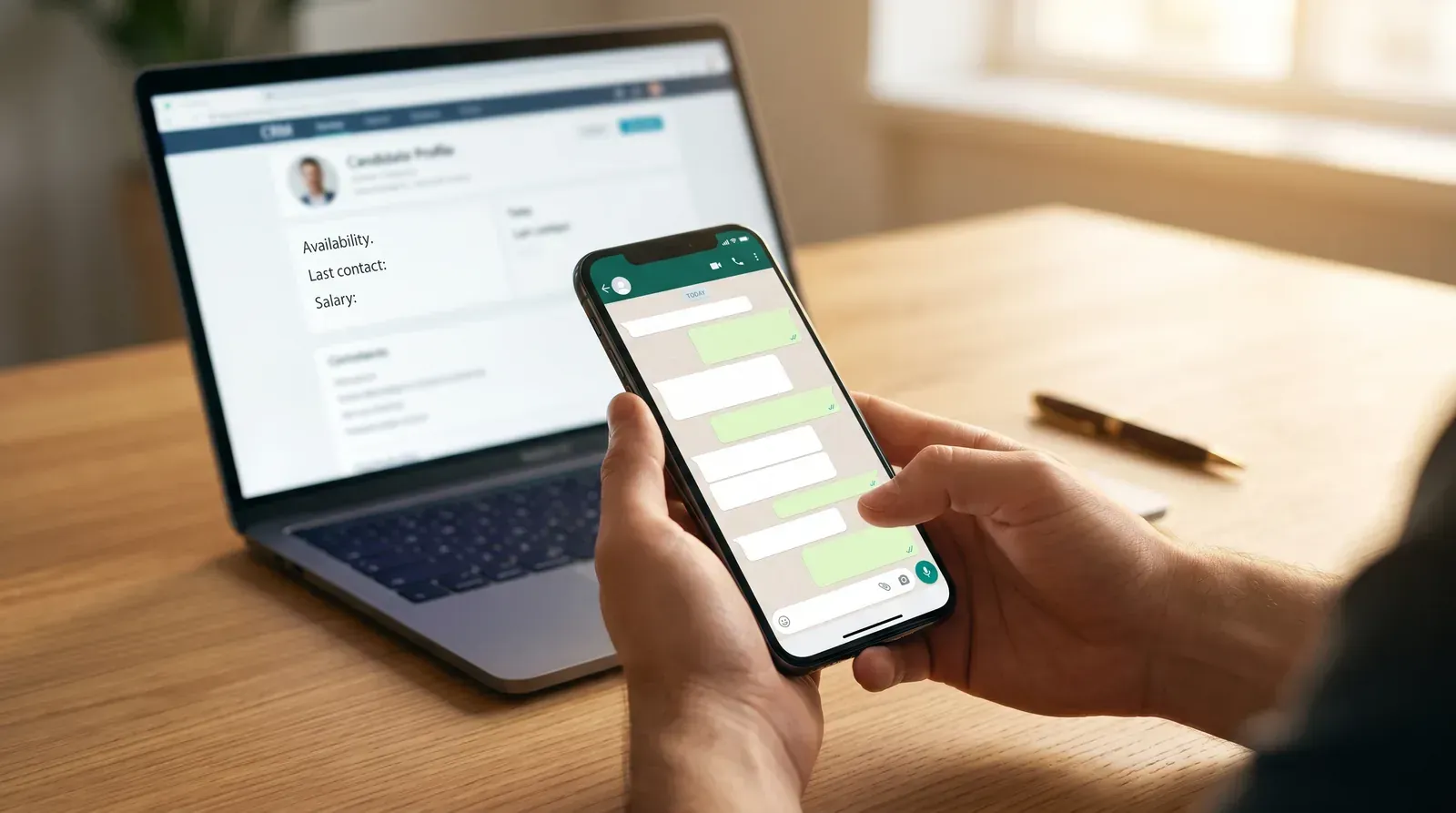
AI and recruitment, in practice

How recruitment agencies are actually using AI, and what changes on a desk when they do.

More from Insights

People change signals for recruitment agencies in 2026: a BD consultant reading leadership-change patterns across target accounts, including the vacancy-chain cascade effect when a leader exits, the timing ladder from SEC 8-K filings at four business days through Companies House filings at fourteen days to LinkedIn auto-posts within two hours, and the seven pattern categories (new leadership hire, internal promotion, placed candidate move, multiple departures, team lead with reports, LinkedIn post velocity, passive-to-active shifts) evaluated by evidence strength BD & Sourcing

People Change Signals for Recruitment Agencies: The Tactical Playbook for 2026

The evidence-led tactical playbook for reading leadership moves, promotions, and vacancy chains as BD signals in 2026. What the peer-reviewed research supports, which seven patterns are evidenced versus craft, where the fastest verifiable signals come from (regulators, not LinkedIn), and the timing ladder from four business days to two years. Spoke 2 of the Signal Detection mini-series that follows the hub piece on the 10 BD signal categories.

Signals Team October 2026
Read
Recruitment CRM for executive search in 2026: the buyer's guide covering AESC-grounded functional needs for retained search firms, the seven jobs the system must do (off-limits enforcement, confidential-search controls, relationship memory, retainer economics, lawful retention, assistive AI, evidence of fit), the vendor landscape of Invenias, Thrive TRM, Clockwork, Crelate, Loxo, Cluen Encore, Ezekia, Dillistone FileFinder, and the seven-criterion buyer's scorecard CRM Strategy

Recruitment CRM for Executive Search in 2026: The Buyer's Guide

The landmark buyer's guide for executive search firms evaluating recruitment CRM technology in 2026. AESC-grounded functional needs, Hunt Scanlon and Korn Ferry market data, the verified 2026 vendor landscape across Invenias, Thrive TRM, Clockwork, Crelate, Loxo, Cluen Encore, Ezekia, and others, the seven buying criteria, and a demo scorecard. Sourced throughout to AESC, GOV.UK, ICO, and vendor documentation.

Signals Team October 2026
Read
Job ad signals for recruitment agencies in 2026: a recruiter reading patterns in client job-posting activity as leading BD indicators, with duplicate deduplication removing up to 80 per cent of noise, Ontario's existing-vacancy disclosure now visible on the face of postings, and the six pattern categories (new roles, description changes, reposts, posting velocity, salary shifts, urgency language) evaluated by evidence strength BD & Sourcing

Job Ad Signals for Recruitment Agencies: The Tactical Playbook for 2026

The evidence-led tactical playbook for reading client job-ad activity as BD signals in 2026, based on peer-reviewed research, official statistics agencies, and vendor methodology disclosures. What the six patterns actually support, what the 2026 Ontario regulation changes, and where the folklore is traceable to its origins. Spoke 1 of the Signal Detection mini-series that follows the hub piece on the 10 BD signal categories.

Signals Team September 2026
Read
Signals vs Crelate recruitment CRM comparison for 2026: two architectural bets, a US-focused modular platform with agentic wrapper on one side, and an AI-native recruitment CRM built ground-up around continuous cross-channel Perfect Memory on the other, differing in capture breadth (WhatsApp, WeChat, LinkedIn messages), native call intelligence versus partner-assembled, pricing transparency, and geographic residency CRM Strategy

Signals vs Crelate: Which Recruitment CRM Fits Your Agency in 2026

Signals vs Crelate is the 10th vs-comparison in the series. Crelate is a mature, founder-led, US-focused platform with a modular Recruit, Hire, Deliver, and Omni structure and a Living Platform agentic wrapper. Signals is an AI-native recruitment CRM built ground-up around cross-channel Perfect Memory. Verified pricing, capture gaps, and honest fit criteria throughout, sourced to Crelate's own documentation.


Signals Team September 2026
Read
Team call coaching for recruitment agencies in 2026: a desk manager reviewing consultant calls through a structured coaching workflow, illustrating the four-layer distinction between call recording and transcription, call metadata analytics, conversation intelligence at content level, and true coaching workflow with anchored scorecards, timestamped feedback, and manager review queues AI & Automation

Team Call Coaching for Recruitment Agencies: What Modern Call Intelligence Actually Delivers in 2026

An evidence-led audit of team call coaching for recruitment agencies in 2026: what the research supports (medium coaching effects, unmeasured hard results), what the eight major recruitment CRMs actually ship (capture yes, coaching no), what the dedicated tools (Gong, Chorus, CallMiner) do and do not name, and why the compliance layer makes permanent continuous recording the wrong default in most of the English-speaking world.

Signals Team September 2026
Read
Signals vs Mercury recruitment CRM comparison for 2026: two different architectural bets, a Microsoft Dynamics 365-based product extended for recruitment on one side, and an AI-native recruitment CRM built ground-up around continuous cross-channel conversation capture on the other, differing in capture breadth (WhatsApp and WeChat), pricing transparency, and EMEA presence CRM Strategy

Signals vs Mercury: Which Recruitment CRM Fits Your Agency in 2026

Signals vs Mercury is one of the sharper vs-comparisons in the recruitment CRM market in 2026 because the two products represent two genuinely different architectural bets: a Microsoft Dynamics 365 extension versus an AI-native product built from day one. Verified pricing, capture, EMEA presence, and audited financials, sourced to Companies House, Microsoft's Marketplace, and Mercury's own documentation.

Signals Team September 2026
Read
Canadian recruitment market in 2026: $24.3 billion employment-services sector with 9,067 establishments, Q1 2026 vacancies at 506,700 (first quarterly increase since Q2 2022), provincial concentration in Ontario at 54.4% of revenue, Ontario recruiter licensing regime since July 2024, Quebec French-language obligations from 25 employees, and LMIA enforcement running at over $10 million in trailing-year penalties BD & Sourcing

Recruitment in Canada in 2026: The Market, the CRM, and the Regulation

A $24.3 billion Canadian employment-services sector recovering unevenly after its first annual revenue decline since 2013, with Q1 2026 vacancies rising for the first time since Q2 2022, Ontario and Quebec licensing regimes that reach even overseas agencies, Quebec French-language obligations from 25 employees, and LMIA enforcement running at over $10 million in trailing-year penalties. The evidence-led Canadian operator guide for 2026 using Statistics Canada, ACSESS, Ontario Ministry of Labour, CNESST, ICO, and ESDC primary sources throughout.

Signals Team September 2026
Read
Signals vs Recruiterflow recruitment CRM comparison for 2026: two AI-native platforms holding the same architectural thesis of an internal continuously enriched relationship graph, differing in execution on capture breadth (WhatsApp and WeChat), search scope (candidates only versus the whole graph), and MCP interoperability posture CRM Strategy

Signals vs Recruiterflow: Which AI-Native Recruitment CRM Fits Your Agency in 2026

Signals and Recruiterflow are the first vs-comparison in this series where both platforms explicitly hold the same architectural thesis: an AI-native recruitment CRM built around a continuously enriched internal relationship graph. The comparison is execution: capture breadth, search scope, MCP posture, and pricing. Verified 2026 detail throughout, sourced to Recruiterflow's own documentation.

Signals Team September 2026
Read