
Signals vs Crelate is the tenth vs-comparison in this series, and it is one of the cleaner architectural contrasts in the market. Both products are real. Both are shipping in production in 2026. Both have satisfied customer bases. Both converge on the same broad promise: a recruitment CRM that helps a consultant see the next move. They arrive at that promise from very different starting points. Crelate is a founder-led, US-focused platform launched in 2012, with a modular Recruit, Hire, Deliver, and Omni structure and an agentic-AI wrapper it calls the Living Platform. Signals is an AI-native recruitment CRM built ground-up around Perfect Memory, the automatic cross-channel conversation capture layer that feeds everything else. This article walks through Crelate’s own current documentation as of September 2026, corrects a couple of commonly repeated claims about it, and draws out the specific execution differences that shape which architecture is a stronger fit for which kind of recruitment agency. Every Crelate claim below is anchored to a primary source: Crelate’s own site, help centre, DPA, pricing page, or public review platforms. Crelate is a real, mature, well-liked product; the differences below are architectural rather than qualitative.
What Crelate actually is in 2026 (verified positioning)
Crelate was founded in 2012 by Aaron Elder and co-founders. Elder remains CEO in 2026 and is quoted as such in Crelate’s November 2025 product release Source: Crelate Insights Agent launch, November 2025. The company is founder-led, headquartered in Eagle, Idaho as of 2026, though press datelines placed the company in Bothell and Kirkland, Washington through at least 2023, with the centre of gravity shifting to Idaho during 2024 and 2025. Total funding disclosed is $11.5 million as of the March 2022 growth investment led by Five Elms Capital, and no further round has been announced since. Five Elms holds a minority position per PitchBook records; secondary-source claims that Crelate is ‘PE-owned’ or ‘private equity backed’ are inaccurate as stated. The correct framing is founder-led with minority growth equity.
Crelate positions itself on its homepage as ‘The Strategic Recruiting Platform’ with the tagline ‘Your Recruiting, brought to life by AI’ and ‘Agentic when you want it. Human when you don’t.’ Source: Crelate homepage. The umbrella brand for its 2025-2026 AI programme is the ‘Living Platform’.
Crelate is genuinely modular. The 2026 product lineup:
- Crelate Recruit: the base module, described as ‘award-winning all-in-one Recruiting CRM and Applicant Tracking System’. Business Development Workflow and CRM ship inside Recruit rather than as a separate ‘Deals’ module.
- Crelate Hire: hiring and onboarding, credentialing, background checks, scorecards, eSignature. ‘Priced Per Hire’ and ‘available for use within the United States’ only per Crelate’s Additional Product Terms updated June 2025.
- Crelate Deliver: back office, timekeeping, assignments, invoicing, payroll. Crelate itself scopes this to ‘lighter contractor or temp volume’, ‘straightforward pay-and-bill, mostly single-state’ Source: Crelate back office.
- Crelate Omni: bundle of Recruit, Hire, and Deliver.
The AI cadence has been consistent. Co-Pilot shipped August 2024. Discover Agent went GA on 31 July 2025, adding natural-language talent sourcing. Insights Agent went GA on 18 November 2025 and marked what Crelate calls ‘the official arrival of the Living Platform’. The September 2026 release added an Agents Dashboard with named Ideas (Discover New People, Company Received Funding, BD Opportunity, Contact May Be Looking for Work), Flexible AI Credits, a Chrome AI Talent Assistant, and a read-only MCP integration Source: Crelate September 2026 release notes. Reviews sit at 4.4/5 across 221 reviews on G2 and 4.5/5 across 443 reviews on Capterra, both as of September 2026 Source: Crelate G2; Source: Crelate Capterra.
The capture question
The sharpest, most verifiable product-level difference between Crelate and Signals is what each platform captures automatically. Both platforms have real capabilities. What each documents on the record is where the gap sits.
Crelate’s own current help centre documents the following capture picture as of September 2026:
- Email sent from Crelate: automatic.
- Email journaling (server-side): automatic after configuration, but requires an enterprise mailbox plan (Google Workspace, Exchange Online Plan 2, Microsoft 365 Business Premium or higher, or Microsoft 365 E3 or higher). Plain SMTP, IMAP, or POP is not supported. Capped at 2 domains on Business Plus Source: Crelate Email Journaling KB.
- Email Outlook add-in: manual per message. Click ‘Track this Email’.
- Calendar: partial. Marketing says ‘sync your calendar’. The help centre documents invite creation, not background two-way sync Source: Crelate Scheduling Calendar Invites KB.
- Phone dialler: partner-dependent (RingCentral or Zoom Phone Smart Embed). Business Plus or higher plus provider licence required.
- Phone call logging: automatic (notes added manually).
- Phone recording: not documented as native. The Zoom help article states voice only: ‘No Zoom meetings. No video.’
- Phone transcripts and AI summaries: partner-only. Ringover, HireLogic, CallMantra, Honeit, and Whippy are listed integrations.
- SMS: two routes, both paid add-ons. Native texting or RingCentral connector.
- LinkedIn profiles: manual record creation via Chrome extension.
- LinkedIn messages, InMail: not documented. Only profile sourcing and job posting are supported natively.
- WhatsApp: not native. Partner-only (Ringover, SourceWhale).
- WeChat: no mention on any Crelate page reviewed.
- Video (Zoom, Teams, Meet): scheduling only.
- Meeting notetaker (native): no. Delegated to partners (HireLogic, Honeit, Jobma, SparkHire).
Signals’ Perfect Memory pillar is designed for cross-channel automatic capture as a first-class native product surface, including calls, emails, WhatsApp, WeChat, LinkedIn messages (inbound and outbound), and meetings, all against the correct candidate, company, or job. This is a documented feature-completeness gap that a Crelate reviewer on Capterra flagged specifically as an unexpected pricing surface: ‘Certain things that should be part of the base package are not such as email journaling across multiple domains’. The reviewer’s frustration maps exactly onto the documented 2-domain cap. Our six channel classes a recruitment CRM needs to capture piece walks through the architectural argument at length: capture breadth is the ceiling on everything downstream.
Agentic AI: what each platform actually ships
This is the section where honest treatment matters most, because Crelate is genuinely in the agentic-AI space and describing it otherwise would be inaccurate.
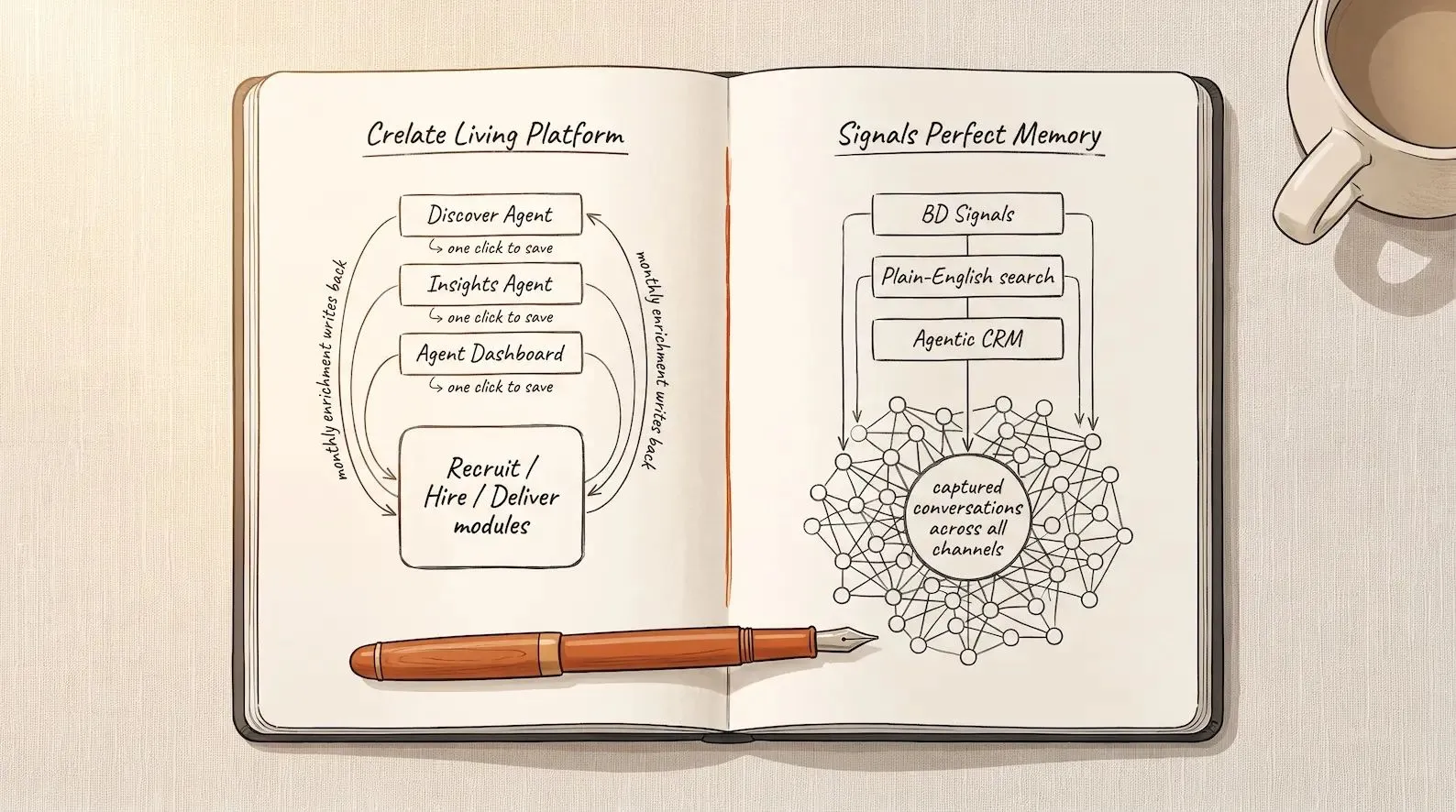
What Crelate ships that is genuinely agentic. Crelate’s Insights Agent runs monthly background enrichment that writes to records: ‘Each month, Crelate automatically updates records with new job titles, company changes, phone numbers, and email addresses’ Source: Crelate roadmap. The Agent Dashboard surfaces Ideas including ‘Discover New People’, ‘Company Received Funding’, ‘BD Opportunity’, and ‘Contact May Be Looking for Work’ Source: Agent Dashboard Ideas. These are real BD signal surfaces, not vapourware. Any Signals vs Crelate framing that claims Crelate has no BD signals is factually wrong.
Where Crelate’s agentic framing is narrower than the marketing suggests. Discover Agent frames every action as ‘one click’, requiring the consultant to confirm before saving. The September 2026 MCP integration is ‘V1 read-only’. Crelate’s Additional Product Terms explicitly disclaim decision autonomy: ‘its AI Products do not automate HR or hiring decisions and are not designed or intended to replace recruiters or hiring managers’ Source: Crelate Additional Product Terms. This is agentic-as-background-enrichment plus proactive surfacing plus a human click at the end, not autonomous workflow execution.
Signals’ Agentic CRM design intent is a different architectural bet. The BD Signals layer is built to detect a wider category set (the 10 BD signal categories introduced in the hub piece) that runs against the agency’s own captured relationship graph rather than against a general-purpose enrichment pool. The plain-English search interface operates across the whole captured graph, not the candidate subset alone. Both platforms have real AI. The differences sit in what the AI operates on and what workflow surface it produces.
For agencies weighing the vs-comparison landscape more broadly, the parallel Signals vs Loxo and Signals vs Recruiterflow pieces cover different vendor framings of the same underlying AI-native question.
Pricing and what sits behind the paywall
Crelate publishes list pricing for two tiers and quotes the other two on request Source: Crelate pricing.
| Tier | Published price | Notes |
|---|---|---|
| Essentials | $85 per user per month billed annually | ’Up to 2 users and 20k contacts’ |
| Business | $119 per user per month billed annually | No user cap stated |
| Business Plus (‘Our most popular’) | ‘Custom’ | Includes BD workflows, Automation and Sequences, Full API, Co-Pilot |
| Platform (Enterprise) | ‘Custom’ | API 120 RPM, ISO/SOC2 report access |
Pricing is USD only with no currency selector. There is no self-serve checkout; even the published prices route to ‘Contact Sales’.
The commercially sharpest finding: Business Development Workflows, Automation and Sequences, Full API and Integrations, and Co-Pilot all sit above the $119 Business tier at an unpublished price. Add-ons flagged as ‘additional fee applies’ with no published price include Crelate Text Messaging, RingCentral Text Connector, Email Campaigns, Crelate eSignature, Native Contact Data Enrichment. Crelate Hire is priced per hire (rate not disclosed). Data Sync is priced ‘on Volume / Frequency’ (rate not disclosed). Any full-BD Crelate configuration is an unpriced quote. This is notable because Crelate’s own vs-Bullhorn comparison page includes a ‘Pricing Transparency’ row while its own most-popular tier is ‘Custom’. Signals plan tiers are Core, Growth, and Enterprise, published on the Signals site.
What Crelate users say
Review sentiment on Crelate is genuinely positive, and the article should say so plainly.
Praise, verbatim from counted Capterra themes Source: Crelate Capterra reviews, updated August 2026: ‘Intuitive and simple interface’ (89 mentions, 97 per cent positive). ‘Streamlined team communication tools’ (42 mentions, 95 per cent positive). ‘Highly customizable recruiting workflows’ (31 mentions, 97 per cent positive). Small firms consistently praise the value for money (Capterra Value for Money sub-score 4.5 out of 5, 335 ratings).
Recurring criticisms. ‘Recurring technical glitches and bugs’ including duplicate-detection problems (31 Capterra mentions, 74 per cent negative). Thin onboarding is documented across at least five reviews spanning late 2024 and 2025. Segmented reporting shows up as the most specific product complaint: ‘its databases are segmented, meaning you can only generate reports from one table at a time (Contacts, Placements, Opportunities)’ (Morgan F., Product Analyst, December 2025). Support is bimodal: aggregate Customer Service sits at 4.5 out of 5 (401 Capterra ratings), but the negative cluster concentrates on small accounts and cites ‘skeleton staff’ and ‘US-based support is pretty good; my encounter with offshore support wasn’t’ as recurring notes. Capterra’s Features sub-score is Crelate’s lowest at 4.3 out of 5 (423 ratings).
The AI-review picture is worth naming as an absence. Across the review corpus reviewed for this research pass, no substantive criticism of Co-Pilot, Discover Agent, or Insights Agent appears. This is a 2026 marketing surface with no meaningful negative review presence yet.
Geography and data residency
Crelate’s data processing is US-only. This is a factual finding, not inference.
The Crelate Data Processing Addendum states: ‘Crelate’s primary processing facilities are in the United States of America’ Source: Crelate DPA. Hosting is Microsoft Azure with geo-replication from California to Virginia per Crelate’s Help Centre. No EU, UK, Canada, or Australia hosting region is offered. Pricing is USD only with no currency selector. Support runs a single window, 8:30 AM to 7:30 PM US Eastern, Monday through Friday Source: Crelate support. Crelate Hire ‘is only available for use within the United States’. All five published customer case studies are US firms; no non-US customer is named on Crelate’s own site.
For an agency operating in the US, this is largely a non-issue. For a Canadian agency with provincial residency expectations, or a UK, EU, or APAC agency whose clients demand in-region hosting, it is decisive. Signals is designed and operated with global recruitment agencies as the primary audience, and the geographic scope is a first-class product commitment rather than a contractual accommodation.
Who should pick which
After the architectural framing and the execution differences, the fit criteria are specific.
Crelate is the stronger fit when:
- The agency is US-based (or serves primarily US clients) and has no non-US data residency requirement.
- Deep configurability, native reporting depth, and per-tier customisation are valued more than cross-channel capture breadth.
- The agency’s client base uses primarily email and calendar for communication, and can accept partner-assembled call intelligence via Ringover, CallMantra, or Honeit.
- The commercial model is comfortable with an unpriced Business Plus tier for BD workflow features and metered add-ons for text messaging, email campaigns, and enrichment.
- Executive search or direct-hire boutique operations are the primary focus, particularly given Crelate’s AESC Americas Partner tie from October 2025.
Signals is the stronger fit when:
- Ambient WhatsApp, WeChat, and LinkedIn inbound conversation capture is part of the daily operational reality of the agency’s recruiters.
- Non-US data residency (Canada provincial, UK, EU, APAC) is a client or regulatory requirement.
- Published, predictable pricing tiers are preferred over ‘Custom’ quoted commercial terms.
- Cross-channel capture breadth is the constraint the agency has been unable to solve with other tooling.
- The agency operates globally or across multiple regions, and wants the CRM to be built for that reality rather than accommodating it contractually.
For a wider frame on how to evaluate any recruitment CRM without getting distracted by feature bingo, our recruitment CRM buyer’s guide for 2026 walks through the Five Dimensions of AI-Native Evaluation. Both platforms score well on some dimensions. Neither is universally better. The right choice is the one whose architecture matches where the agency’s operating leverage sits.
The choice, in one sentence
Signals vs Crelate is not a debate about product quality. Crelate is mature, well-liked, and shipping genuine agentic capability including named BD signal surfaces. The comparison is architectural: whether an agency’s operating reality needs a US-hosted platform with modular back-office and partner-assembled call intelligence, or an AI-native platform built ground-up for cross-channel capture across a global footprint. Both answers are defensible. The right choice is the one whose bet matches where the agency’s future value sits.
See what cross-channel capture and non-US residency look like when built ground-up
Signals is live for recruitment agencies globally. Book a demo to see the AI-native architecture.
Common questions
Signals and Crelate represent two different architectural bets. Crelate is a modular US-focused platform launched in 2012, comprising Crelate Recruit (ATS plus CRM), Crelate Hire (US-only onboarding and credentialing), Crelate Deliver (back office scoped to lighter contractor or temp volume), and Crelate Omni (bundle). Its agentic layer wraps around this core as 'Living Platform', with Discover Agent, Insights Agent, and an Agents Dashboard surfacing named Ideas including 'Company Received Funding' and 'BD Opportunity' [Source: Crelate Agent Dashboard Ideas](https://help.crelate.com/en/articles/12649901-agent-dashboard-ideas). Signals is an AI-native recruitment CRM built ground-up around Perfect Memory, the automatic cross-channel conversation capture layer (calls, emails, WhatsApp, WeChat, LinkedIn messages, meetings). Crelate's own documentation shows no native call recording, transcription, meeting notetaker, LinkedIn message capture, WhatsApp, or WeChat support; those channels are delivered through partners. The choice comes down to capture architecture and geographic scope.
Crelate is a private, founder-led company. Aaron Elder is CEO and Co-Founder, and is quoted as such in Crelate's own November 2025 product release [Source: Crelate Insights Agent launch, November 2025](https://www.crelate.com/blog/crelate-launches-insights-agent-living-platform). Five Elms Capital holds a minority growth-equity position per PitchBook records; the 2019 Series A and March 2022 growth investment together brought Crelate's total raised to $11.5 million per its own release, with no disclosed round since. Common secondary-source claims that Crelate is 'PE-owned' or 'private equity backed' should be treated as inaccurate as stated; the correct framing is founder-led with minority growth equity. Crelate's contact page describes the company as 'Founder-led' and headquartered in Eagle, Idaho, though press datelines from 2022 and 2023 placed the company in Bothell and Kirkland, Washington, and the centre of gravity shifted to Idaho during 2024 and 2025.
Crelate publishes list pricing for two tiers and quotes the other two on request, per its pricing page as of September 2026 [Source: Crelate pricing](https://www.crelate.com/pricing). Essentials is $85 per user per month billed annually, limited to 2 users and 20,000 contacts. Business is $119 per user per month billed annually. Business Plus (Crelate's marketing describes it as 'Our most popular') is 'Custom'. Platform (Enterprise) is 'Custom'. Pricing is USD only with no currency selector. Critically, Business Development Workflows, Automation and Sequences, Full API and Integrations, and Co-Pilot all sit above the $119 Business tier, at an unpublished price. Add-ons with 'additional fee applies' but no published price include Crelate Text Messaging, RingCentral Text Connector, Email Campaigns, Crelate eSignature, Native Contact Data Enrichment, plus Data Sync Service, Crelate Hire (per hire), and MCP. Any full-BD Crelate configuration is an unpriced quote.
Per Crelate's own help centre as of September 2026, Crelate does not natively capture WhatsApp messages, WeChat conversations, or LinkedIn InMail and message content. WhatsApp is delivered only through partners including Ringover and SourceWhale [Source: Crelate marketplace](https://www.crelate.com/marketplace). WeChat is not mentioned anywhere in Crelate's product or help documentation reviewed. LinkedIn support covers profile creation via Chrome extension and job posting; InMail and message capture are not documented. On call recording and transcription: Crelate documents automatic call logging (calls are logged on the contact's profile), but call recording, transcription, and AI summaries are partner-delivered through Ringover, HireLogic, CallMantra, Honeit, and Whippy, not native. The Zoom help article documents voice-only integration: 'No Zoom meetings. No video.' [Source: Crelate + Zoom integration](https://help.crelate.com/en/articles/12872008-crelate-zoom-integration). Native meeting notetaker is delegated to partners including HireLogic, Honeit, Jobma, and SparkHire. Signals' Perfect Memory pillar is designed for cross-channel automatic capture including calls, emails, WhatsApp, WeChat, LinkedIn messages, and meetings as first-class native channels.
Crelate's data processing is US-only. The Crelate Data Processing Addendum states that 'Crelate's primary processing facilities are in the United States of America' [Source: Crelate DPA](https://www.crelate.com/legal/data-processing-addendum). Hosting is on Microsoft Azure with geo-replication from California to Virginia [Source: Crelate Help Centre](https://help.crelate.com/en/articles/4120484-crelate-data-retention-backup-security-and-availability). No EU, UK, Canada, or Australia hosting region is offered. Crelate Hire 'is only available for use within the United States' per Additional Product Terms updated June 2025. Pricing is USD only with no currency selector. Support runs a single window, 8:30 AM to 7:30 PM US Eastern, Monday through Friday. All five published customer case studies are US firms; no non-US customer is named on Crelate's own site. For an agency operating in the US, this is largely a non-issue. For a Canadian agency with provincial residency requirements, or a UK, EU, or APAC agency with in-region hosting demands from clients, it is decisive.