
Team call coaching is one of the fastest-growing categories in recruitment technology in 2026 and one of the most weakly defined. Every vendor selling call recording, transcription, or conversation intelligence to recruitment agencies calls part of what they ship ‘coaching’. Almost none of them ship the coaching workflow the general sales-technology market has documented for years. And no analyst house has published a recruitment-specific definition of the category as of September 2026, meaning almost every claim of ‘recruitment call coaching best practice’ is practitioner convention borrowed from B2B sales rather than research or analyst framework. This article walks through what the research actually supports, what the current recruitment CRM market documents on the record, what the specialised call-intelligence tools name and do not name, and what the compliance layer requires. The organising principle is honest labelling. Where the evidence is strong, it is stated as such. Where it is weak, that is stated too.
What ‘call coaching’ actually means: four documented layers
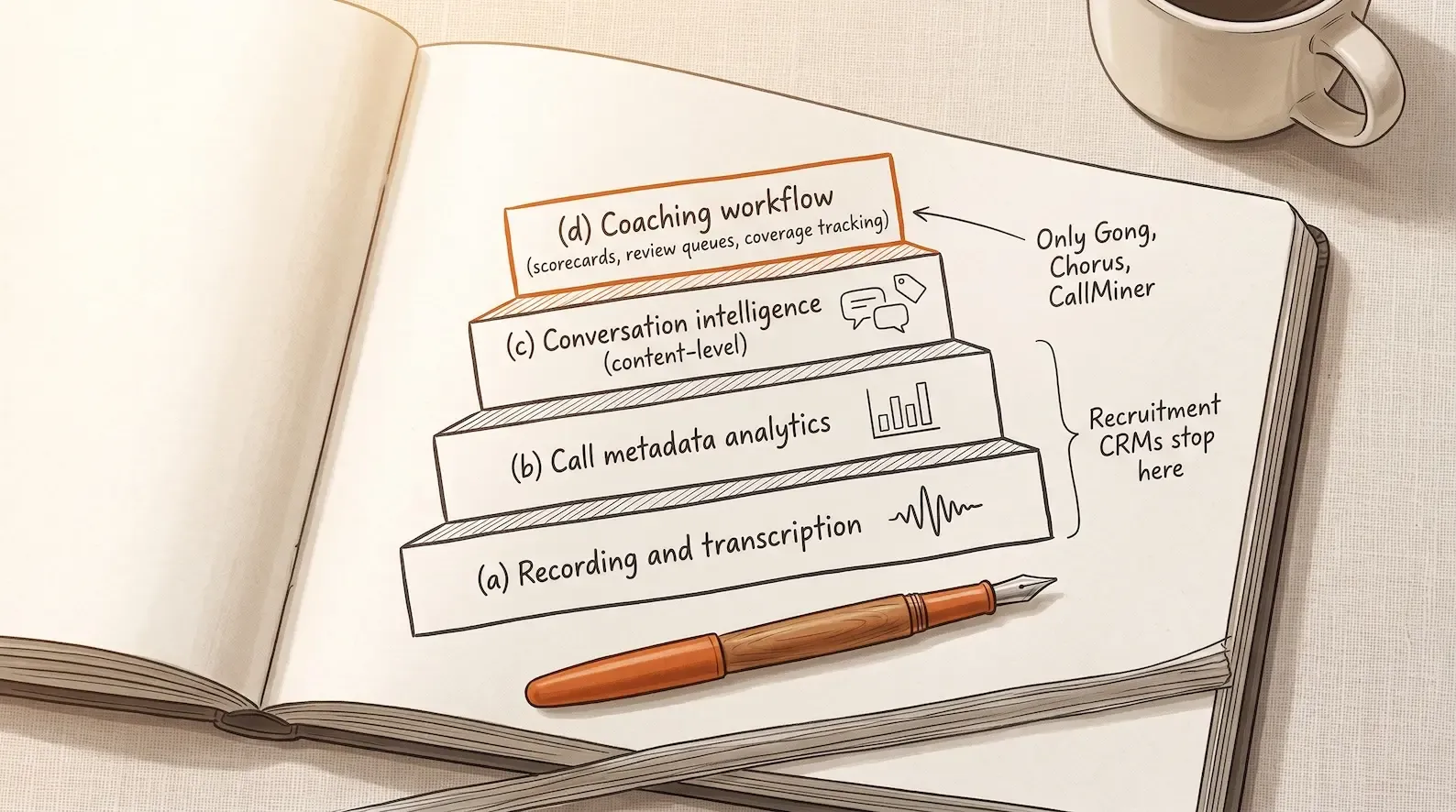
The category has four distinct layers, each with different vendor documentation. This structure is not an analyst taxonomy; it is derived from what different products’ own docs do and do not claim.
Layer (a): Recording and transcription. Speech captured, converted to text, summarised. CloudCall documents this as its core: ‘Every call is automatically transcribed and summarized’ Source: CloudCall AI Call Transcription. Most vendors in the recruitment-adjacent stack stop here.
Layer (b): Call metadata analytics. Call counts, duration averages, best-time-to-connect. Prodoscore and OneUp Sales publish agency benchmarks at this layer. No content-level analysis, no coaching.
Layer (c): Conversation intelligence at content level. Sentiment, keyword and topic detection, buying signals, style feedback. Ringover Empower integrated with Bullhorn documents ‘sentiment analysis’ and insights ‘without the need to listen to hours of calls’ Source: Ringover Empower Bullhorn integration. In2Dialog documents extracting ‘goals, buying signals, and development needs’ plus ‘feedback on conversational style’ Source: Bullhorn Marketplace, In2Dialog, July 2025. Content analysis is present. Coaching workflow is absent.
Layer (d): Coaching workflow. Anchored 1-to-5 scorecards, timestamped feedback tagged to the consultant, manager review queues, weekly digests of recommended calls, coaching inbox, coaching-on-the-coaches analytics. Gong documents the whole loop: ‘Gong gives you a seamless experience for coaching your team by scoring recorded calls’, ‘find coachable moments quickly, track progress over time, and tie coaching to business outcomes’ Source: Gong coaching documentation, June 2026. The AI Call Reviewer can ‘Score entire calls automatically, based on your scorecard criteria’. Gong is explicitly sales-framed. Its documentation names ‘RevOps, Sales rep, Sales manager’ and does not mention recruiters, candidates, placements, or recruitment coaching anywhere.
The one-sentence version: the recruitment-adjacent tooling documents layers (a) and (c). The documented layer (d) coaching machinery comes from sales products that never mention recruitment.
What the research actually says about call quality and placements
The peer-reviewed evidence base is honest but thin, and the famous numbers are weaker than their reputation.
Workplace coaching produces medium positive effects. Cannon-Bowers et al’s 2023 meta-analysis of 11 papers reports aggregate g = 0.44, 95 per cent CI 0.31 to 0.57, described as a medium positive effect. Skill outcomes were g = 0.72; affective outcomes g = 0.41. Manager-rated outcomes 0.50; self-rated 0.41. Face-to-face 0.48 versus virtual 0.35, not significantly different Source: Cannon-Bowers et al, Frontiers in Psychology, October 2023. Number of sessions was not a significant predictor. Wang et al report g = 0.51 (k = 20, n = 957). The findings are consistent: coaching works, small-to-moderate effects, strongest on skills.
Two caveats matter operationally. First, the 2023 meta-analysis states that none of its included studies measured hard business results outcomes. Second, Kluger and DeNisi’s 1996 review of 131 controlled feedback studies, updated by CIPD, found that over one third of feedback interventions decreased performance, with effectiveness dropping as attention moves from task to self Source: CIPD evidence review. The honest operational conclusion: coach the behaviour in the call, not the person. Do it less often but better rather than more often.
Sales-specific research is real but modest. Pousa and Mathieu report β = 0.280 and β = 0.200 significant at p < 0.05, coaching explaining 6.2 per cent and 2.9 per cent of additional variance. Their own conclusion: ‘Although this impact is not very strong, it is noticeable’. Carvalho et al report managerial coaching to customer orientation β = 0.362 in PLS-SEM. These are real effects. They are also cross-sectional and self-report.
The famous 43 to 57 talk-to-listen ratio is a 2016 vendor blog post. Gong Labs’ original 2016 analysis of 326,000 sales calls (no date range, no statistical tests, no effect sizes, no confidence intervals) named 43 per cent talking to 57 per cent listening as the ‘golden ratio’ Source: Gong talk-to-listen analysis. Gong’s own 2025 re-analysis materially weakens it: closed-won 57 per cent talk, lost 62 per cent, with Gong’s own caveat that ‘the difference isn’t massive’. The 2025 data further finds that losing sellers asked more questions than winners (roughly 20 versus 15 to 16 per call), contradicting standard ‘more discovery is better’ coaching advice. Treat the ratio as directional at most.
No peer-reviewed evidence exists on coaching recruiters specifically. No coaching meta-analysis uses recorded-call feedback as the intervention. Recruitment-specific claims about call-coaching effect on placements should be treated as vendor marketing until published research exists.
What the current recruitment CRM market actually ships
Eight recruitment CRMs were reviewed for documented call coaching capability. Not one ships a coaching product.
| Vendor | Native call capture | Coaching workflow (scorecards, review queues) | Pricing note |
|---|---|---|---|
| Bullhorn | Amplify Transcribe and Live Transcribe (device audio for phone calls) Source: Bullhorn Amplify KB | No. Bullhorn Analytics’ ‘coaching insights’ run on activity data | Digital Workers SKU, quote-only, Growth or Enterprise tier |
| Recruit CRM | AI call transcript and AI-Assist on call logs | No | Calling in Pro, credits at Enterprise |
| Recruiterflow | AIRA Notetaker via RingCentral, Twilio, Aircall Source: Recruiterflow Help | No. Scorecard Agent scores candidates, not consultants | Custom AI Plan plus AIRA credits, prices not published |
| Manatal | AI Notetaker (Beta, video only) Source: Manatal Support | No | Add-on on request, credit-burning |
| Mercury | Call Transcript AI via Teams and Activity AI | No workflow | Not public |
| Loxo | AI Notetaker (video only); no dialler recording or transcription documented | No | Notetaker not itemised in pooled credit allowance |
| JobAdder | None native. Partners only (TalentLynk, Metaview, Vxt, RecView, CallMantra) | No | Quote-only |
| Vincere | None GA. Meeting Assistant Evo is waitlist. AI Coach scores call-to-placement ratios | No | CRM £69 per user; AI tiers £25 to £349 per agency contain no call features |
The near-misses are instructive. Recruiterflow’s Scorecard Agent scores candidates, not consultants. Vincere’s ‘AI Coach’ scores call-to-placement ratios rather than call content. Bullhorn Analytics’ ‘coaching insights’ run on activity data. None is a rubric-based call scorecard, a manager review queue, or coverage-tracking of who has been coached and how often. The genuine coaching machinery, anchored answer values, coaching inbox, coaching-on-the-coaches analytics, exists only in general sales tools that never mention recruiters.
The gating pattern is worth naming. Bullhorn’s transcription sits inside a quote-only SKU requiring Growth or Enterprise. Recruiterflow requires a Custom AI Plan plus consumable AIRA credits despite marketing ‘No add-ons. No surprises’. Manatal’s Notetaker is an on-request, credit-burning add-on. Loxo bundles into a pooled credit allowance that does not itemise Notetaker. Vincere sells AI in agency-level tiers that contain no call features at all. Anyone comparing recruitment CRMs on published call-intelligence pricing is comparing marketing pages, not procurement outcomes.
What coaching actually means beyond a transcript
The documented coaching workflow, drawn from Gong and Salesloft, has specific mechanics that no recruitment CRM currently ships.
Anchored scorecards with calibration. Gong’s documented 1-to-5 rubric example includes anchor definitions: ‘Did the rep set a clear agenda up front?’ with answer values ‘1. No reason given; 3. Mention of call intention (but no full context); 5. Purpose, duration and potential outcomes mentioned’ Source: Gong scorecards documentation. Gong states the essential prerequisite: ‘Scoring is only effective if your team is aligned on what each of your answer values mean’. Calibration matters more than the scorecard itself.
Timestamped feedback tagged to the consultant. Salesloft’s model: ‘pause playback at the relevant moment, type your feedback and tag the rep, the comment is anchored to the timestamp where you paused. When the rep clicks through from their notification, they jump directly to that moment’ Source: Salesloft manager guide, September 2026. This is fundamentally different from a general call summary. The coaching value sits in the specific 90-second segment being reviewed together.
Coverage-equity tracking. The best operational idea in the documented playbooks: ‘Monitor how much coaching each of your team members is getting in the Coaching Received tab, so you can make sure you don’t miss anyone or focus too much on a specific person’. Without this, desk managers coach whoever they like most.
The verify stage has the strongest evidence. Harkin et al’s 2016 meta-analysis of 138 randomised controlled trials found progress monitoring raised goal attainment (d = 0.40), with larger effects ‘when the outcomes were reported or made public, and when the information was physically recorded’. Scored, recorded, tracked coaching beats verbal-only coaching on measurable outcomes. That is the strongest evidential link in the whole category.
The compliance layer that shapes the whole design
Compliance is where the design decision for team call coaching actually gets made. Permanent continuous recording is the wrong default in most of the English-speaking world.
United Kingdom. The ICO does not say ‘get consent’. Consent ‘is not usually appropriate in the employment context because of the imbalance of power between employers and workers’. Legitimate interests is ‘the most flexible basis’ but requires a documented three-part assessment. The quotable line: ‘It is not usually proportionate to monitor or record the content of calls in all cases’ Source: ICO monitoring workers guidance. The ICO also notes that systematic call recording used for performance management is high-risk processing, meaning a DPIA is the defensible default.
European Union. WP29 Opinion 2/2017 sets proportionality expectations that make ‘always-on’ the wrong default: monitoring must be ‘carried out in the least intrusive manner possible’, ‘targeted to the specific area of risk’, and subject to ‘sampling instead of continuous monitoring’. France CNIL prohibits permanent or systematic recording except where a legal text requires it; caps recordings at six months and analysis documents at one year. Germany BetrVG s.87(1)(6) gives works councils a co-determination right over technology ‘designed to monitor employees’ behaviour or performance’. A German rollout without a works agreement risks an injunction.
EU AI Act Article 5(1)(f). The single most consequential provision for this category. Workplace emotion inference by AI is prohibited, in force since 2 February 2025 Source: EU AI Act consolidated text. Recital 18 expressly brings ‘raised voice or whispering’ into scope when used to infer emotions. The Digital Omnibus provisionally agreed in May 2026 postpones certain high-risk obligations to late 2027 and 2028, but Article 5 prohibitions are not identified among the postponed parts. Vendors marketing ‘sentiment analysis’ on recruiter calls in the EU workplace context should be evaluated against Article 5(1)(f) directly. Ringover Empower, Mercury, Aircall, and Dialpad each market some form of sentiment feature.
Australia. The federal privacy statute is not the binding constraint. The state and territory surveillance-devices Acts are, and they differ. Queensland and Victoria permit a party to record without the other party’s consent. NSW, WA, SA, and Tasmania require all principal parties’ consent unless a lawful-interests exception applies (routine coaching does not qualify). The practical operating rule in those four states: get audible consent on every call. Our Australia 2026 recruitment piece covers the wider regulatory context.
Canada. PIPEDA and OPC guidance: ‘reasonable purposes’ test, notify and obtain consent from the candidate, and the critical purpose-creep warning: ‘An organization should not state that it is recording the conversation for quality assurance purposes if the recording will be used for other purposes, such as marketing or profiling’. Quebec Law 25 s.8.1 requires advance notice where technology allows profiling, expressly including ‘analyzing that person’s work performance’. BC PIPA permits collection without employee consent but mandates advance notice.
United States. Federal one-party consent. All-party consent verified from statute in California, Massachusetts, Washington, Florida, Maryland, and Connecticut (with Illinois turning on surreptitiousness). The ‘twelve all-party consent states’ lists circulating are largely uncheckable. Any US-based recruitment agency operating across state lines should assume the strictest standard, an audible recorded announcement at the start of every call.
The editorial conclusion: almost every regime allows AI call analysis if you say so up front and can justify necessity, and almost every regime is hostile to bolting AI analysis onto recordings originally announced as ‘for quality and training’. Purpose limitation is where the compliance fights happen.
Manager oversight and the operational pattern
Rapp et al (n = 159 managers, 899 sales reps, 15-minute time diaries) found that how a manager spends time predicts team performance (managing-people time β = 0.163, p < 0.01) while span of control itself was not statistically significant. Cadence guidance from Gong’s documentation (‘one call per direct report once a week’, ‘review the coaching inbox once a week’) and Chorus’s documented ‘two calls per rep per week’ are vendor conventions, not research findings.
The published effect sizes converge on a specific operational pattern. Coach the behaviour in the call, not the person (Kluger & DeNisi). Keep the coaching note, delete the raw audio where compliance allows (CNIL pattern). Sample rather than surveil (WP29, ICO, PCPD Hong Kong all converge here). Track coaching coverage per consultant, not just per manager (Salesloft convention). The five-stage loop that emerges is capture, detect, surface, coach, verify, with the verify stage carrying the strongest evidential link to outcome improvement (Harkin et al, d = 0.40 with recording).
For a wider frame on how to evaluate any AI-native recruitment CRM against these structural requirements, our recruitment CRM buyer’s guide for 2026 walks through the Five Dimensions of AI-Native Evaluation. And the six channel classes a recruitment CRM needs to capture piece covers the underlying capture-layer architecture, without which no coaching layer can be built.
What Signals does at this layer
Signals is designed so that team call coaching is a first-class product surface built on the Perfect Memory capture layer that already sits at the architectural core of the CRM. Calls captured via Perfect Memory feed a coaching workflow with anchored rubrics, timestamped feedback tagged to the consultant, and a manager view that tracks coaching coverage across the desk rather than leaving it to individual manager discretion. The design intent is to give recruitment agencies the coaching workflow that Gong and Chorus documented for B2B sales, adapted for the recruiter workflow, on the same platform that already holds the candidate, client, and conversation history. Compliance controls (per-user recording enablement, jurisdiction-aware notice, retention policy, EU Article 5(1)(f) posture) are built into the architecture rather than layered on afterwards. Book a demo to see it in production.
See what call intelligence looks like when it is designed for recruitment
Signals is live for recruitment agencies globally. Book a demo to see call intelligence built as a first-class product surface.
Common questions
Team call coaching for recruitment agencies is the structured process of using recorded consultant calls to develop skill and performance through anchored rubric scorecards, timestamped feedback, and manager review workflows. The core loop is capture, detect, surface, coach, and verify: the call is captured and transcribed, patterns are detected automatically, coachable moments are surfaced to a manager for review, structured feedback is delivered against a scorecard, and progress is tracked over time. As of September 2026, this loop is documented only in general sales tools like Gong, Chorus, and CallMiner. No analyst house (Aptitude Research, SIA, APSCo, or Bullhorn GRID) has published a recruitment-specific definition of the category, so any claim of 'recruitment call coaching best practice' is practitioner convention rather than analyst framework.
None. As of September 2026, no recruitment CRM in the market ships a documented call coaching product with anchored scorecards, manager review queues, or consultant-level aggregation of call quality. What is shipped: Bullhorn ships Amplify Transcribe within a quote-only Digital Workers SKU [Source: Bullhorn Amplify KB](https://kb.bullhorn.com/amplify/), Recruiterflow ships AIRA Notetaker via RingCentral, Twilio, or Aircall telephony [Source: Recruiterflow Help](https://help.recruiterflow.com/en/articles/15027497-using-aira-notetaker-with-phone-calls-ringcentral-twilio-aircall), Manatal ships an AI Notetaker in Beta covering video only [Source: Manatal Support](https://support.manatal.com/docs/ai-notetaker-1), Mercury ships Call Transcript AI on the Teams stack, Loxo ships a video-only AI Notetaker without documented dialler recording, JobAdder ships nothing native, Vincere's 'AI Coach' scores call-to-placement ratios rather than calls, and Recruit CRM's AI runs on call logs. Near-misses exist. Coaching workflow does not.
No peer-reviewed effect size exists on structured call coaching and recruitment placement rates specifically. General workplace coaching effect sizes are medium positive: g = 0.44 (k = 11) in Cannon-Bowers et al's 2023 meta-analysis [Source: Frontiers in Psychology, October 2023](https://pmc.ncbi.nlm.nih.gov/articles/PMC10597717/), g = 0.51 (k = 20, n = 957) in Wang et al, and sales-specific effects of β = 0.20 to 0.28 explaining 3 to 6 per cent of additional variance. Two caveats are essential. First, the 2023 meta-analysis states that none of its included studies measured hard business results outcomes. Second, Kluger and DeNisi (1996), reviewed by CIPD, found that over one third of feedback interventions decreased performance, with effectiveness dropping as attention moves from task to self [Source: CIPD evidence review](https://www.cipd.org/globalassets/media/knowledge/knowledge-hub/evidence-reviews/performance-feedback-scientific-summary_tcm18-111387.pdf). Number of sessions is not a significant moderator of effect. Coach behaviour in the call, not the person, less often but better rather than more often.
The rules vary materially by jurisdiction. UK: the ICO says consent is not usually appropriate for employee monitoring due to power imbalance; legitimate interests plus a DPIA is the defensible default; and 'It is not usually proportionate to monitor or record the content of calls in all cases' [Source: ICO monitoring workers guidance](https://ico.org.uk/for-organisations/uk-gdpr-guidance-and-resources/employment/monitoring-workers/). EU: WP29 requires proportionality including 'sampling instead of continuous monitoring'. France CNIL prohibits permanent or systematic recording and caps recordings at six months. Germany BetrVG s.87(1)(6) gives works councils co-determination rights over performance-monitoring technology. Australia: NSW, WA, SA, and Tasmania require all principal parties' consent; Queensland and Victoria permit party-recorded calls. Canada PIPEDA: notice and consent for candidates, purpose limitation (do not say 'quality assurance' if it will be used for profiling). Singapore PDPA: no employee consent needed, notification required. US: federal one-party consent; California, Massachusetts, Washington, Florida, Maryland, and Connecticut verified from statute as all-party. Check your jurisdiction before configuring anything.
Not for workplace emotion inference. Article 5(1)(f) of the EU AI Act prohibits AI systems that infer emotions of natural persons in workplace and educational contexts, with a narrow exception for medical or safety reasons. This prohibition has applied since 2 February 2025 [Source: EU AI Act consolidated text](https://eur-lex.europa.eu/eli/reg/2024/1689/oj). Recital 18 expressly brings 'raised voice or whispering' into scope when used to infer emotions. The Digital Omnibus provisionally agreed 7 May 2026 postpones certain high-risk AI Act obligations to 2 December 2027 and 2 August 2028, but Article 5 prohibitions are not identified among the postponed parts. Vendors marketing 'sentiment analysis' on recruiter calls in the EU workplace context should be evaluated against Article 5(1)(f) directly. Ringover Empower, Mercury, Aircall, and Dialpad each market some form of sentiment feature; deployers in the EU carry the compliance responsibility.