
Search “recruitment CRM data decay” and you’ll find a figure repeated across almost every vendor blog: 30% of your database goes stale each year. It’s the number Atlas cites in narrative form, that Yena AI attributes to “SHRM’s talent research,” that Loxo pins on Salesforce, and that SignalHire wraps around a 546-hours-per-year productivity-loss claim. It’s also unreliable. The 30% figure cannot be independently traced to a verifiable primary source. This piece resolves the confusion, walks the credible 2026 data that actually exists, and — more importantly — reframes what data decay in a recruitment CRM actually is: not one problem, but two. Only one of the two is fixable by architecture. That’s the half Perfect Memory is designed to prevent, through continuous capture across the Six Channel Classes at the moment the conversation happens rather than periodic cleanup after the fact.
The 30% problem — why the widely-cited figure isn’t verifiable
Every article about recruitment CRM data decay cites the same figure, and none of them can prove where it comes from. Two commonly-claimed origins fall apart under inspection.
Origin claim 1: Harvard Business Review, 2017. The Nagle/Redman/Sammon article “Only 3% of Companies’ Data Meets Basic Quality Standards” is often invoked as the source. It isn’t. The paper uses the Friday Afternoon Measurement Method on 75 executives’ record samples to measure data quality scores at a point in time — not annual decay rate. Its actual findings are that 47% of newly-created records have at least one critical error, and only 3% of data quality scores were rated “acceptable” Source: Harvard Business Review, September 2017. Legitimate paper. Wrong number for what it’s being cited for.
Origin claim 2: Gartner, 2018. A Gartner research note titled “How to Create a Business Case for Data Quality Improvement” is widely referenced as the source of the 30% figure. It’s paywalled, and independent tracing efforts have not been able to confirm what it actually says about decay rate specifically. Treat this attribution as widely repeated but not independently verified.
The problem this creates is bigger than one weak number. When vendor blogs repeat unsourced statistics without checking primary provenance, the entire category conversation drifts away from what the data actually shows. Atlas’s competing article on data decay cites zero statistics at all — a defensible response to the source confusion, but one that leaves the credibility question unanswered. This piece takes a different path: cite the numbers that are actually verifiable, correct the record on the ones that aren’t, and let the evidentiary rigor become the differentiator.
What the credible 2026 data actually shows
Three primary sources published or available in 2025-2026 give a defensible picture of CRM data decay — none of them landing exactly at “30% per year,” but all of them showing decay as a real and current problem worth architecting against.
Cognism 2026 — role-specific European C-suite decay. Cognism’s April 2026 research found that C-suite CRM data across the UK, France, and Germany decays at 26% per year for CEOs, 32% for CFOs, 34% for CROs, and 35% for CMOs — meaning half of all C-suite CRM records in these markets become inaccurate within roughly two years. US roles decay slightly slower: 23% (CEO), 24% (CFO), 29% (CRO), 30% (CMO) Source: Cognism, April 2026, vendor-produced research. Cognism sells contact data, so flag the vendor interest — but the methodology is transparent and the sample is role-specific and geography-specific, which is more than the “30% flat” figure ever provided.
Cleanlist 2026 — continuous measurement changes the number. Cleanlist’s 2026 Waterfall Decay Study re-verified 5,000 anonymised CRM contacts weekly over 13 weeks and found decay running at 1.8-2.4% per week, compounding to approximately 67% per year — roughly double the commonly-cited annual figure. The study attributes the gap to a methodology issue: annual snapshots miss churn that happens and reverses within the same year (someone changes jobs in March, changes again in September; an annual scan on December 31st might see only the second change) Source: Cleanlist, July 2026, vendor-produced research. Again vendor-produced (Cleanlist sells data enrichment), but the methodology is more rigorous than any of the sources circulating the 30% figure.
Validity 2025 — the state of the underlying data. Validity’s 2025 State of CRM Data Management research — surveying 602 CRM users and administrators across the UK, US, and Australia — found that 76% of organisations say less than half of their CRM data is accurate and complete, 45% say their CRM data is not ready for AI, and 37% report losing revenue directly due to poor data quality (with 25% of that group saying it costs at least 10% of annual revenue) Source: Validity, State of CRM Data Management 2025, July 2025. Not a decay-rate study specifically, but the strongest current primary source on what CRM data quality actually looks like at any point in time.
The honest answer to “what’s the real decay rate?” is that it depends on measurement method and role. Cognism’s role-specific figures are the most defensible anchor for European and US executive-contact decay. Cleanlist’s continuous measurement is the strongest evidence that the flat annual figure understates true churn. Neither is “30%.” Both are traceable.
Data decay is two problems, not one
The measurement question matters, but it isn’t the most important question. The more useful reframe is what causes decay in the first place — because CRM data decays for two structurally different reasons, and only one of them is fixable by architecture.
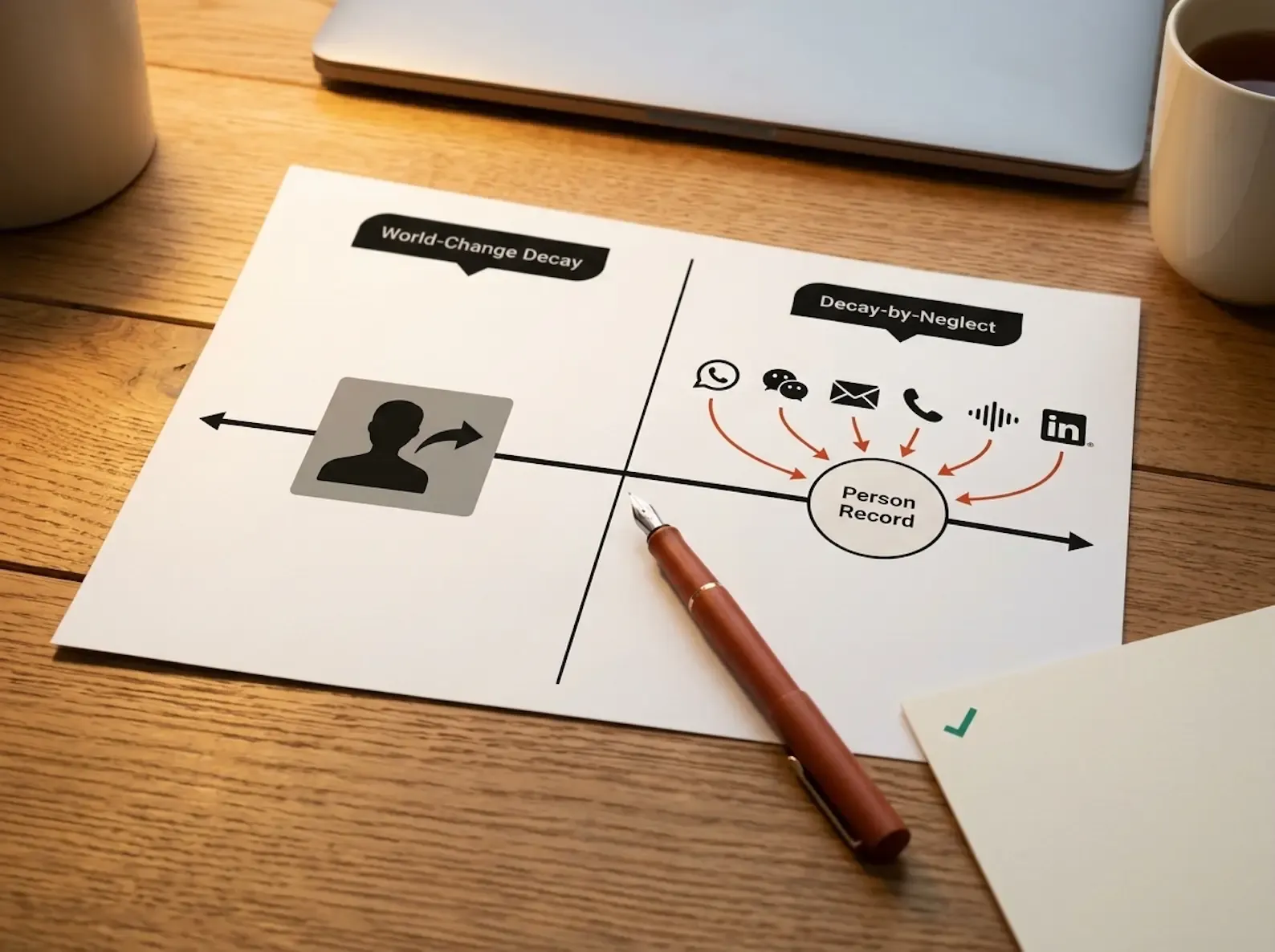
Problem 1: World-change decay. The facts changed in the world and no one told the CRM. A candidate takes a new job, and no conversation about the new job happens between them and the recruiter. The record decays because the world moved on and no signal reached the system. This kind of decay is genuinely inevitable — no CRM architecture can prevent a fact-change that never generates a communication event.
Problem 2: Decay-by-Neglect. The world changed, a conversation happened that reflected the change, and the conversation never got captured into the CRM. A candidate mentions their new role in a WhatsApp voice note. The recruiter hears the update. The CRM record doesn’t. This kind of decay is not inevitable — it’s a process failure that continuous capture prevents at source. This is the fixable half of the problem.
The distinction matters because most industry commentary on data decay treats it as a single, undifferentiated force to be fought with periodic audits. Data hygiene sprints, quarterly enrichment purchases, database clean-up projects — these treat the symptoms after decay has occurred. They cannot prevent Decay-by-Neglect because the conversation that would have kept the record current already happened, out of the system’s reach.
LinkedIn’s 2025 Economic Graph found that professionals entering the workforce today are on pace to hold roughly twice as many jobs over their careers as those entering 15 years ago Source: LinkedIn Economic Graph, Work Change Report, January 2025. Rising job mobility is the underlying driver of accelerating world-change decay — that portion of the problem no architecture solves, only better market intelligence can partially mitigate. But every additional job change is also another moment when a conversation about the change either does or doesn’t reach the CRM. The doubled mobility rate makes the Decay-by-Neglect fraction of total decay both larger in absolute terms and more consequential in recruitment outcomes.
The Living Record — Perfect Memory as architectural prevention
The architectural answer to Decay-by-Neglect isn’t a better hygiene process. It’s a different data model — one where the record is continuously updated by the capture of the conversations that actually happen, not periodically corrected by the enrichment of records after they’ve gone stale.
Signals’ Perfect Memory pillar is designed around this principle. Every conversation across every channel — WhatsApp threads, WeChat threads, email exchanges, phone-call transcripts, voice notes, LinkedIn signals — attaches to the person record continuously without manual logging. When a candidate mentions a new role in a WhatsApp voice note, the record updates as the voice note is received. When an email arrives with an updated title in the signature line, the record refreshes. When a phone call surfaces the news of a company move, the transcript enters the timeline automatically. The record is Living because it is being written into continuously, not because it is being corrected occasionally.
This is Capture-at-Source Prevention — the architectural principle that decay is prevented at the moment the conversation happens, not detected and corrected later. It changes what data decay actually means operationally. In a Living Record architecture, Decay-by-Neglect approaches zero because every channel that produces a signal is captured; only World-change decay remains, and even that is reduced because the same architecture that captures conversations also captures signals like LinkedIn profile changes that would otherwise never enter the CRM.
What each of the Six Channel Classes prevents from decaying
Every channel class Perfect Memory captures prevents a specific form of Decay-by-Neglect. The Six Channel Classes article walks the architecture in depth; this section shows what each channel actually keeps fresh.
| Channel class | What it captures | What it prevents from decaying |
|---|---|---|
| WhatsApp threads | Message body, media, voice-note transcripts, delivery/read status | Senior candidate updates in HK/SG markets where WhatsApp is primary business channel |
| WeChat threads | Message body, media, voice notes | China-facing candidate updates and cross-border relationship history |
| Email exchanges | Message body, attachments, signature-line metadata | Title and company changes visible in email signatures |
| Phone-call transcripts | Auto-transcribed audio with speaker separation | Discovery-call and briefing content that would otherwise live only in memory |
| Voice notes | Standalone recorded audio, transcribed | Salary negotiations, quick updates between meetings, driving-time context |
| LinkedIn signals | Profile changes, posts, connection activity, InMail exchanges | Job changes, promotions, industry moves surfaced through public activity |
Each channel is a source of continuous record-refresh. Take any one away and the corresponding decay category becomes preventable-in-theory but unrealised-in-practice — the recruiter would need to manually log what the channel captures automatically, and the same 63%-of-firms-don’t-consistently-log gap that plagues legacy CRMs would reassert itself.
Why periodic audits fail and continuous capture works
The default industry response to data decay is periodic audits — quarterly database clean-ups, annual enrichment refreshes, “data hygiene sprints” run by ops teams. Every article in the SERP that covers recruitment CRM decay treats these as the answer.
Periodic audits fail for the same reason weekly measurement produces higher decay rates than annual snapshots (Cleanlist’s finding). The audit fixes the database on the day it runs. Between audits, decay compounds continuously — every conversation that isn’t captured is a moment of Decay-by-Neglect happening in real time. A quarterly audit cycle produces a database that is optimally accurate 4 days per year and progressively less accurate for the other 361.
Continuous capture inverts this. Instead of running audits to correct decay after it has occurred, the architecture prevents Decay-by-Neglect at the moment the conversation happens. The record is refreshed by the conversation that already occurred anyway; no additional process, no additional cost, no scheduling window. Validity’s 2024 State of CRM Data Management found that 48% of CRM administrators noticed acceleration in customer data decay over the preceding 12 months Source: Validity, State of CRM Data Management 2024, May 2024. Periodic audits become less effective as decay accelerates because the interval between audits captures more decay events. Continuous capture becomes more effective at higher decay rates because more conversations are happening that would otherwise create Decay-by-Neglect.
The Weekly BD Call List Cycle is the operational rhythm this data model enables. Ranked call lists work because the underlying records are current. If the CRM ranking Monday morning was built on stale contact data — wrong titles, wrong companies, wrong roles — the list itself is decayed before the recruiter sees it. Continuous capture keeps the list current.
What operators do differently on a Living Record architecture
Three things change day-to-day on a Living Record.
First, the database becomes an asset that appreciates rather than depreciates. In a legacy CRM, the database is a diminishing asset — every quarter that passes without an audit is another quarter of decay. In a Living Record architecture, every conversation that happens adds value to the record. The database compounds over time rather than decaying between cleanups.
Second, the “reactivate old candidates” workflow works. Recruitment agencies invest heavily in building candidate databases and then discover that reactivating candidates from 18-24 months ago is often harder than sourcing fresh — because the old records are decayed. In a Living Record architecture, records that were captured 18 months ago have been continuously updated by subsequent conversations (or by the absence of signals, which is also information). Reactivation works because the record is still true.
Third, the Legacy CRM Migration Framework doesn’t fire — because the CRM never accumulates the architectural debt that triggers migration. The migration tax that new agencies pay in year two when their AI-added CRM stops compounding — the tax the Recruitment CRM Buyer’s Guide 2026 frames as the biggest hidden cost of the wrong day-one choice — is largely a data-decay problem. When the underlying data model is designed for continuous capture at source, the record doesn’t decay to the point where the system needs replacing.
The final honest note on this topic: no CRM architecture eliminates data decay entirely. World-change decay is real, mobility is rising, and some records will always go stale for reasons no system can prevent. But architecture can decisively prevent Decay-by-Neglect — the portion of decay that occurs because a conversation happened and no system caught it. That’s the fixable half of the problem, and it’s the half that determines whether a recruitment database is an appreciating asset or a depreciating one. Perfect Memory is the architectural bet that the fixable half is worth fixing at source.
See what continuous capture at source actually delivers
See Signals on a recruitment desk like yours.
Common questions
The widely-cited 30% annual data decay figure cannot be independently traced to a verifiable primary source. The most recent, methodologically-transparent data (Cognism 2026) shows C-suite CRM data decays 26-35% per year across the UK, France, and Germany, and 23-30% in the US, depending on role. Cleanlist's 2026 continuous weekly re-verification study found decay closer to 67% per year, suggesting annual snapshots understate true churn. Prevention requires architectural change, not periodic cleanup: continuous conversation capture across every channel (Perfect Memory's Six Channel Classes) updates the record as the conversation happens, rather than trying to correct stale records via quarterly audits.
There is no single canonical figure. Different measurement methods produce different rates: Cognism's 2026 study of European C-suite records found role-specific rates of 26% (CEO) to 35% (CMO) per year. Cleanlist's 2026 continuous weekly re-verification of 5,000 CRM contacts found decay closer to 2.1% per week, compounding to approximately 67% per year, with the difference explained by annual snapshots missing churn that happens and reverses within the same year. Validity's 2025 State of CRM Data Management survey found that 76% of organisations report less than half of their CRM data is accurate and complete at any point in time. All three figures reflect real, current, primary research, but each measures decay slightly differently.
The '30% per year' figure is widely repeated across vendor blogs but its provenance is unclear. Two commonly-cited origin sources don't hold up under inspection: Harvard Business Review's 2017 Nagle/Redman/Sammon article measures data quality scores at a point in time (using the Friday Afternoon Measurement Method on 75 executives' record samples) rather than annual decay, and its actual findings are that 47% of newly-created records have at least one critical error and only 3% of data quality scores are 'acceptable.' A Gartner 2018 research note is often cited as the source of '30%' but is paywalled and could not be independently verified. Recommend treating '30%' as widely repeated but not independently verified, and anchoring on Cognism 2026 or Cleanlist 2026 instead.
Decay-by-Neglect is the portion of CRM data decay caused by process failure rather than world-change. When a candidate takes a new job and the recruiter doesn't hear about it, the record decays because the world changed, and that is inevitable. When the candidate does mention the new job in a WhatsApp thread that never gets logged into the CRM, the record decays because the conversation wasn't captured, and that is Decay-by-Neglect. The distinction matters because only Decay-by-Neglect is fixable by architecture. Continuous multi-channel capture (Perfect Memory's Six Channel Classes) prevents Decay-by-Neglect at source. No CRM architecture can prevent the decay that happens when a fact changes in the world and no conversation happens to record it.
Perfect Memory captures six channel classes at source (WhatsApp threads, WeChat threads, email exchanges, phone-call transcripts, voice notes, and LinkedIn signals) and attaches each to the person record continuously, with no manual logging required. When a candidate mentions a new role in a WhatsApp voice note, the record updates as the voice note is received. When an email arrives with an updated title in the signature, the record refreshes. When a phone call surfaces the news of a company move, the transcript enters the timeline automatically. This is Capture-at-Source Prevention, the architectural principle that decay is prevented at the moment the conversation happens, not detected and corrected later. Periodic audits fix a database on the day they run. Continuous capture keeps it current between cleanups.