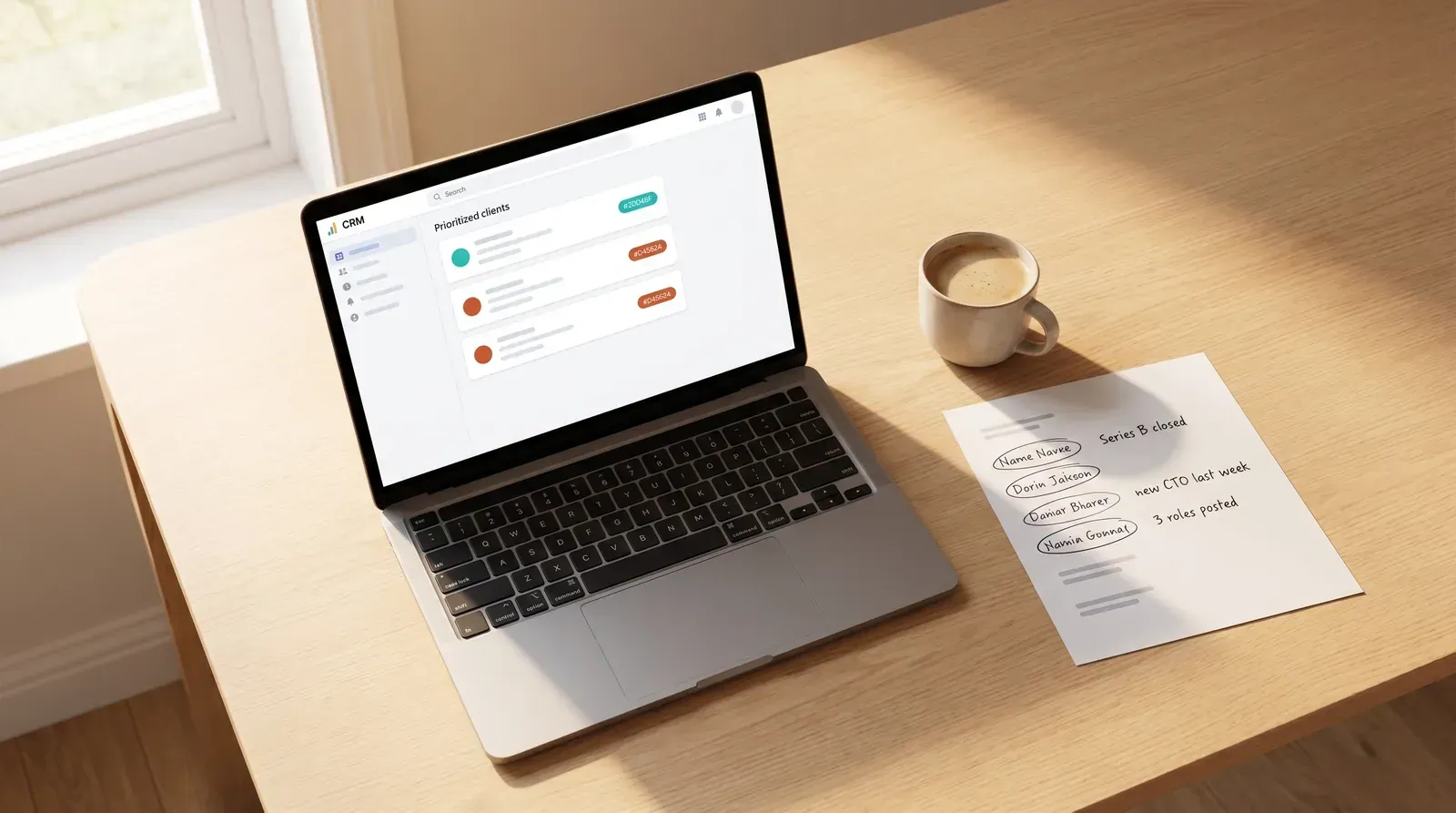
Every senior recruiter has a weekly BD call list. The question is whether it’s a list anyone could see, or whether it exists only in the recruiter’s head. At most agencies, it is the second. The senior partner opens the CRM on Monday morning, looks at the open mandates view, looks at the BD pipeline view, and starts typing the day. What gets done depends on what’s in front of them and what they remember. By Wednesday the BD plan has been pulled into delivery work. By Friday the BD touches that did happen are unlogged because the partner was on calls. By Monday the cycle restarts with a blank screen. This article specifies what a weekly BD call list for recruitment actually looks like as a system — the Weekly BD Call List Cycle, a five-stage operating rhythm that converts BD Signals and relationship history into ranked weekly action.
Why most agencies don’t actually have a weekly BD call list
The pattern is so consistent across recruitment agencies that it qualifies as the default. The agency has a CRM. The CRM has every client and prospect logged with a status field. The senior recruiter knows BD is the responsibility that grows revenue. And yet the weekly BD activity is whatever the senior recruiter can remember to do between delivery deadlines.
The data underneath this is stark. Bullhorn’s GRID 2026 Recruitment Industry Trends Report found that 44% of staffing firms say generating enough new client leads is a top business challenge Source: Bullhorn GRID, March 2026. The Staffing Industry Analysts’ 2025 Small Staffing Firm Growth Survey found that 57% of recruitment business owners say their team’s BD calling is inconsistent week to week, and 41% say BD time is the first thing sacrificed when delivery pressure rises Source: SIA, June 2025.
These are not three different problems. They are one problem described three ways. The agency has the people, the CRM, and the intent — and still produces inconsistent BD output because the system underneath does not surface a ranked weekly action list. The senior recruiter’s CRM shows everyone the agency has ever talked to, organised by status. That is not a weekly BD call list. That is a contact database with status fields.
The structural difference between status-with-fields and ranked-weekly-action is what this article addresses. A weekly BD call list is not “who do I know who might be hiring?” It is a ranked queue of the top 10 BD touches for the week, generated from live signals plus relationship history, with each touch tied to a defined action.
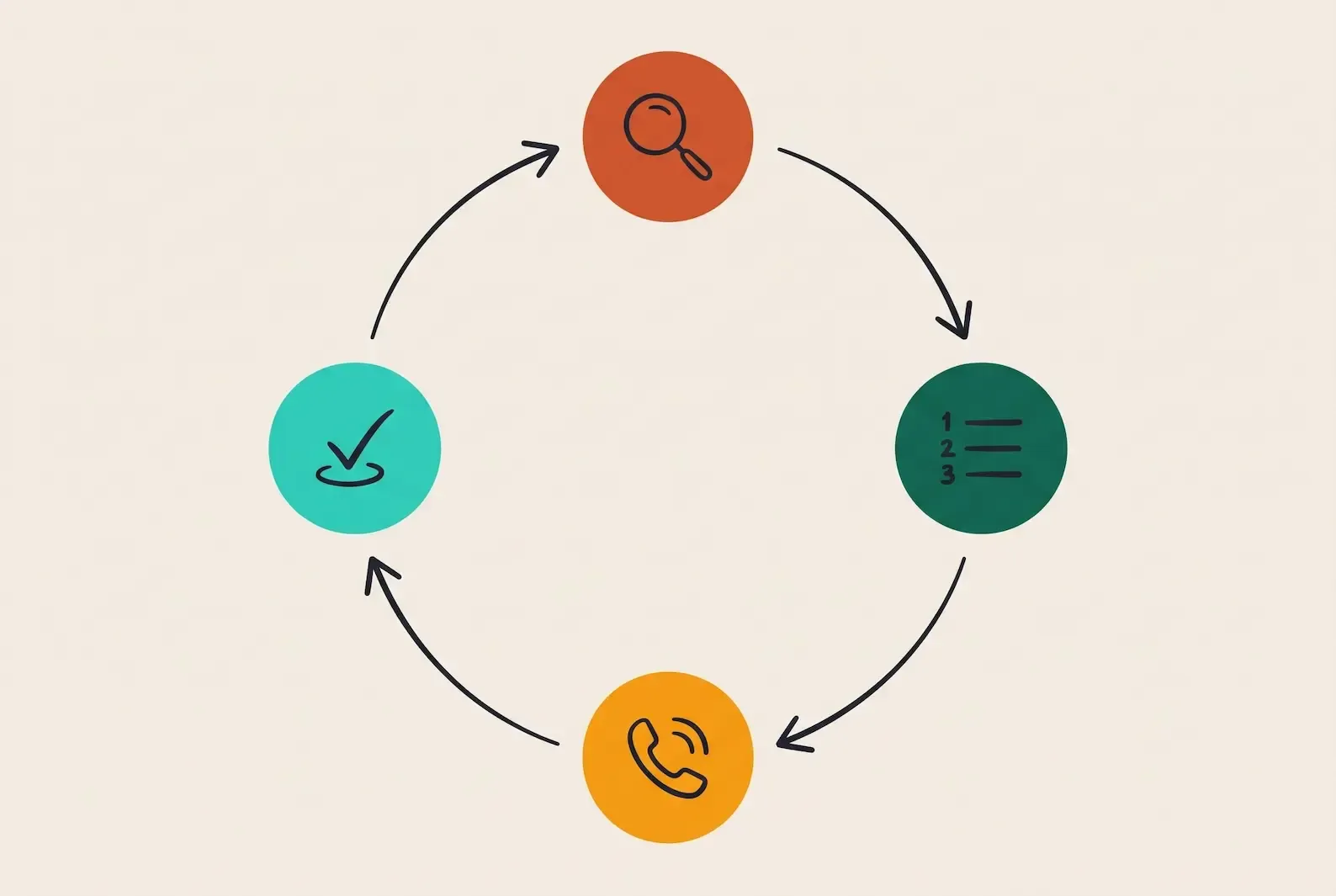
The Weekly BD Call List Cycle — at a glance
The Weekly BD Call List Cycle is structured around four operating windows in the week. Each stage has a defined input, output, and CRM action.
| Stage | Window | Input | Output | CRM action |
|---|---|---|---|---|
| 1. Monday signal scan + close-out | Monday morning | BD signal flow from last 7 days · pipeline status from last week | Updated pipeline view · raw list of 20-30 candidate BD touches | Close-out notes logged · last-week touches marked done |
| 2. Tuesday ranked call list | Tuesday morning | 20-30 raw candidate touches · BD Signals weighting · Perfect Memory history | Ranked top-10 BD touches for the week | Top-10 list written into the CRM week view |
| 3. Mid-week execution | Tue afternoon – Thu | Ranked top-10 list · prepared relationship context per touch | 8-12 BD touches completed (call, WhatsApp, LinkedIn, email, meeting) | Each touch logged with outcome, next step, signal observed |
| 4. Friday close-out | Friday morning | Week’s logged touches · client responses · new signals fired during week | Updated pipeline view · new mandates flagged · brief for next Monday | Friday review note logged · next week’s signal scan setup |
The Cycle is deliberately simple because the operational difficulty is not in naming the stages — it is in making the inputs available to the consultant at the right moment. The next four sections walk each stage in practical terms.
Stage 1 — Monday signal scan + close-out
Monday morning is when the Cycle starts. Two things happen in this window: the previous week is closed out, and the new week’s BD signal flow is scanned.
Close-out first. The senior recruiter opens the CRM and works through last week’s pipeline — every BD touch that happened, every response received, every change of state. The touches get logged. The responses get categorised (interested, not interested, ghost, schedule pending). The pipeline status fields update. By Monday end, last week’s BD activity is fully reflected in the system rather than half-remembered in the consultant’s head.
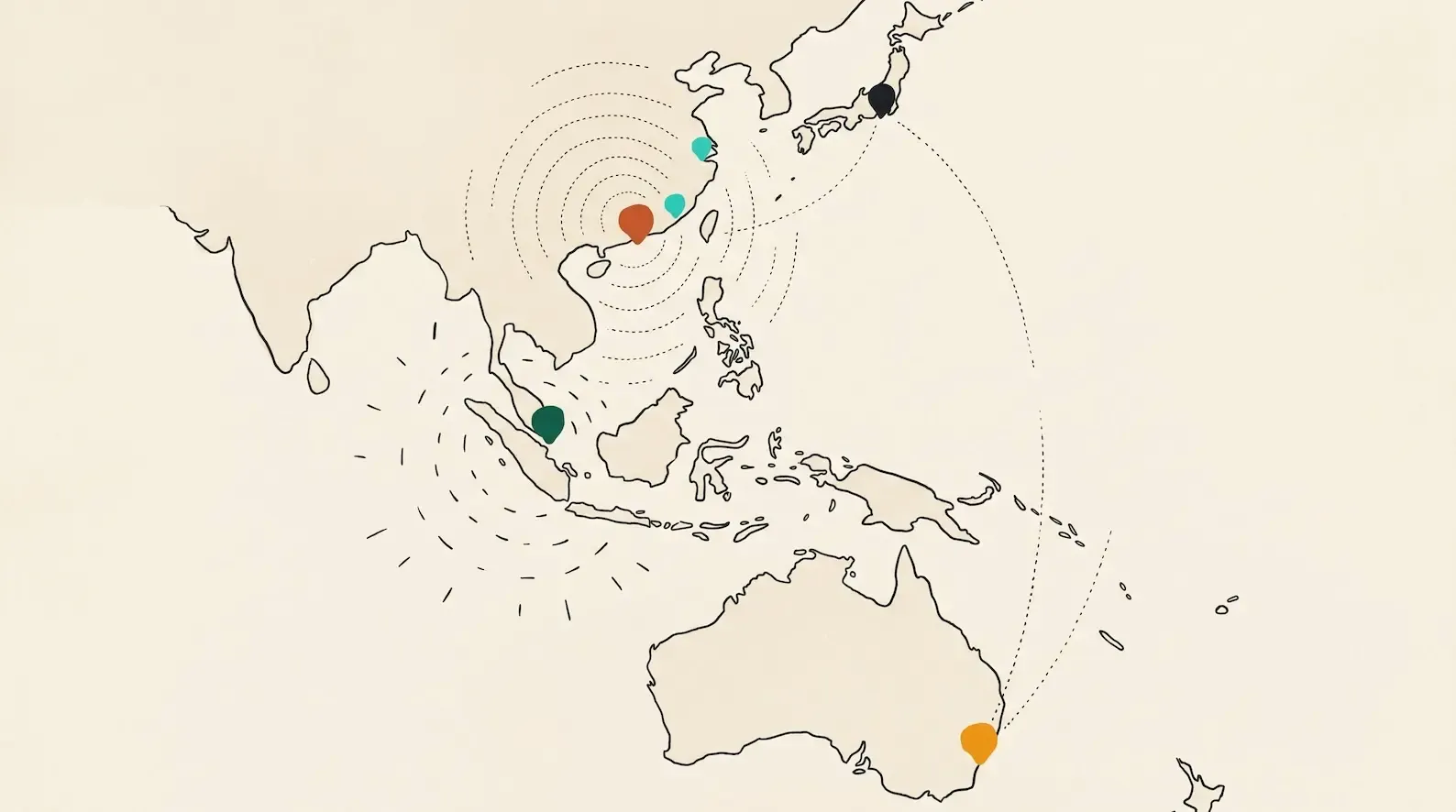
Signal scan second. With the pipeline closed-out, the consultant runs the BD signal scan over the last 7 days of BD Signals flow. The signals to scan against are market-specific — the Hiring Intent Signal Map catalogues them per APAC market: leadership change for Hong Kong finance, funding rounds and regional HQ buildouts for Singapore tech, SEEK clusters for Australia, cross-border headcount expansion for the Greater Bay Area. The scan produces 20-30 candidate BD touches — contacts the signal layer says are now in a different position than they were last week.
This is the input Stage 2 ranks against. The 20-30 candidates are not all going to make the week. The Monday scan is deliberately broad — let the signal layer surface everything that fired, then rank in Stage 2 against relationship history and capacity.
Bullhorn’s GRID 2024 finding that 61% of staffing firms say top performers proactively develop new client relationships while underperformers rely on inbound job orders Source: Bullhorn GRID, March 2024 is the Monday signal scan in a single statistic — the top performers run the proactive scan; the rest of the market reacts.
Stage 2 — Tuesday ranked call list (top 10)
Tuesday morning is when the ranked weekly call list is produced. The 20-30 candidates from Monday’s signal scan get cut to the top 10 BD touches the senior recruiter will actually run this week.
The ranking criteria are two-dimensional. Signal weight comes from BD Signals — a fresh leadership change at a tier-one bank that the agency has placed two senior people into in the last 18 months is a higher-weight signal than a generic LinkedIn job post at a company the agency has never worked with. Relationship strength comes from Perfect Memory — the contact who the agency has a five-year conversation history with is a higher-conversion BD touch than the contact who came in cold from a webinar last month.
The top-10 list sits in the CRM week view. Each entry has the contact, the trigger signal, the relationship summary, and the specific next action. A typical entry looks like: “Contact J. Tan, MD Investment Banking. Signal: new APAC head appointment fired Sunday. History: spoke 3x in 18 months, last placed VP Strategy at adjacent bank Q2 2025. Next action: WhatsApp re. the new appointment and team build-out implications, today.”
That is what the senior recruiter opens Tuesday morning. Not a blank planning page. Not a contact database to sort through. A ranked weekly call list with the relationship context already loaded.
What this changes is decision fatigue. Most BD inconsistency is not lack of intent — it is decision-fatigue caused by having to manually choose who to call on Monday morning every week. When the system surfaces the top 10 with the context, the decision is already made. The consultant’s job is the conversation, not the deciding.
Stage 3 — Mid-week execution
Tuesday afternoon through Thursday is the execution window. The ranked top-10 list gets worked.
Each BD touch is a structured action: a call, a WhatsApp message, a LinkedIn DM, a coffee meeting request, or an email. The channel choice follows the channel mix the desk runs — WhatsApp for senior local candidates, LinkedIn for international or formal contacts, email for documented continuation. A senior partner running a Hong Kong finance desk on a strong execution week completes 8-12 of the 10 ranked touches by Thursday end.
The CRM action per touch is the same regardless of channel: log the touch with a structured outcome, the next step, and any signal observed during the conversation. “Spoke with J. Tan re. APAC head appointment. He mentioned three senior roles likely in next 6 weeks. Action: prepare bench-side note on senior FX trading talent. Signal: new role at adjacent Asian bank for Tan’s prior #2 — worth flagging to BD Signals.”
This is where the Cycle proves itself against the SIA 2025 Lead Management Benchmark finding that 70% of recruitment and staffing firms follow up on fewer than half of inbound leads within 24 hours Source: SIA, June 2025. The 70% is not a discipline problem — it is a routing problem. With the Tuesday list defined and the mid-week window allocated to running it, the consistent follow-up window happens by structure rather than by remembering.
What this changes at the partner level is week-on-week predictability. The partner running three concurrent mandates doesn’t have to remember which 10 BD calls were the right ones this week — the list told them. The partner just runs the list.
Stage 4 — Friday close-out + pipeline update
Friday morning closes the week. The senior recruiter works through the week’s logged touches, updates the pipeline view, flags any new mandates that emerged from the BD activity, and writes the close-out brief for next Monday.
What the close-out brief contains is the handover to next week’s signal scan. Which contacts moved? Which signals fired during the week? Which BD touches converted into a mandate brief and which didn’t? Which contacts need follow-up next week (and at what cadence)? The Friday brief is not a report for management — it is the system note for the consultant’s own Monday morning.
The pipeline update is the data layer underneath. Every touch that produced a structured outcome in Stage 3 flows into the pipeline view. Mandates that emerged from the week get created. Touches that produced no response are tagged for the appropriate next-week cadence — Tuesday re-touch, two-week follow-up, deprioritise.
Lighthouse Research’s 2024 study on sales activity in staffing found that 63% of recruiters say they do not consistently track BD activity against weekly targets in their CRM Source: Lighthouse Research & Advisory, October 2024. The Friday close-out is the structural answer to that gap — it converts a week of BD touches into a weekly metric that is logged, traceable, and coachable.
By Friday end, last week is fully reflected in the system. Monday morning starts on a clean signal scan rather than on a recovery exercise.
How BD Signals and Perfect Memory make the Cycle credible
The Weekly BD Call List Cycle is operationally credible only if two underlying systems do their job. BD Signals has to surface the signals worth scanning. Perfect Memory has to load the relationship history per contact when the ranked list is built.
BD Signals reads market activity — leadership changes, funding rounds, headcount growth, regional HQ buildouts, SEEK clusters, MAS announcements — and weights each signal by the desk’s actual conversion history. A Hong Kong finance desk’s BD Signals layer weights executive appointment news at a tier-one bank materially higher than a generic SEEK job-ad spike. The desk that has converted on Series B funding signals five times in the last quarter sees Series B announcements ranked higher than the desk that has never converted on one. The signal layer learns from outcomes.
Perfect Memory is the relationship layer. Every prior conversation across every channel — calls, email, WhatsApp, WeChat, voice notes, meetings — feeds the single record per contact. When the Tuesday ranking step pulls the top 10 BD touches, the relationship history is already attached. The consultant doesn’t manually look up what was said to J. Tan two years ago — the system surfaces the relevant prior context alongside the signal.
This is also the architectural connection to Signal-Timed Outbound. The Weekly BD Call List Cycle is Signal-Timed Outbound run on the BD side rather than the recruitment-marketing side. Same three inputs — relationship history, signal trigger, market-fit message — applied to the BD partner’s weekly cadence rather than the marketing function’s outbound programme. Same architecture, different operating window.
McKinsey’s 2023 B2B sales research found that organisations with formal, documented sales processes see 18% higher revenue growth than those running informal or ad-hoc processes Source: McKinsey, June 2023. The Weekly BD Call List Cycle is the formal process — but the formality lives in the system, not in extra discipline imposed on the consultant.
The compound effect — predictable BD output rather than consultant memory
The compound effect of running BD on the Weekly BD Call List Cycle is that the agency stops betting on consultant memory and starts producing a predictable BD output rate.
Today, most agencies report BD activity as a function of how busy the consultant felt that week. A strong week produces 15 BD touches; a stretched delivery week produces 2. Over a quarter, the average lands somewhere between 5 and 8 weekly touches per consultant. The average obscures the variance — the weeks of 15 are the source of most mandates that close in the quarter, and the weeks of 2 are the source of next quarter’s BD gap.
When the Cycle runs, the variance collapses. The Tuesday list is 10. The Wednesday-Thursday execution window completes 8-12. The Friday close-out logs the week. The next Monday signal scan starts from a clean state. The quarter’s BD output ceases to be a function of consultant mood and becomes a function of system architecture.
ManpowerGroup’s APAC Employment Outlook for Q2 2025 reported a +30% net hiring intention, up three points year-on-year Source: ManpowerGroup, March 2025. In a strengthening hiring environment, the agency that runs predictable BD output captures structurally more of the demand than the agency that runs ad-hoc reach-outs. The compound effect over four quarters is the difference between a BD function that the partner runs and a BD function that the system runs with the partner.
Signals is built so the Weekly BD Call List Cycle is the operating default — not a discipline the consultant has to impose every Monday morning, but a rhythm the CRM tracks. BD Signals at the trigger layer, Perfect Memory at the relationship layer, the ranked top-10 surfaced on Tuesday, the Friday close-out logged structurally. The partner brings the conversation. The system brings the list.
Run a weekly BD call list on signal flow
See Signals on a recruitment desk like yours.
Common questions
Senior recruiters run a weekly BD call list as a defined five-stage cycle, not as ad-hoc Monday-morning reach-outs. The Weekly BD Call List Cycle is the framework: Monday signal scan plus close-out from last week, Tuesday ranked call list of the top 10 BD touches by signal weight and relationship strength, mid-week execution (Tuesday afternoon through Thursday), and Friday close-out plus pipeline update. Each stage has a defined input, output, and CRM action. The system surfaces the ranked top-10 list, and the consultant runs the conversations.
The Weekly BD Call List Cycle is a Signals-coined five-stage operating rhythm for senior recruiter BD. Stage 1 (Monday signal scan + close-out) closes out last week's pipeline and scans the new week's BD signal flow, producing 20-30 candidate touches. Stage 2 (Tuesday ranked call list) cuts the 20-30 to the top 10 BD touches ranked by signal weight and relationship strength. Stage 3 (mid-week execution) runs the top 10 through the appropriate channels: call, WhatsApp, LinkedIn, email, meeting. Stage 4 (Friday close-out) logs the week's touches and prepares the close-out brief for next Monday's scan.
BD Signals reads market activity over the last 7 days, covering leadership changes, funding round announcements, headcount growth signals, regional HQ buildouts, SEEK clusters, and MAS announcements, then weights each signal by the desk's actual conversion history. The Monday signal scan pulls everything that fired in the previous week and presents it as a 20-30 candidate touch list, with the relationship history attached per contact via Perfect Memory. The signals are market-specific: the Hiring Intent Signal Map catalogues which signals predict mandates in which APAC market.
The Tuesday ranked call list is the top 10 BD touches for the week, written into the CRM week view. Each entry contains the contact, the trigger signal that fired, the relationship summary from Perfect Memory, and the specific next action with channel choice. A typical entry: 'Contact J. Tan, MD Investment Banking. Signal: new APAC head appointment fired Sunday. History: spoke 3x in 18 months, last placed VP Strategy at adjacent bank Q2 2025. Next action: WhatsApp re. the new appointment and team build-out implications, today.' That is what the senior recruiter opens Tuesday morning, not a blank planning page.
Most agency BD programmes lack consistency because the underlying system is built to record what consultants type in, not to produce a ranked weekly action list. The CRM holds everyone the agency has ever talked to organised by status fields, but the senior recruiter on Monday morning has to manually decide who to call from that database. Decision fatigue plus delivery pressure means BD gets postponed. SIA's 2025 research found 57% of recruitment business owners say their team's BD calling is inconsistent week to week, and 41% say BD time is the first thing sacrificed when delivery pressure rises. The Weekly BD Call List Cycle fixes this by surfacing the ranked top-10 before the consultant has to decide anything.