Why hiring intent signals don’t translate across APAC markets
Most published guides on hiring intent signals treat them as a uniform global set — funding rounds, leadership changes, job-ad spikes, headcount growth — that work the same way in every market. They do not. On an APAC desk, the signal mix is structurally different. The hiring intent signals that predict mandates in Hong Kong are not the ones that predict them in Singapore, and neither matches the indicators an Australian or Japanese desk reads first. Running an APAC operation on a US/UK signal taxonomy is reading the wrong indicators. This article defines the Hiring Intent Signal Map — a market-by-market taxonomy of the BD signals that actually predict mandates in each APAC market — and shows what an agency loses by running a single global signal model.
BD signals are observable data points that indicate a client is moving toward a hire — funding announcements, leadership changes, job-ad clusters, headcount growth, technology adoption — typically appearing two to four weeks before any job goes live. Hiring intent signals are the predictive subset of that category: the ones the data shows actually correlate with mandate opportunity for a recruitment agency.
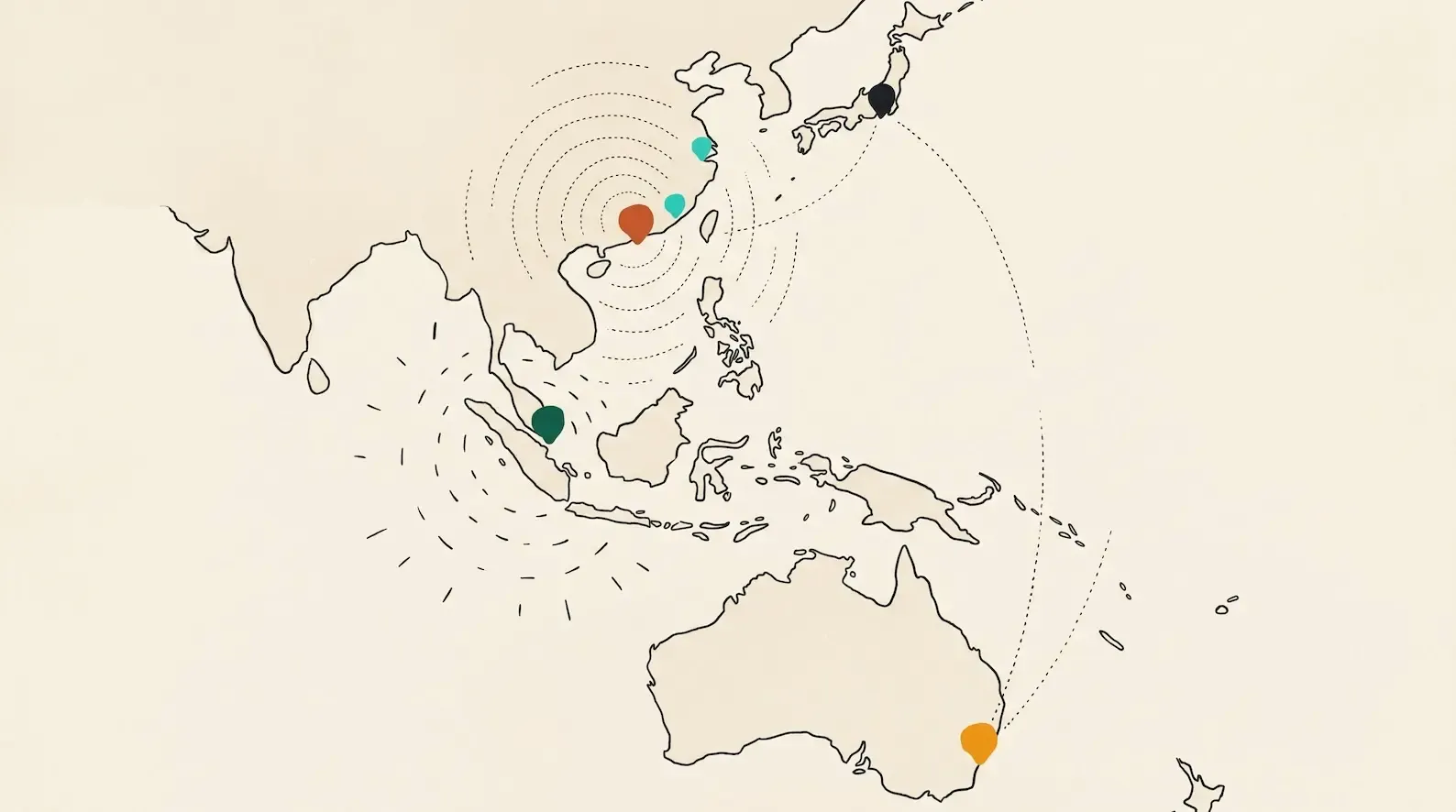
The reason these signals do not translate cleanly across APAC markets is structural. Three things differ market to market. The first is channel mix: Australia runs on SEEK; Hong Kong and Singapore on a blend of LinkedIn, WhatsApp, and local channels; Japan on smaller domestic job boards plus discrete executive search; the Greater Bay Area on WeChat and Maimai. A signal model that monitors LinkedIn job posts as the primary indicator misses most of the Australian market and most of the Japanese. The second is sector concentration: Hong Kong’s senior market is heavily finance-led; Singapore is tech-led and a regional HQ hub; Australia skews professional services, mining, and engineering; Japan concentrates in legacy enterprise. The third is hiring rhythm: Japan’s senior demand concentrates in the first quarter of the fiscal year; Hong Kong pulses around finance bonus cycles; Singapore weights to Q2 tech funding rhythm.
ManpowerGroup’s APAC Employment Outlook for Q2 2025 registered a net hiring intention of 30%, up 3 points year-on-year Source: ManpowerGroup, March 2025. In a market where demand is rising, the cost of running the wrong signal model rises with it.
The Hiring Intent Signal Map — a market-by-market framework
The Hiring Intent Signal Map is a market-by-market taxonomy of the BD signals that most reliably predict mandate opportunity in each APAC market. It sits as a sub-framework under the BD Signals pillar — the BD Signals layer detects signals; the Map defines which signals to weight where. As an exercise in APAC recruitment market mapping, the Map’s job is to make the signal stack explicit so the CRM can rank correctly rather than apply a single default.
The Map is structured around five APAC layers, each with a dominant signal stack:
| Market | Dominant signals | Secondary signals | Hiring rhythm |
|---|---|---|---|
| Hong Kong | Finance and banking leadership change · Executive appointments | Bonus-season post-cycle moves · Family-office expansion | Finance bonus cycle · Pause around Chinese New Year |
| Singapore | Tech funding rounds · Regional HQ buildouts | Government grant disbursements · Cross-border expansion announcements | Western calendar · Q2 tech weighting |
| Australia | SEEK job-ad clusters · LinkedIn headcount growth | Contract role spikes · Mining and resources project announcements | Mixed calendar · End-of-financial-year (June) effects |
| Japan | Early-year senior search activity · Domestic job-board movement | C-suite changes at legacy enterprises · Discrete executive search briefs | Q1 of fiscal year (April–June) concentration |
| Greater Bay Area | Cross-border headcount expansion · Bilingual leadership moves | WeChat and Maimai signal activity · Regional cluster sub-market moves | Multi-calendar (mainland and HK overlap) |
The point of the table is not just descriptive. It is operational. A consultant running a Hong Kong finance desk should be weighting executive-appointment news materially higher than the same desk would weight a generic SEEK job-ad spike. An Australian contract recruiter should be reading SEEK cluster data continuously rather than waiting for LinkedIn announcements. A Singapore tech BD lead should set up signal flow around regional HQ filings and funding rounds, not a generic global feed.
The next four sections walk through each market layer in turn.

Hong Kong: finance leadership change and executive appointments
Hong Kong’s senior recruitment market is finance and banking heavy. Investment banking, asset management, hedge funds, family offices, and the professional services that wrap around them dominate the senior end of the talent market. The dominant BD signals for Hong Kong recruitment track that sector concentration.
The strongest predictor is executive appointment news. A new CFO at a tier-one bank, a new APAC head at an asset manager, a new managing partner at a family office — each appointment generates a recognisable wake of senior searches over the following six to eighteen months. The new executive needs lieutenants. The departing executive’s team often follows them to a new firm. A Hong Kong finance desk that watches executive appointments closely runs months ahead of agencies reading only published job posts.
The second signal is bonus-season movement. Hong Kong finance hiring follows a distinctive cycle: bonuses pay in Q1 of the calendar year, and senior moves concentrate in the weeks immediately after. Funds announce restructures; senior managing directors signal interest in moving; family offices recruit aggressively. A signal model that watches Q1 movement patterns picks up an annual surge that does not appear in Western markets.
The third is family-office expansion. Hong Kong has become a primary hub for ultra-high-net-worth family offices managing capital across Greater China and Southeast Asia. New family-office registrations, hires of investment principals, and CFO appointments in private-investment vehicles are signals most generic CRMs do not track at all — but for a Hong Kong desk specialised in that segment, they are the highest-conversion BD prompts available.
The pattern that defines the Hong Kong layer of the Map is that the strongest signals are leadership-led rather than role-led. The CRM that watches executive appointment news first, and only then watches the job postings that follow, is reading Hong Kong in the right order.
Singapore: tech funding rounds and regional HQ buildouts
Singapore is a different sector concentration with a different signal stack. The dominant industries are technology, financial services, professional services, and an emerging cluster of regional headquarter offices for global companies running APAC from the city. The signal mix reflects all three, and hiring intent for Singapore agencies is concentrated in capital and HQ flow rather than role flow.
The strongest signal on a Singapore desk is the tech funding round. The LinkedIn Economic Graph’s APAC analysis describes foreign-company hiring as growing faster in APAC than in either Europe or the US, with Singapore acting as the regional HQ hub for many of those expansions Source: LinkedIn Economic Graph, 2024. For a Singapore tech BD desk, a Series B funding round at a Southeast Asian SaaS company predicts mandates for VP Engineering, Head of Sales, and APAC GM hires within two to four weeks. A Series C predicts the same plus a CFO. A US-led tech company opening a Singapore regional HQ predicts an entire leadership team’s worth of mandates inside eight weeks.
The second signal is regional HQ buildout. Companies announcing that they are establishing or expanding their APAC headquarters in Singapore generate a predictable hiring wave that runs for months. The Economic Development Board publishes some of this; LinkedIn carries the rest in the form of new-office posts and senior-hire announcements. By the time the role appears on a job board, the search is well underway.
The third is government and grant signal flow. Singapore’s regulatory and incentive environment generates signals other APAC markets do not have. Major MAS announcements, Enterprise Singapore grant rounds, and government-linked sector pushes all precede hiring waves in the affected industries. An agency reading these inputs is operating with a lead the SEEK-and-LinkedIn signal model does not pick up.
The Singapore layer of the Map is about reading the city as a regional hub rather than a national market. The signals fire when capital and HQ activity move; the mandates follow.
Australia: SEEK job-ad clusters and LinkedIn headcount growth
Australia’s recruitment market is structurally different from Hong Kong and Singapore in one critical respect: it has a dominant local job board that runs much of the hiring economy. SEEK is the primary platform for posting, sourcing, and tracking job activity, and any signal model that monitors LinkedIn but not SEEK is reading the Australian market on partial data.
The strongest signal on an Australian desk is the SEEK job-ad cluster. A single new job post is noise; a cluster of three or four related roles posted by the same employer in the same week is a signal — it indicates active hiring budget, an internal restructure or expansion, and a willingness to pay agency fees if the in-house attempt does not move quickly enough. Australian recruiters who run SEEK cluster monitoring as the first BD input arrive earlier than agencies waiting for the next inbound from a client they know.
The second signal is LinkedIn headcount growth. Companies announcing significant headcount expansion via LinkedIn — new offices, new APAC operations, ramped product teams — generate predictable secondary mandates for senior hires, BD heads, and team leads who follow the wave. The APAC HR Outlook 2026 survey reports that adoption of AI-driven HR systems grew 21% year-on-year across the region, with Singapore, South Korea, Malaysia, and Australia leading the trend Source: APAC HR Outlook 2026, APMI Partners, December 2025 — Australian clients are running their own data layer, so an agency arriving with surface-level signals reads as less informed than the client.
The third is the end-of-financial-year effect. Australia’s June year-end generates a recognisable hiring pulse in May–July as departmental budgets confirm and headcount plans crystallise. A signal model that ignores the seasonal pattern misses the predictable Q2 burst that drives a meaningful share of permanent placements.
The Australian layer of the Map is about reading SEEK as a primary signal source rather than as a publishing platform — and treating it as the recruiter intent data layer it functions as in practice.
Japan and the Greater Bay Area: early-year cycles and cross-border moves
The last two layers cover markets where the signal mix is most distinct from US/UK norms.
Japan. Japanese senior search demand is concentrated in the first quarter of the country’s fiscal year — April through June. Companies finalise leadership plans in February and March, with senior briefs landing with executive search firms shortly after. A signal model running a uniform monthly cadence misses this concentration entirely. The dominant signals are domestic — BizReach activity at senior bands, Doda movement in mid-senior layers, discrete executive search briefs that circulate through trusted intermediaries before any public posting. The APMI Partners research notes that AI-driven HR adoption is rising across the region but more slowly in Japan than in Singapore or Australia Source: APMI Partners, December 2025 — meaning Japanese signals remain more relationship-mediated and less digitally visible than elsewhere in APAC. An agency reading Japan correctly weights relationship intelligence at least as heavily as data signal flow.
Greater Bay Area. The GBA — Hong Kong, Macau, and nine mainland cities including Shenzhen, Guangzhou, and Foshan — generates a signal pattern none of the single-market layers above capture. The dominant signal is cross-border headcount expansion: a mainland Chinese company opening a Hong Kong office, a Hong Kong financial services firm building a Shenzhen tech arm, a multinational shifting operations between Guangzhou and Hong Kong. Each generates a wave of bilingual leadership mandates — Mandarin and English, with Cantonese often required. The companion signal is bilingual leadership moves themselves: when a senior executive moves between mainland and Hong Kong roles, their next several hires often replicate the bilingual profile.
GBA signals are also concentrated on different channels. WeChat and Maimai carry the early intelligence; mainland Chinese business news platforms publish the formal expansion announcements; LinkedIn surfaces only the international layer. A signal model that watches only LinkedIn reads GBA at half-coverage. Asia-Pacific staffing and recruitment market data values the regional opportunity at US$158.1 billion in 2023, projected to US$444.8 billion by 2031 Source: Business Market Insights, February 2025 — with China dominating regional share. The GBA layer of the Map is what an agency uses to participate in that growth from a Hong Kong base.
How an AI-native CRM reads the Map
The Hiring Intent Signal Map is a specification. It tells you which signals to weight in each market. The execution layer is the recruitment CRM — and most legacy CRMs cannot read the Map even if you hand it to them. What a CRM has to do differently to read it is the subject of a CRM built for APAC; this section is the short version.
There are three reasons. First, legacy CRMs run a single global signal model — usually a US/UK default that overweights LinkedIn job posts and underweights local channels. Second, they do not capture the conversation layer where APAC signals first appear — WhatsApp, WeChat, voice notes, in-person meetings. Third, they do not learn from desk history; the same signal type that fired five mandates last quarter on a Hong Kong finance desk gets ranked identically on a Singapore tech desk that has never converted on it.
An AI-native CRM solves all three at the architecture level. BD Signals ingests market-specific signal sources and weights them per market — finance leadership news prioritised for Hong Kong, funding wires and HQ filings prioritised for Singapore, SEEK cluster data prioritised for Australia. Perfect Memory captures every conversation across every channel, so the early-stage exchange that often precedes a GBA or Hong Kong mandate actually reaches the system. The combination — captured conversation history plus market-specific signal ranking — is what lets the CRM read each desk’s signal stack rather than apply a global template.
What this changes operationally is the BD prompt. A consultant on a Hong Kong finance desk opens the CRM in the morning and sees the executive appointments fired overnight, ranked by historical conversion against that desk’s prior mandates. A Singapore tech consultant sees the Series B and HQ buildout signals. An Australian contract recruiter sees the SEEK clusters. None of the three sees a generic global feed they have to filter manually.
For an APAC desk, the Hiring Intent Signal Map is the BD specification. The CRM is the layer that reads it. The agency that runs the same global model across all five APAC layers is reading the wrong indicators on four of them — and the cost compounds with the regional opportunity. Signals is built so the CRM reads each desk’s specification by design: BD Signals weighted per market, Perfect Memory holding the conversation layer where APAC signals first appear, and the agency operating with the local signal stack rather than a global default.
See BD Signals ranked by APAC market
See Signals on a recruitment desk like yours.
Common questions
The hiring intent signals that matter most for APAC recruitment agencies vary by market. Hong Kong desks rely on finance and banking leadership change as the dominant signal; Singapore desks weight tech funding rounds and regional HQ buildouts highest; Australia desks read SEEK job-ad clusters and LinkedIn headcount growth; Japan desks watch early-year senior search activity; Greater Bay Area desks track cross-border headcount expansion and bilingual leadership moves. The Hiring Intent Signal Map catalogs which signals predict mandates in each market.
The Hiring Intent Signal Map is a market-by-market taxonomy of the hiring intent signals that most reliably predict mandate opportunity in each APAC market. It is a sub-framework under the BD Signals pillar, designed for recruitment agencies running APAC desks where signal mixes differ structurally by geography. A US/UK signal taxonomy reads the wrong indicators on an APAC desk; the Map gives each desk the signal stack it actually depends on.
Hiring intent signals don't translate across APAC markets because the channel mix, sector concentration, and hiring rhythm are structurally different in each. Hong Kong's executive search market is finance-heavy with leadership-change-driven signals; Singapore is a regional tech hub where funding rounds and HQ buildouts dominate; Australia's market runs on SEEK and LinkedIn rather than US-style job boards; Japan's hiring cycle is concentrated in the first quarter of the fiscal year. A single global signal model overweights generic indicators and misses the ones that fire first in each market.
An agency running a single global signal model loses the lead time that comes from reading the right indicators first. Bullhorn's 2025 Talent Trends research finds only 35% of candidates approach recruitment agencies first [Source: Bullhorn GRID Talent Trends, November 2025](https://www.bullhorn.com/grid/2025-talent-trends/). Agencies are already disadvantaged on the candidate side, and they compound the issue by arriving late on the client side when their signal model is mis-tuned for the market.
Signals ranks hiring intent signals by APAC market through BD Signals, the product pillar that reads each market's signal stack rather than a single global model. The architecture depends on Perfect Memory underneath: every captured conversation, every observed signal, every prior mandate outcome is preserved against the desk so the ranking improves as the agency's history accumulates. The Hiring Intent Signal Map is the market-by-market specification that layer reads from.