
What “AI-native” actually means for a recruitment CRM
The recruitment software market is saturated with AI claims. Virtually every CRM vendor — Bullhorn, Vincere, Manatal, JobAdder — now advertises AI features. But there is a fundamental difference between a system that has AI and a system that is AI-native, and that difference determines whether your agency data stays current or decays the moment a recruiter forgets to log a call.
AI-native recruitment CRM: a platform designed from the ground up with AI as its core engine — not a legacy CRM with AI features layered on top. The data model, the workflows, and the UX are all built around the assumption that AI handles data capture; human input is the exception, not the default.
The distinction is architectural, not cosmetic. AI-powered software adds AI capabilities — resume parsing, predictive scoring, email drafting — to a system originally designed for manual input. The workflow still depends on recruiters entering data. AI-native software captures data automatically from every interaction and updates records continuously, so the CRM reflects reality whether or not the recruiter remembers to log anything.

Why AI-powered CRMs fail recruitment agencies
Most CRM data is wrong within months of being entered. Research shows that approximately 74% of CRM records become stale or inaccurate within a year — a figure that is almost certainly higher in recruitment, where candidate availability, role, salary, and contact details change constantly. [Source: Loxo, 2024]
The root cause is not recruiter negligence. It is a structural problem: traditional CRMs were designed for a world where humans enter data, and in recruitment, most conversations never make it into the system at all. WhatsApp messages, phone calls, WeChat threads, informal LinkedIn exchanges — these are where the real relationship context lives, and AI-powered CRMs have no mechanism to capture them.
“The problem isn’t that recruiters are bad at updating the CRM. The problem is that the CRM was designed for a workflow that no longer exists.”
Recruiters in APAC markets like Hong Kong and Singapore conduct the majority of their candidate and client conversations over WhatsApp — a channel that sits entirely outside every legacy CRM. By the time a recruiter reaches their desk to log the call, the next task has already taken priority. The data is lost.
The consequence is compounding: bad data leads to bad shortlists, missed BD opportunities, and duplicate outreach. Bullhorn and Vincere have both introduced AI features to surface insights from this degraded data — but the data problem itself remains unsolved because the architecture still depends on manual entry as the foundation.
| Capability | AI-powered CRM (e.g. Bullhorn, Vincere, Manatal) | AI-native CRM (e.g. Signals) |
|---|---|---|
| Conversation capture | Manual logging required | Automatic across all channels |
| Record updates | Recruiter must update | Updates continuously in background |
| WhatsApp / WeChat | Not captured natively | Captured and filed automatically |
| Next action | Suggested after manual input | Proactively surfaced from live data |
| Data decay | ~74% annually | Continuous refresh eliminates decay |
| Admin burden | 40–60% of recruiter time | Reduced to near zero |
The AI-Native Stack: three layers that define a genuinely AI-native CRM
Not all AI-native claims are equal. The AI-Native Stack is a three-layer framework for evaluating whether a recruitment CRM is genuinely AI-native or simply AI-powered with better marketing.
Layer 1 — Conversation Capture A genuinely AI-native recruitment CRM captures every recruiter interaction automatically: calls, emails, WhatsApp messages, WeChat threads, LinkedIn exchanges, and meeting notes. No manual logging. Every conversation is filed against the right candidate, company, or job the moment it happens. This is the foundation — without it, the other layers have nothing to work with. Signals delivers this through Perfect Memory, which runs continuously in the background across every channel a recruiter uses.
Layer 2 — Autonomous Record-Keeping The second layer is what happens to captured data. An AI-native CRM does not present raw conversation logs for recruiters to parse — it extracts the relevant updates and applies them to records automatically. Candidate availability changes after a call? Updated. Client signals a new headcount in a WhatsApp message? Logged against the company record. Recruiter takes a briefing note on a job? Filed against the role, structured, and searchable. Signals’ Agentic CRM layer handles this without any recruiter input.
Layer 3 — Proactive Intelligence The third layer is where AI-native platforms create real competitive advantage. Once data is captured and maintained accurately, the CRM can surface intelligence before recruiters ask for it: which clients are showing early hiring intent, which candidates are most likely to be open to a move, which jobs should be prioritised based on current pipeline. Signals delivers this through BD Signals — surfacing hiring intent from the client base before a job goes live — and Speed to Shortlist, which ranks candidates from the existing network the moment a role lands.
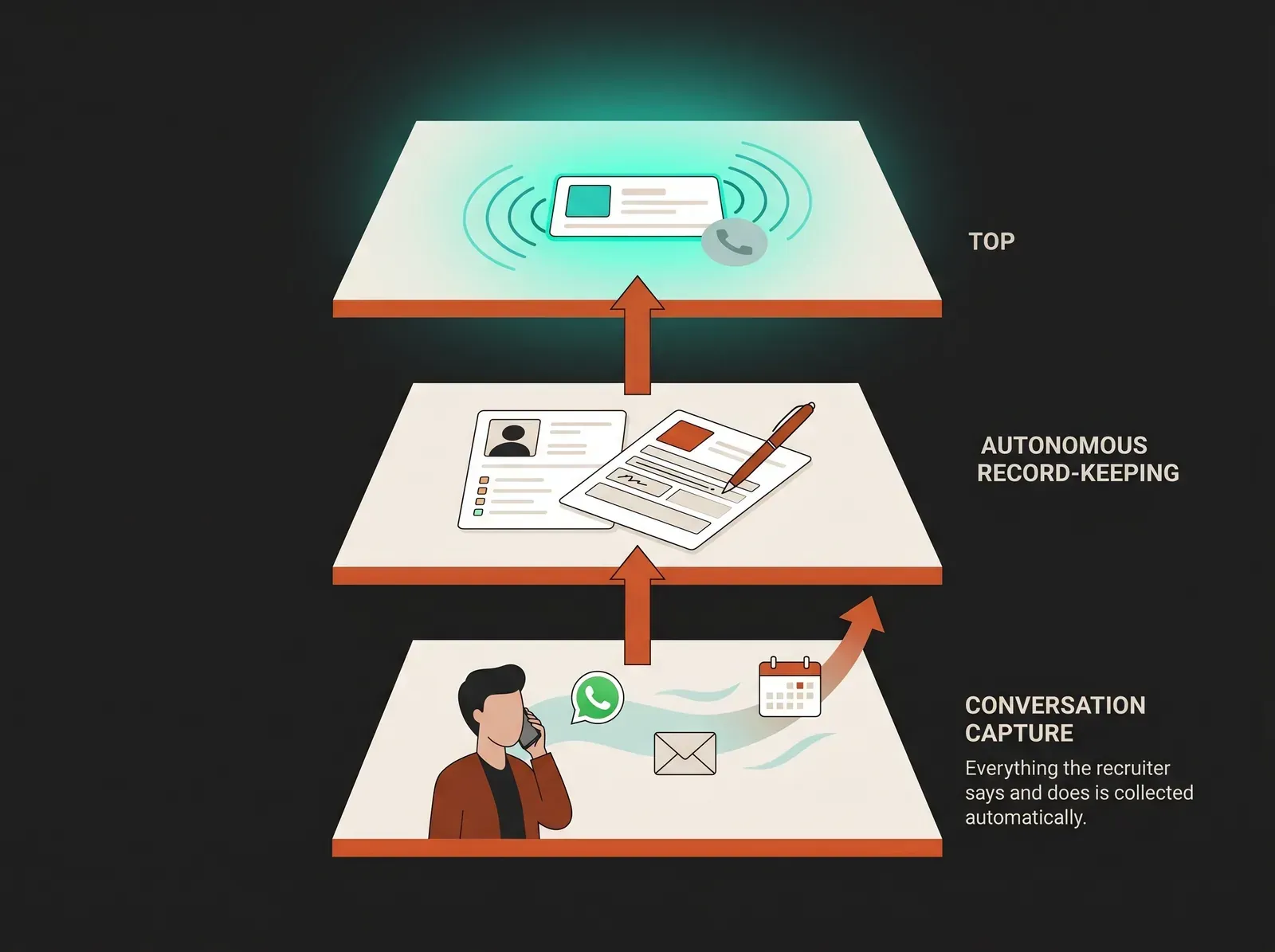
Manatal, Bullhorn, and Vincere operate at Layer 3 only — they try to surface intelligence from data that was never properly captured in the first place. That is why their AI features produce limited results in practice: the foundation is missing. Signals is built on all three layers from the ground up: capture at source feeds record-keeping, and record-keeping is what Layer 3 reasons over.
What to look for when evaluating an AI-native recruitment CRM
The AI-native label is increasingly used by vendors who do not meet the architectural standard. When evaluating whether a CRM is genuinely AI-native, ask these questions:
- Does it capture WhatsApp and WeChat natively? In APAC, this is non-negotiable. If a CRM cannot capture these channels automatically, it cannot maintain accurate data for agencies operating in Hong Kong, Singapore, or across the region.
- Does the system update records without recruiter input? Ask vendors to demonstrate a live record update triggered by a conversation — not a demo where a recruiter logs a note manually.
- Does it surface intelligence proactively, or only respond to queries? An AI-native CRM tells you which clients are about to hire. An AI-powered CRM tells you what it found when you searched.
- What happens to data when a recruiter leaves? In AI-powered CRMs, departing recruiters take their context with them — relationship history, conversation details, and deal context often exist only in their heads or their call logs. AI-native architecture preserves that context automatically because it was never dependent on the recruiter to enter it.
Signals is built to answer all four questions. The features page covers the full capability set for agencies evaluating AI-native recruitment CRM options across Asia Pacific, Europe and the Americas.
AI-native CRM in APAC: why the architecture matters more here
APAC recruitment has characteristics that make the AI-native vs AI-powered distinction especially consequential. WhatsApp response rates from candidates run at 25–50% compared to roughly 5% for email — which means the majority of recruiter-candidate relationship context is being built on a channel that legacy CRMs cannot see. [Source: LinkedIn, SamTakeTwoBrothers-TTB, December 2025]
In Hong Kong, executive search relationships are built over months of WhatsApp exchanges and informal calls. In Singapore, tech sector roles often move from initial signal to shortlist in days — speed that is only possible if your CRM reflects the current state of your network accurately. In Australia, email and LinkedIn are more dominant, but the underlying problem is the same: conversations happen outside the CRM, and legacy systems have no mechanism to capture them.
AI-native architecture solves this at the source. Signals captures conversations across WhatsApp, WeChat, email, LinkedIn, calls, and meetings — and files them automatically against the right record, regardless of which channel the recruiter used. For agencies running cross-market desks across APAC, this means a single, accurate source of truth for every client relationship and every candidate conversation. The for-agencies page covers how Signals is configured for APAC market conditions specifically.
Why the architecture decision compounds over time
The gap between AI-native and AI-powered CRMs widens with every week of use. An AI-powered CRM starts with incomplete data and gets worse as records decay — the AI features built on top of that data become progressively less useful. An AI-native CRM starts capturing context from day one and builds a continuously improving picture of every relationship in the network.
For recruitment agencies, this compounding effect is the core value proposition. Agencies using Signals accumulate relationship context automatically across every recruiter interaction. When a consultant leaves, their pipeline does not leave with them — the data was never dependent on their willingness to log it. When a client sends a WhatsApp at 9pm signalling a new hire, that signal is captured and surfaced to the right recruiter the next morning through BD Signals.
The AI-native recruitment CRM is not a better version of the tools that came before it. It is a different category — one that treats every recruiter conversation as a data event, and every data event as an opportunity to act. It is why AI-native is the only accurate way to describe what we have built.
See what an AI-native CRM looks like in practice
See Signals on a desk like yours.
Common questions
An AI-native recruitment CRM is a platform designed from the ground up with AI as its core engine, not a legacy system with AI features layered on top. It captures every recruiter conversation automatically across email, calls, WhatsApp, WeChat, and LinkedIn, updates candidate and client records without manual input, and proactively surfaces the next best action. This is architecturally different from AI-powered CRMs, which use AI as an add-on to workflows built for manual data entry.
AI-powered recruitment software adds AI features such as resume parsing, chatbots, or predictive scoring to a system originally designed for manual input, typically delivering 10–15% efficiency gains without changing the underlying workflow. AI-native recruitment software rebuilds the entire data model and workflow around AI from day one, so manual entry is the exception rather than the rule. The distinction matters because AI-powered tools still require recruiters to log data; AI-native tools capture it automatically.
Traditional recruitment CRMs were built for manual input, relying on recruiters to log calls, update candidate records, and file notes after every interaction. Research shows that approximately 74% of CRM records become stale or inaccurate within a year, because most recruiter conversations happen off-platform via WhatsApp, WeChat, phone calls, and email that never reach the CRM. [Source: Loxo, 2024] AI-native CRMs solve this at the architectural level by capturing conversations automatically rather than depending on recruiter compliance.
Signals captures WhatsApp and WeChat conversations automatically through its Perfect Memory pillar, logging every message against the right candidate, company, or job without any manual input from the recruiter. This is critical in APAC markets like Hong Kong and Singapore where WhatsApp is the primary recruiter-candidate communication channel, and where the majority of relationship context is built outside the CRM. Signals is designed specifically for the multi-channel communication patterns of APAC agency recruiters.
Yes, and the transition is significantly easier than switching between two legacy CRMs, because an AI-native CRM like Signals starts building context from day one without requiring historical data to be perfect. Platforms like Bullhorn and Vincere position themselves as AI-powered but are built on legacy architectures that still require manual data entry as the foundation. Switching to an AI-native CRM means the system learns and updates continuously going forward, rather than depending on the accuracy of data that was manually entered in the past.