What “agentic” actually means — and why the word matters now
Every major technology vendor used the word “AI” for a decade before it meant anything specific enough to evaluate. “Agentic” is following the same path — it is currently everywhere and defined precisely nowhere in most vendor marketing. Getting to a working definition matters because the gap between a CRM that is agentic and one that merely claims to be is the difference between a system that eliminates admin and one that rearranges it.
Agentic CRM for recruitment: a system that perceives what is happening across recruiter conversations and client interactions, reasons about what those events mean for the agency’s priorities, and acts autonomously — updating records, surfacing opportunities, drafting communications, and executing follow-ups — without requiring a recruiter to initiate each task.
This article defines agentic CRM precisely, explains how it differs from the two CRM categories that came before it, and makes the case for why this shift matters more for recruitment agencies than for almost any other industry.
The three generations of CRM — and where agentic fits
Understanding what makes a CRM agentic requires understanding what came before. There have been three distinct CRM generations, each defined by a different relationship between the system and the user.
Generation 1 — Passive CRM The passive CRM is a structured database. It stores what people enter into it and retrieves what people ask for. Contacts, pipeline stages, notes, email logs — all present, all manually entered, all static until someone updates them. The overwhelming majority of recruitment CRMs in use today are passive systems, regardless of how many AI features they advertise. The defining characteristic is dependency: the system only knows what a human has told it, and it only acts when a human asks it to.
Generation 2 — Copilot CRM The copilot CRM adds an AI layer on top of a passive foundation. It analyses the data in the system and surfaces suggestions — candidate recommendations, pipeline health scores, next-best-action prompts, follow-up reminders. Bullhorn Pulse is an early example: it automatically captures email and phone activity and highlights relationships that need attention. Salesforce’s Agentforce represents the current peak of this category — AI that can draft communications, qualify leads, and suggest actions, operating as a capable assistant that still waits for human authorisation before executing. [Source: Salesforce press release, Sep 2024]
The copilot CRM is a genuine improvement over passive systems. But it has a ceiling: it advises, it does not act. The recruiter still needs to read the suggestion, evaluate it, and decide. And if the recruiter is busy — which recruiters always are — the suggestion goes unread, the follow-up does not happen, and the opportunity passes.
Generation 3 — Agentic CRM Gartner named agentic AI the top strategic technology trend for 2025, defining it as AI that moves “beyond query–response chatbots to machine agents that can autonomously perform enterprise tasks without continuous human prompting.” [Source: THE Journal citing Gartner, Oct 2024] McKinsey’s 2026 analysis of agentic AI characterises these systems as ones that “reason, plan, and act” — not just generate content or surface recommendations. [Source: McKinsey, Apr 2026]
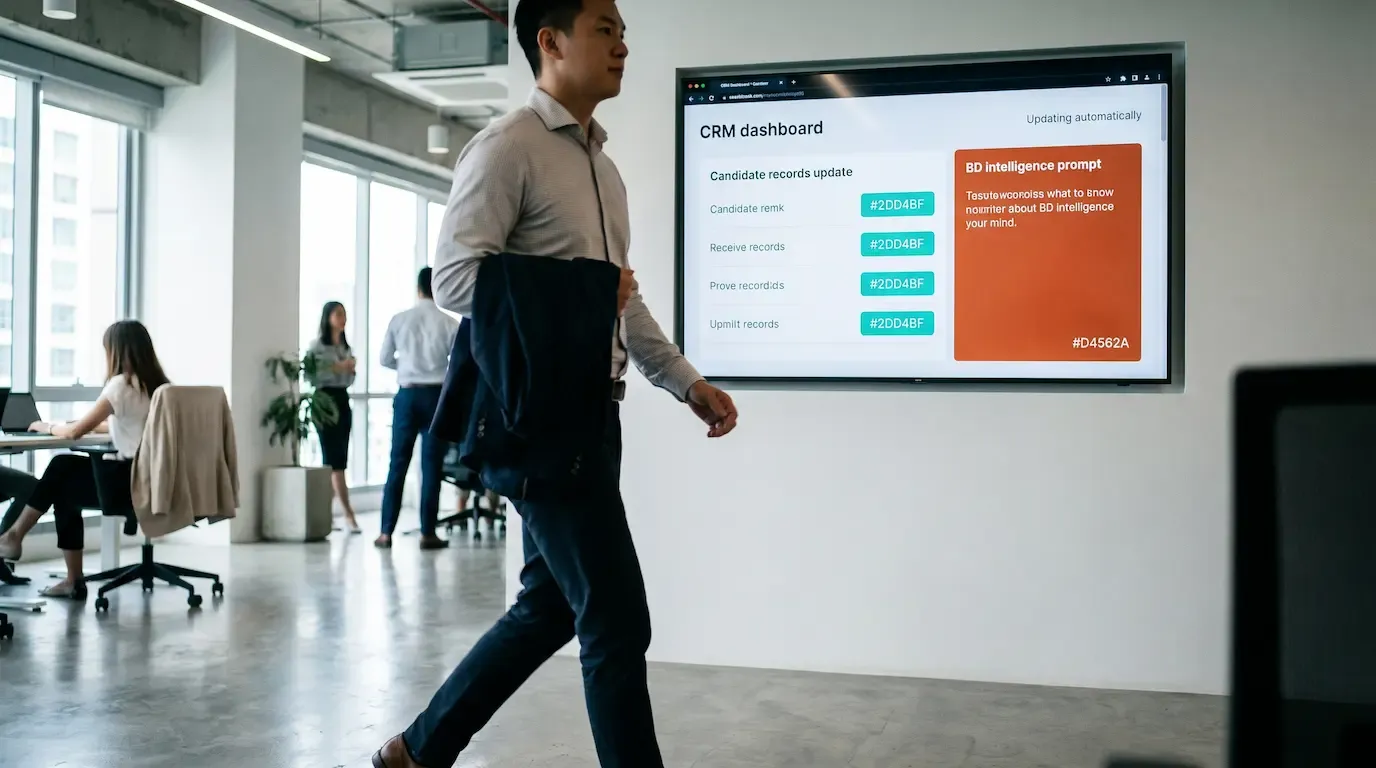
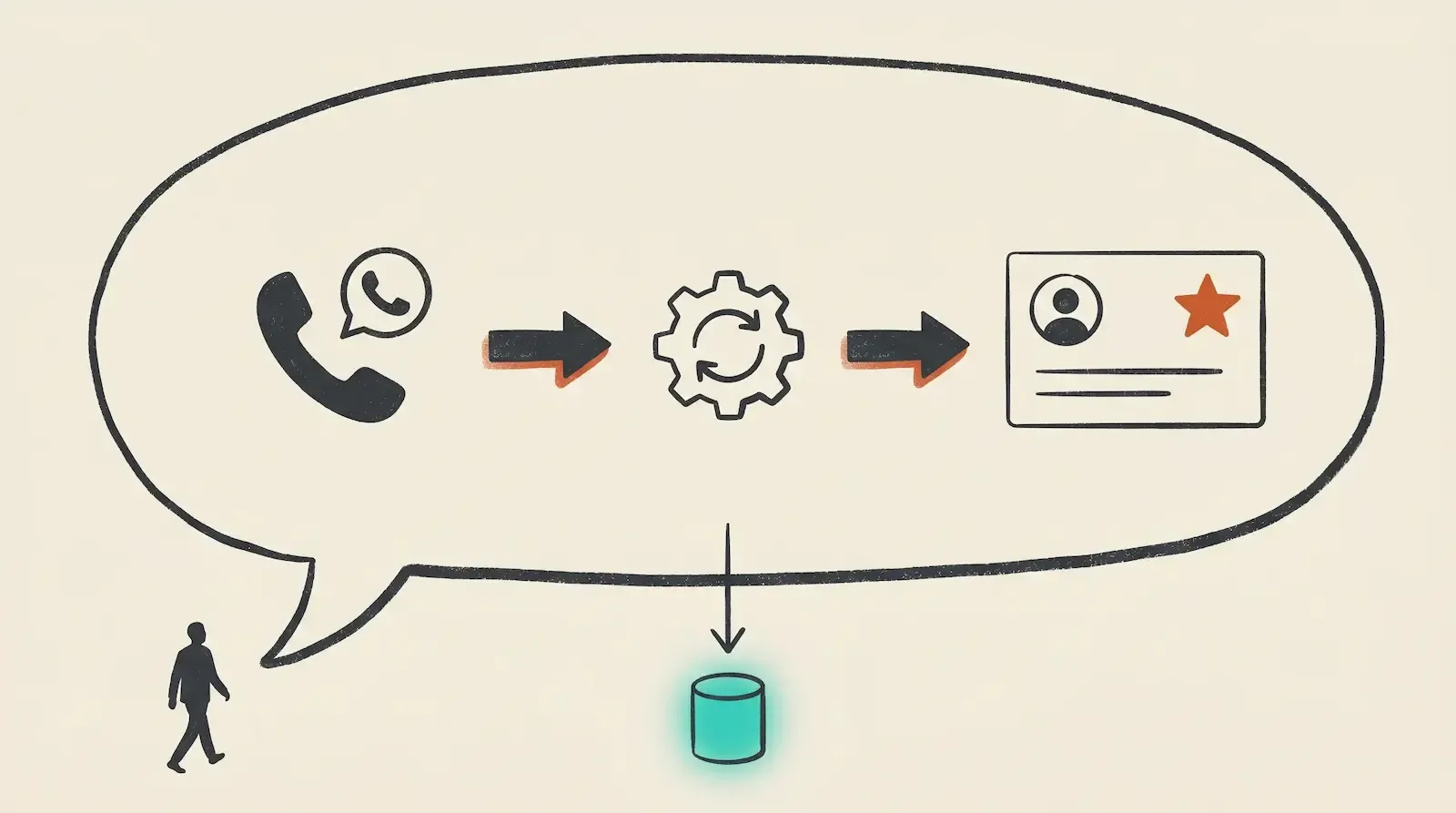
An agentic CRM applies these principles to relationship management. It does not wait for a recruiter to log a WhatsApp conversation — it captures it the moment it happens. It does not surface a recommendation that a client is showing hiring intent — it sends the BD prompt to the right consultant automatically. It does not ask the recruiter to update a candidate’s availability after a call — it extracts that update from the conversation and applies it to the record. The system pursues the goal of keeping the agency’s data accurate and its BD active, without requiring human instruction for each task.
“A passive CRM knows what happened. A copilot CRM tells you what to do. An agentic CRM does it — without being asked.”
McKinsey’s 2025 global AI survey found that 23% of enterprises are already scaling AI agents across business functions and 62% are actively experimenting with autonomous AI systems. [Source: McKinsey via Tosin Joseph LinkedIn summary, Dec 2025] Agentic AI is not a future category — it is the current frontier, moving from horizontal enterprise applications into vertical domains like recruitment.
Why agentic CRM matters more for recruitment than almost any other industry
The commercial case for agentic CRM is strongest in industries where three conditions hold simultaneously: relationship complexity is high, data capture is fragmented across multiple channels, and the timing of action is commercially critical. Recruitment meets all three at once — more acutely than most.
Relationship complexity: A recruiter managing an active desk in Hong Kong or Singapore maintains hundreds of candidate and client relationships simultaneously, each with a different history, status, availability window, and communication preference. Keeping those relationships accurately represented in a CRM — while also running live mandates, conducting BD conversations, and managing placements — is beyond the realistic capacity of manual logging. Research from HootRecruit estimates that recruiters spend 70–80% of their working day on repetitive admin including CRM updates, documentation, and scheduling. [Source: HootRecruit, Aug 2025] An agentic CRM addresses this not by making admin faster but by making it unnecessary.
Fragmented data capture: Most recruitment conversations do not happen in email. In APAC, WhatsApp dominates — over 90% of Hong Kong professionals use it for work, and Southeast Asia leads globally in WhatsApp Business adoption. [Source: Regus survey via Hong Kong Business; Sinch, 2025] A CRM that depends on manual logging will always be missing the majority of APAC recruiter activity. EverReady.ai’s compilation of CRM research estimates that 23% of users cite manual data entry as their primary barrier to CRM adoption, and that only 2% of companies report using all the functionality in their CRM. [Source: EverReady.ai, Dec 2025] An agentic CRM solves this at the capture layer — every conversation becomes a data event regardless of channel, without recruiter compliance.
Timing criticality: In recruitment, the difference between calling a client at the right moment and calling them a week later is often the difference between winning a mandate and missing it entirely. An agentic CRM does not file a signal in a report for a recruiter to review on Friday — it surfaces the BD prompt the morning the signal fires. It does not remind a consultant to follow up with a candidate about a counter-offer — it drafts the message based on what the consultant knows and flags it for immediate action. The commercial value of autonomous action compounds in a market where timing is everything.
How agentic CRM compares to what the major platforms offer today
| Capability | Passive CRM (most legacy tools) | Copilot CRM (Bullhorn Pulse, Vincere Intelligence) | Agentic CRM (Signals) |
|---|---|---|---|
| Conversation capture | Manual logging required | Partial auto-capture (email/phone only) | Automatic — WhatsApp, WeChat, email, calls, LinkedIn |
| Record updates | Manual input required | Suggested updates — human decides | Autonomous — extracts and applies updates from conversations |
| BD opportunity surfacing | Reactive — recruiter searches | Alert/recommendation — recruiter acts | Proactive — BD prompt surfaced before recruiter asks |
| Follow-up drafting | Manual composition | AI drafts — human sends | Agentic CRM drafts and prepares — human reviews |
| Next-action intelligence | None | Suggested — human chooses | Prioritised and acted on autonomously |
| Data accuracy over time | Degrades — depends on compliance | Partial — email/phone maintained, messaging absent | Maintained — every channel captured continuously |
| APAC messaging channels | No | No | Yes — WhatsApp, WeChat, LINE |
[Sources: Bullhorn product pages 2021/2024; Vincere product pages 2025/2026; Manatal Forbes review 2024; Signals product 2026]
No major recruitment CRM vendor currently uses the term “agentic CRM” in its primary positioning — the language of agency and autonomy is more common in horizontal enterprise AI from Salesforce, OpenAI, and Microsoft. [Source: Review of Bullhorn, Vincere, Loxo, Manatal public materials, 2024–2026] But the underlying capability distinction is real and growing. Bullhorn’s Pulse represents the beginning of this shift in recruitment — capturing activity automatically and surfacing relationship health without human prompt. Its 2025 roadmap continues in this direction with AI assistant steps embedded in automation flows. [Source: Bullhorn, Dec 2024]
The gap between where the major platforms are today and where agentic CRM is heading is significant. HR.com’s Future of Recruitment Technologies research notes that leading recruitment tech teams are investing in systems that unify data and automate more of the recruitment lifecycle — the direction is clear, even if the terminology is catching up. [Source: HR.com, 2025]
What an agentic CRM actually does for a recruitment desk — in practice
The clearest way to understand the value of agentic CRM for recruitment is to trace a single working day through a passive system versus an agentic one.
In a passive CRM: A consultant finishes a WhatsApp conversation with a Hong Kong finance executive at 8:45am. The candidate mentioned they are open to a move if the right CFO role comes up — but only for roles with regional responsibility. The consultant means to log this. By 9:30am they are in a client briefing. By lunch the note is not written. By the following Monday, the specific detail — regional scope, CFO level, actively open — has been overwritten by a week of new conversations. When a CFO role lands three weeks later, the candidate is matched from a keyword search that does not capture any of this nuance.
In an agentic CRM: The same conversation ends at 8:45am. By 8:46am, Perfect Memory has captured the message, extracted the candidate’s stated availability, seniority preference, and role scope requirement, and updated their record automatically. When the CFO role lands three weeks later, Speed to Shortlist surfaces the candidate at the top of the ranked list — not because of a keyword match, but because the system understood what was said and maintained that intelligence continuously.
The same logic applies to BD. In a passive CRM, a client contact’s WhatsApp message mentioning a new headcount plan disappears into a recruiter’s personal message history. In an agentic CRM, that message becomes a BD prompt — surfaced to the right consultant the next morning with the relevant context attached.
For APAC agencies operating in markets where 78% of professionals use AI tools weekly and where recruitment is growing at 8–13% CAGR, this compounding intelligence advantage is not a nice-to-have. [Source: BCG, Oct 2025; Signals APAC CRM guide, May 2026] It is the margin between a BD pipeline that grows and one that stalls.
Signals as an agentic CRM — what the four pillars actually do
Signals is built on four pillars, each of which corresponds to a specific agentic behaviour applied to recruitment workflows.
Perfect Memory is the perception layer — it captures every recruiter conversation automatically across WhatsApp, WeChat, email, calls, LinkedIn, and meetings, treating each as a structured data event without any manual input. This is the foundation of agentic behaviour: the system cannot act on what it has not perceived.
Agentic CRM is the action layer — it extracts updates from the conversations Perfect Memory captures and applies them to records continuously. Candidate availability changed in a call? Updated. Client mentioned new headcount in an email? Logged and flagged. Follow-up due based on conversation context? Drafted and surfaced. The system reasons about what each interaction means for the agency’s current priorities and acts accordingly.
BD Signals is the intelligence layer — it monitors the client base continuously for early hiring intent signals, combining external data (funding rounds, leadership changes, job ad activity) with conversational signals captured automatically by Perfect Memory, and surfaces the result as a prioritised BD prompt to the right consultant at the right moment. No manual monitoring required.
Speed to Shortlist is the delivery layer — when a mandate lands, it ranks candidates from the existing network immediately, drawing on the complete and current data that Perfect Memory and the Agentic CRM layer maintain. The shortlist reflects everything the agency knows about every relevant candidate — not just what was typed into fields.
Together, these four pillars constitute a genuinely agentic recruitment CRM: a system that perceives, reasons, and acts across the full recruitment workflow without requiring continuous human prompting. This is what Gartner’s definition describes and what the recruitment industry is beginning to build toward.
See an agentic CRM built for recruitment
See Signals on a desk like yours.
Common questions
An agentic CRM is a customer relationship management system that takes autonomous action on behalf of the recruiter, updating records, surfacing priorities, drafting communications, and executing follow-ups, without requiring human prompting for each task. Gartner defines AI agents as 'autonomous or semi-autonomous software entities that use AI techniques to perceive, make decisions, take actions, and achieve goals,' and an agentic CRM applies this principle directly to relationship management workflows. [Source: Gartner via Polestar Analytics, Jul 2025] Unlike passive CRMs that store data or copilot CRMs that suggest next steps, an agentic CRM reasons, plans, and acts: the system pursues goals rather than waiting for instruction.
The difference between an agentic CRM and a standard AI-powered CRM is the difference between a system that acts and a system that advises. A standard AI-powered CRM uses AI to generate insights, suggest next actions, or score pipeline items, but still requires a recruiter or salesperson to read those suggestions and decide what to do. An agentic CRM executes tasks autonomously: it updates records when a conversation happens, drafts the follow-up email based on what was discussed, and surfaces the BD opportunity before anyone asks. EverWorker's analysis frames this as the distinction between 'trigger-based automation that reacts' and 'goal-oriented AI workers that independently act.' [Source: EverWorker, Jul 2025]
Agentic AI matters for recruitment agencies because the admin burden of manual CRM management is disproportionately high relative to the value it creates, and because the speed at which recruitment opportunities open and close makes autonomous action more commercially significant than in slower-moving industries. Recruiters spend 70–80% of their working day on repetitive admin including CRM updates, documentation, and scheduling. [Source: HootRecruit, Aug 2025] An agentic CRM eliminates this at the architecture level rather than reducing it at the task level, capturing conversations automatically, updating records continuously, and surfacing BD opportunities before a recruiter thinks to look. In a market where calling before the brief goes live determines whether a mandate is won or missed, the difference between a system that reminds and a system that acts is a placement.
Signals is built on agentic CRM principles, and the Agentic CRM pillar is one of Signals' four core product pillars alongside Perfect Memory, BD Signals, and Speed to Shortlist. Perfect Memory captures every conversation automatically across WhatsApp, WeChat, email, calls, and LinkedIn without recruiter input. The Agentic CRM layer extracts updates from those conversations, applies them to records continuously, drafts follow-up communications, surfaces next actions, and prompts BD activity based on live client signals, all without requiring a recruiter to initiate each task. This is the definition of agentic behaviour applied to recruitment: the system perceives what happened, reasons about what it means, and acts on behalf of the recruiter.
In 2026, most major recruitment CRMs are still pre-agentic, with AI features that are primarily analytics, suggestions, and copilot-style assistance rather than autonomous action. Bullhorn's Pulse module automatically captures email and phone activity, which is an early form of agentic behaviour, and its 2025 roadmap introduces AI assistant steps in automation flows. [Source: Bullhorn, Dec 2024] Manatal and Vincere offer AI features focused on candidate matching and analytics rather than autonomous CRM action. Signals is built from the ground up on agentic principles of automatic capture, autonomous record-keeping, and proactive intelligence surfacing without recruiter input, making it the most fully agentic recruitment CRM currently available for APAC and global agencies.