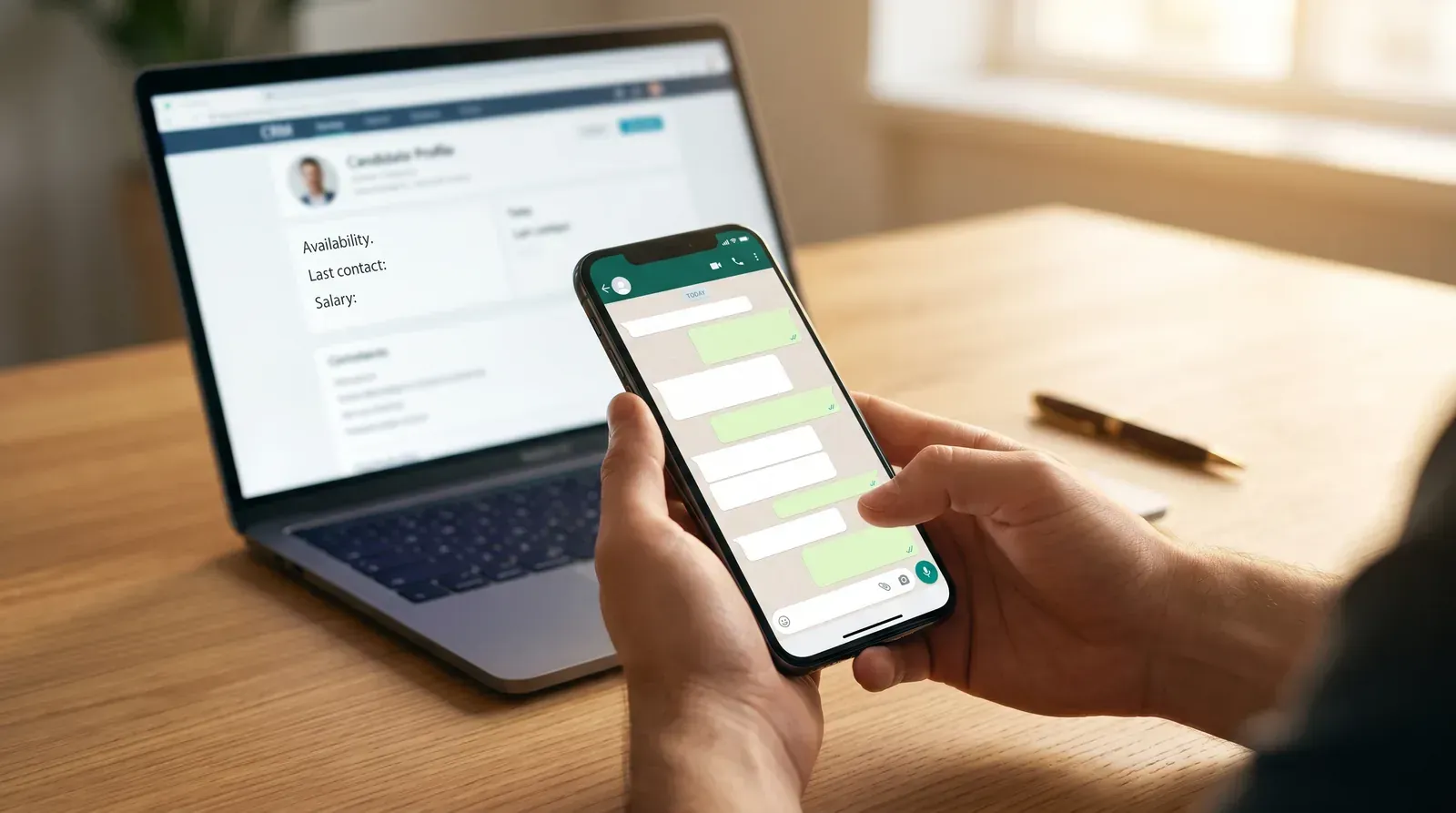
The recruitment data problem starts with the channel, not the recruiter
Recruitment data loss is not a discipline problem. It is a channel problem — and understanding that distinction is the first step toward fixing it permanently.
Most recruitment conversations happen on channels that legacy CRMs were never designed to see: WhatsApp threads with candidates about salary expectations, phone calls where a client mentions a new headcount plan, LinkedIn exchanges that start a relationship before it ever reaches the system. Each of these interactions contains real intelligence. None of it reaches the CRM unless a recruiter manually opens a record and types it in — and in a working day already consuming 30–40% of recruiter time in admin, that logging almost never happens. [Source: US Tech Automations citing SHRM, 2026]
This guide identifies exactly where recruitment data goes missing, quantifies what it costs, and explains the system change that eliminates the problem at the source.
Where recruitment data actually disappears
Recruitment data loss: the gap between every interaction a recruiter has with candidates and clients, and the subset of those interactions that actually reaches the CRM. In most agencies using manual-entry systems, this gap is not marginal — it is the majority of all activity.
Research from conversation-intelligence vendor Avoma puts the scale in concrete terms: CRMs are missing up to 72% of sales and recruitment activity when teams rely on manual logging, with emails and meetings being the most commonly absent data types. [Source: Avoma, 2026] In recruitment, where WhatsApp and phone calls carry a significant share of relationship context, the gap is likely wider still.
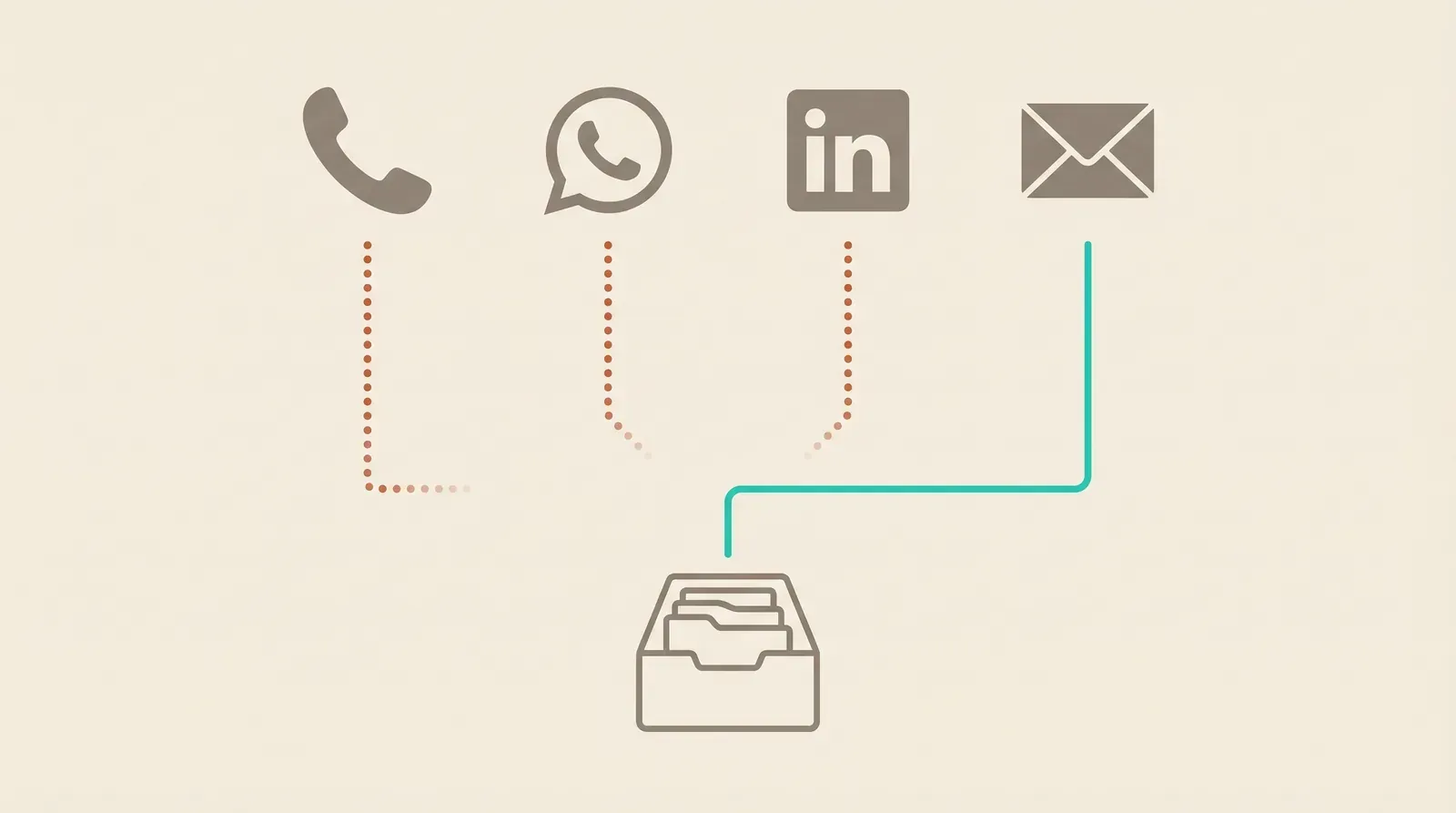
The missing data concentrates in four specific places.
WhatsApp and WeChat conversations WhatsApp generates 98% open rates and around 80% of replies arrive within five minutes — which is exactly why recruiters use it for every time-sensitive candidate and client conversation. [Source: Benjamin Durrant, LinkedIn, May 2025] In Hong Kong, over 90% of professionals use WhatsApp for work communication. [Source: Hong Kong Business citing Regus, 2026] In Singapore, it serves the same role across tech and finance sector relationships. In Japan, Line and WeChat carry equivalent weight. None of these conversations reach a legacy CRM automatically. Every message that stays on a recruiter’s personal phone is invisible to the system — and when that recruiter leaves the agency, it is gone permanently.
Phone calls and video meetings A phone call where a candidate reveals a new counter-offer, or a Zoom briefing where a client outlines an upcoming restructure, contains some of the highest-value intelligence in the recruitment workflow. Research shows many organisations only log calls but completely fail to capture meetings from tools like Zoom or Microsoft Teams — meaning critical client and candidate conversations never appear in the CRM at all. [Source: Revenue.io, 2026] In a manual-entry system, the call note depends entirely on whether the recruiter has a free moment to type it up before the next task arrives.
LinkedIn messages and InMails LinkedIn has become a primary sourcing and relationship channel for agencies in Australia, New Zealand, Singapore, and globally. Bullhorn has built an explicit LinkedIn integration specifically to pull InMail history into candidate records — a feature that exists precisely because so much recruiter-candidate interaction happens in LinkedIn and never makes it to the CRM otherwise. [Source: Bullhorn Knowledge Base, Dec 2025] Without that integration configured correctly, every LinkedIn thread is a data silo.
Email threads that start outside the system Even agencies with email-connected CRMs lose data to threads that begin outside the platform — a client forwarding a job description to a recruiter’s personal address, a referral introduction made via LinkedIn message, a candidate replying to an email the recruiter sent from their phone. Manual email logging produces the same result as manual call logging: incomplete records that reflect whatever the recruiter remembered to connect, not the full history of the relationship.
| Channel | Typical capture method | Automatic in legacy CRM? | Data lost when recruiter leaves? |
|---|---|---|---|
| Manual copy or screenshot | No | Yes — on personal device | |
| WeChat / Line | Manual copy | No | Yes — on personal device |
| Phone calls | Manual note after call | No | Yes — if never logged |
| LinkedIn messages | Manual or via integration | Partial | Partially |
| Auto-sync if configured | Sometimes | Partial | |
| Zoom / video meetings | Manual note after meeting | No | Yes — if never logged |
The compounding cost of missing recruitment data
Missing data in a recruitment CRM does not stay static — it compounds. CRM data decays at roughly 2–3% per month, which means around 30% of any database becomes inaccurate or incomplete within a year without systematic refresh. [Source: Man Digital, 2026] Research from The Global Recruiter found that 37% of CRM users have lost revenue directly as a result of poor data quality — including missed placements and backdoor hires that went undetected because the system lacked complete records. [Source: The Global Recruiter, 2026]
“Recruitment data doesn’t disappear — it was never captured in the first place. The problem is the channel, not the recruiter.”
The tool sprawl problem makes it worse. The average recruiting agency uses 5–7 different platforms to complete a single placement, and recruiters switch between those platforms 30+ times per day — with data getting trapped in whichever tool it started in and rarely making it back to the central CRM. [Source: Zileo, Apr 2026] Sixty-five percent of agencies surveyed report that their tools are not effective — in large part because no single system has complete visibility across all the channels where real work happens. [Source: Zileo, Apr 2026]
The recruiter departure scenario crystallises the cost. When a consultant leaves an agency using a manual-entry CRM, every relationship they built through WhatsApp, every client conversation they never logged, every candidate they were informally managing — all of it leaves with them. As recruitment tech specialist Benjamin Durrant has put it directly: when recruiters use personal WhatsApp accounts, those conversations are trapped on personal devices outside any auditable trail, and when they leave, the data is gone forever. [Source: Benjamin Durrant, LinkedIn, May 2025]
How to audit your agency’s data loss right now
Running a data loss audit takes less than a week and makes the invisible cost concrete. The goal is to quantify the gap between what actually happened and what the CRM knows about.
Step 1 — Map every channel your team uses for candidate and client conversations List every platform: email, phone, WhatsApp, WeChat, LinkedIn, Line, Zoom, in-person meetings. For each one, ask a single question: does this channel feed the CRM automatically, or does it require a recruiter to manually log the interaction?
Step 2 — Count unlogged interactions for one week Ask each recruiter to mark every WhatsApp message, phone call, and LinkedIn exchange they have in a single week that they did not log in the CRM. Do not ask them to change behaviour — just observe. The number is almost always significantly larger than expected, and it represents the weekly rate at which relationship intelligence is leaving the system.
Step 3 — Open the last 20 active candidate records and check completeness For each record: is the most recent interaction logged? Is current availability recorded? Is the last salary discussion captured? In most agencies using manual-entry CRMs, the majority of records fail at least one of these checks — not because recruiters are negligent, but because the system was not designed to capture the channels where the conversations happened.
Step 4 — Check what happens when you search for a specific past conversation Pick a candidate conversation from three months ago that happened over WhatsApp. Search for it in the CRM. In a manual-entry system, the answer is almost certainly nothing — because it was never logged. That missing conversation represents real intelligence your agency earned and immediately lost.
Signals’ features page covers exactly what automatic capture looks like in practice — and what a zero-data-loss CRM means for agencies running active desks across APAC markets.
How Signals eliminates recruitment data loss at the source
The fix for recruitment data loss is not a better logging policy or a stricter CRM hygiene process. It is a system that captures conversations automatically, across every channel, without depending on recruiter compliance.
Signals delivers this through Perfect Memory — the capture layer that treats every recruiter interaction as a data event, regardless of which channel it happened on. Every call is logged. Every email is filed. Every WhatsApp message is captured and matched to the right candidate, company, or job record automatically, in real time, without the recruiter opening the CRM at all.
For agencies in Hong Kong where executive search relationships are built over months of WhatsApp exchanges with finance and banking sector clients, this means no conversation is invisible to the system. For agencies in Singapore running tech sector desks where candidates move fast and context changes week to week, Perfect Memory ensures the CRM reflects the current state of every relationship — not a snapshot from the last time a consultant had a moment to type a note. For agencies in Australia where LinkedIn and email dominate, the same automatic capture applies across those channels.
The Agentic CRM layer builds on this foundation by extracting meaningful updates from captured conversations and applying them to records continuously — candidate availability, salary movements, client headcount signals — so the CRM updates itself rather than waiting for recruiter input.
When a consultant leaves a Signals agency, their pipeline stays. Every conversation they had is already in the system. The data asset belongs to the agency — not to the individual recruiter’s personal WhatsApp history.
Recruitment data loss is structural. The system that depends on manual logging will always lose the majority of what actually happened — because the channels where recruitment conversations happen were never designed to feed a CRM. Signals is built from the ground up to solve that problem at the source.
Stop losing data your agency already earned
See Signals on a desk like yours.
Common questions
Recruitment data goes missing because most recruiter conversations happen on channels that legacy CRMs cannot capture automatically: WhatsApp, WeChat, phone calls, LinkedIn messages, and informal emails. Research shows up to 72% of activity is never captured when teams rely on manual logging, because it depends entirely on recruiters choosing to open a record and type a note after every interaction. [Source: Avoma, 2026] In markets like Hong Kong and Singapore where WhatsApp is the dominant communication channel, the gap between what actually happened and what the CRM knows is especially large.
When a recruiter leaves an agency that uses a manual-entry CRM, every conversation they had on their personal WhatsApp, personal email, or personal LinkedIn account leaves with them, because none of it was ever captured in the system. As recruitment tech specialist Benjamin Durrant has noted, when recruiters use personal WhatsApp accounts, any candidate conversations on their personal phone are lost forever the moment they walk out the door. [Source: Benjamin Durrant, LinkedIn, May 2025] In an AI-native CRM like Signals, this problem does not exist because Perfect Memory captures every conversation automatically against the right record, so the data belongs to the agency, not the individual.
Missing recruitment CRM data costs agencies in three direct ways: lost placement opportunities from candidates and clients who were never properly tracked, wasted recruiter time re-establishing context that should already be in the system, and damaged client and candidate relationships from follow-ups that reference incomplete history. Research from The Global Recruiter found that 37% of CRM users have lost revenue directly as a result of poor data quality, including missed placements and backdoor hires that went undetected because the CRM lacked accurate records. [Source: The Global Recruiter, 2026] CRM data also decays at roughly 2–3% per month, meaning around 30% of any database becomes inaccurate within a year without continuous refresh. [Source: Man Digital, 2026]
Tool sprawl causes recruitment data loss because conversations and interactions are distributed across multiple disconnected platforms (CRM, email, WhatsApp, LinkedIn, video conferencing, job boards) with no single system capturing all of them automatically. Research shows the average recruiting agency uses 5–7 different platforms to complete a single placement, and that recruiters switch between platforms 30+ times a day, with data getting trapped in whichever tool it started in. [Source: Zileo, Apr 2026] Unless each tool feeds the CRM automatically, every platform switch is an opportunity for context to be lost.
Signals prevents recruitment data loss through Perfect Memory, an automatic capture layer that logs every call, email, WhatsApp message, WeChat thread, LinkedIn exchange, and meeting against the right candidate, company, or job in real time, without any recruiter input required. Unlike manual-entry CRMs where data only enters the system when a recruiter chooses to log it, Signals treats every recruiter interaction as a data event and captures it automatically in the background across every channel. The Agentic CRM layer then extracts meaningful updates from those captured conversations and applies them to records continuously, so the CRM always reflects reality rather than a partial record of whatever was typed in last week.