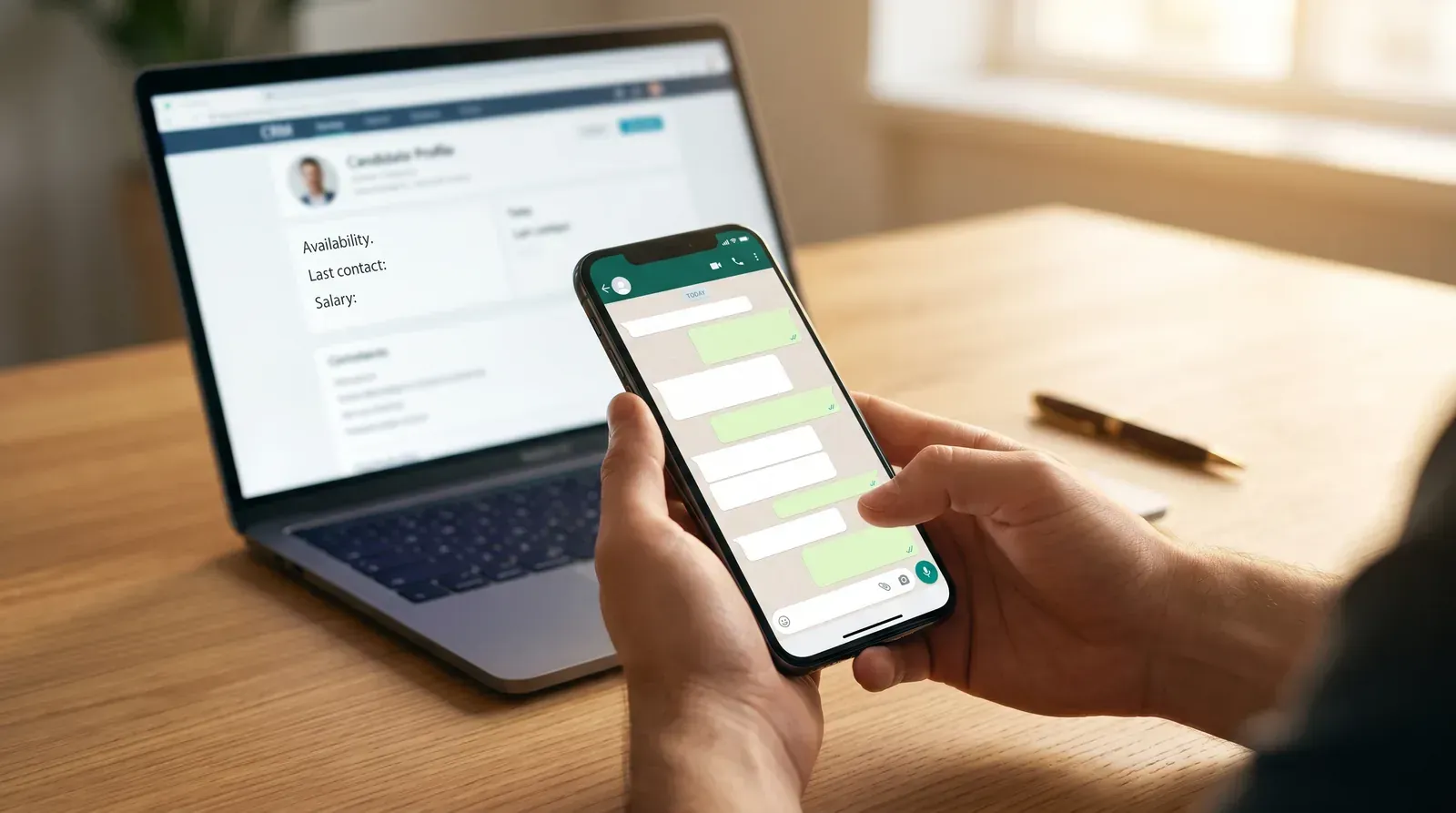
Why WhatsApp is the primary BD channel for Hong Kong recruitment
In most markets, email is the default first contact for recruitment BD. In Hong Kong, WhatsApp is.
WhatsApp recruitment in Hong Kong is not a workaround or an informal supplement to professional channels — it is the primary channel through which recruiters build and maintain the relationships that drive placements. Over 90% of Hong Kong professionals use WhatsApp for work communication, according to a Regus survey of 365 Hong Kong workers. [Source: Hong Kong Business citing Regus, 2015] A Meta-commissioned survey by Kantar found that nearly 50% of Hong Kong consumers prefer WhatsApp over email and phone when contacting businesses — ahead of email at 29% and phone at 28%. [Source: The Standard citing Meta/Kantar, Oct 2024]
This article covers how Hong Kong recruitment agencies use WhatsApp across every stage of the BD and placement workflow, where the data loss risk concentrates, and how AI-native tools like Signals capture WhatsApp conversations automatically so agencies never lose the relationship intelligence they have earned.
How Hong Kong recruiters use WhatsApp across the recruitment workflow
WhatsApp is not used for one type of recruitment conversation in Hong Kong — it is used across the entire workflow, from first BD contact through to offer negotiation and post-placement relationship maintenance.
BD outreach and first contact Initial BD contact in Hong Kong finance and banking sector recruitment frequently happens over WhatsApp rather than email. A hiring manager who would ignore a cold email will often respond to a WhatsApp message from a known contact or a warm introduction. WhatsApp messages generate open rates near 98% and most replies arrive within five minutes — which is why recruiters default to the channel for any time-sensitive BD touchpoint. [Source: SchedulingKit citing Meta, 2026] For executive search agencies operating in the city’s finance sector, WhatsApp is where the first conversation about a potential mandate begins.
Informal hiring intent signals Some of the most valuable BD intelligence in Hong Kong arrives informally over WhatsApp. A client contact mentioning a new headcount plan, a frustration with the current search process, or an upcoming restructure in a casual message represents a hiring intent signal that could generate a mandate weeks before any formal brief. These conversational signals are invisible to a CRM unless someone manually copies them across — and in the pace of a Hong Kong recruitment desk, that rarely happens.
Candidate outreach and management WhatsApp is the preferred channel for candidate communication in Hong Kong, particularly for finance and banking sector placements where discretion matters and response speed is critical. Candidates who would not answer a call from an unknown number will respond to a WhatsApp message from a recruiter they have met. Interview confirmations, salary discussions, counter-offer conversations, and reference check coordination all happen over WhatsApp in the Hong Kong market.
Offer negotiation and closing Offer negotiations in Hong Kong frequently move to WhatsApp once the formal offer stage is reached — particularly for senior roles where the recruiter is managing a sensitive conversation between client and candidate simultaneously. The informal register of WhatsApp can actually facilitate faster, more honest negotiation than formal email exchanges. But every message in that negotiation represents relationship intelligence that belongs in the CRM — and almost none of it gets there automatically.
The data problem that WhatsApp creates for Hong Kong agencies
WhatsApp is deeply embedded in Hong Kong recruitment because it works. The problem is not the channel — it is the invisible data leak that the channel creates when it operates outside the CRM.
“In Hong Kong, the relationship is built on WhatsApp. The CRM just doesn’t know about it — unless you have a system that captures it automatically.”
Global CRM research from Avoma estimates that up to 72% of sales and recruitment activity is never captured when teams rely on manual logging. [Source: Avoma, 2026] In Hong Kong, where WhatsApp carries a larger share of recruiter communication than in almost any other market, this gap is likely wider still. The majority of relationship intelligence in a Hong Kong agency — the candidate preferences discussed over WhatsApp, the client headcount signals mentioned in passing, the offer negotiation thread that ran across three days of messages — exists only on individual recruiters’ personal phones.
| Communication channel | Typical capture in legacy CRM | Captured automatically in Signals |
|---|---|---|
| WhatsApp (personal) | No — manual copy required | Yes — Perfect Memory |
| WhatsApp Business | Partial — depends on integration | Yes — Perfect Memory |
| No | Yes — Perfect Memory | |
| Phone calls | No — manual note required | Yes — Perfect Memory |
| Sometimes — if configured | Yes — Perfect Memory | |
| LinkedIn messages | Partial — via integration | Yes — Perfect Memory |
| In-person / video meetings | No | Yes — Perfect Memory |
The departure risk is acute in Hong Kong’s high-turnover recruitment market. When a consultant leaves, every WhatsApp conversation on their personal phone leaves with them. Months of client relationships built through daily WhatsApp exchanges — salary benchmarking conversations, informal hiring signals, candidate sentiment — disappear permanently. As recruitment tech specialist Benjamin Durrant has noted directly: when recruiters use personal WhatsApp accounts for work, those conversations are trapped outside any auditable trail, and when the recruiter leaves, the data is gone forever. [Source: Benjamin Durrant, LinkedIn, May 2025]
How to use WhatsApp effectively for BD without losing your data
Using WhatsApp effectively for BD in Hong Kong requires more than just accepting it as a channel — it requires a deliberate approach to ensuring the intelligence it generates reaches the agency’s CRM automatically.
Step 1 — Separate business and personal WhatsApp use Establish a clear policy that all client and candidate communication happens through a designated business WhatsApp number, not personal accounts. This creates the foundation for automatic capture integration and ensures conversations are at least theoretically recoverable if a recruiter leaves.
Step 2 — Use WhatsApp Business for client-facing BD WhatsApp Business provides features designed for professional use — business profiles, quick replies, message labels, and API access — that make it easier to integrate with CRM systems. For agencies in Hong Kong running active BD operations across multiple consultants, WhatsApp Business is the starting point for building a capture-ready workflow.
Step 3 — Treat every WhatsApp signal as a CRM event Every client message that mentions headcount, a new role, or a hiring challenge is a BD signal that belongs in the CRM. Every candidate message that indicates a change in availability, salary expectation, or interest level is a record update. Without automatic capture, these events require a recruiter to manually log them within minutes of receiving them — in practice, this almost never happens consistently.
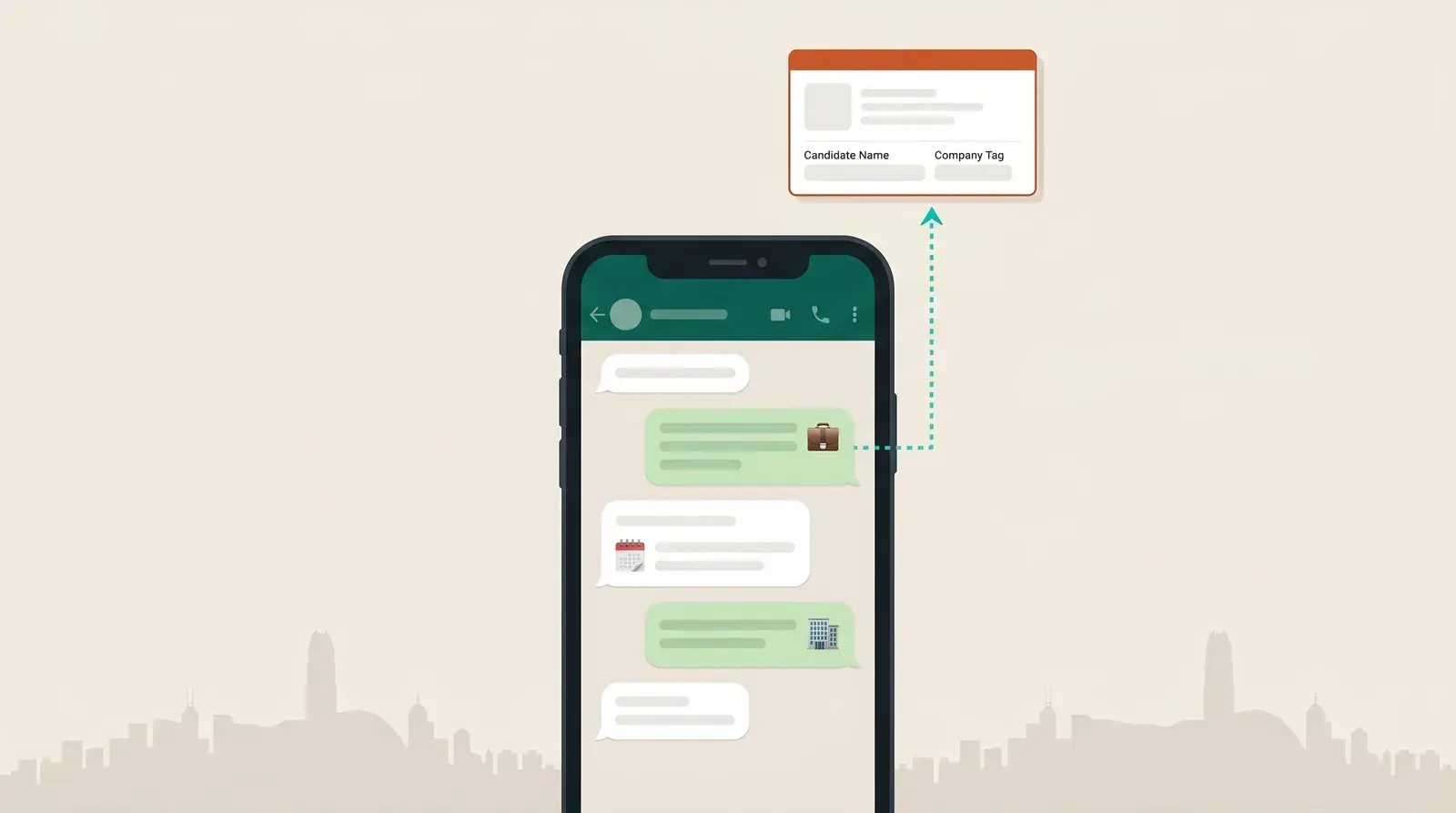
Step 4 — Implement automatic WhatsApp capture The only reliable solution to WhatsApp data loss in Hong Kong recruitment is automatic capture — a system that logs every message against the right record in real time, without recruiter input. Signals delivers this through Perfect Memory, which captures every WhatsApp conversation automatically and files it against the correct candidate, company, or job record the moment it arrives. For Hong Kong agencies where WhatsApp carries the majority of relationship intelligence, this is the single most impactful change to data completeness available.
Step 5 — Review captured WhatsApp intelligence weekly Once WhatsApp conversations are captured automatically, the intelligence they contain becomes a BD asset. Weekly review of client WhatsApp signals — mentions of headcount, new hires, team changes — surfaces BD opportunities that would otherwise be invisible. BD Signals in Signals does this automatically, combining captured conversation intelligence with external signals to surface a prioritised list of clients showing early hiring intent.
Why WhatsApp capture is a competitive advantage in Hong Kong
Omnichat, a Hong Kong conversational commerce provider, describes WhatsApp as “Hong Kong’s most widely adopted messaging platform” and has built an entire HR workflow system around it — reflecting how central the channel has become to business operations in the city. [Source: Omnichat, Jan 2026] The agencies that treat their WhatsApp conversations as a CRM asset — rather than as ephemeral messages that disappear when a recruiter changes phone — build a compounding relationship intelligence advantage over competitors whose data evaporates with every personnel change.
For agencies running executive search in Hong Kong’s finance and banking sector, where relationships are built over years and mandates are awarded based on trust and market knowledge, this advantage is significant. The consultant who can reference a conversation from six months ago — “you mentioned in September that you were thinking about adding to the structuring desk” — is demonstrably better informed than the one who is starting the conversation from scratch.
Signals is built for exactly this market context. The for-agencies page covers how Signals is configured for APAC recruitment agencies in Hong Kong, Singapore, and across the region. The features page covers how Perfect Memory captures WhatsApp, WeChat, email, calls, and meetings automatically — so every conversation your team has in Hong Kong today becomes an intelligence asset your agency owns permanently.
WhatsApp recruitment in Hong Kong is not going away — it is the channel where the most important relationships are built and maintained. The only question is whether those conversations live in your CRM or on your recruiter’s personal phone. Signals answers that question at the architectural level: every conversation, captured automatically, filed against the right record, owned by the agency.
Capture every WhatsApp conversation automatically
See Signals on a desk like yours.
Common questions
Hong Kong recruitment agencies use WhatsApp for BD because it is the dominant communication channel in the market: over 90% of Hong Kong professionals use it for work, and nearly 50% prefer it over email and phone when contacting businesses. [Source: Regus survey via Hong Kong Business, 2015; Meta/Kantar survey via The Standard, 2024] Agencies use WhatsApp to make initial BD contact with new clients, maintain warm relationships with existing contacts, share job briefings and candidate profiles, and receive informal hiring intent signals before a role is publicly advertised. The challenge is that all of this activity happens outside the CRM and rarely gets logged manually.
WhatsApp is the standard communication channel for recruitment in Hong Kong, not an exception. Research from Hays Hong Kong confirms that candidates and recruiters widely use WhatsApp, Telegram, and WeChat for recruitment outreach in the market, and a Regus survey found over 90% of Hong Kong workers use WhatsApp for work communication. [Source: Hays Hong Kong, Nov 2025; Hong Kong Business citing Regus, 2015] For finance and banking sector clients in particular, the dominant sector for executive search in Hong Kong, WhatsApp is typically the first point of contact for any urgent or informal communication.
When a recruiter leaves a Hong Kong agency that uses manual-entry CRM, every WhatsApp conversation on their personal phone leaves with them, permanently. Because WhatsApp messages are stored on the device rather than in the CRM, any relationship context built through months of exchanges with finance sector clients, candidate negotiations, and informal BD touchpoints is lost the moment the recruiter walks out the door. As recruitment tech specialist Benjamin Durrant has noted, when recruiters use personal WhatsApp accounts for work, those conversations are outside any auditable trail and cannot be recovered once the phone is gone. [Source: Benjamin Durrant, LinkedIn, May 2025]
Recruitment agencies in Hong Kong can log WhatsApp conversations in their CRM through automatic capture tools that integrate with WhatsApp Business API and file messages against the right candidate or client record in real time. Manual copy-paste or screenshot logging is theoretically possible but fails in practice, because recruiters managing active desks in Hong Kong's fast-moving finance and fintech sectors do not have time to manually log every message, and the most time-sensitive signals arrive and are acted on before anyone opens the CRM. Signals captures WhatsApp conversations automatically through Perfect Memory, requiring no recruiter input and ensuring every message reaches the right record the moment it is sent.
Signals is built specifically for APAC recruitment agencies where WhatsApp is a primary communication channel, including Hong Kong, Singapore, and other markets where WhatsApp dominates recruiter-client and recruiter-candidate communication. Perfect Memory, Signals' automatic capture layer, logs every WhatsApp message against the right candidate, company, or job record in real time without any manual input from the recruiter. This means every BD conversation, candidate update, and client signal that happens over WhatsApp in Hong Kong reaches the CRM automatically, building a complete, searchable relationship history that belongs to the agency, not to any individual recruiter's personal device.