
Why recruitment admin is an architecture problem, not a discipline problem
Recruitment agencies lose more billable time to admin than to almost any other single cause. Research from HootRecruit puts the average recruiter’s non-billable admin burden at 40–60% of their working day — time spent logging calls, updating CRM records, writing notes, and chasing follow-ups that a well-designed system should handle automatically. [Source: HootRecruit, Aug 2025]
This guide covers the root cause of recruitment admin overload, the specific tasks that consume the most time, and the system changes that actually eliminate the problem — not just reduce it.
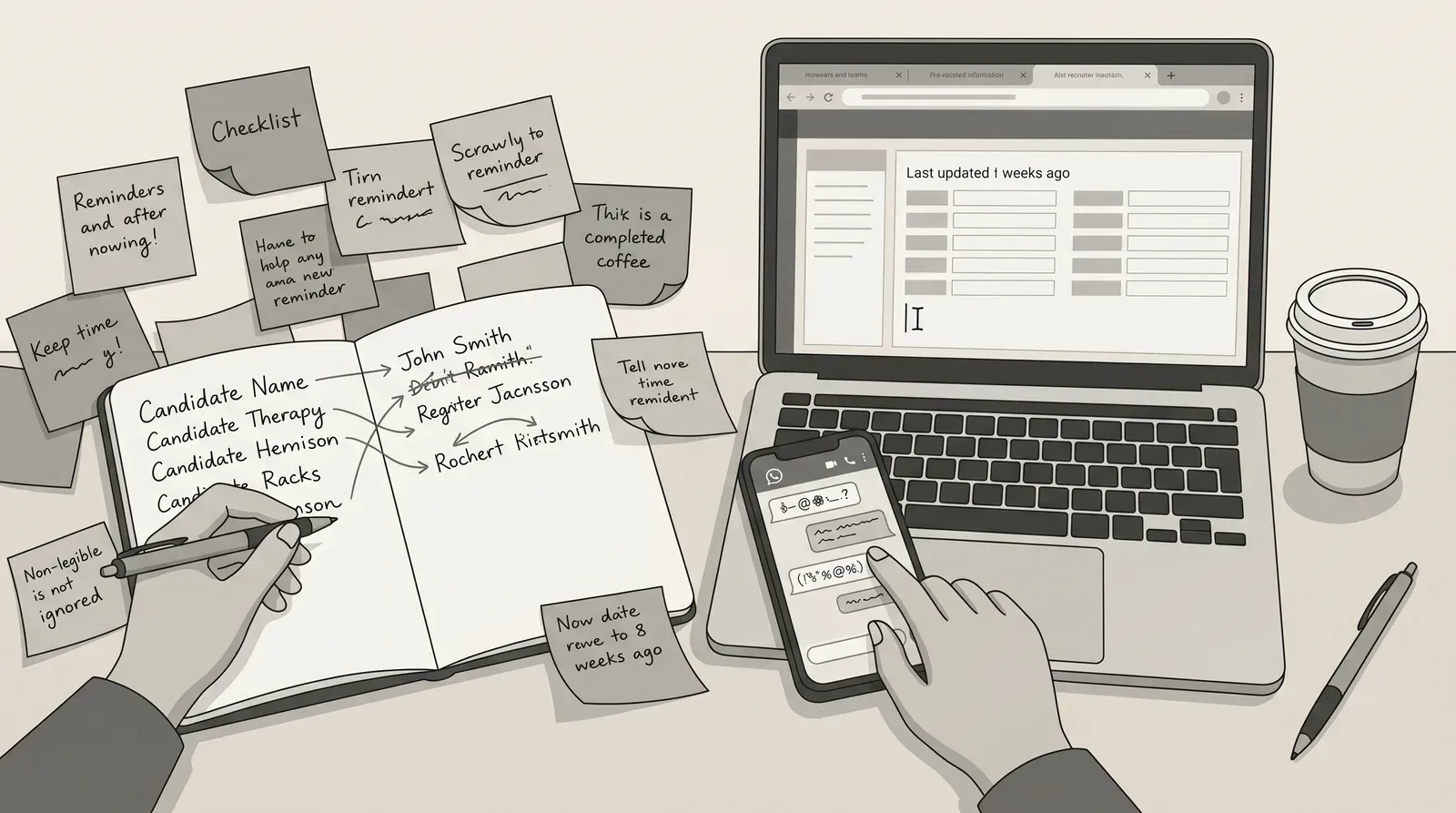
The four admin tasks costing your agency the most time
Recruitment admin is not one problem — it is four distinct problems, each with a different root cause and a different fix. Understanding where the time actually goes is the first step to recovering it.
1. Manual CRM logging Every call, every WhatsApp message, every candidate update — in a traditional CRM, each one requires a recruiter to open a record, type a note, and save it. Research shows recruiters lose 6+ hours per week to manual CRM updates alone, equivalent to four to five additional selling weeks per year if recovered. [Source: Klu.so, Dec 2025] In practice, most of this logging never happens — recruiters are too busy to update records in real time, and context is lost.
2. Manual client follow-up Sixty-two percent of recruitment SMBs still handle all client follow-ups manually — across CRM tasks, emails, and calls — losing 15–20 hours per week in the process. [Source: Bullhorn via LinkedIn/Marathon Limited, Mar 2026] Response rates drop 35% when follow-up takes longer than two hours, which means delayed manual follow-up is not just a time problem — it is a revenue problem.
3. CV formatting and candidate documentation Formatting CVs, writing candidate summaries, and preparing submission packs are among the highest-volume repetitive tasks in any agency. AI recruiting automation recovers 25–30% of admin time in the first month when applied to CV formatting and CRM updates combined. [Source: ATLAS blog, Jul 2025] Most agencies still do this manually for every candidate, on every submission.
4. Meeting notes and post-call documentation The minutes after a candidate or client call are critical — and typically wasted on note-taking that should be automatic. Administrative tasks of this type consume an average of two hours per day per recruiter, more than any other single category in part-time recruiting roles. [Source: SkillSeek, Mar 2026] Notes written from memory an hour after a call are less accurate, less complete, and less useful than notes captured in real time.
What actually reduces recruitment admin — and what doesn’t
Agencies have tried to solve the admin problem with process changes for years. Dedicated admin sessions, CRM hygiene policies, weekly data audits — all of them shift the burden rather than eliminate it. The reason is structural: manual-entry CRMs create admin by design. Every workflow is built around the assumption that a human will log each interaction.
“The admin problem in recruitment isn’t a discipline problem. It’s an architecture problem — and the fix is a system change, not a process change.”
The table below separates approaches that reduce admin from approaches that eliminate it at the source.
| Approach | What it changes | Admin reduction | Root cause addressed? |
|---|---|---|---|
| CRM hygiene policies | Recruiter behaviour | Minimal | No |
| Dedicated admin sessions | When admin happens | Moderate | No |
| AI-powered CRM features | Specific task automation | Partial | No |
| AI-native CRM (e.g. Signals) | Capture architecture | Near-total | Yes |
| Template libraries | Speed of manual entry | Low | No |
| VA / admin support | Who does the admin | Moderate | No |
The only approach that addresses root cause is changing the capture architecture — moving from a system that requires manual input to one that captures conversations automatically. Signals is built on this principle: every interaction is a data event, captured and filed the moment it happens, without recruiter involvement.
How to reduce recruitment admin time: a practical audit
Before implementing any system change, run a time audit across your team for one week. The goal is to quantify exactly where admin time is going — because the biggest wins are almost always concentrated in two or three specific tasks.
Step 1 — Track every admin task for five working days Ask each recruiter to log every non-billable task as it happens: CRM updates, note-writing, CV formatting, email drafting, follow-up scheduling. Thirty seconds of logging per task is enough. At the end of the week, categorise by type.
Step 2 — Identify the highest-volume categories In most agencies, CRM logging and manual follow-up account for 60–70% of total admin time. These are also the tasks most directly addressable by system change. CV formatting and documentation typically account for another 20–25%.
Step 3 — Separate tasks that require judgment from tasks that require data entry Judgment tasks — candidate assessment, client relationship management, negotiation — cannot and should not be automated. Data-entry tasks — logging a call, updating a record, formatting a CV — have no judgment component and should never require recruiter time.
Step 4 — Evaluate your CRM against automatic capture Ask one question: does your CRM capture conversations automatically, or does it depend on recruiters to log them? If the answer is the latter, the admin problem is systemic, not behavioural. No amount of process improvement fixes a system designed for manual input.
Signals’ features page covers exactly how automatic capture works in practice — across calls, emails, WhatsApp, WeChat, and LinkedIn — for agencies evaluating the move to AI-native architecture.
How Signals eliminates recruitment admin at the source
Reducing recruitment admin with Signals works differently from implementing automation features in a legacy CRM. The foundation is Perfect Memory — the pillar that captures every recruiter interaction automatically across every channel, with no manual input required.
Perfect Memory: Signals’ automatic conversation capture layer that logs every call, email, WhatsApp message, WeChat thread, LinkedIn exchange, and meeting against the right candidate, company, or job — in real time, without recruiter involvement.
For agencies in Hong Kong and Singapore, where WhatsApp is the primary channel for both candidate outreach and client communication, this is the most significant single change to daily workflow. Conversations that previously lived only in a recruiter’s WhatsApp history are captured, structured, and filed automatically. When a consultant leaves the agency, their pipeline stays.
The Agentic CRM layer builds on Perfect Memory by extracting actionable updates from captured conversations and applying them to records continuously. Candidate available from next month? Updated. Client mentioned a new headcount plan in a WhatsApp message? Logged against the company record and surfaced through BD Signals. No recruiter action required.
For agencies in Australia and New Zealand, where email and LinkedIn are more dominant channels, the same logic applies — every interaction is a data event, and every data event updates the record automatically. The result is a CRM that reflects reality at all times, not a snapshot from the last time a recruiter had a moment to log something.
The compounding effect: why admin reduction improves every other metric
Reducing recruitment admin time is not just a quality-of-life improvement for recruiters — it directly improves placement rates, client retention, and revenue per head. Bullhorn data shows agencies that automate admin achieve 36% more placements and a 22% higher fill rate compared to those that do not. [Source: Bullhorn, Feb 2026]
The mechanism is straightforward. When recruiters are not spending 40–60% of their day on admin, that time goes to candidate conversations, client development, and shortlist quality. Speed to Shortlist — Signals’ AI ranking of candidates from the existing network the moment a role lands — only works well when the underlying candidate data is accurate and current. Admin reduction and shortlist quality are directly linked.
The same applies to BD intelligence. Agencies that reduce admin time find their CRM data becomes reliable enough to surface genuine hiring signals — clients showing early intent, candidate availability windows, market movement. BD Signals surfaces this intelligence automatically from the clean data that Perfect Memory maintains. Admin reduction unlocks the full value of every other AI capability in the platform.
Reducing admin time in your recruitment agency is not a marginal improvement — it is the foundation that makes every other part of the system work better. The path to that reduction runs through architecture, not process. Signals is built from the ground up to eliminate recruitment admin at the source, so your team spends their time on the work that actually generates placements.
See how Signals eliminates recruitment admin
See Signals on a desk like yours.
Common questions
Recruitment agencies reduce admin time by automating conversation capture, eliminating manual CRM updates, and using AI to surface the next best action automatically. The average agency recruiter spends 40–60% of their working day on non-billable admin tasks like logging calls, updating pipelines, and writing notes. AI-native platforms like Signals capture every call, email, WhatsApp message, and meeting automatically and file them against the right record without recruiter input, eliminating the admin burden at its source rather than managing it downstream.
Research shows recruiters spend between 20–30 hours per week on manual data entry, CRM updates, and documentation, equivalent to up to 75% of their working time in admin-heavy roles. Separately, 62% of recruitment SMBs handle client follow-ups manually, losing 15–20 hours per week on that task alone. [Source: HootRecruit, Aug 2025; Bullhorn via LinkedIn/Marathon Limited, Mar 2026] The result is a median cost-per-hire of $4,129 driven largely by delays caused by manual processes.
CRM data becomes outdated in recruitment agencies because most recruiter conversations happen off-platform, via WhatsApp, WeChat, phone calls, and informal emails that never get logged in the system. Research shows approximately 74% of CRM records become stale or inaccurate within a year in manual-entry systems. [Source: Loxo, 2024] When recruiters are busy, logging a call is always the last priority, which means the CRM reflects yesterday's reality, not today's.
Signals reduces recruitment admin time through Perfect Memory, a core pillar that captures every call, email, WhatsApp message, WeChat thread, LinkedIn exchange, and meeting automatically, filing each interaction against the right candidate, company, or job without any recruiter input. The Agentic CRM layer then extracts updates from those conversations and applies them to records continuously, so the CRM always reflects the current state of the network. Recruiters using Signals spend their time on relationships and placements, not on data entry.
Reducing recruitment admin requires more than switching CRM. It requires switching CRM architecture. AI-powered CRMs add automation features on top of systems still designed for manual input, which reduces some friction but doesn't eliminate the underlying problem. AI-native CRMs like Signals rebuild the data model around automatic capture from day one, so the system never depends on recruiter compliance to stay accurate. The distinction is architectural: process changes and training only go so far when the system itself creates the admin burden.