
The architectural difference between AI-native and AI-powered CRM
Every major recruitment CRM now advertises AI. Bullhorn calls it “AI built in.” Vincere promotes automation across the hiring workflow. Manatal positions itself as next-generation. But these platforms share a common foundation: they were designed for manual data entry, and their AI features are additions to that foundation — not replacements for it.
AI-native vs AI-powered CRM is not a marketing distinction. It is an architectural one, and for recruitment agencies it determines whether admin is eliminated at the source or rearranged at the edges. This article defines both categories precisely, compares the leading platforms, and explains why the distinction matters more in recruitment than in almost any other industry.
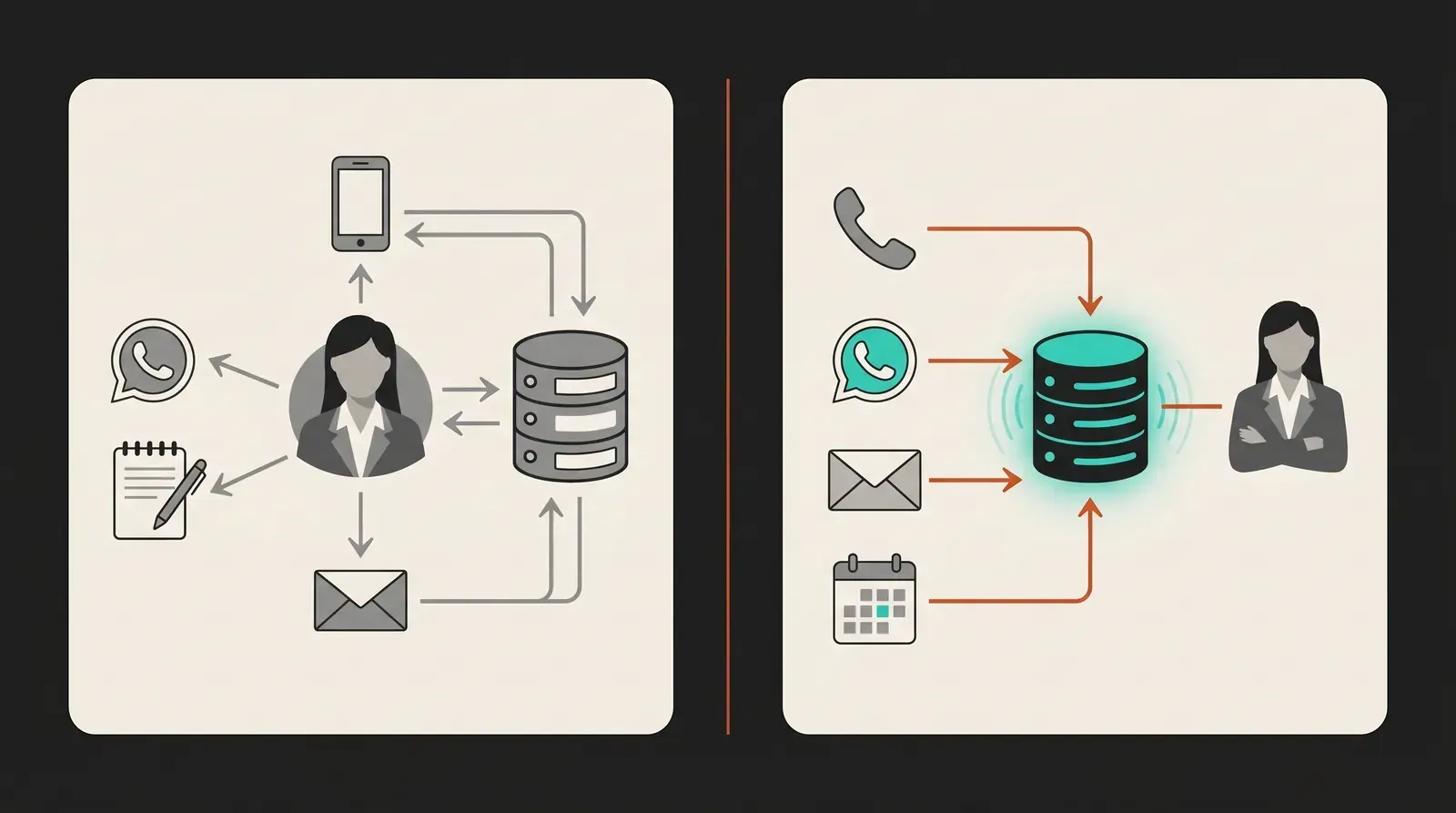
Defining the terms: AI-native vs AI-powered
Both terms describe how AI relates to a software platform’s core architecture. The definitions matter because the industry uses them interchangeably — incorrectly.
AI-powered CRM: a platform that adds AI features — resume parsing, predictive scoring, automated email drafting, insight dashboards — on top of a system originally designed for manual data entry. The underlying workflow still depends on recruiters to log conversations, update records, and maintain CRM hygiene. AI handles specific tasks within that workflow; it does not change the workflow itself.
AI-native CRM: a platform designed from the ground up with AI as the core engine. The data model, capture layer, and workflow logic are all built around the assumption that AI handles data input — so manual entry is the exception, not the default. Every conversation is a data event captured automatically. Records update continuously. Next actions surface proactively.
As Mosaic.ai put it in April 2026: “AI-powered is about making an old process slightly more efficient. AI-native is about creating an entirely new, more intelligent process.” [Source: Mosaic.ai, Apr 2026]
The distinction is not about feature count. An AI-powered CRM can have dozens of AI features and still depend on recruiters to log calls. An AI-native CRM has fewer visible AI features because the AI is structural — it runs in the background rather than appearing as buttons and widgets.
How the leading recruitment CRMs actually classify
The table below classifies the major recruitment CRM platforms by architecture — not by their own marketing claims.
| Platform | Architecture | AI approach | Manual entry still required? | Pricing (per user/month) |
|---|---|---|---|---|
| Bullhorn | AI-powered | AI features layered on legacy | Yes | $99–$150 |
| Vincere | AI-powered | Automation on manual foundation | Yes | $65–$120 |
| Manatal | AI-powered | AI parsing and insights on manual base | Yes | $15–$35 |
| JobAdder | AI-powered | AI built in to legacy workflow | Yes | $80–$130 |
| Signals | AI-native | AI as core architecture — no manual entry | No | See /pricing |
[Sources: Whitecarrot.ai, 2026; Zumotalent, 2026]
Bullhorn dominates the market — installed at roughly 60% of staffing agencies with 50 or more employees — but its AI features are additions to a system whose architecture has not fundamentally changed. [Source: LinkedIn/CRM market research, 2026] A 20-person agency running Bullhorn at $125 per user per month spends approximately $30,000 per year on a platform that still requires recruiters to do the admin work the platform should be handling. [Source: Zumotalent, 2026]
Vincere and Manatal sit in the same category. Both have invested heavily in AI features — interview scheduling automation, resume parsing, candidate scoring — but both still depend on recruiters to initiate conversations, log call outcomes, and update records. The AI improves specific steps in a manual process; it does not eliminate the process.
What AI-powered CRMs miss in recruitment
The core limitation of AI-powered architecture becomes most visible in APAC recruitment, where the majority of recruiter-candidate and recruiter-client conversations happen on channels that legacy CRMs cannot see.
In Hong Kong, executive search relationships are built over months of WhatsApp exchanges. In Singapore, tech sector roles move from initial signal to shortlist in days — speed that requires the CRM to reflect the current state of the network at all times. In Australia, email and LinkedIn dominate, but the same structural problem applies: conversations happen outside the CRM, and AI-powered platforms have no mechanism to capture them automatically.
“There’s a big difference between a CRM built with AI at its core — and a legacy platform that has bolted AI on top of existing technology.” — Jonathan Scott, LinkedIn, March 2026
An AI-powered CRM can draft a follow-up email automatically. It cannot log the WhatsApp conversation that preceded it. It can score a candidate based on their CV. It cannot update that score when the candidate mentions a change in availability during a phone call the recruiter forgot to log. The gap between what the CRM knows and what actually happened compounds every day.
Signals addresses this through Perfect Memory — the capture layer that logs every call, email, WhatsApp message, WeChat thread, LinkedIn exchange, and meeting automatically, against the right record, in real time. No recruiter input required. The features page covers how this works across every channel relevant to APAC agency recruiters.
What AI-native architecture enables that AI-powered cannot
The practical differences between AI-native and AI-powered CRM show up across four areas of daily recruitment workflow.
Conversation capture AI-powered CRMs capture what recruiters log. AI-native CRMs capture what recruiters do — every interaction, every channel, automatically. For agencies where a significant share of communication happens over WhatsApp or WeChat, this is not a marginal improvement. It is the difference between a CRM that reflects reality and one that reflects whatever the recruiter remembered to type.
Record accuracy over time Research shows approximately 74% of CRM records become stale or inaccurate within a year in manual-entry systems. [Source: Loxo, 2024] AI-native architecture eliminates decay by treating every conversation as a record update event. Signals’ Agentic CRM layer extracts updates from captured conversations and applies them continuously — so candidate availability, salary expectations, and client headcount plans stay current without any recruiter action.
Proactive intelligence AI-powered CRMs surface insights when recruiters ask for them. AI-native CRMs surface intelligence before recruiters know to ask. BD Signals — Signals’ hiring intent layer — identifies clients showing early signals of a new hire before a job goes live, based on conversation patterns and client activity captured automatically. This is only possible when the underlying data is complete and current — which requires AI-native architecture at the foundation.
Speed to shortlist Agencies using AI automation in recruitment CRMs fill roles 38% faster and grow five times faster than traditional firms. [Source: LinkedIn/CRM market research, 2026] Speed to Shortlist — Signals’ candidate ranking layer — produces a ranked shortlist from the existing network the moment a role lands. That ranking is only as good as the underlying candidate data. In an AI-powered CRM, that data is as accurate as recruiter logging compliance. In an AI-native CRM, it reflects every conversation that has ever happened.
How to evaluate whether a CRM is genuinely AI-native
Vendors across the market now use “AI-native” as a positioning claim regardless of their underlying architecture. These four questions cut through the marketing.
1. Does the CRM capture WhatsApp and WeChat automatically? If the answer is no — or if capture requires a manual integration the recruiter has to maintain — the platform is AI-powered at best. Automatic channel capture is a foundational requirement of AI-native architecture, not an optional feature.
2. Does the CRM update records without recruiter input? Ask for a live demonstration: make a call, send a WhatsApp, and watch whether the record updates automatically. If a recruiter has to open a record and type anything, the platform is not AI-native.
3. Does the CRM surface intelligence proactively or only on request? An AI-native CRM tells you which client is about to post a new role before you ask. An AI-powered CRM tells you what it found when you ran a report. The difference is whether intelligence is push or pull.
4. What happens to data when a recruiter leaves? In AI-powered CRMs, departing recruiters take their context with them — relationship history, deal detail, and candidate intelligence often exist only in their heads or their personal call logs. AI-native architecture preserves that context automatically because it was never dependent on the recruiter to enter it.
Signals passes all four tests. The for-agencies page covers how this applies specifically for agencies in APAC markets where multi-channel communication is standard and data loss on recruiter departure is a significant operational risk.
Why the gap between AI-native and AI-powered CRM widens over time
The AI-native vs AI-powered distinction compounds with every week of use. An AI-powered CRM starts with incomplete data and gets progressively less useful as records decay — the AI features built on top of that data produce diminishing returns. An AI-native CRM starts building accurate context from day one and improves continuously as more conversations are captured.
Top-performing recruitment agencies are already 57% more likely to be in advanced stages of digital transformation compared to their peers. [Source: Bullhorn GRID Report, 2025] The agencies investing in AI-native architecture now are building a data asset — a complete, accurate, continuously updated picture of every client relationship and every candidate in their network — that AI-powered competitors cannot replicate by adding features to a legacy foundation.
The architectural decision made today determines the quality of that data asset in twelve, twenty-four, and thirty-six months. Signals is built AI-native from the ground up — so every conversation your team has today becomes an intelligence advantage tomorrow.
See AI-native recruitment CRM in practice
See Signals on a desk like yours.
Common questions
AI-native vs AI-powered CRM is an architectural distinction: AI-native platforms are designed from the ground up with AI as the core engine, so data capture, record-keeping, and next-action surfacing happen automatically without recruiter input. AI-powered CRMs add AI features such as resume parsing, predictive scoring, and email drafting as a layer on top of a legacy system still built for manual data entry. For recruitment agencies, this means AI-native platforms eliminate admin at the source, while AI-powered platforms reduce it at the edges.
Bullhorn is AI-powered, not AI-native. Bullhorn has introduced AI features including automation, resume parsing, and insights, but these sit on top of a system architecture originally designed for manual data entry, where recruiters are still required to log calls, update records, and maintain CRM hygiene. Bullhorn dominates the market with roughly 60% of staffing agencies with 50+ employees using it, but its AI features are additions to a legacy foundation rather than a rebuild from the ground up. [Source: LinkedIn/CRM market research, 2026]
AI-native architecture matters for recruitment agencies because the majority of recruiter conversations happen off-platform, via WhatsApp, WeChat, phone calls, and informal emails, and never reach a manual-entry CRM. AI-native platforms like Signals capture these conversations automatically across every channel and update records continuously, so the CRM reflects reality whether or not the recruiter logs anything. AI-powered platforms, by contrast, still depend on recruiter compliance to maintain data accuracy, which means the admin problem is never fully solved.
An AI-powered CRM cannot become AI-native by adding features, because the distinction is architectural, not a question of feature count. AI-native means the underlying data model, capture layer, and workflow logic were all designed around the assumption that AI handles data input; AI-powered means those foundations were built for human input and AI was layered on top. As one industry commentator put it: 'There's a big difference between a CRM built with AI at its core and a legacy platform that has bolted AI on top of existing technology.' [Source: Jonathan Scott, LinkedIn, March 2026] Adding more AI features to a legacy system does not change the underlying architecture.
Signals, Vincere, and Manatal all use AI in their platforms, but only Signals is AI-native, meaning the entire platform is built around automatic data capture rather than manual entry. Vincere and Manatal are AI-powered: they automate specific tasks like resume parsing, interview scheduling, and email drafting, but their core architecture still requires recruiters to log conversations and maintain records manually. Signals captures every call, WhatsApp message, email, and meeting automatically through Perfect Memory, and updates records through its Agentic CRM layer, without any recruiter input.