What Perfect Memory in a Recruitment CRM Means
Every recruitment agency has the same blind spot. The conversations that win placements happen on calls, in WhatsApp threads, over WeChat, and in meetings — and most of them never reach the CRM. Perfect Memory in a recruitment CRM is the capability that closes that gap. This guide defines Perfect Memory, explains why agency memory fails today, and gives you a three-question test to assess whether your own CRM has it.
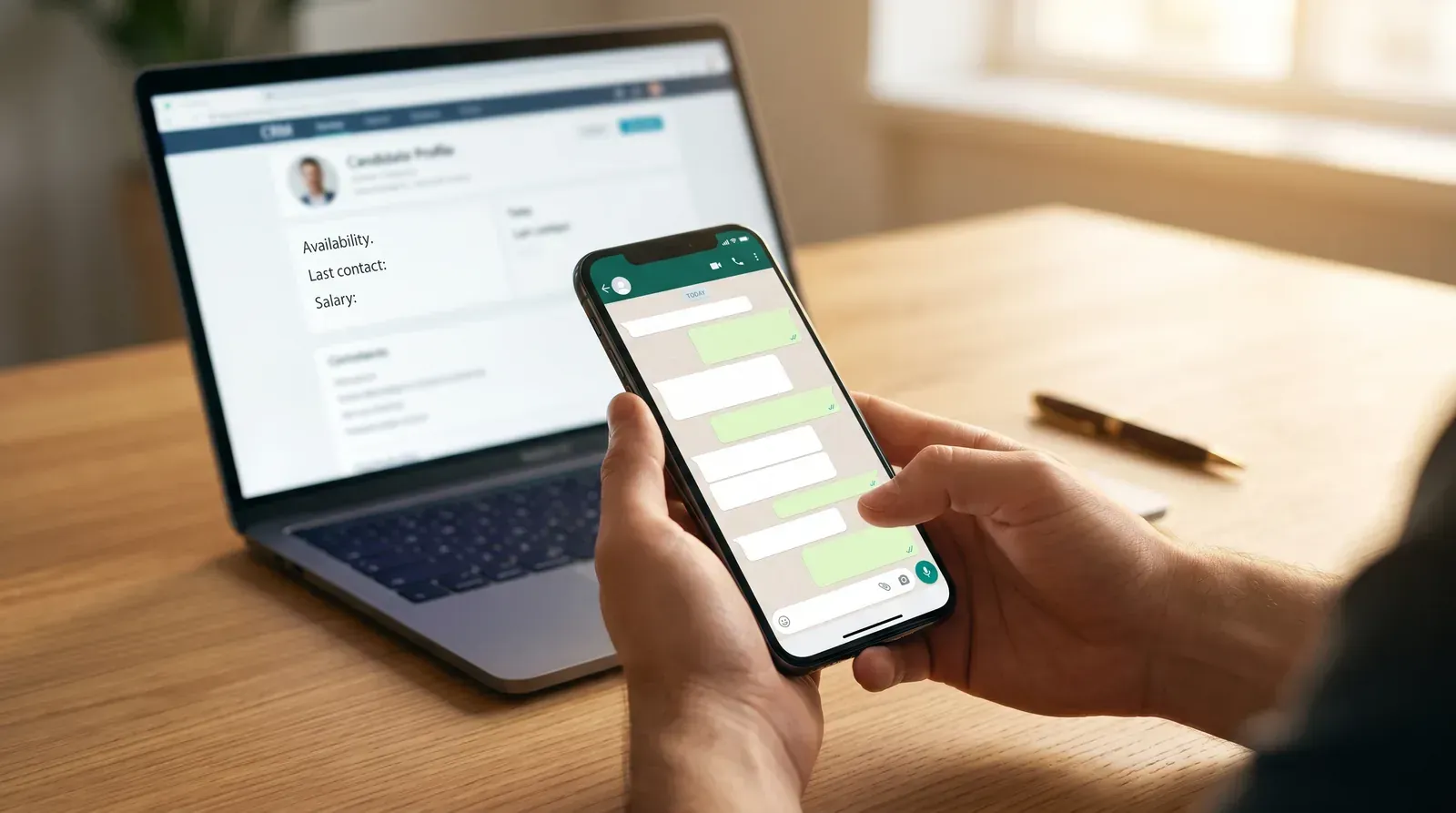
Perfect Memory in a recruitment CRM means every client and candidate conversation is captured, retained, and retrievable in context — across every channel, and regardless of which recruiter was in the room. It covers calls, emails, WhatsApp messages, WeChat exchanges, and meetings. It is not a notes field, and it is not a transcription add-on. It is the complete, durable record of what an agency actually said and heard.
The distinction that matters is between a system of record and a system of engagement. A system of record stores structured data a recruiter types in: names, salaries, job titles, pipeline stage. A system of engagement captures what actually happened — the objection a candidate raised, the budget a client let slip, the reason a deal stalled. Most recruitment CRMs are systems of record. Perfect Memory makes a CRM a system of engagement.
Recruiter memory is not the same as recruiter notes. Notes are what a recruiter remembers to write down, filtered by how busy the day was. Memory is everything that was said. The gap between the two is where placements quietly disappear. A client mentions a second role on a Friday call; the recruiter means to log it on Monday; by Monday the detail is gone. Multiply that by a year of conversations and the lost ground is substantial.
| Dimension | CRM without Perfect Memory | CRM with Perfect Memory |
|---|---|---|
| What it captures | Structured fields a recruiter types in | Every conversation, captured automatically |
| Channels covered | In-app email, manual notes | Calls, email, WhatsApp, WeChat, meetings |
| When a recruiter leaves | Their context leaves with them | The record stays with the agency |
| Retrieval | Search by name or tag | Full context: who, when, why, what next |
Signals treats Perfect Memory as a product pillar, not a feature — the foundation the rest of the CRM is built on. Every later capability, from candidate ranking to business development, depends on the agency actually remembering what happened.
Why Recruitment CRM Memory Fails Today
Recruitment CRM memory fails for a structural reason, not a discipline reason. The conversations that build recruitment relationships happen on the channels a CRM cannot see.
In Singapore, WhatsApp reaches 74.7% of the population and is the single most-used platform [Source: We Are Social/Meltwater Digital 2024: Singapore, February 2024]. For roles facing mainland China, WeChat — with 1.4 billion monthly active users — is the default business channel [Source: Value China, 2025]. A recruiter in Hong Kong or Singapore runs candidate outreach, scheduling, and salary conversations across these apps every day. None of it lands in a legacy CRM unless the recruiter stops and types it in.
They mostly do not. Across organisations, 76% say less than half of their CRM data is accurate and complete [Source: Validity, July 2025]. The cost is not abstract: 37% report losing revenue as a direct result of poor CRM data quality [Source: Validity, July 2025], and workers spend an average of 13 hours a week hunting for basic information inside the CRM [Source: Validity, July 2025]. An agency that cannot find what it knows is paying for the same conversation twice.
Then a recruiter leaves. Research finds 42% of institutional knowledge is unique to the individual — when they go, colleagues simply cannot perform that part of their job [Source: Panopto, July 2018]. Staffing agency permanent staff turnover averages around 25% a year [Source: TimeRack, March 2024], so for a ten-desk agency that is two or three handovers annually. Replacing each departing recruiter costs an estimated 50% to 200% of their annual salary [Source: SHRM via NXTThing RPO, November 2023] — and that figure counts only the rehire, not the client relationships that left with them. Each handover is a recruiter walking out with a phone full of WhatsApp history the agency never recorded.

When a recruiter leaves, they take two things: their salary expectations and their WhatsApp history. An agency with Perfect Memory loses only the salary expectations.
The recruiter who inherits that desk starts cold. New employees take three to six months to reach full productivity [Source: Panopto, July 2018] — and on an inherited desk with no conversation record, much of that time is spent rebuilding context that already existed. This is the problem behind why recruitment data goes missing: the data was never captured in the first place. Signals was built to remove that failure point — capturing every call, email, and message automatically, so the record exists whether or not a recruiter remembers to create it.
The Perfect Memory Test: Three Questions
Not every CRM that claims to capture conversations has Perfect Memory. The Perfect Memory Test is a three-question diagnostic for telling genuine memory from a notes field. A CRM has to pass all three — failing any one means the memory has a hole in it.
1. Is every conversation captured? Capture has to be complete and automatic. The test is not whether the CRM can store a call note — it is whether calls, emails, WhatsApp messages, WeChat exchanges, and meetings all reach the system without a recruiter manually entering them. Partial capture is not memory; it is a sample. If a channel your recruiters actually use is not covered by automatic conversation capture, the CRM fails question one.
2. Is it retrievable in context? A captured conversation is only useful if it can be found with its context intact — who said it, when, in relation to which role, and what was agreed next. A transcript dumped into a record is data, not memory. The test is whether a recruiter can open a candidate or client and see the full thread of the relationship, in sequence, without reconstruction. If retrieval means scrolling and guessing, the CRM fails question two.
3. Does it survive recruiter turnover? This is the question most CRMs fail. Memory that lives in a recruiter’s head, inbox, or personal phone is not institutional — it is personal, and it leaves when they do. The test is whether a new recruiter inheriting the desk can pick up every client and candidate relationship exactly where it was left. If the answer depends on the previous recruiter being available to ask, the CRM fails question three.
A CRM that passes all three has Perfect Memory. One that fails any of them has a notes field with good marketing. Signals was designed against exactly these three questions — Perfect Memory is the pillar, and the test is how an agency can hold any CRM, including ours, to account. The test is deliberately strict, because the cost of a near-miss — a re-introduced candidate, a forgotten client preference, a placement nobody invoiced — is paid in revenue.
What Perfect Memory Unlocks for an Agency
Perfect Memory is not an archival nicety. It is the precondition for everything else a modern recruitment CRM is supposed to do.
Business development gets faster. When every client conversation is captured, the signals that a client is about to hire — a passing comment about headcount, a budget mentioned on a call — are on the record instead of in someone’s memory. This is what makes BD Signals work: the CRM can surface hiring intent because it has the raw material. A CRM with no memory has nothing to read.
Candidate re-engagement gets warmer. A recruiter reopening a candidate after six months can see the whole history: the role they wanted, the reason the last process stalled, the personal detail that builds rapport. The candidate is not contacted as a stranger. They are contacted as someone the agency genuinely remembers.
Desk handovers stop being cold starts. When a recruiter inherits a desk backed by Perfect Memory, the relationships transfer with the desk. There is no three-month rebuild and no awkward “remind me how we know each other” — the context is already there. The agency keeps billing the desk while the new recruiter learns it, instead of absorbing a quarter of lost production every time someone moves on.
And the CRM can finally act. An Agentic CRM — one that drafts the follow-up, updates the record, and surfaces the next step — can only act on what it can see. Perfect Memory is the input; Agentic CRM is what the agency gets to do with it. Signals pairs the two deliberately: memory first, action on top.
Why Perfect Memory Needs an AI-Native CRM
Perfect Memory cannot be bolted on. It is an architecture decision, and that is why it separates AI-native recruitment CRMs from legacy systems with AI features added.
Consider what genuine capture requires: ingesting unstructured conversation from half a dozen channels, identifying who and what each exchange relates to, structuring it against the right candidate, company, and role, and keeping it retrievable in context — continuously, in the background, for every recruiter at once. A transcription tool records a call. A note-taking add-on saves a snippet. Neither was built to do the whole job, because the legacy CRM underneath them was never designed to hold it.
The gap shows up the moment an agency tries to add AI. Across organisations, 45% say their CRM data is not ready for AI [Source: Validity, July 2025]. AI built on broken memory produces broken output — it ranks candidates on partial history and drafts outreach from gaps. Perfect Memory is the prerequisite, not the bonus.
An AI-native recruitment CRM is built from the ground up to capture and structure conversation as its core function. That is the difference between AI-native CRM memory that holds and a legacy CRM that quietly forgets. Signals is AI-native for this reason: Perfect Memory is not a feature inside the product — it is what the product is built around.
Perfect Memory Is Institutional, Not Personal
The deepest problem Perfect Memory in a recruitment CRM solves is ownership. In most recruitment agencies, the memory of a client relationship belongs to a person, not the firm. It sits in a recruiter’s inbox, their phone, and their head — and it walks out the door with them.
Perfect Memory moves that knowledge from personal to institutional. Every conversation is captured and retrievable, regardless of who had it or whether they still work at the agency. An agency that never loses candidate data is an agency whose value compounds instead of resetting with every resignation.
Run the Perfect Memory Test on whatever CRM you use now. Is every conversation captured? Is it retrievable in context? Does it survive turnover? If the honest answer to any of the three is no, the agency is carrying a memory it does not own. Signals was built to make that memory permanent — an AI-native recruitment CRM where Perfect Memory is the foundation, not the feature.
See Perfect Memory in action
See Signals on a recruitment desk like yours.
Common questions
Perfect Memory in a recruitment CRM is the capability that captures, retains, and makes retrievable every client and candidate conversation, across every channel. It covers calls, email, WhatsApp, WeChat, and meetings, rather than only what a recruiter types into a notes field. A CRM has Perfect Memory only when that record survives recruiter turnover and stays usable by whoever inherits the desk.
Recruitment CRMs lose conversation data because most are built as systems of record that store structured fields a recruiter enters by hand. The real conversations happen off-platform on WhatsApp, WeChat, and phone calls, and those exchanges rarely reach the CRM. As a result, 76% of organisations say less than half their CRM data is accurate and complete [Source: Validity, July 2025].
The Perfect Memory Test is a three-question check for whether a recruitment CRM has genuine memory: Is every conversation captured? Is it retrievable in context? Does it survive recruiter turnover? A CRM that fails any one of the three does not have Perfect Memory, regardless of how many features it lists.
Recruiter turnover erases CRM memory because much of a recruiter's working knowledge about clients and candidates is never written down. Research finds 42% of institutional knowledge is unique to the individual and cannot be performed by colleagues once that person leaves [Source: Panopto, July 2018]. Staffing agency permanent staff turnover averages around 25% a year, so the knowledge base erodes continuously [Source: TimeRack, March 2024].
Perfect Memory requires AI-native architecture because capturing every conversation across every channel is a structural job, not a single feature. A transcription tool or note-taking add-on bolted onto a legacy CRM captures fragments, not the full record. An AI-native CRM is built from the ground up to ingest calls, email, WhatsApp, WeChat, and meetings automatically and surface them in context.