
Recruitment marketing for agencies has been miscategorised for a decade. Most existing guides describe recruitment marketing as content posting, employer branding, and social campaigns — the discipline of building an inbound funnel. For a corporate in-house HR team running pipeline marketing at scale, that framing works. For a recruitment agency running a desk of senior consultants, it does not. The actual lever for recruitment marketing at an agency is not more content. It is timing: the right outbound touch to the right person at the moment that touch will land. And the system that owns the timing is not a separate marketing automation tool — it is the recruitment CRM.
Why recruitment marketing for agencies has been the wrong discipline
The default vocabulary for recruitment marketing came from in-house corporate hiring, not from agency recruitment. The dominant frameworks — inbound funnels, AIDA, employer-brand stages — describe what a corporate talent acquisition team does to build a candidate pipeline against future job openings. They make sense in that context. Applied to a recruitment agency desk, they describe roughly nothing the agency actually does.
The agency desk runs on relationships, not pipelines. A senior consultant on a Hong Kong finance desk does not run a 12-month content nurture sequence against a hiring manager at a tier-one bank. They run a relationship: a conversation history that goes back two, three, five years, punctuated by mandates, candidate placements, follow-up calls, and the occasional dinner. The same is true of the client side at a tech-focused Singapore desk or a contract-perm Australian desk. The consultant does not need to broaden their inbound funnel — they need to know which existing contact is moving toward a hire next quarter, and reach them at the right moment.
This is why generic recruitment marketing programmes have consistently failed at smaller and mid-sized agencies. The State of Agency Recruitment 2026 benchmark reported that 56.16% of agency recruiters describe their current tech stack as “functional but fragmented,” with sourcing, outreach, CRM, and automation operating in silos Source: Atlas, March 2026. The fragmentation matters because it means relationship history sits in one tool, outbound campaigns run from another, and signal flow lives in a third — none of which talk to each other. The default agency “marketing programme” ends up generic precisely because the data it needs to be specific is scattered.
The fix is architectural, not tactical. Recruitment marketing for agencies should be defined as the discipline of timing outbound touches against captured relationship history and live BD signals. Where the relationship history lives, and where the BD signal flow runs, is the recruitment CRM.
What recruitment marketing actually is when the CRM is the marketing engine
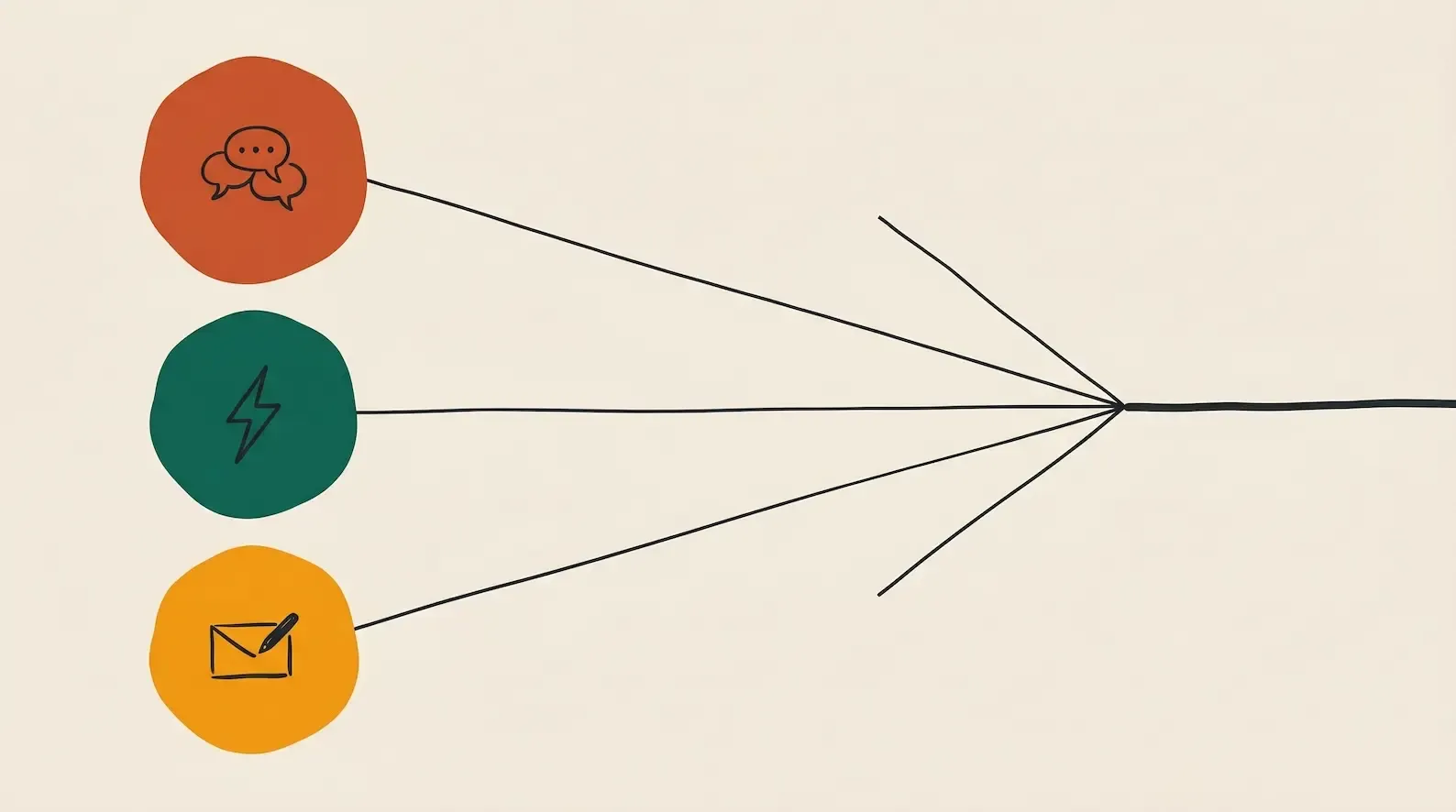
The functional definition of recruitment marketing for an agency in 2026 is short: every outbound touch — call, email, WhatsApp, LinkedIn message, in-person meeting — fired with the relationship context already attached and the signal trigger already known. Three components have to come together for that to happen: a memory layer holding every prior conversation, a signal layer surfacing live hiring intent, and a message layer crafting the actual touch.
In a legacy stack, those three components live in three different tools. The memory layer is partially in the CRM, partially in email, partially in WhatsApp, partially in nobody’s head except the senior consultant’s. The signal layer is whatever the consultant manually noticed in the news or in a LinkedIn alert. The message layer is whatever the consultant typed at 9am Monday morning. The marketing function is the consultant remembering all three at once.
In an AI-native recruitment CRM, the three components are one system. Perfect Memory holds every conversation across every channel as a single record per contact. BD Signals reads the live signal flow — leadership change, funding round, headcount growth — and ranks where hiring intent is rising. The message layer becomes the consultant’s actual job: writing the touch the system has already decided is well-timed and well-informed.
This is what the Signal-Timed Outbound model formalises. It is the operating definition of recruitment marketing for agencies — not a content programme, not a social cadence, but a three-input system run from the CRM.
Perfect Memory — the relationship history layer
The first input to Signal-Timed Outbound is relationship history. Marketing without history is a cold sequence. Marketing with history is a continuation of a conversation that already exists. The difference is what makes outbound from a recruitment agency read as professional intelligence rather than as spam.
The reason most agencies cannot operate with full relationship history is that the conversation layer is structurally fragmented. The State of Agency Recruitment 2026 found that 80.82% of agency recruiters use AI primarily for admin and data entry tasks Source: Atlas, March 2026 — meaning most AI investment in recruitment agencies today is going to patching the data-fragmentation problem rather than to operating intelligently on the data. The marketing layer cannot be timed when most of the energy is going to making the underlying data legible in the first place.
Perfect Memory removes the problem at the architecture level. Every call, every email, every WhatsApp thread, every WeChat exchange, every meeting note feeds one record per contact. The next outbound touch references that record. A consultant pitching to a Singapore tech client opens the CRM and sees the full conversation history with the contact going back as far as the agency has existed — the prior mandate they ran together, the candidate they shortlisted, the conversation about a regional expansion six months ago, the WhatsApp message about timing that nobody else on the team remembers. The marketing touch lands as a continuation, not a cold introduction.
The reason this changes the economics of agency recruitment marketing is that relationship-anchored outbound converts at multiples of cold outbound. The signal is not new — every senior recruiter knows this intuitively. What is new is the system that makes it operationally possible at scale, across an entire desk, without depending on any individual consultant’s memory.
BD Signals — the trigger layer
The second input is the signal. Relationship history alone is insufficient — it tells you who, but not when. The when is what BD Signals provides.
A BD signal is a discrete data point that indicates a client is moving toward a hiring decision: a leadership appointment, a funding round announcement, a regional HQ buildout, a SEEK cluster of related roles, a LinkedIn headcount spike. The signal precedes the mandate, usually by two to four weeks. An agency that reads the signal at week one is operating with a two-to-three-week lead on the agencies that read it at week three. The lead time is the marketing advantage.
In APAC the signal stack is structurally different by market — Hong Kong reads finance leadership change, Singapore reads tech funding rounds, Australia reads SEEK clusters and LinkedIn headcount growth. The Hiring Intent Signal Map catalogues which signals predict mandates in which markets, and the CRM is the layer that reads them per desk.
What the BD Signals layer does for recruitment marketing is convert the signal into the trigger. When a signal fires on a contact in the CRM, the consultant gets the prompt to reach out — with the relationship history already loaded and the signal already named. The outbound touch becomes timed. The marketing programme stops running on a calendar and starts running on intent.
This is the operational difference between agency recruitment marketing in 2026 and how the discipline has been described for the last decade. The calendar-driven newsletter is replaced by the signal-driven touch. The consultant’s job is no longer to remember to reach out — it is to write the message when the system tells them to.
The Signal-Timed Outbound model
Signal-Timed Outbound is the framework that combines relationship history, signal trigger, and market-fit message into a single operating model for recruitment marketing at agencies.
The model has three inputs and one output.
Input 1 — Relationship history from Perfect Memory. The conversation record per contact, including every channel and every prior interaction.
Input 2 — BD signal trigger from BD Signals. The live indicator that the contact is moving toward a hiring decision, ranked by historical conversion against the desk’s prior mandates.
Input 3 — Market-fit message. The actual content of the touch, written by the consultant — informed by the relationship history and timed by the signal.
Output — A timed outbound touch. A WhatsApp message, an email, a LinkedIn message, a call, or a meeting request that references the relationship and addresses the signal, fired at the moment the signal is freshest.
The model is deliberately simple because the operational difficulty is not in the inputs — it is in keeping the inputs current, accurate, and connected. The recruitment CRM is what does that connecting. In a legacy stack the consultant manually reconciles three tools to construct each outbound touch. In an AI-native CRM, the reconciliation has already happened by the time the consultant opens the contact record.
This is what it means for the CRM to be the marketing engine. It is not that the CRM sends the touch — a marketing automation tool can send a touch. It is that the CRM decides which touch, to whom, at what moment, with what reference. The decision-making layer is the marketing layer. Sending is downstream.
What Signal-Timed Outbound looks like on an APAC desk
The model generalises across APAC because the inputs adapt by market. Three vignettes show the same operating logic playing out differently.
Hong Kong finance desk. A consultant runs a four-year relationship with a managing director at a tier-one bank. BD Signals fires — the bank announces a new APAC head of investment banking. The consultant opens the contact record, sees the full conversation history including prior senior team build-out discussions, and sends a WhatsApp message that references both the appointment and the earlier conversation. The mandate that follows two weeks later goes to the consultant who reached out first.
Singapore tech desk. The consultant holds a relationship with a regional VP at a Southeast Asian SaaS company, with two prior candidate referrals in the history. BD Signals fires on a Series B announcement. The consultant sees the funding round, opens the relationship record, and emails a curated shortlist for the predictable Series-B hires — VP Engineering, Head of Sales, APAC GM — referencing the prior placements as proof of fit. The email lands 48 hours after the announcement.
Australia desk. A relationship has been dormant for six months. BD Signals fires on a SEEK cluster — three senior engineering roles posted by the same employer in the same week. The consultant calls the talent director, references the prior placement they did together, and offers help on the new cluster. The talent director’s inbound process had not yet briefed an agency.
The architecture is the same in all three vignettes. The relationship history is loaded. The signal fires. The consultant writes the touch. The CRM is the system that connected the two. The signal stack differs by market but the operating model is unified — which is what makes Signal-Timed Outbound a framework rather than a single workflow. For agencies running APAC desks, the recruitment CRM has to be built for the region — multi-channel ingest, multi-market signal flow, and a single contact record across the channel mix. That is the marketing engine.
Why this only works inside an AI-native CRM
Signal-Timed Outbound only works as a continuous operating model if the recruitment CRM is built to hold the three inputs as one system. Three architectural conditions have to be true.
First, the conversation layer has to be captured at source. If WhatsApp, WeChat, voice, and email do not feed the CRM automatically, the relationship history is incomplete and the marketing touch falls back to whatever the consultant remembers. An AI-native CRM ingests the conversation layer at the channel level. A legacy CRM logs what the consultant types in.
Second, the signal layer has to be live and per-market. A US/UK default signal model misses most of the Hong Kong finance market and most of the Singapore tech market. An AI-native CRM weights signals by desk based on the agency’s actual placement history. A legacy CRM weights signals by a single global template.
Third, the system has to learn from outcomes. Every touch that converts to a mandate, every touch that does not, every signal that fired before a placement, every signal that fired before nothing — the CRM has to feed all of that back into the ranking. The signal that fired five mandates last quarter on the Hong Kong desk should outrank the signal that has never fired a mandate. A legacy CRM cannot do that ranking. An AI-native CRM does it as the default operating mode.
Asia Pacific talent acquisition software spending is projected to grow from US$3.39 billion in 2026 to US$5.31 billion by 2031 Source: Mordor Intelligence, May 2026. The investment is real, and APAC staffing market growth is forecast at 13.8% CAGR through 2031 Source: Business Market Insights, February 2025. The question is whether the agencies making that investment are choosing CRMs that can run Signal-Timed Outbound — or CRMs that will leave the marketing programme as fragmented as it was a decade ago. The architectural choice now determines the marketing capability later. Signals is built so the CRM is the marketing engine by default: Perfect Memory at the data layer, BD Signals at the trigger layer, and the consultant operating with both already connected.
See what Signal-Timed Outbound looks like
See Signals on a recruitment desk like yours.
Common questions
Recruitment agencies use modern CRM systems as the marketing engine, the place where every outbound touch is timed against captured relationship history and live BD signals. The CRM holds the conversation record per contact across every channel (email, WhatsApp, WeChat, calls, meetings), and surfaces hiring intent signals (leadership changes, funding rounds, headcount growth) as triggers for outbound. The result is signal-timed outbound rather than calendar-driven campaigns. Brand visibility is measured through CRM-based touchpoints such as opens, replies, call outcomes, and meeting logs, rather than vanity content metrics.
The Signal-Timed Outbound model is a three-input framework for recruitment marketing at agencies. Input one is relationship history from Perfect Memory: the conversation record per contact across every channel. Input two is the BD signal trigger from BD Signals: the live indicator that the contact is moving toward a hire. Input three is the market-fit message written by the consultant, informed by the relationship and timed by the signal. The output is a timed outbound touch that lands as professional intelligence rather than as cold outreach. The model is the operating definition of recruitment marketing for agencies in 2026.
Generic content marketing fails at recruitment agencies because the agency desk runs on relationships, not pipelines. A senior consultant does not run a 12-month content nurture sequence against a hiring manager. They run a multi-year relationship that needs to be referenced at the moment a hiring decision is forming. Content marketing optimises for inbound funnel volume. Agency recruitment marketing needs to optimise for outbound timing on existing relationships. The two disciplines have different inputs, different outputs, and different infrastructures.
Perfect Memory changes outbound recruitment marketing by removing the relationship-fragmentation problem at source. In a legacy stack, prior conversations live in email, WhatsApp, WeChat, voice notes, and the consultant's head, so the next outbound touch can only reference whatever the consultant remembers. Perfect Memory captures every channel into one record per contact, so the next touch references the full conversation history automatically. The marketing touch lands as a continuation rather than a cold introduction, which is what converts at multiples of cold outbound.
Yes. Recruitment marketing for APAC agencies depends on a channel mix and signal stack that US/UK guides do not describe. The dominant communication channels include WhatsApp in Hong Kong and Singapore, WeChat in the Greater Bay Area, Line in Japan, and a SEEK + LinkedIn mix in Australia. The signal stack is also market-specific: Hong Kong reads finance leadership change, Singapore reads tech funding rounds, Australia reads SEEK job-ad clusters. An APAC recruitment CRM has to ingest the regional channel mix and read the regional signal stack, otherwise the marketing engine misfires on most of the desk's actual activity.