
“Should we switch our CRM?” is the question the partner group asks. It’s the wrong question. The right question is “which specific readiness signals are firing, and are they structural or fixable?” The answer to the first question depends entirely on the answer to the second. This article specifies the five readiness signals that separate a legacy CRM that needs training and configuration from a legacy CRM that needs replacement. Three or more signals firing means architecture problem, not process problem — the point at which recruitment CRM migration is not just justified but strategically overdue. The Legacy CRM Migration Framework walks the five signals, the migration path, and the operational reality after the switch.
Why “should we switch CRM?” is the wrong question
Most agencies asking “should we switch CRM?” are actually asking two different questions at once. Question one: is the current CRM performing poorly? Question two: is there a better CRM available? Both are worth asking, but neither is the migration decision.
The migration decision is: is the performance problem structural, or is it configuration and training? A poorly configured CRM can be reconfigured. A poorly trained team can be retrained. Both are cheaper than migration. But a structurally misaligned CRM cannot be trained or configured out of the mismatch — the architecture is producing the problem, and no amount of user-adoption effort will change that.
Salesforce and Forrester’s 2023 State of CRM in Asia Pacific research surveyed 795 executives globally, including 164 executives across APAC. 71% of APAC executives reported dealing with data from “far too many sources,” struggling to access crucial insights in real time Source: Salesforce / Forrester Consulting, March 2023. That’s a structural integration problem — no amount of user training makes the data less fragmented.
Bullhorn’s 2024 APAC recruitment technology analysis reported that 69% of respondents said they could not do their job effectively without their CRM, rising to 76% for technology recruitment agencies Source: Bullhorn, November 2024. The CRM is mission-critical. Which means the cost of an architectural mismatch compounds daily — every day the mismatch persists, revenue outcomes shift because the system is producing the wrong signals to the wrong people.
The Legacy CRM Migration Framework specifies five signals that distinguish structural mismatch from fixable issue. Two or fewer firing: patch. Three or more firing: migrate.
The Legacy CRM Migration Framework — five readiness signals
The Legacy CRM Migration Framework has five signals. Each has a diagnostic question the senior partner can answer without waiting for a formal audit.
| Signal | Diagnostic question | Fixable by training? |
|---|---|---|
| 1. Conversation Capture Gap | What percentage of the actual channel mix (WhatsApp, WeChat, LinkedIn, voice, email, meetings) does the CRM automatically capture? | No — capture is architectural |
| 2. BD Signal Blindness | Does the CRM proactively surface hiring-intent signals per contact, or does the partner have to search for them? | No — signal detection is architectural |
| 3. Cross-Channel Handover Loss | When a consultant leaves, what percentage of their conversation history transfers vs stays on their phone? | No — capture location is architectural |
| 4. Attribution Debt | Can the partner group answer “which touch closed which mandate?” for any placement in the last quarter? | No — attribution linkage is architectural |
| 5. Speed-to-Shortlist Ceiling | Is the 7-day shortlist cadence limited by system constraints or by team discipline? | Partially — some constraints are system, some are process |
Three or more of these firing as system constraints (not fixable by training or configuration) indicates structural mismatch. The rest of this article walks each signal and closes on what migration actually looks like.
The framework is deliberately diagnostic rather than aspirational. It doesn’t ask “is your CRM great?” It asks “which specific structural problems exist?” The senior partner running the diagnostic can complete it in one afternoon and get a defensible answer to the migration question.
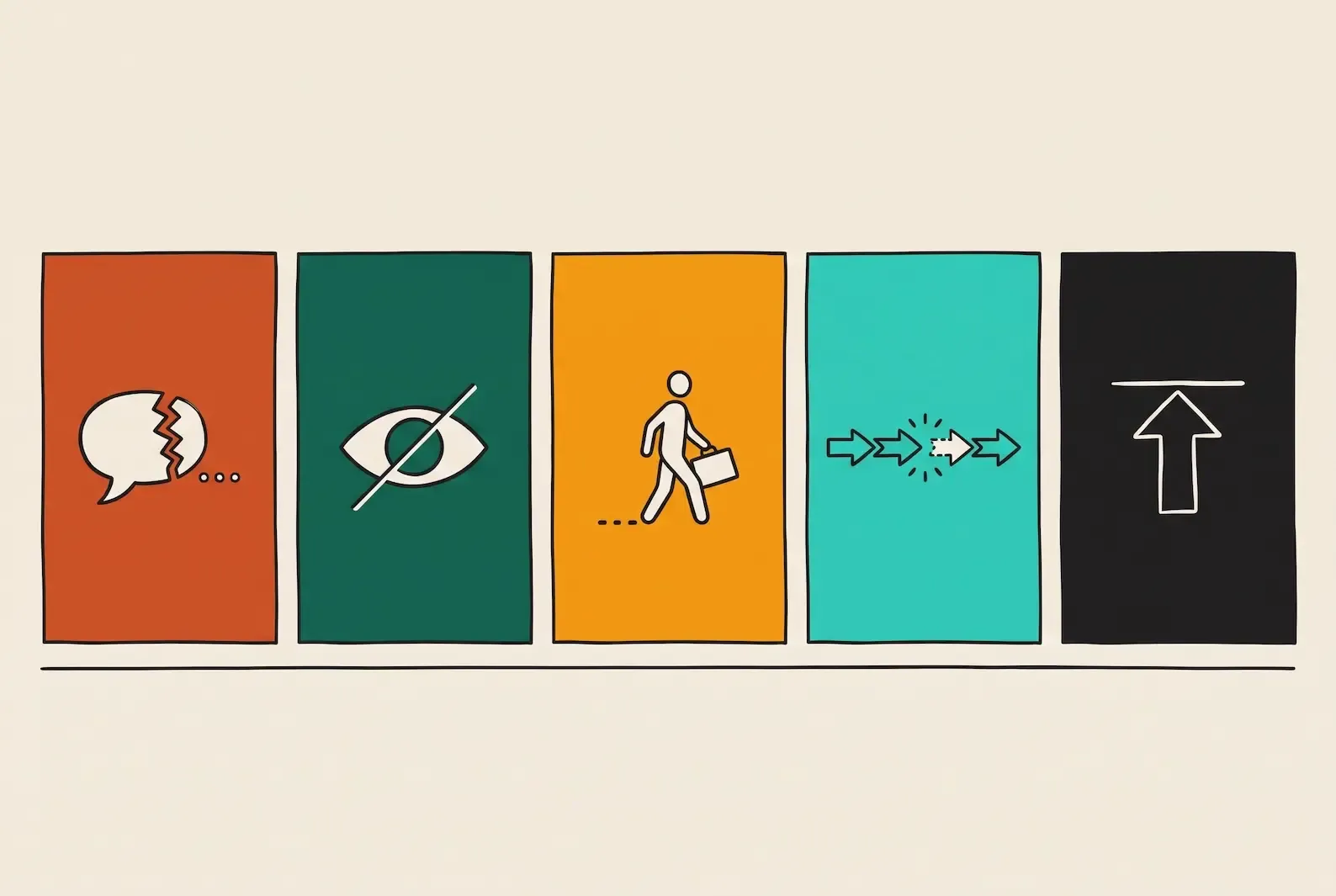
Signal 1 — Conversation Capture Gap
The Conversation Capture Gap measures how much of the actual channel mix the current CRM automatically captures. On a senior desk running WhatsApp for candidate work, WeChat for GBA, LinkedIn for international, and email for formal continuation, the honest audit is: what percentage of last week’s conversations ended up in the CRM record without manual logging?
For most agencies, the answer is under 40%. Email is captured, usually. LinkedIn message metadata may be. But WhatsApp, WeChat, voice calls, and in-person meetings often live entirely outside the CRM. Validity’s 2025 State of CRM Data Management research found that 76% of organisations say less than half of their CRM data is accurate and complete Source: Validity, July 2025. The gap is not a training problem — it’s a capture-architecture problem.
The Conversation Capture Stack is the operational layer that closes this gap. Whether the current CRM has one is the diagnostic. If it doesn’t, and the channel mix on the desk is dominated by messaging apps and voice, Signal 1 is firing structurally. The gap is not closable by training the team to log more — the team will not log more consistently than they have for the past two years.
Signal 1 is the most common structural signal in APAC-market recruitment agencies. Where WhatsApp and WeChat dominate the senior channel mix, a CRM without native ingest for those channels has a permanent structural gap. Training and configuration cannot close it. Migration to a CRM built to ingest messaging channels at source can.
Signal 2 — BD Signal Blindness
BD Signal Blindness measures whether the CRM proactively surfaces hiring-intent signals per contact, or whether the partner has to search for them manually.
The diagnostic: on Monday morning, does the CRM show the partner a ranked list of contacts where BD signals fired last week? Or does the partner open the CRM and start manually thinking about who to call?
Most legacy CRMs are storage systems, not signal systems. They record what was typed into them but do not read external market activity — leadership changes, funding rounds, headcount growth, regional HQ buildouts, executive appointment news — and surface those against the contact record. The partner has to notice signals themselves, correlate with relationship history themselves, and decide what to do. When that manual work stops (usually within a quarter of any new BD initiative), BD activity reverts to the consultant’s memory.
This is what the Weekly BD Call List Cycle addresses at the operating-cadence level. But the cadence only works if BD Signals is doing the signal detection underneath — and BD Signals only works if the CRM architecture is designed to ingest market data and rank against desk history.
The Atlas 2026 State of Agency Recruitment benchmark found that only 34.25% of agencies measure recruiter performance primarily through placements and revenue; the rest rely on activity metrics as their main KPIs Source: RecruitWithAtlas, March 2026. Signal Blindness is what forces the fallback to activity metrics — the CRM cannot show what actually converts, so effort becomes the proxy.
Signal 2 firing structurally is the point at which an Agentic CRM becomes the architectural answer — not a nice-to-have, but the specific feature category the current system lacks.
Signal 3 — Cross-Channel Handover Loss
Cross-Channel Handover Loss measures what happens when a consultant leaves the agency. The diagnostic: of the relationships the departing consultant built over their tenure, what percentage of the conversation history stays with the agency vs walks out on their phone?
For most agencies, the answer is closer to 20% than 80%. The email records stay in the corporate email system. The status fields in the CRM stay. But the WhatsApp threads, the WeChat exchanges, the voice notes, the personal-LinkedIn DMs live on the consultant’s personal device and go with them. The agency’s relationship with a candidate the consultant developed over five years reduces to what the CRM structured fields captured, which is often minimal.
This is the Perfect Memory architectural requirement: every conversation across every channel captured at source into the agency’s system of record, not into the consultant’s personal device. Legacy CRMs treat capture as a manual data-entry step by the consultant. Every manual step is a data-loss surface. The consultant leaves, the data leaves.
Signal 3 firing structurally means the agency is one departure away from losing meaningful relationship history. The senior partner should ask: “if our top consultant left tomorrow, what percentage of their pipeline could a new consultant continue?” If the answer is “we could reconstruct maybe half,” Signal 3 is firing — and it’s firing structurally, not because the departing consultant didn’t want to hand over.
The ATS+CRM integration failure piece covers the related handover-loss mode. Signal 3 as a migration signal is more specific: it’s about whether the architecture makes handover automatic or manual. Automatic handover is not achievable through team training.
Signal 4 — Attribution Debt
Attribution Debt measures accumulated inability to link marketing and BD activities to placements and fees. The diagnostic: can the partner group answer “which touch closed which mandate” for any closed placement in the last quarter?
For most agencies, the answer is no — or “we can guess, but not confidently.” The touch happened. The mandate closed. Both are in the CRM, sometimes. But the linkage between them — the sequence of touches that produced the mandate, the signal that triggered the outreach, the channel that got the reply — is not queryable data. It’s institutional memory in the partner’s head, or lost.
Staffing Industry Analysts’ 2025 Small Staffing Firm Growth Survey reported that 57% of small staffing firms do not have a defined process for linking BD and marketing activity to pipeline stages or fee revenue Source: SIA, June 2025. That’s Attribution Debt as an industry-wide pattern. The Signal-to-Fee Trace is the measurement model designed to close it — but the model only runs if the underlying CRM captures the touchpoints and links them.
Attribution Debt compounds every quarter. In year one, the partner has a rough intuition of what works. In year three, that intuition is untestable — the data was never captured cleanly. The strategic decisions for year four are being made on years-old assumptions no data can validate.
Signal 4 firing structurally means the agency is running BD strategy on partner instinct rather than on data. That’s not a training problem or a discipline problem — it’s an architecture problem. Legacy CRMs were designed to store records, not to link touches to outcomes as a queryable path.
Signal 5 — Speed-to-Shortlist Ceiling
Speed-to-Shortlist Ceiling measures whether the 7-day shortlist cadence is limited by system constraints or by team discipline.
The Speed to Shortlist Playbook specifies a 7-day operating cadence. When an agency tries to run that cadence and can’t, the question is: where’s the constraint? If Days 2-3 (longlist generation) take twice as long as they should because the CRM can’t surface relationship history alongside candidates, that’s system. If Day 4 (conversation pass) is capped at 8 calls instead of 12 because manual logging takes 90 minutes at the end, that’s system. If Day 5 (stakeholder triangulation) collapses because the CRM can’t hold multi-user collaborative notes, that’s system.
Signal 5 is the partially-fixable signal. Some Speed-to-Shortlist constraints are system; some are process. The diagnostic is: which specific days of the cadence break, and is the break at the CRM layer or the team-discipline layer?
If Days 2, 4, and 5 break at the CRM layer, Signal 5 is firing structurally. The 7-day cadence becomes the 14-21 day default not because the team lacks discipline but because the system is producing the delay.
HeyMilo’s 2026 AI recruiting tools analysis reported that 41% of AI recruiting tool deployments fail at the ATS integration layer Source: HeyMilo, June 2026 — a self-reported vendor figure but consistent with the structural argument. Adding AI tooling to a legacy CRM to try to hit the cadence often fails because the integration layer is where the mismatch concentrates. Signal 5 firing structurally means the ceiling is the CRM, not the team — and the ceiling doesn’t lift with more tools bolted on.
What migration actually looks like — the 90-day path
When three or more signals are firing structurally, migration becomes the strategic answer. The path is a 90-day one — not a weekend switch, not a two-year project.
Days 1-30 — data preservation and audit. Export the current CRM to a portable format. Audit the data — contact records, activity history, mandate records, fee records. Identify what was captured versus what was implied. Clean the export. The ATS+CRM integration failure patterns that caused sync drift will be visible in the audit; the migration is also the opportunity to resolve version drift into a single canonical record.
Days 31-60 — channel-mix transition and configuration. Set up the new CRM with the channel ingest points active — WhatsApp, WeChat, LinkedIn, email, voice. Route new conversations into the new system. Preserve read access to the old system for reference. Configure BD Signal ingest for the desk’s specific market and signal mix. Set up Perfect Memory as the underlying data layer.
Days 61-90 — team transition and rollout. Migrate consultants to the new system in cohorts of 2-3 rather than all at once. Each cohort has 10 days to shift daily workflow. Feedback loop tuning happens in real time. By Day 90, the whole desk is on the new system and the old system is read-only.
The pattern breaks when agencies try to migrate over a weekend (data loss, team pushback) or try to run parallel systems for six months (nobody uses the new one). 90 days with cohort rollout is the durable path. Bullhorn’s 2024 APAC data shows 78% of agencies already have a CRM in place Source: Bullhorn, November 2024 — so the migration question isn’t about adopting CRM for the first time. It’s about switching from a legacy stack to an architecture that matches the current reality.
What changes on the new stack — and why patching keeps failing
Ninety days after the new stack is live, four operational changes are visible to the senior partner.
First, the Conversation Capture Gap closes. Every WhatsApp, WeChat, email, voice, and meeting feeds the candidate record automatically. The consultant stops the end-of-day logging ritual because there’s nothing to log — the record built itself.
Second, BD Signal Blindness disappears. Monday morning shows the ranked signal list, not a blank contact search. The partner runs the week from the CRM prompt instead of from memory.
Third, Cross-Channel Handover Loss stops being a business risk. When a consultant leaves, the relationship history stays. The next consultant opens the contact and reads the actual conversation — WhatsApp threads included.
Fourth, Attribution Debt begins to unwind. New touches captured cleanly can be linked to new placements. The first quarter of post-migration data is where the Signal-to-Fee Trace starts working. Legacy data doesn’t magically become attributable — but from Day 90 forward, the debt stops growing.
The alternative — the keep-patching path — fails at the same points every time. Each new integration compounds the sync-drift patterns the ATS+CRM integration failure piece documented. Each new AI tool bolted on hits the 41% integration-failure rate. Each quarter the Attribution Debt compounds. The patching path doesn’t converge — it accumulates.
Signals is built as the architecture the Legacy CRM Migration Framework diagnoses toward. Perfect Memory captures every channel at source. Agentic CRM reads market signals and surfaces the ranked list. Conversation capture, cross-channel history, attribution linkage, and 7-day cadence support are architectural defaults, not add-ons. The migration decision is whether the current stack is closing these gaps or accumulating them — and three or more firing signals is the answer.
Run the five-signal diagnostic on your stack
See Signals on a recruitment desk like yours.
Common questions
A recruitment agency should migrate off a legacy CRM when three or more of the five readiness signals are firing structurally, meaning training and configuration cannot fix the underlying mismatch. The Legacy CRM Migration Framework specifies the five signals: Conversation Capture Gap, BD Signal Blindness, Cross-Channel Handover Loss, Attribution Debt, and Speed-to-Shortlist Ceiling. Two or fewer firing signals indicate a fixable configuration or training problem, which is cheaper to patch. Three or more indicate structural architecture mismatch, at which point migration is the strategic answer rather than a nice-to-have.
The Legacy CRM Migration Framework is a Signals-coined diagnostic model with five readiness signals that separate a legacy CRM that needs training and configuration from a legacy CRM that needs replacement. Each signal has a specific diagnostic question the senior partner can answer without waiting for a formal audit. Conversation Capture Gap asks what percentage of the channel mix the CRM captures. BD Signal Blindness asks whether the CRM surfaces hiring-intent signals proactively. Cross-Channel Handover Loss asks what stays when a consultant leaves. Attribution Debt asks whether touches can be linked to mandates. Speed-to-Shortlist Ceiling asks whether the 7-day cadence is limited by system or team. Three or more signals firing structurally means architecture problem.
The Conversation Capture Gap measures how much of the actual channel mix a CRM automatically captures. On a senior desk running WhatsApp for candidate work, WeChat for GBA, LinkedIn for international, and email for formal continuation, the honest audit is: what percentage of last week's conversations ended up in the CRM without manual logging? For most agencies the answer is under 40%. This is not a training problem. It's a capture-architecture problem, and it's the most common structural signal in APAC-market recruitment agencies where WhatsApp and WeChat dominate the senior channel mix.
The Legacy CRM Migration Framework specifies a 90-day path: Days 1-30 for data preservation and audit (export, clean, resolve version drift), Days 31-60 for channel-mix transition and configuration (activate ingest points, route new conversations, configure BD Signals for the desk's market), Days 61-90 for team transition (cohort rollout of 2-3 consultants at a time, 10-day workflow shift per cohort). Weekend switches produce data loss and team pushback; six-month parallel-system runs mean nobody uses the new one. 90 days with cohort rollout is the durable path.
Patching a legacy CRM keeps failing because patches address symptoms, not architecture. Every quarter another workaround gets bolted on. Every workaround introduces a new integration point that will fail. HeyMilo's 2026 vendor analysis reported that 41% of AI recruiting tool deployments fail at the ATS integration layer, which is self-reported vendor data but consistent with the structural argument that legacy stacks compound errors rather than absorbing them. Each new tool bolted onto a legacy stack hits the same failure surface. The patching path doesn't converge; it accumulates.