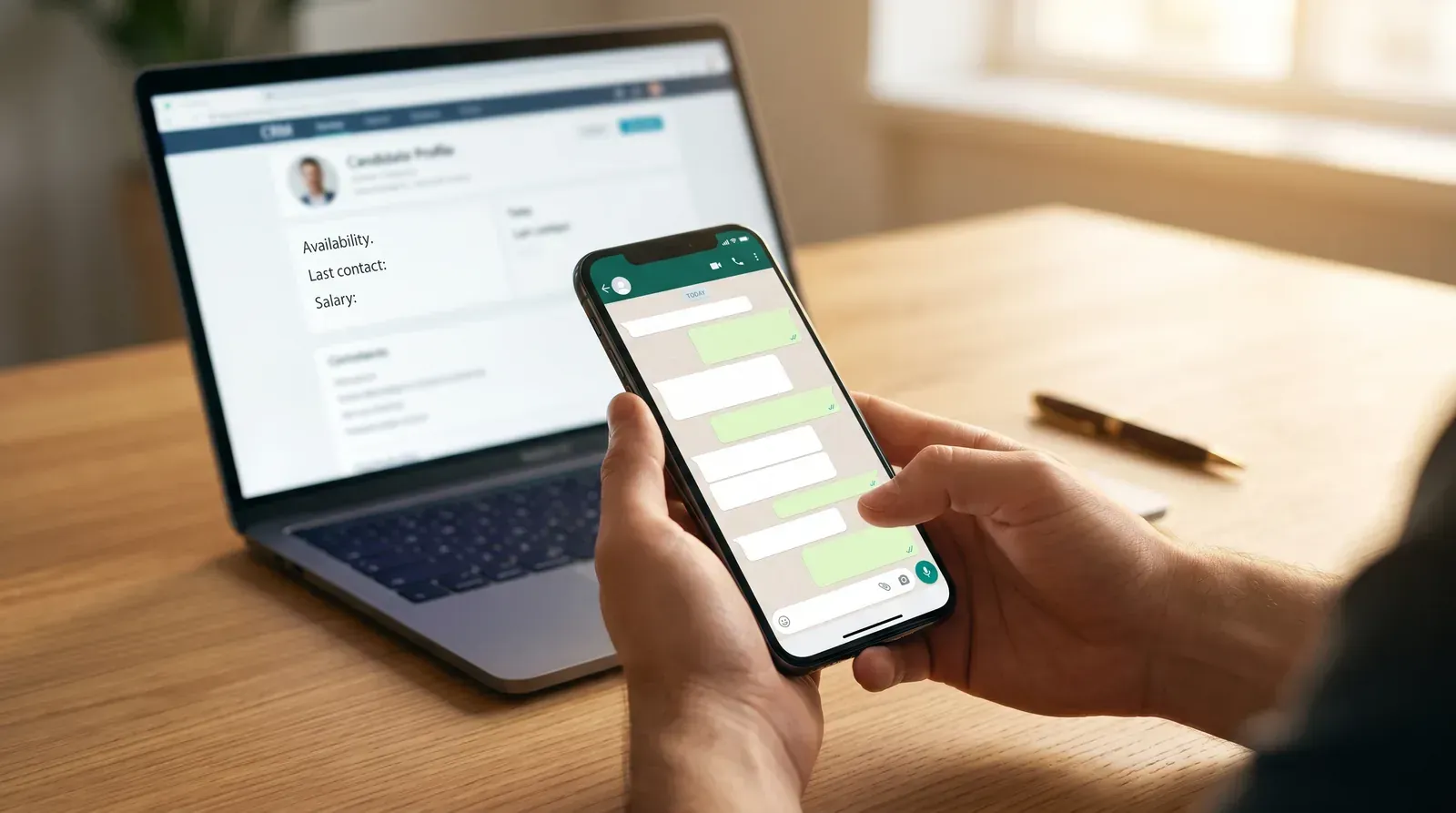
What conversation capture in a recruitment CRM actually means
Every recruitment agency loses conversations. The call where a candidate dropped their salary expectation, the WhatsApp where a client mentioned a new headcount, the meeting note that never reached the system — these vanish unless the CRM captures them automatically. This article defines conversation capture in a recruitment CRM as a category, walks through the four layers of the Conversation Capture Stack, and shows how to evaluate any CRM against the standard.
Conversation capture in a recruitment CRM is the automatic ingestion of every recruiter interaction across every channel — calls, email, WhatsApp, WeChat, and meetings — into a single relationship record, without any manual logging step. It covers what was said and sent, not just what was typed into a notes field. Forrester defines the parent category as conversation intelligence: tools that use natural language processing to capture unstructured data from conversation channels between buyers and sellers Source: Forrester, June 2023. The recruitment version of this is narrower in audience and broader in channel — agency recruiters communicate across more channels per relationship than almost any other sales profession, and the channels differ sharply by market.
The case for automatic capture is structural, not aspirational. Salesforce’s sixth State of Sales report finds sales professionals spend 60% of their working week on non-selling tasks — CRM entry, manual note logging, scheduling — leaving only 40% for revenue-generating activity Source: Salesforce, July 2024. The downstream consequence is worse: when manual logging is incomplete, the CRM data degrades. Validity’s 2025 research finds 76% of CRM users say less than half their data is accurate and complete, and 37% lose revenue as a direct result Source: Validity, July 2025. Manual capture is the structural cause.
This is why Signals treats conversation capture as the foundation layer of an AI-native recruitment CRM rather than as a feature within it. Perfect Memory — Signals’ name for the capture pillar — is the precondition for every other capability the platform delivers.
The four layers of the Conversation Capture Stack
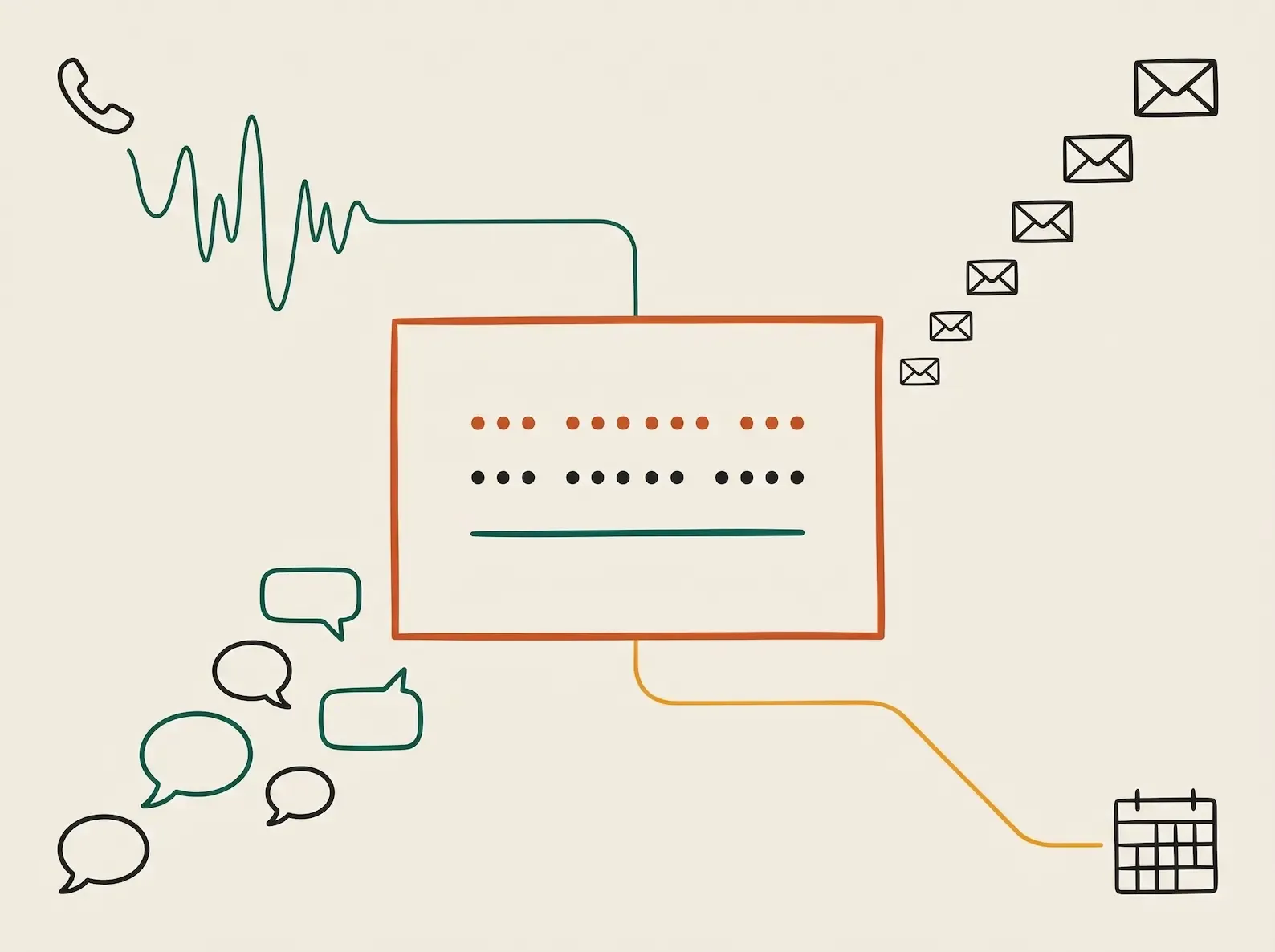
The Conversation Capture Stack is a four-layer model defining the channels a recruitment CRM must capture automatically to maintain a complete relationship record. Each layer corresponds to a distinct technical mechanism. A CRM that handles three layers and fails the fourth is not a partial capture system — it is a system that misses one out of every four interactions a recruiter has, and the gap compounds into a structurally incomplete dataset.
Layer 1 — Calls. Voice conversations enter the CRM via VoIP integration or native call recording, then pass through transcription and natural language processing to surface key moments — salary mentions, availability changes, client intent signals. The technical baseline is a dialler tied to the CRM; the modern minimum is real-time transcription with structured extraction against the right candidate or company record.
Layer 2 — Email. Email is the most mature capture layer because it has been a structured channel for two decades. OAuth-based sync with Gmail and Outlook pulls every inbound and outbound message into the right candidate or company record. The hard part is not capture itself but matching — assigning the right thread to the right relationship without manual tagging.
Layer 3 — Messaging apps (WhatsApp and WeChat). This is the layer where most recruitment CRMs fail. WhatsApp capture for an APAC agency requires either the WhatsApp Business API — Meta’s official enterprise channel, with template messaging and per-message fees — or a QR-code integration with personal WhatsApp accounts. For mainland-China-facing recruitment, WeChat (or its enterprise variant WeCom) is non-negotiable. Tencent reports 1.38 billion monthly active users on WeChat globally Source: Statista citing Tencent, Q3 2024.
Layer 4 — Meetings and video. Conferencing integrations (Zoom, Teams, Google Meet) and calendar hooks capture the meeting itself, the attendees, and — through transcription and summary — the substance of what was discussed. This layer differs from Layer 1 only in delivery medium; the same NLP extraction logic applies.
Across all four layers the principle is constant: the CRM ingests the conversation at source, not from a recruiter’s post-hoc summary. This is what distinguishes Signals’ Perfect Memory layer from add-on transcription tools layered onto a legacy CRM — the architecture treats every conversation, on every channel, as a structured data event from the moment it happens.
Why each layer is non-negotiable for APAC agencies
The Conversation Capture Stack matters most where the channel mix is most fragmented. APAC recruitment is the canonical case: every layer of the Stack is active, and the messaging layer dominates in a way it does not in the US or UK.
In Singapore, WhatsApp is the most-used social platform — 80.1% of the population uses it monthly, and 30.4% cite it as their preferred platform Source: We Are Social/Meltwater, February 2025. In Hong Kong, WhatsApp reaches 70.6% of internet users, tied with Facebook as the leading platform Source: Statista, Q3 2024. A recruitment CRM that captures email perfectly but cannot ingest WhatsApp is structurally blind to the majority of recruiter activity in both markets.
For Hong Kong agencies running cross-border mandates into mainland China, WeChat — and its enterprise variant WeCom — is the parallel requirement. The channel cannot be substituted for WhatsApp or email; mainland Chinese candidates and clients communicate on WeChat by default. In Australia, the channel mix is closer to the UK pattern — email and LinkedIn dominate, with WhatsApp at roughly 10 million active users Source: Social Media News Australia, June 2025 and SMS still significant for short-form candidate contact.
The implication is that “complete capture” is geographically defined. A US-built CRM that ingests email, calls, and meetings is complete by US standards and incomplete by Hong Kong or Singapore standards. Signals was built on the APAC channel set first — every layer of the Conversation Capture Stack, including WhatsApp and WeCom, treated as primary rather than optional.
The capture failure cost — what an incomplete Stack actually leaks
When the Stack fails at any layer, the agency loses three categories of value simultaneously.
The first is data quality. CRM records age fast in recruitment because the underlying world changes fast — candidates take new roles, salary expectations shift, clients restructure their priorities. Each off-platform conversation that does not reach the CRM is a record that quietly goes stale, and the cumulative effect compounds. Salesforce’s State of Sales finds only 35% of sales professionals completely trust the accuracy of their CRM data Source: Salesforce, July 2024. A two-thirds trust gap is what manual capture produces.
The second is BD intelligence. The most valuable signals in a client relationship are usually informal — a passing mention of a restructure on a WhatsApp message, a candidate saying they are “open in three months” on a call. These never reach a legacy CRM unless someone types them in. BD Signals — Signals’ name for the hiring-intent layer — runs on what Perfect Memory captures. A capture gap in any layer of the Stack is a BD signal that the system never sees.
The third is institutional knowledge at recruiter departure. In an agency where conversations live on individual phones and in personal inboxes, a recruiter leaving is a data-loss event. Every WhatsApp thread, every undocumented call note, every client preference held in someone’s head exits with them. Validity’s 2025 data — 45% of organisations say their CRM data is not ready for AI Source: Validity, July 2025 — is the aggregate version of the same problem. AI cannot reason about data that was never captured.
Conversation capture is the layer that makes all three risks structural rather than personnel-dependent.
How AI-native architecture handles each layer at source
There is a meaningful distinction between adding a transcription tool to a legacy CRM and architecting the CRM around automatic capture. Both produce some output. Only one produces a system of record.
Bolt-on tools — meeting transcribers, WhatsApp browser extensions, AI note-takers — handle one layer well and require a separate sync to land in the CRM. Each tool stores its data in its own platform, and matching that data to the right candidate, company, or job becomes a downstream cleanup job. The Forrester Wave on conversation intelligence flags this directly, noting that most CI tool users “only use CI to record and listen to calls, which creates more work for managers and sellers” Source: Forrester Wave, October 2023. Recording is not the same as capturing.
An AI-native recruitment CRM treats each layer of the Stack as a primary data source. Calls hit a transcription engine that writes the structured outcome — not the raw audio — to the candidate record. Emails sync via OAuth and resolve to the right thread automatically. WhatsApp and WeChat are wired in at the platform layer via the relevant API, not patched in via browser extensions. Meeting transcripts attach to the search rather than to the recruiter. The recruiter never opens the CRM to log anything — the CRM is already up to date when they open it.
This is what makes Perfect Memory possible as a product pillar rather than a marketing claim, and it is what an Agentic CRM depends on to act. The agent can only act on what the system can see. Every layer of the Stack the CRM does not capture is a blind spot in the agent’s reasoning.
How to evaluate any CRM against the Conversation Capture Stack
The Stack is a diagnostic, not a marketing claim. Any recruitment CRM under evaluation can be tested against it in an afternoon. The test is binary per layer: does the CRM capture this channel automatically at source, or does it require a recruiter to do something to log it?
| Layer | Pass condition | Common failure mode |
|---|---|---|
| Calls | Calls log automatically with transcription against the right record | Calls require a manual outcome note; transcription is a separate tool |
| Inbound and outbound email syncs via OAuth without recruiter forwarding | Only emails sent from inside the CRM are captured | |
| Messaging — WhatsApp / WeChat | Messages flow into the CRM through a native integration with no recruiter action | Messages require copy-paste; the channel is not supported natively |
| Meetings | Calendar and conferencing hooks attach attendees, transcripts, and summaries automatically | Meetings require a separate note-taker or post-hoc summary |
A CRM that passes all four layers has genuine conversation capture. A CRM that passes three has a structural gap on one channel — usually messaging, and usually for an APAC agency that did not realise the layer was scored separately. A CRM that passes two or fewer is a system of record only for what recruiters type into it.
The question to ask vendors is not “do you have WhatsApp?” but “does WhatsApp flow into the candidate record without any recruiter action?” The first question gets a marketing answer. The second produces a demonstration.
Signals is built to pass all four layers by design — every layer of the Stack treated as a primary data source, with Perfect Memory as the capture architecture and the Agentic CRM layer reading the captured data to surface the next action.
Conversation capture is infrastructure, not a feature
The Conversation Capture Stack is the diagnostic for whether a recruitment CRM is doing the job at all. If the CRM cannot capture every layer at source — calls, email, WhatsApp and WeChat, and meetings — it is producing partial intelligence on partial data, and the AI features layered on top inherit the same gap.
Manual capture is the structural cause of stale data, missed BD signals, and the institutional knowledge loss that happens at every recruiter departure. Validity’s research is the most current published version of this finding Source: Validity, July 2025; the recruitment-specific version is sharper because the channel mix is more fragmented and the relationships are more personal. The fix is architectural — capture at source, on every channel, automatically. That is what Signals builds toward, with Perfect Memory as the foundation and the rest of the platform — BD Signals, Speed to Shortlist, Agentic CRM — running on the data the Stack collects.
See the Conversation Capture Stack in action
See Signals on a recruitment desk like yours.
Common questions
Conversation capture in a recruitment CRM is the automatic ingestion of every recruiter interaction, across calls, email, WhatsApp, WeChat, and meetings, into the CRM without any manual logging step. It covers what was said, sent, and scheduled, not just what a recruiter typed into a notes field. Most CRMs only store the latter, which is why most of an agency's relationship intelligence ends up sitting on personal devices rather than in the system.
An AI-native recruitment CRM captures WhatsApp and WeChat through native channel integrations, typically the WhatsApp Business API and Tencent's WeCom for enterprise, with QR-code integrations available for personal WhatsApp accounts. Each message is filed against the right candidate, company, or job record in real time. The technical mechanism differs by channel, but the outcome is the same: every message reaches the CRM the moment it is sent, with no recruiter action required.
The Conversation Capture Stack is a four-layer model defining the channels a recruitment CRM must capture automatically to maintain a complete relationship record: calls (via VoIP integration), email (via OAuth sync), messaging apps including WhatsApp and WeChat, and meetings (via calendar and conferencing integrations). A CRM that fails any layer leaves recruiter intelligence outside the system, where it is invisible to AI and unrecoverable when a recruiter leaves.
WhatsApp is the dominant communication channel in Singapore and Hong Kong, used by 80.1% of Singaporeans and 70.6% of Hong Kong internet users monthly [Source: We Are Social/Meltwater Digital 2025](https://wearesocial.com/sg/blog/2025/02/digital-2025-top-digital-and-social-media-trends-in-singapore/). A recruitment CRM that cannot capture WhatsApp is structurally blind to the majority of recruiter activity in these markets, regardless of how strong its other features are.
An agency loses three things at once: data quality (records age fast and quietly), BD signals (the informal hiring intent mentioned on a call or in a message never reaches the system), and institutional memory at recruiter departure (every undocumented conversation walks out with the person). Validity's 2025 research finds 76% of CRM users say less than half their data is accurate and complete, and 37% report losing revenue as a direct result [Source: Validity, July 2025](https://www.validity.com/resource-center/the-state-of-crm-data-management-in-2025/).