
Executive search is not a faster version of contingency recruitment
The distinction matters because it determines whether any given CRM will ever work for your desk.
Contingency recruitment is a volume discipline — multiple agencies competing simultaneously on success-fee terms, drawing from databases of active candidates, placing roles in weeks. Executive search is a relationship discipline — a retained, exclusive engagement where a single firm conducts bespoke research to identify and assess passive leaders for a role that may take four to five months to fill. CEO roles now average 149 days to close. [Source: Forbes, Apr 2024] Standard hiring cycles average 30–45 days. [Source: Korn Ferry, Feb 2026] The CRM built for the second model will structurally fail the first — not because of missing features, but because the underlying architecture makes the wrong assumptions about how recruitment work actually happens.
This article identifies the five specific ways most recruitment CRMs fail executive search desks, and explains what an AI-native approach changes for each one.
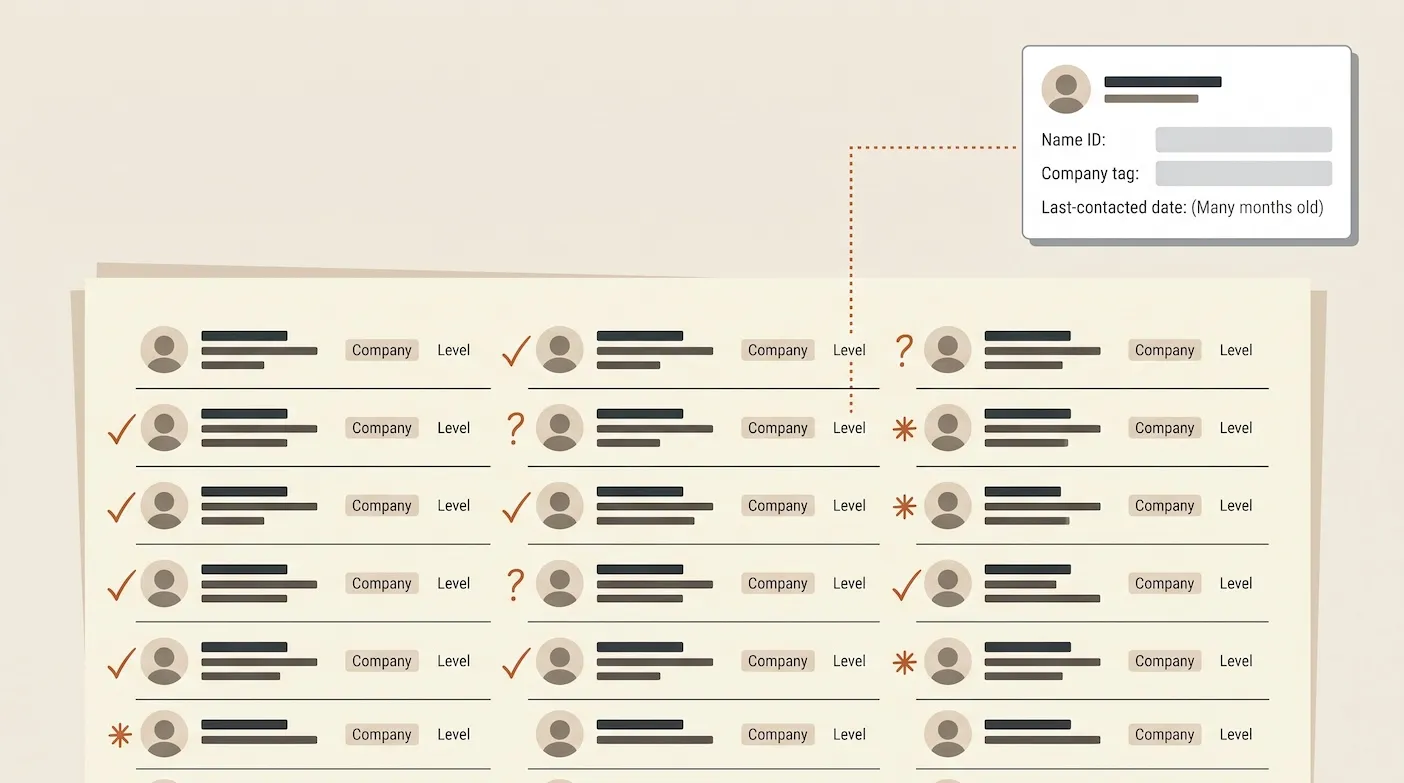
Why most CRMs are designed for the wrong model
Executive search is defined by three characteristics that most recruitment CRMs were not designed to support.
Retained and exclusive: AESC defines executive search firms as specialist management consultants retained on an exclusive basis to identify, assess, and select the best candidate for a leadership role — operating in an advisory capacity with strict confidentiality and off-limits obligations throughout. [Source: AESC, 2025] The relationship between the firm and the client is a consulting engagement, not a vendor transaction. Most CRMs model the relationship as a deal in a pipeline.
Passive candidates over long timescales: Executive search requires sourcing candidates who are not actively looking — people already in senior roles who need to be approached directly, assessed carefully, and engaged over time before a placement conversation is even appropriate. AltoPartners describes retained executive search as “low-volume, high-value,” focused on C-suite and board roles where candidates are often passive and relationships are built over years. [Source: AltoPartners, Jul 2024] Most CRMs are designed for active candidates who apply to jobs.
Multi-year relationship intelligence: A candidate assessed for a CFO role in 2023 may be the ideal fit for a CEO mandate in 2026. Executive search firms win by remembering what that person told them three years ago — their appetite for a step up, their geographic constraints, their compensation expectations, their off-limits organizations. That intelligence lives in conversations. Most CRMs can only store what someone manually typed into a field.
The global executive search market is valued at approximately USD 64 billion in 2026 and growing. [Source: Mordor Intelligence, Jan 2026] The firms capturing that growth are those whose systems preserve relationship intelligence across years — not those whose consultants spend their days on data entry. The platforms built specifically for that model rather than adapted to it are a short list, and how Loxo, Ezekia and Signals differ across it is where the architectural choice becomes concrete rather than categorical.
Failure mode 1 — Conversations happen off-platform and never reach the CRM
The most fundamental CRM failure for executive search desks is also the most common: the conversation happened, but the CRM doesn’t know about it.
In APAC executive search — Hong Kong finance, Singapore tech, regional HQ markets across Southeast Asia — the majority of candidate and client communication happens over WhatsApp. Over 90% of Hong Kong professionals use WhatsApp for work communication, and the channel’s dominance in APAC makes it the default for the sensitive, relationship-building exchanges that define executive search. [Source: Regus survey via Hong Kong Business] WeChat carries equivalent weight for mainland China-connected markets.
None of these conversations reach a legacy CRM automatically. They require a consultant to open a record, navigate to the interaction log, and type a summary — after the fact, from memory, while managing five other live searches. Research from EverReady.ai estimates that incomplete CRM logging can cost companies an average of 15% in revenue, and that 85% of professionals say they have missed opportunities because of incorrect or missing data. [Source: EverReady.ai, Dec 2025]
For executive search, the stakes are higher still. A candidate who mentions in a WhatsApp exchange that they are considering relocating from Hong Kong to Singapore in the next twelve months is sharing intelligence that could determine whether they are shortlisted for three different mandates over the next year. If that message never reaches the CRM, that intelligence is gone.
| Communication channel | Captured in legacy CRM? | Captured in Signals? |
|---|---|---|
| No — manual logging required | Yes — Perfect Memory, automatic | |
| No — manual logging required | Yes — Perfect Memory, automatic | |
| Phone calls | No — manual note required | Yes — Perfect Memory, automatic |
| Sometimes — if configured | Yes — Perfect Memory, automatic | |
| LinkedIn messages | Partial — via integration | Yes — Perfect Memory, automatic |
| In-person / video meeting | No — manual note required | Yes — Perfect Memory, automatic |
Signals addresses this through Perfect Memory — the capture layer that logs every conversation automatically across every channel, against the right candidate, company, or assignment record, in real time. Executive search consultants in Hong Kong can have a WhatsApp exchange with a CFO candidate at 9pm and arrive at their desk the next morning with the conversation already in the record, tagged, and searchable.
Failure mode 2 — Pipeline stages don’t map to executive search workflow
Executive search is not a five-stage funnel. A retained search typically runs through research, market mapping, long-list, outreach, qualification interviews, assessment, short-list, client presentation, stakeholder interviews, referencing, offer, and onboarding — each stage requiring different actions, different stakeholder involvement, and different data capture requirements. [Source: AltoPartners, Jul 2024; Gogloby, Mar 2026]
Most recruitment CRMs ship with pipeline templates designed for contingency volume hiring: sourced, screened, interviewed, offered, placed. These stages map cleanly to a 30-day placement cycle. They do not map to a 149-day retained executive search with three rounds of client presentations, a reference process that spans four continents, and a notice period negotiation that runs for eight weeks after acceptance.
“Executive search is won by remembering what a candidate told you eighteen months ago. A CRM that depends on manual logging will never give you that.”
The consequence of mismatched pipeline stages is not just an aesthetics problem. It forces executive search consultants to either misuse existing stages — compressing or skipping steps that the system does not recognise — or to maintain a parallel system of spreadsheets, documents, and notebooks that actually reflects the search. That parallel system is invisible to the CRM, uncheckable by management, and gone the moment the consultant changes role.
Signals’ Agentic CRM layer is designed around workflow logic — it adapts to how executive search actually flows rather than forcing consultants into a template built for volume hiring. The next action is surfaced automatically based on where the assignment actually is, not based on where a pre-built pipeline stage assumes it should be.
Failure mode 3 — Manual data entry consumes the time that should go to relationship-building
Executive search is relationship-intensive by definition. EBSCO’s academic overview of executive headhunting describes it as requiring network-based sourcing that goes beyond conventional advertising — sourcing built on personal relationships, trusted referrals, and the credibility of individual consultants who are known in their market. [Source: EBSCO, Jan 2025]
Manual CRM data entry is the direct enemy of that relationship work. Research from HootRecruit estimates that recruiters spend 70–80% of their working time on repetitive administrative tasks including CRM updates, documentation, and scheduling. [Source: HootRecruit, Aug 2025] A CXR briefing on recruiter productivity found that executive-level recruiters managing multiple live searches can lose over 10 hours per week to avoidable friction — including more than 90 minutes per day on duplicated data entry across systems. [Source: CXR, Jan 2026]
For executive search consultants, this admin burden is particularly damaging because the work that generates revenue is almost entirely relational — it cannot be parallelised or outsourced. Every hour spent logging call notes in a CRM is an hour not spent calling the next candidate on the long-list, maintaining the relationship with the client, or building the network that generates the next retained mandate.
AI adoption in recruitment nearly doubled from 26% to 53% of organisations between 2023 and 2024, and 78% of high-growth staffing firms already run AI inside their CRM. [Source: HR.com via HRmarketer, Nov 2024; Bullhorn GRID 2026 via Pin, Feb 2026] The firms moving fastest are those whose AI layer eliminates data entry entirely — not those adding AI features on top of a manual-entry foundation.
Signals removes manual entry at the architecture level. Perfect Memory captures every conversation automatically. The Agentic CRM layer extracts updates from those conversations and applies them to records continuously. The consultant’s time goes to the work that generates fees — not to the system that is supposed to track it.
Failure mode 4 — Data integrity degrades over the multi-year timescales executive search requires
Standard B2B contact data decays at 20–30% per year as professionals change roles, companies, and availability. [Source: Salesmate, 2024] For most recruitment CRMs operating on 30–45 day contingency cycles, this decay rate is manageable — the data is used quickly and a record that is six months old barely matters. For executive search, where a candidate assessed today may not be placed for twelve months and may be ideal for a different mandate eighteen months later, a 20–30% annual decay rate means the majority of the database is unreliable within two years.
This is not a theoretical risk. It is the standard operating condition for executive search firms that use manual-entry CRMs. A candidate’s current role, compensation, availability, and geographic appetite all change over time — and none of those changes reach the CRM unless someone manually updates the record. Most do not. Only 2% of companies report using all the functionality in their CRM platforms, suggesting that the vast majority of records are partially completed at best. [Source: EverReady.ai, Dec 2025]
For an executive search firm in Hong Kong or Singapore where the same handful of senior finance or technology executives circulate across multiple mandates over a five-year period, an unreliable database is not just an inconvenience — it is a reputational risk. Approaching a candidate for a role they were considered for eighteen months ago, without knowing whether they took another position in the interim, signals a firm that does not maintain its own intelligence. That is fatal to the trusted-advisor positioning that retained executive search depends on.
Signals maintains data integrity through continuous automatic update. Every conversation that mentions a candidate’s current situation — their new role, their salary expectation, their availability window — is captured by Perfect Memory and surfaced through the Agentic CRM layer as a record update. The database reflects the current state of relationships, not a snapshot from the last time a consultant had a moment to type.
Failure mode 5 — Search and recall fails to surface relationship context
When an executive search mandate lands for a CFO role in a Singapore fintech company, the question is not “which candidates in our database have ‘CFO’ in their title” — it is “which candidates do we know well enough, who are in the right moment of their career, and who have expressed interest in this type of role in the conversations we have had over the past two years?”
Standard CRM keyword and Boolean search cannot answer that question. It can find records where a field has been populated correctly. It cannot surface a candidate based on something they said in a phone call three months ago that was never typed into a field. AI-powered NLP and semantic search — the kind that reads across unstructured conversation data — can. [Source: SmartRecruiters, Nov 2025]
This is the most commercially significant failure mode for executive search desks, because it determines the quality of the shortlist and the speed of the search. An executive search consultant who can ask their system “who in our network is a strong CFO profile in Southeast Asia who has expressed interest in a move in the next six months” and get a ranked, contextual answer is fundamentally more effective than one who runs a Boolean search and reads through three hundred manually-maintained records.
AESC’s commentary on the 2024 Global Conference in Singapore highlighted growing experimentation with AI tools in executive search and described Asia as a growth region for leadership consulting. [Source: Kaneko & Associates summary, Feb 2025] BCG’s 2025 survey found that 78% of APAC respondents use AI tools at least weekly — a higher rate than any other region globally. [Source: BCG, Oct 2025] The executive search firms building the most competitive desks in APAC are those making this shift from keyword retrieval to contextual intelligence now.
Signals surfaces relationship context through Speed to Shortlist — the layer that ranks candidates from the existing network the moment a mandate lands, drawing on the full conversation history captured by Perfect Memory. The shortlist is not a keyword search result — it is a contextual ranking based on everything the firm knows about every relevant candidate in its network.
What an AI-native CRM changes for executive search
Each of the five failure modes described above has the same root cause: the CRM was designed for human-entered, structured data in a short-cycle hiring workflow. Executive search generates unstructured, relationship-rich data over multi-year timescales. The mismatch is architectural, not superficial — adding features to a manual-entry system does not solve it.
An AI-native recruitment CRM like Signals solves each failure mode at the architecture level:
- Off-platform conversations captured automatically across WhatsApp, WeChat, email, calls, and meetings — no manual logging required
- Pipeline stages adapted to executive search workflow through Agentic CRM — not forced into a volume-hiring template
- Manual data entry eliminated — consultants spend their time on relationships, not on administration
- Data integrity maintained continuously — every conversation that updates a candidate’s situation is captured and applied automatically
- Relationship context surfaced on demand — Speed to Shortlist ranks candidates based on full conversation history, not keyword fields
The global executive search market is projected to grow at approximately 10% CAGR through 2029. [Source: Infiniti Research via MarketResearch.com, Dec 2024] The firms that build the most defensible competitive position in that growth market are those whose institutional memory — their accumulated relationship intelligence — is complete, current, and searchable. That requires a CRM built for how executive search actually works, not adapted from a system built for something else.
See how Signals handles executive search workflows
See Signals on a desk like yours.
Common questions
Recruitment CRMs fail executive search desks because they are designed for volume hiring workflows such as bulk candidate outreach, quick pipeline throughput, and short placement cycles, rather than for the multi-month, relationship-intensive, confidential process of retained leadership search. CEO roles average 149 days to fill, yet most CRM pipeline stages assume a 30–45 day cycle. [Source: Forbes citing executive search data, Apr 2024; Korn Ferry, Feb 2026] The result is a system that captures transactions but not relationships, missing the conversation context, long-term candidate intelligence, and off-platform communication that define how executive search actually works.
Executive search is retained and exclusive: a single firm conducts a bespoke market mapping and research process for a leadership role, working with passive candidates who are not actively seeking a move and managing strict confidentiality and off-limits obligations throughout. [Source: AESC, 2025] Contingency recruitment is success-fee-only and high-volume, with multiple agencies competing simultaneously, drawing from existing databases of active candidates. In CRM terms, this means executive search requires deep relationship tracking across multi-year timescales, highly configurable multi-stage workflows, and automatic capture of sensitive conversations, none of which most volume-oriented CRMs provide natively.
The most common CRM data integrity problem in executive search is relationship context decay, the gradual loss of accurate, current intelligence about candidates and clients when CRM records are only updated through manual logging. B2B contact data decays at 20–30% per year as people change roles, companies, and availability. [Source: Salesmate, 2024] For executive search firms where a candidate engaged eighteen months ago may be the ideal fit for a mandate today, stale records and missing conversation context mean the desk's most valuable asset, its institutional memory, degrades silently. Only 14% of companies report that their recruitment teams actually adopt their CRM after purchase, which means most records are even less complete than they appear. [Source: hireEZ, Mar 2024]
Executive search firms reduce manual CRM data entry by moving to AI-native architecture that captures conversations automatically across every channel, including calls, email, WhatsApp, WeChat, and LinkedIn, without requiring consultants to log interactions manually. Research shows that 32% of recruiters spend more than an hour per day on manual data entry, and that 70–80% of recruiter time is consumed by repetitive administrative tasks rather than relationship-building. [Source: EverReady.ai, Dec 2025; HootRecruit, Aug 2025] Signals eliminates this through Perfect Memory, automatic conversation capture that files every interaction against the right candidate, company, or assignment record in real time, without any consultant input.
An executive search CRM should automatically capture every form of recruiter-candidate and recruiter-client communication, including WhatsApp messages, phone calls, emails, video meeting notes, and LinkedIn exchanges, and file each interaction against the right assignment, candidate profile, or client record without manual input. It should also preserve the context of those conversations: not just that a call happened, but what was discussed, what the candidate's current situation is, and what their availability timeline looks like. Most legacy CRMs capture none of this automatically. Signals does this through Perfect Memory, treating every conversation as a structured data event regardless of which channel it happened on.