
Why this comparison is not a feature checklist exercise
Loxo, Ezekia, and Signals all appear on executive search CRM shortlists. All three handle contacts, candidates, and client relationships. All three have some form of AI. And all three will confidently tell you they are a good fit for your desk.
The difference is in what each platform was designed to optimise — and that design intent determines whether the tool accelerates your desk or creates friction at exactly the moments that matter. The global executive search market is valued at USD 64 billion in 2026 and growing at 10.11% CAGR through 2031. [Source: Mordor Intelligence, Jan 2026] At those growth rates, the compounding cost of a mismatched CRM — data not captured, signals missed, admin consuming relationship time — is significant.
This comparison covers all three platforms honestly, including where each competitor is genuinely strong. The verdict on each is driven by desk model fit, not by which platform is ours.
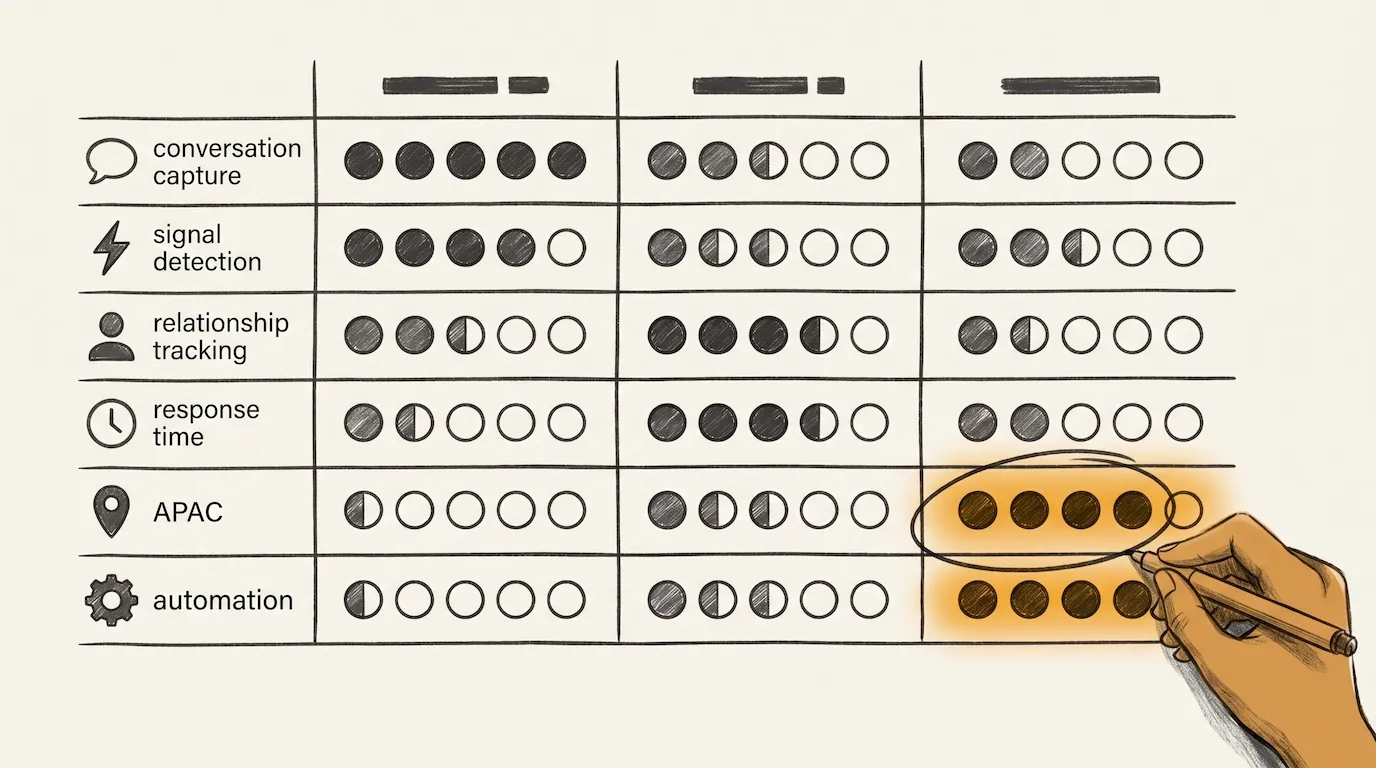
What each platform was actually built for
Understanding design intent is the fastest way to eliminate the wrong options.
Loxo describes itself as “The AI Recruiting Platform For Scaling Firms” — built to help direct hire and executive search firms align their teams around a scalable, end-to-end workflow. [Source: Loxo homepage, 2026] In practice, Loxo’s primary strengths are its AI sourcing engine (Loxo Source), omni-channel outreach automation (email and SMS campaigns), and the combination of ATS, recruiting CRM, and sales CRM in one platform. It is a broad, scalable tool that works across contingency and executive search — but its architecture prioritises pipeline throughput and candidate volume over the deep relationship tracking and assignment management that retained executive search requires.
Ezekia describes itself as “AI-powered all-in-one CRM, ATS and BD platform” built specifically for “executive search firms, in-house teams and talent partners.” [Source: Ezekia homepage, 2026] Unlike Loxo, Ezekia was built exclusively for executive search. Its core value is in assignment management — the long-list, short-list, presentation, referencing, and stakeholder workflow that defines retained search — combined with client portals, customisable reporting, and relationship-centric design. Ezekia is the most purpose-built of the three for the retained executive search workflow.
Signals is an AI-native recruitment CRM built for recruitment agencies across Asia Pacific, Europe and the Americas. It is not designed around any single desk model — it is designed around a fundamental architectural principle: every recruiter conversation is a data event that should be captured automatically, regardless of which channel it happened on. For APAC executive search firms where the majority of candidate and client communication happens over WhatsApp and WeChat — channels that Loxo and Ezekia cannot capture automatically — Signals addresses the data capture gap that undermines both platforms in this market.
Side-by-side comparison across six dimensions
| Dimension | Loxo | Ezekia | Signals |
|---|---|---|---|
| Best for | High-volume agencies, scaling firms, AI-led sourcing | Retained executive search, in-house talent, PE/VC teams | APAC agency recruiters — executive search and contingency |
| Pricing (indicative) | From ~USD 169/user/month (Basic, annual) | From ~USD 70/user/month (estimated; quote required) | See /pricing |
| AI features | AI sourcing, talent matching, outreach, AI Notetaker, database refresh | AI-assisted candidate recommendations, CV parsing, profile summarisation | AI-native architecture: automatic capture, BD signals, candidate ranking, Agentic CRM |
| WhatsApp / WeChat capture | No | No | Yes — Perfect Memory, automatic |
| Assignment management | Standard pipeline stages | Deep exec-search specific (long-list, short-list, referencing, presentation) | Agentic CRM adapts to workflow; assignment management in development |
| Client portal | Not a highlighted feature | Yes — shortlist presentation and client feedback | Client Rooms — candidate presentation and client collaboration |
| BD intelligence | Standard CRM pipeline tracking | BD tracking module, lead and opportunity management | BD Signals — proactive hiring intent from client base before roles go live |
| APAC fit | Limited — no messaging channel capture | Limited — no messaging channel capture | Strong — built for WhatsApp, WeChat, LINE, APAC messaging patterns |
| Outreach automation | Strong — multi-step email and SMS campaigns | Limited — relationship-first, less automation-oriented | Agentic CRM — next-action prompts and automated follow-up |
| Free trial / tier | Yes — Free Forever tier available | Demo required; no public free tier | Demo required, no public free tier |
[Sources: Loxo pricing page 2026; G2 Loxo pricing Apr 2025; Ezekia homepage and Capterra 2026; Signals product 2026]
Dimension 1 — AI features: sourcing vs assistance vs architecture
This is where the three platforms diverge most clearly — and where the language of “AI” most often misleads buyers into comparing things that are not comparable.
Loxo’s AI is centred on sourcing and outreach. Loxo Source automatically finds candidates based on a role profile, enriches their contact data, and feeds them into outreach sequences. The AI Notetaker captures call notes automatically — a genuinely useful feature. The AI talent matching ranks candidates from the existing database against open roles. For a scaling agency that runs high outreach volume, Loxo’s AI features are well-developed and directly tied to placement productivity.
Ezekia’s AI is centred on assistance within the executive search workflow — AI-assisted candidate recommendations, profile summarisation, CV parsing, and email drafting via OpenAI integration. [Source: Ezekia features page, 2026] These are features that reduce the documentation burden on consultants without fundamentally changing how data reaches the system. A search that happens over WhatsApp still requires manual logging in Ezekia, regardless of how sophisticated the AI summarisation is.
Signals is architecturally different from both. AI in Signals is not a feature layer — it is the foundation. Perfect Memory captures every conversation automatically across WhatsApp, email, calls, LinkedIn, and meetings. BD Signals monitors the client base continuously for hiring intent signals. Speed to Shortlist ranks candidates the moment a mandate lands. Agentic CRM surfaces next actions and drafts communications without waiting for a consultant to initiate. The AI does not assist the workflow — it is the workflow. APAC leads the world in AI adoption, with 78% of APAC professionals using AI at least weekly. [Source: BCG, Oct 2025] The firms building competitive advantage in this market are those whose AI layer captures the conversations that happen — not those whose AI layer analyses the conversations that were manually entered.
Dimension 2 — APAC fit: where both Loxo and Ezekia fall short
For executive search firms operating in Hong Kong, Singapore, Japan, and across Southeast Asia, APAC fit is the single most important evaluation dimension — and it is the one most often absent from CRM comparison articles written for Western markets.
APAC executive search runs on messaging apps. Over 90% of Hong Kong professionals use WhatsApp for work communication. In Southeast Asia, WhatsApp is the dominant business platform. In mainland China-connected markets and among candidates with cross-border exposure, WeChat carries equivalent weight. In Japan, LINE serves the same function. As Sinch’s regional overview puts it: “Southeast Asia loves WhatsApp. China chooses WeChat. Japan and Thailand like LINE. Australia is an SMS market.” [Source: Sinch via LinkedIn, 2025]
“Loxo automates outreach. Ezekia manages assignments. Signals captures the conversations that neither of them can see.”
Neither Loxo nor Ezekia captures these conversations automatically. Both platforms handle email and, in Loxo’s case, SMS — but neither has native WhatsApp or WeChat capture. For APAC executive search consultants, this means the majority of relationship intelligence — salary expectations discussed over WhatsApp, client headcount signals mentioned in a WeChat message, candidate availability shared in a LINE exchange — never reaches the CRM unless manually logged.
Partners in APAC executive search firms are already, as one industry commentary puts it, “drowning in manual tasks like market mapping, scheduling, and interview synthesis.” [Source: MA Executive Search, Jan 2026] Adding manual WhatsApp logging on top of an already admin-heavy workflow is not a realistic expectation. The data simply does not make it into the system — which means shortlists are built on partial intelligence, BD is reactive rather than proactive, and the firm’s institutional memory degrades every time a consultant changes role.
Signals captures WhatsApp, WeChat, LINE, email, calls, and LinkedIn automatically through Perfect Memory — treating every message as a structured data event without any consultant input. For APAC executive search firms, this changes the quality of the CRM’s intelligence at the foundation rather than at the reporting layer.
Dimension 3 — Assignment management: where Ezekia has a genuine advantage
On the dimension of retained executive search workflow management, Ezekia has a genuine competitive advantage over both Loxo and Signals as currently configured.
Executive search does not follow a simple pipeline. A retained mandate runs through research, market mapping, long-list, outreach, qualification, short-list, client presentation, stakeholder interviews, referencing, offer, and onboarding — each stage requiring different data, different stakeholder involvement, and different reporting. [Source: RecTec, Ezekia vs Loxo comparison] Ezekia was built specifically for this workflow. Its assignment management module, client portals for real-time shortlist collaboration, and customisable reporting at each stage of the process are genuine differentiators for retained search firms that run complex, multi-stakeholder searches.
Loxo’s pipeline management is broader and more generalised — well-suited to scaling firms running multiple desk types, but less granular than Ezekia for the specific stages of retained executive search. As Rectec’s comparison notes, “Ezekia focuses on executive search CRM and assignment management, whereas tools like Loxo are broader recruiting CRMs with strong AI sourcing and ATS capabilities.” [Source: RecTec, 2023]
Signals’ Agentic CRM layer handles workflow logic adaptively — it does not force consultants into pre-built pipeline stages — but the depth of Ezekia’s assignment management for retained executive search is a legitimate strength that a buyer evaluating purely for that use case should weigh accordingly.
Dimension 4 — Pricing: what you are actually buying
Pricing for these three platforms operates at different tiers and transparency levels, which makes direct comparison difficult.
Loxo’s Basic plan is listed at USD 169 per user per month on an annual contract on Loxo’s own pricing page, with the Professional and Enterprise tiers requiring a custom quote. [Source: Loxo pricing page, 2026] Third-party directories show lower figures — around USD 109 to USD 119 — which likely reflect outdated data or different contract structures. For a scaling executive search firm using Professional or Enterprise tier features, Loxo is one of the higher-priced options in the market.
Ezekia’s pricing is not fully public. Directories list starting prices around USD 70 per user per month as an indicative figure, but Ezekia directs prospects to a demo rather than publishing a full pricing grid. [Source: Capterra, 2026] For firms that want to understand total cost before a sales conversation, this opacity adds friction to the evaluation process.
The more important cost question for all three platforms is not the subscription price — it is the cost of admin time that the CRM does or does not eliminate. Research shows that recruiters spend 30-40% of their time on administrative work, and that automation can save 12.75 hours per recruiter per week. [Source: US Tech Automations citing SHRM; Bullhorn automation report] For executive search consultants whose time generating fees is irreplaceable, the admin cost of a manual-entry CRM compounds every week. A platform that eliminates manual entry at the architecture level generates a different ROI calculation from one that reduces it at the task level.
Who each platform is built for — the honest verdict
Choose Loxo if: you run a high-volume or scaling recruitment firm — direct hire, executive search, or a combination — and your primary need is integrated AI sourcing, automated outreach campaigns, and a combined ATS and CRM that handles the full placement lifecycle. Loxo is a legitimate, well-developed platform with strong AI features and a clear product vision for scaling firms. Its limitations are in deep executive search assignment management and APAC messaging capture — both significant if those are your primary needs.
Choose Ezekia if: you run a retained executive search firm, an in-house executive talent function, or a PE/VC talent team where the core workflow is assignment management — long-list, short-list, stakeholder presentations, client portals, and relationship-centric reporting built specifically for the executive search process. Ezekia is the most purpose-built platform in this comparison for that specific use case, and its ease of use and customisability are consistently well-rated. Its limitations are in APAC messaging capture and outreach automation — significant if those are your needs.
Choose Signals if: you run a recruitment agency in APAC — executive search, contingency, or both — where WhatsApp and WeChat carry the majority of your relationship activity, where proactive BD intelligence is a competitive priority, and where you want to eliminate manual CRM data entry entirely rather than reduce it incrementally. Signals is built for the market and communication reality of APAC recruitment — the data capture gap that limits both Loxo and Ezekia for this market is the architectural problem Signals was built to solve.
APAC executive search is growing at a significant rate — contributing substantially to the global market’s 10% CAGR through 2029. [Source: Technavio, Dec 2024] The firms that compound most in that growth are those whose CRM reflects reality rather than a partial record of what got manually entered.
See how Signals compares for your desk
See Signals on a desk like yours.
Common questions
Loxo, Ezekia, and Signals serve different desk models, which means 'better' depends entirely on your workflow. Loxo is best for high-volume agencies and scaling firms that need integrated AI sourcing, outreach automation, and a combined ATS and CRM. Ezekia is best for retained executive search firms that need deep assignment management, long-list and short-list workflows, customisable client portals, and relationship-centric reporting. Signals is best for recruitment agencies across Asia Pacific, Europe and the Americas that need automatic conversation capture across WhatsApp, WeChat, email, and calls, combined with proactive BD intelligence and zero manual data entry. All three are legitimate platforms in their respective categories; the comparison only matters in the context of your specific desk model.
Loxo is positioned as an AI recruiting platform for scaling firms, and its primary strengths are AI-powered sourcing (Loxo Source), outreach automation, and a broad ATS and CRM stack that handles the full recruitment lifecycle. Ezekia is positioned specifically for retained executive search, and its primary strengths are assignment management, relationship tracking across long search cycles, client portals for shortlist presentations, and a workflow built around the executive search process rather than volume hiring. For a retained executive search desk, Ezekia's workflow alignment is a genuine advantage over Loxo's broader, volume-oriented architecture.
Loxo explicitly markets itself as designed for direct hire and executive search firms, and its AI sourcing and talent intelligence features are relevant for firms that want to automate candidate discovery and outreach. Where Loxo is less aligned to typical executive search workflows is in the depth of assignment management and long-cycle relationship tracking. Ezekia, which was built exclusively for executive search, offers more granular control over the retained search process. For APAC executive search firms specifically, neither Loxo nor Ezekia captures WhatsApp or WeChat conversations automatically, which means a significant share of relationship activity in markets like Hong Kong and Singapore never reaches the CRM.
Loxo's pricing varies by tier and source. The Basic plan is listed at USD 169 per user per month on an annual contract on Loxo's own pricing page, while third-party directories have listed figures ranging from USD 109 to USD 119 per user per month, and these discrepancies likely reflect different contract terms or outdated pricing. [Source: Loxo pricing page, 2026; G2 pricing, Apr 2025] Loxo's Professional and Enterprise tiers require a custom quote. Ezekia's pricing is not fully public: directories list starting prices around USD 70 per user per month as an indicative figure, but Ezekia's own site directs prospects to book a demo for firm pricing. Signals' pricing is available at /pricing.
For APAC executive search agencies, the critical evaluation question is whether the CRM captures WhatsApp and WeChat conversations automatically, because these are the channels where the majority of recruiter-candidate and recruiter-client communication happens in Hong Kong, Singapore, and across Southeast Asia. Over 90% of Hong Kong professionals use WhatsApp for work communication, and Southeast Asia leads globally in WhatsApp adoption. [Source: Regus survey via Hong Kong Business; Sinch, 2025] Neither Loxo nor Ezekia captures these channels automatically. Signals is built specifically for APAC agencies: Perfect Memory captures every WhatsApp message, WeChat thread, email, and call automatically, and BD Signals surfaces hiring intent from the client base before roles go live.