
Why this comparison matters — and why most CRM decisions go wrong
Choosing between Ezekia, Thrive TRM, and Signals is not a feature comparison exercise. It is a desk model question. Each of these platforms was built for a different type of recruitment business, and the right answer depends almost entirely on which model matches yours — not on which platform has the longest feature list.
The stakes are real. Research from hireEZ found that only 14% of companies report their recruitment teams actually adopt a recruitment CRM after purchase. [Source: hireEZ, Mar 2024] Nearly half of all CRM projects fail primarily due to lack of adoption, and 23% of users cite manual data entry as their primary barrier to using the tool at all. [Source: EverReady.ai, Dec 2025] A CRM that your team does not use is not a productivity tool — it is an expensive contact database that nobody trusts.
This comparison covers all three platforms honestly, including where each competitor is genuinely strong. It ends with a clear verdict on who each tool is actually built for.
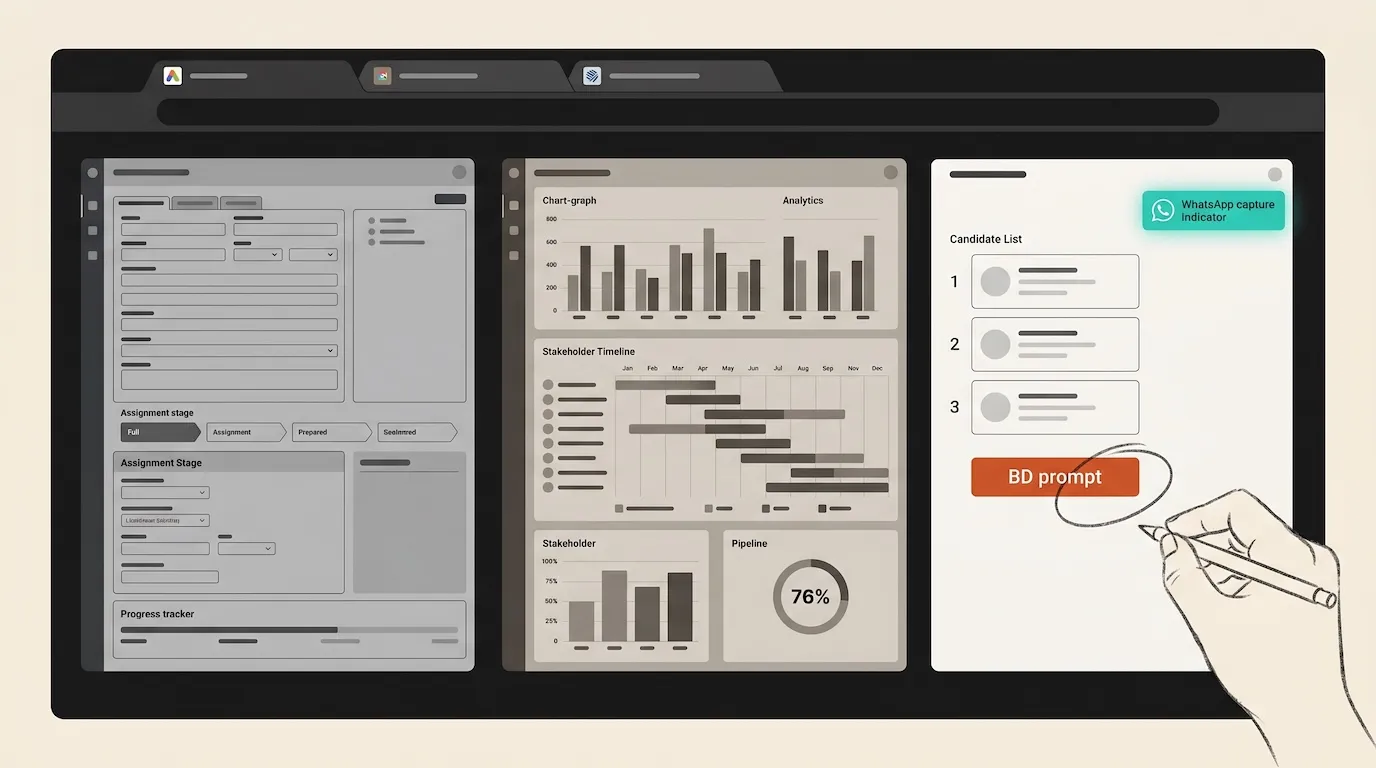
What each platform is and who it was built for
Understanding the design intent behind each platform is the fastest way to eliminate options that are structurally wrong for your desk.
Ezekia is a cloud-based CRM and assignment management system built specifically for retained executive search firms, in-house talent teams, and private equity and venture capital talent partners. [Source: Capterra, 2026] It is not designed for high-volume contingency recruitment or temp staffing. Its core value proposition is depth of assignment management — the ability to run a retained search project from BD through shortlist to placement, with client portals for feedback, strong Outlook integration, and reporting dashboards built for leadership search workflows. Ezekia is trusted by over 550 firms globally and is ISO-certified. [Source: iSmartRecruit, Jun 2025]
Thrive TRM is a talent relationship management platform designed for in-house executive talent acquisition teams, PE/VC portfolio talent functions, and larger executive search firms that need a TRM plus ATS with strong analytics and stakeholder reporting. [Source: iSmartRecruit, Jun 2025] It is analytics-heavy and reporting-first — built for functions that need visibility into search progress across multiple stakeholders rather than for agencies running high volumes of contingency roles. Thrive TRM’s annual contract values typically run around USD 30,000, positioning it alongside enterprise-grade executive search systems rather than SMB agency tools. [Source: Vendr, 2025]
Signals is an AI-native recruitment CRM built for recruitment agencies across Asia Pacific, Europe and the Americas. It is not a job board, not an ATS, and not a legacy CRM with AI features added on top. Signals is designed from the ground up so that AI handles everything recruiters currently do manually: capturing conversations across WhatsApp, email, calls, and LinkedIn automatically; surfacing hiring intent before roles go live; and ranking candidates from the existing network the moment a mandate lands. The platform is built specifically for agency recruiters whose communication runs through messaging apps rather than email, and whose BD depends on being first to a mandate — not first to respond to a job post.
Side-by-side comparison across five dimensions
| Dimension | Ezekia | Thrive TRM | Signals |
|---|---|---|---|
| Pricing | ~£120/user/month | ~USD 30k/year (enterprise) | See /pricing |
| Best for | Retained executive search | In-house exec TA / PE/VC talent | APAC agency recruiters |
| AI features | OpenAI-assisted summaries, CV parsing, email drafting | Analytics and pipeline reporting; limited AI positioning | AI-native architecture: automatic capture, BD signals, Speed to Shortlist, Agentic CRM |
| WhatsApp / WeChat capture | No — manual or third-party | No — not in public feature set | Yes — Perfect Memory captures automatically |
| APAC fit | AU, SG, JP supported; no messaging capture | Primarily North American / European | Built for APAC; WhatsApp, WeChat, LINE natively captured |
| BD intelligence | Assignment management and opportunity tracking | Stakeholder reporting and search analytics | BD Signals: proactive hiring intent from client base before roles go live |
| Adoption risk | Medium — strong fit for exec search; steep for other models | Medium-High — enterprise complexity | Low — zero manual entry removes the primary adoption barrier |
| Free trial | Yes | No | Book a demo |
| ISO certified | Yes | Not confirmed in public materials | — |
| Client portal | Yes — shortlist and feedback portal | Yes — stakeholder collaboration | Client Rooms — candidate presentation and client collaboration |
[Sources: Capterra 2026; iSmartRecruit Jun 2025; Vendr 2025; Signals product, 2026]
Dimension 1 — Pricing and total cost of ownership
Pricing comparisons between these three platforms are genuinely difficult because they operate at different tiers and transparency levels.
Ezekia publishes a starting price of approximately £120 per user per month, with a free trial available. [Source: Capterra, 2026; GetApp, Mar 2026] For a mid-sized executive search firm, this is a meaningful per-seat investment — but one that is defensible if the platform eliminates the need for separate assignment management, client reporting, and BD tracking tools. The free trial makes evaluation lower-risk than most enterprise-tier tools.
Thrive TRM does not publish pricing publicly. Procurement data from Vendr puts average annual contract values around USD 30,000, with maximum contracts up to USD 50,000. [Source: Vendr, 2025] This pricing tier aligns Thrive TRM with enterprise executive search platforms rather than agency CRMs — the investment is significant and requires a clear business case. The absence of a free plan makes evaluation harder and increases switching cost risk.
Signals’ pricing is available on the pricing page. The more relevant cost question for agency recruiters evaluating Signals is not the subscription price but the cost of the alternative: 70–80% of recruiter time consumed by repetitive admin tasks that Signals eliminates at the architecture level, and CRM data missing up to 72% of activity when logging is manual. [Source: HootRecruit, Aug 2025; Avoma, 2026] The ROI calculation for an AI-native CRM that eliminates admin rather than reducing it is structurally different from a traditional subscription comparison.
Dimension 2 — AI features: assistants vs architecture
This is where the three platforms diverge most significantly — and where the AI-native versus AI-powered distinction matters most for a buying decision.
Ezekia integrates OpenAI features to generate insights, write summaries, and draft emails — AI as an embedded assistant within an existing workflow. [Source: iSmartRecruit, Jun 2025] These are genuinely useful features for a retained search firm producing regular client reports and candidate summaries. They reduce the time cost of documentation without changing the underlying workflow architecture.
Thrive TRM’s public positioning emphasises analytics and pipeline reporting more than explicit AI features. Third-party reviews frame it as a data-driven, analytics-heavy platform rather than an AI-native one — AI is present but not the primary architecture. [Source: iSmartRecruit, Jun 2025]
“A CRM that your team does not adopt is not a CRM — it is an expensive contact database that nobody trusts.”
Signals is architecturally different from both. AI in Signals is not an assistant layer — it is the core engine. Perfect Memory captures every conversation automatically across every channel without recruiter input. BD Signals monitors the client base continuously and surfaces hiring intent before roles go live. Speed to Shortlist ranks candidates from the existing network the moment a mandate lands. Agentic CRM drafts emails, surfaces next actions, and books meetings without waiting for a recruiter to ask. The distinction is not that Signals has more AI features — it is that the entire system is designed around AI handling the work rather than assisting with it. AI adoption in recruitment nearly doubled from 26% to 53% of organisations between 2023 and 2024, and the gap between assistive AI and architectural AI is widening. [Source: HR.com HR Research Institute via HRmarketer, Nov 2024]
Dimension 3 — APAC fit
This dimension eliminates Thrive TRM quickly for most APAC agencies. Public materials for Thrive TRM show no explicit APAC positioning, no messaging-app integrations, and a case study base that is predominantly North American and European. [Source: iSmartRecruit, Jun 2025; Capterra, 2026] For agencies operating in Hong Kong, Singapore, or Southeast Asia where WhatsApp is the dominant business communication channel, Thrive TRM’s architecture creates an immediate data capture gap.
Ezekia has a genuine APAC presence — supporting clients in Australia, Singapore, Japan, South Korea, and Thailand with 24/7 support. [Source: iSmartRecruit, Jun 2025] For retained executive search firms operating in these markets at a relatively low conversation volume, Ezekia’s manual-entry model is manageable. Where it breaks down is in markets like Hong Kong, where 90%+ of professional communication happens over WhatsApp and the majority of recruiter-client interaction happens on a channel Ezekia cannot capture automatically.
Signals is built for APAC from the ground up. Perfect Memory captures WhatsApp, WeChat, LINE, email, calls, and LinkedIn automatically — treating messaging apps as first-class data sources rather than channels that require manual workarounds. For agencies in Hong Kong’s finance sector, Singapore’s tech ecosystem, or across Southeast Asia, this is not a nice-to-have — it is the foundational requirement that determines whether the CRM reflects reality or a partial record of what got manually entered.
Dimension 4 — BD tools and hiring intelligence
Ezekia covers the BD side of retained executive search well — opportunity tracking, business development pipeline, and assignment management from mandate to placement. [Source: G2 product description, 2024] What it does not do is surface proactive hiring intelligence. Ezekia knows about clients you are already engaged with; it does not monitor your client base for early signals that a hire is coming before anyone has mentioned it.
Thrive TRM is similarly retrospective. Its strength is reporting on search progress and stakeholder communication — it tells you what has happened, not what is about to happen.
BD Signals in Signals is a different category of tool entirely. It monitors the existing client base continuously for hiring intent signals — funding announcements, leadership changes, job ad clusters, and conversational signals captured automatically from client WhatsApp and email exchanges — and surfaces a prioritised BD prompt to the right recruiter at the right moment. The mandate is won before the brief is written. This is not a reporting feature; it is a proactive intelligence layer that changes the BD conversation from reactive to predictive.
Dimension 5 — Adoption and ease of use
Adoption is the metric that matters most in CRM evaluation — and the one most often ignored in feature comparisons.
Ezekia consistently receives high ratings for ease of use and configurability on Capterra and G2, with scores around 4.5–4.8 out of 5 across both platforms. [Source: Capterra, 2026; iSmartRecruit, Jun 2025] For retained executive search firms, Ezekia’s workflow alignment with the actual shape of a search project makes adoption relatively natural. Where adoption risk increases is outside that specific use case — the platform is optimised for retained search and less suited to contingency or high-volume agency workflows.
Thrive TRM’s enterprise pricing and complexity create higher adoption risk for smaller firms. The lack of a free plan and the opacity of pricing increase the evaluation risk before any adoption challenge is even reached.
Signals addresses adoption at the architecture level. The primary barrier to CRM adoption — manual data entry — is eliminated entirely when the CRM captures conversations automatically. Recruiters do not need to be trained to log WhatsApp messages they sent yesterday; the system already logged them. The adoption question shifts from “will the team remember to use it” to “does the team find the intelligence it surfaces useful” — a significantly easier bar to clear.
Who each tool is built for — the honest verdict
Choose Ezekia if: your agency runs retained executive search, your communication volume is manageable manually, client reporting and assignment management are your primary CRM use cases, you need a client portal for shortlist feedback, and you operate in markets where Outlook and email are your primary channels. Ezekia is genuinely well-built for this model.
Choose Thrive TRM if: you run an in-house executive talent function or a PE/VC portfolio talent team, your primary stakeholders are internal rather than external clients, you need sophisticated analytics and search progress reporting, and your budget supports an enterprise-tier annual contract. Thrive TRM is not built for agency recruiters.
Choose Signals if: you run a recruitment agency in APAC or globally, your team communicates with clients and candidates primarily over WhatsApp, WeChat, or other messaging apps, your BD depends on calling before the brief goes live rather than responding after the job is posted, and you need a CRM that captures every conversation automatically without requiring your team to log anything manually. Signals is built specifically for this model — it is an AI-native recruitment CRM designed for how APAC agency recruitment actually works in 2026.
See how Signals compares in practice
See Signals on a desk like yours.
Common questions
Ezekia is a CRM and assignment management platform built specifically for retained executive search firms, covering business development, assignments, candidate tracking, and client portals in one system. Thrive TRM is a talent relationship management platform designed for in-house executive talent acquisition teams, PE/VC talent partners, and larger leadership hiring functions. Signals is an AI-native recruitment CRM built for agency recruiters across Asia Pacific, Europe and the Americas who need automatic conversation capture across WhatsApp, WeChat, email, and calls, combined with proactive BD intelligence and zero manual data entry. They serve different desk models and should be evaluated on that basis first.
Ezekia's pricing starts at approximately £120 per user per month, offered as a monthly subscription with a free trial available. [Source: Capterra, 2026; iSmartRecruit, Jun 2025] The platform is positioned at the upper end of the recruitment CRM market, reflecting its specialisation in retained executive search and its ISO certification. Pricing may vary by team size and contract length, so firms evaluating Ezekia should contact the vendor directly for current volume pricing.
Thrive TRM does not publish a public rate card. Third-party procurement data from Vendr indicates that annual contract values typically run around USD 30,000, with maximum prices up to USD 50,000 depending on firm size and features required. [Source: Vendr, 2025] Capterra lists a generic starting price of approximately USD 25 per user per month in its comparison widget, but this figure is likely a floor rather than a typical contract value. Firms should treat Thrive TRM as an enterprise-tier investment and request a custom quote.
Ezekia supports clients in Australia, Singapore, Japan, South Korea, Thailand, and other APAC markets, and offers 24/7 support. [Source: iSmartRecruit, Jun 2025] However, Ezekia is designed for retained executive search and does not offer automatic WhatsApp or WeChat capture, which are primary communication channels for recruitment agencies operating in Hong Kong, Singapore, and across the region. For agencies whose BD and candidate communication runs heavily through messaging apps, Ezekia's manual-entry architecture creates a significant data capture gap from day one.
CRM adoption failure in recruitment is primarily driven by two factors: poor workflow fit and manual data entry burden. Research from hireEZ found that only 14% of companies report their recruitment teams actually adopt a recruitment CRM after purchase, meaning most CRM investments generate little return because the tool gets bypassed rather than used. [Source: hireEZ, Mar 2024] A separate compilation found that 23% of users cite manual data entry as the primary barrier to CRM adoption, and that nearly half of all CRM projects fail due to low adoption. [Source: EverReady.ai, Dec 2025] The remedy is not better training. It is choosing a CRM that captures data automatically, removing the compliance requirement entirely.