
UK recruitment in 2026 is the largest single-country recruitment market in EMEA and one of the most sharply differentiated globally. It generated £40.6 billion in direct gross value added in 2024, equal to 1.6 per cent of UK GDP, per REC’s Recruitment Industry Status Report 2024 to 2025 Source: REC, December 2025. It is also a market coming out of a long downturn. Permanent placements had been in near-continuous decline for 45 consecutive months before stabilising in July 2026, per REC and KPMG’s UK Report on Jobs August 2026 Source: KPMG and REC, August 2026. Sector demand is materially split, regional conditions diverge, and regulation tightens meaningfully in 2026 around off-payroll working and umbrella companies. This article is the fourth in a market series that already covers Singapore, Hong Kong, and Australia in 2026. Same structural approach: primary sources for every number, honest labelling of what the data covers and what it does not, and a concrete conclusion on what the UK recruitment CRM stack has to hold. Every claim below is anchored to REC, KPMG, ONS, HMRC, GOV.UK, ICO, or APSCo.
The 2026 UK recruitment market by the numbers
REC’s most recent annual Recruitment Industry Status Report covers calendar year 2024 and was published in December 2025 Source: REC, December 2025. Its headline anchor figures for the UK recruitment sector are as follows.
- Direct gross value added: £40.6 billion in 2024, equal to 1.6 per cent of UK GDP.
- Recruitment enterprises: 31,345 in 2025, up modestly from 31,225 in 2024.
- Permanent placements supported: 536,382 in 2024.
- Temporary and contract placements supported: 21.6 million in 2024.
- Temporary workers on assignment on an average day in 2024: 872,000.
Direct GVA in 2024 fell 5.5 per cent in nominal terms and 9.2 per cent in real terms below 2023, per REC and KPMG analysis Source: REC / KPMG Report on Jobs December 2025. That contraction is the fiscal signature of the 45-month permanent-placement downturn documented in the monthly REC/KPMG series.
Two figures commonly repeated about UK recruitment do not have primary-source support and are omitted here. There is no verified Companies House aggregate for ‘active recruitment agencies’ at a specific number: Companies House publishes individual company data, not a standardised industry aggregate. Any ‘X thousand agencies per Companies House’ claim should be treated as a methodology-dependent estimate. There is also no verified ‘X per cent of UK recruitment revenue is generated in London’ figure. Regional revenue splits require careful sourcing that current primary material does not clearly supply.
The vacancy picture in August 2026
ONS’s August 2026 labour-market release, covering the three months to July 2026, put total UK vacancies at 707,000, down 6,000 (0.8 per cent) on the February to April 2026 quarter Source: ONS Vacancies and jobs in the UK August 2026. Year-on-year vacancies were lower, and ONS described the vacancy series as continuing to fall while the rate of decline eased Source: ONS Labour market overview August 2026.
Two important caveats on the ONS release, for agency operators reading it commercially. First, the count measures employee-job vacancies across the whole UK economy. It is not a count of recruitment-agency vacancies specifically, and it is not directly translatable into an agency market-share figure. Second, ONS’s August 2026 headline release does not provide a currently reliable regional vacancy table that would let a UK-wide agency compare London, South East, North West, Scotland, Wales, and Northern Ireland vacancy stocks side by side in the accessible bulletin Source: ONS VACS02 Vacancies by industry. ONS publishes an industry breakdown, but not the clean cross-region comparison that agency planners often want. Regional insight for this period is more reliably read from REC and KPMG’s Report on Jobs, which surveys UK recruitment consultancies directly.
The commercial reading of ONS August 2026 is that vacancy conditions remain soft in aggregate, direction is still down, but the rate of contraction is easing. That easing is consistent with the placement turning point captured in the REC and KPMG series.
The July 2026 turning point in placements
The August 2026 UK Report on Jobs from KPMG and REC documents four material month-on-month shifts in July 2026 that together mark a turning point Source: KPMG and REC, August 2026.
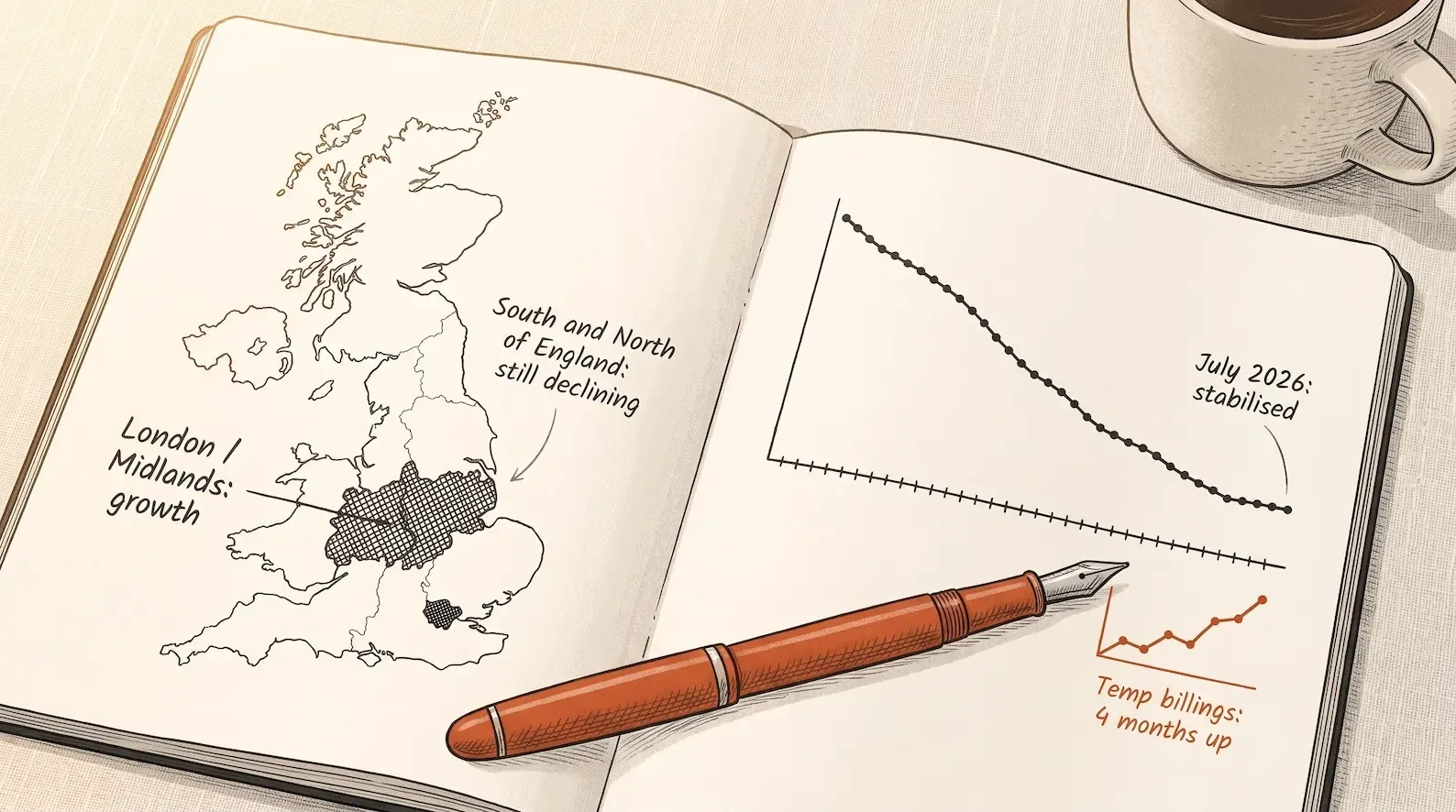
- Permanent placements stabilised, ending a 45-consecutive-month period of decline.
- Temporary billings rose for the fourth consecutive month, among the quickest increases since early 2023.
- Candidate availability continued to rise for both permanent and temporary roles, although growth slowed.
- Starting-salary inflation reached a six-month high; temporary wage inflation reached a 26-month high.
The regional detail matters commercially. In July 2026, London and the Midlands recorded renewed permanent-placement growth, with London reaching a near four-year high. The South and North of England still declined in the same month. Scotland, Wales, and Northern Ireland are not covered in the same detail in the English-region diffusion series.
The mixed picture is why national-level narratives (‘the UK recruitment market is up’ or ‘the UK recruitment market is still down’) both misread July 2026. A London-focused permanent desk has meaningfully different conditions from a North of England-focused permanent desk in the same month. A UK-wide agency running standard national KPIs will conflate two divergent local realities. The commercial implication is that agency dashboards and BD prioritisation need to reflect the regional split, not smooth over it. This is the same pattern documented in the Australia 2026 piece: a national headline that masks materially different regional cycles, requiring a CRM whose view of the market can shift between national and regional granularity without additional configuration work.
Sector concentration in 2026: the split market
REC and KPMG’s July 2026 sector view puts the sharpest permanent-worker demand in Nursing/Medical/Care, Engineering, and IT Source: KPMG and REC, August 2026. Temporary-worker demand rose in seven of ten monitored sectors in the same month, led by Blue Collar and Engineering. Retail and Hotel & Catering were the weakest categories, with the sharpest permanent-vacancy declines; Retail was also the largest negative contributor to temporary demand.
The pattern reads as a UK labour market bifurcating along two axes. On one axis, essential-services and technical sectors remain firm: healthcare, engineering, industrial trades, and technology. On the other, consumer-discretionary sectors soften: retail, hospitality, and other categories linked to household-spending confidence.
Sector-level BD context that this research did not verify from primary sources, and that this article therefore does not claim: London financial-services placement volumes as a specific figure, UK technology hiring as a sector-wide market-share number, and any UK construction-vacancy movement expressed in ABS-Australia style. Agency operators should not import figures from adjacent markets or vendor blogs as UK evidence. What can be said with primary-source support is directional and diffusion-index based, not volume based.
APSCo’s January 2026 Bullhorn Recruitment Trends Snapshot supports the directional finding that contract recruiting remains more resilient than permanent recruitment during uncertainty, with December’s slowdown described as expected and contract activity holding Source: APSCo, January 2026 snapshot. Quantitative APSCo permanent-versus-contract splits sit behind member access and are not restated here.
IR35, umbrella reform, and the CRM implications
UK regulation shapes the recruitment CRM stack more directly than in most other markets, and 2026 is a year in which two specific rule sets tighten materially.
IR35 and off-payroll working. HMRC’s off-payroll working rules require medium and large organisations to determine the employment status of workers engaged through intermediaries such as personal service companies Source: HMRC / GOV.UK, accessed August 2026. Where the rules apply, the client or the agency in the labour supply chain becomes responsible for operating PAYE and National Insurance. For a UK recruitment CRM, this creates a specific record-keeping requirement that a generic global CRM does not automatically hold. The system must store: the engagement chain (client, agency, worker, personal service company), the status determination statement, the role facts underpinning that determination, the determination itself, any dispute correspondence, and the fee-payer responsibility position. That is not a nice-to-have field. It is the audit trail HMRC can request, and it has to be architecturally distinct from a permanent placement record.
Umbrella-company reform from 6 April 2026. New PAYE rules for umbrella-company supply chains took effect on 6 April 2026 Source: GOV.UK Working through an umbrella company, updated 2026. Responsibility for operating PAYE moved to the recruitment agency supplying the worker to the client, or to the client where no agency is involved. The government’s March 2025 consultation response committed to defining umbrella companies in statute and bringing them under Employment Agency Standards Inspectorate, and later Fair Work Agency, oversight through the Employment Rights Bill Source: GOV.UK Tackling non-compliance in the umbrella company market government response, March 2025.
For a UK agency operating any labour-hire or umbrella-linked contract book, the CRM implications are concrete. It must hold supplier and umbrella records, map the supply chain per placement, distinguish worker engagement types, record which party carries PAYE responsibility, store compliance documents, and enforce payment-period controls. None of that is optional after 6 April 2026, and none of it fits comfortably inside a CRM record type that treats every placement the same.
Right to Work, GDPR, and the record-keeping layer
Beyond IR35 and umbrella reform, two further compliance layers shape the UK recruitment CRM record.
Right to Work checks. Employers must conduct compliant Right to Work checks before employment begins Source: GOV.UK Employer’s guide to right to work checks, accessed August 2026. Acceptable routes include an online Home Office share-code check, a manual document check, or the use of Identity Document Validation Technology (IDVT) where permitted. The CRM implication is that per-placement records must hold the check date, the method used, the share-code reference or IDVT provider identity, any expiry or recheck trigger, document copies where appropriate, and the responsible user who conducted the check. Post-Brexit, share codes and IDVT have become the practical default for most non-UK-national candidates.
UK GDPR and candidate data retention. UK GDPR requires purpose limitation, storage limitation, a defensible lawful basis, and a documented retention policy Source: ICO Storage limitation, accessed August 2026. There is no universal statutory retention period for candidate records. What is required is a defensible internal policy, applied consistently, with the ability to enforce deletion or suppression when consent or legitimate-interest basis expires. For a UK recruitment CRM, that means configurable retention rules per record class, an accessible consent and lawful-basis record, and an operational deletion or suppression workflow. This is a specific application of the broader recruitment CRM data decay problem: the CRM has to hold the record while it is lawful to hold it, and stop holding it when it is not.
The UK recruitment CRM stack a 2026 agency actually needs
Pulling the market data and the regulatory picture together produces a specific set of UK recruitment CRM requirements for 2026.
| Requirement | Why it matters in the UK specifically | What breaks without it |
|---|---|---|
| Distinct permanent and contract-and-umbrella workflows | IR35 status determination and PAYE responsibility apply to contract-under-IR35 and umbrella-chain placements, not to permanent placements | Single ‘placement’ record type fails HMRC audit; agency carries unclear PAYE risk |
| IR35 audit-trail fields as first-class record structure | HMRC can request the status determination statement, role facts, determination, dispute correspondence, and fee-payer position | Reconstruction of the audit trail from ad-hoc fields is slow and error-prone under review |
| Umbrella-company supplier records with per-placement supply-chain mapping | 6 April 2026 rules moved PAYE responsibility to agencies in most supply chains | Agency cannot demonstrate which party carried PAYE for a given placement period |
| Right-to-Work check records with method, share code, IDVT provider, expiry, and responsible user | GOV.UK guidance requires a defensible check trail before employment begins | Missing recheck triggers create compliance exposure at visa or share-code expiry |
| Configurable UK GDPR retention rules per record class | UK GDPR requires purpose limitation, storage limitation, and enforceable deletion or suppression | Candidate records held past lawful basis; ICO complaint or data-subject request cannot be honoured cleanly |
| Regional visibility (London, Midlands, South, North, plus devolved nations) | July 2026 shows London and Midlands returning to growth while South and North of England still declining | National KPIs conflate divergent local desks; capacity and BD misallocated |
| Sector-aware BD signalling | Healthcare, engineering, and IT are firm; retail and hospitality are soft | Undifferentiated client outreach ignores the sector bifurcation the market data shows |
The final two requirements are where the AI-native argument matters most in practice. The automatic capture layer is what keeps the record complete across UK-specific channels: emails, phone calls, LinkedIn messages, meeting notes, and any WhatsApp use that has crept into UK agency workflows. On top of that layer, hiring-intent signal detection is what tells a UK BD lead which of the agency’s client base is in the strengthening half of the market and which is in the softening half. Both requirements are structural, not features to be added later.
For a wider frame on how to evaluate a recruitment CRM against these requirements without getting distracted by feature bingo, our recruitment CRM buyer’s guide for 2026 walks through the Five Dimensions of AI-Native Evaluation. The Singapore 2026 and Hong Kong 2026 pieces cover the equivalent market-shaped requirements for the two major APAC markets Signals is built for. Together with the Australia 2026 piece, the four articles specify the market-specific realities that any AI-native recruitment CRM has to hold as first-class design constraints, not as configuration options.
UK recruitment in 2026 is a market where the regulatory shape of the CRM matters as much as the market-cycle shape of the desk. An agency operating on a generic global CRM configured for a US or APAC single-national-cycle assumption, without the IR35 audit trail and umbrella-company supply-chain records the UK actually requires, is taking a compliance risk that will surface at the wrong moment. A CRM designed for the UK market can support the audit trail natively; a CRM that treats the UK as a US or APAC equivalent cannot.
Run a UK desk on a CRM that fits UK regulation and UK market conditions
Signals is live for recruitment agencies globally. Book a demo to see the UK-fit CRM stack.
Common questions
The UK recruitment sector generated £40.6 billion in direct gross value added in 2024, equal to 1.6 per cent of UK GDP, across 31,345 recruitment enterprises, per REC's Recruitment Industry Status Report 2024 to 2025 [Source: REC, December 2025](https://www.rec.uk.com/our-view/research/recruitment-and-industry-status-report/uk-recruitment-industry-status-report-202425). REC recorded 536,382 permanent placements, 21.6 million temporary and contract placements, and 872,000 temporary workers on assignment on an average day in 2024. Direct GVA fell 5.5 per cent in nominal terms and 9.2 per cent in real terms from 2023 to 2024, per REC and KPMG analysis. IBISWorld and Companies House aggregate agency figures commonly cited in industry commentary were not primary-verified for this article and are therefore omitted.
UK vacancies were 707,000 in May to July 2026, per the Office for National Statistics August 2026 release, down 6,000 (0.8 per cent) on the February to April 2026 quarter [Source: ONS Vacancies and jobs in the UK August 2026](https://www.ons.gov.uk/employmentandlabourmarket/peopleinwork/employmentandemployeetypes/bulletins/jobsandvacanciesintheuk/august2026). Year-on-year vacancies were lower, and ONS described the vacancy series as continuing to fall while the rate of decline eased. The ONS series measures employee-job vacancies across the whole UK economy, not recruitment-agency vacancies specifically. ONS's August 2026 headline release does not provide a currently reliable regional vacancy table comparing London, South East, North West, Scotland, Wales, and Northern Ireland; regional insight for this period is more reliably read from REC and KPMG's Report on Jobs, which surveys UK recruitment consultancies directly.
Per REC and KPMG's UK Report on Jobs August 2026, permanent placements stabilised in July 2026 for the first time after 45 consecutive months of decline [Source: KPMG and REC, August 2026](https://kpmg.com/uk/en/media/press-releases/2026/08/kpmg-and-rec-uk-report-on-jobs.html). Temporary billings rose for a fourth consecutive month, among the quickest increases since early 2023. London and the Midlands recorded renewed permanent-placement growth in July 2026, with London reaching a near four-year high, while the South and North of England still declined in the same month. The commercial reading is that the market is bifurcating regionally rather than recovering uniformly. A national narrative that describes UK permanent recruitment as either still down or recovering will misread what a London desk and a North of England desk are actually experiencing in the same month.
IR35, formally the off-payroll working rules, requires medium and large organisations to determine the employment status of workers engaged through intermediaries such as personal service companies, per HMRC and GOV.UK guidance [Source: HMRC / GOV.UK, accessed August 2026](https://www.gov.uk/guidance/check-employment-status-for-tax). Where the rules apply, the client or the agency in the supply chain becomes responsible for operating PAYE and National Insurance. A UK recruitment CRM must therefore store the engagement chain, the status determination statement, role facts underpinning that determination, the determination itself, any dispute correspondence, and the fee-payer responsibility position for every affected placement. This is an audit-trail requirement, not a nice-to-have. A CRM that treats permanent placement and contract-under-IR35 placement as the same record type will fail an HMRC review. A UK-fit CRM has to distinguish those record types architecturally.
New PAYE rules for umbrella-company supply chains took effect on 6 April 2026, per GOV.UK's Working through an umbrella company guidance updated 2026 [Source: GOV.UK, 2026](https://www.gov.uk/guidance/working-through-an-umbrella-company). Responsibility for operating PAYE moved to the recruitment agency supplying the worker to the client, or to the client where no agency is involved. The government's March 2025 consultation response committed to defining umbrella companies in statute and bringing them under Employment Agency Standards Inspectorate, and later Fair Work Agency, oversight through the Employment Rights Bill [Source: GOV.UK Tackling non-compliance in the umbrella company market government response, March 2025](https://www.gov.uk/government/consultations/tackling-non-compliance-in-the-umbrella-company-market/outcome/tackling-non-compliance-in-the-umbrella-company-market-government-response-accessible). For a UK agency operating any contract or umbrella-linked book, the CRM must hold supplier and umbrella records, map the supply chain per placement, record which party carries PAYE responsibility, and enforce payment-period controls.