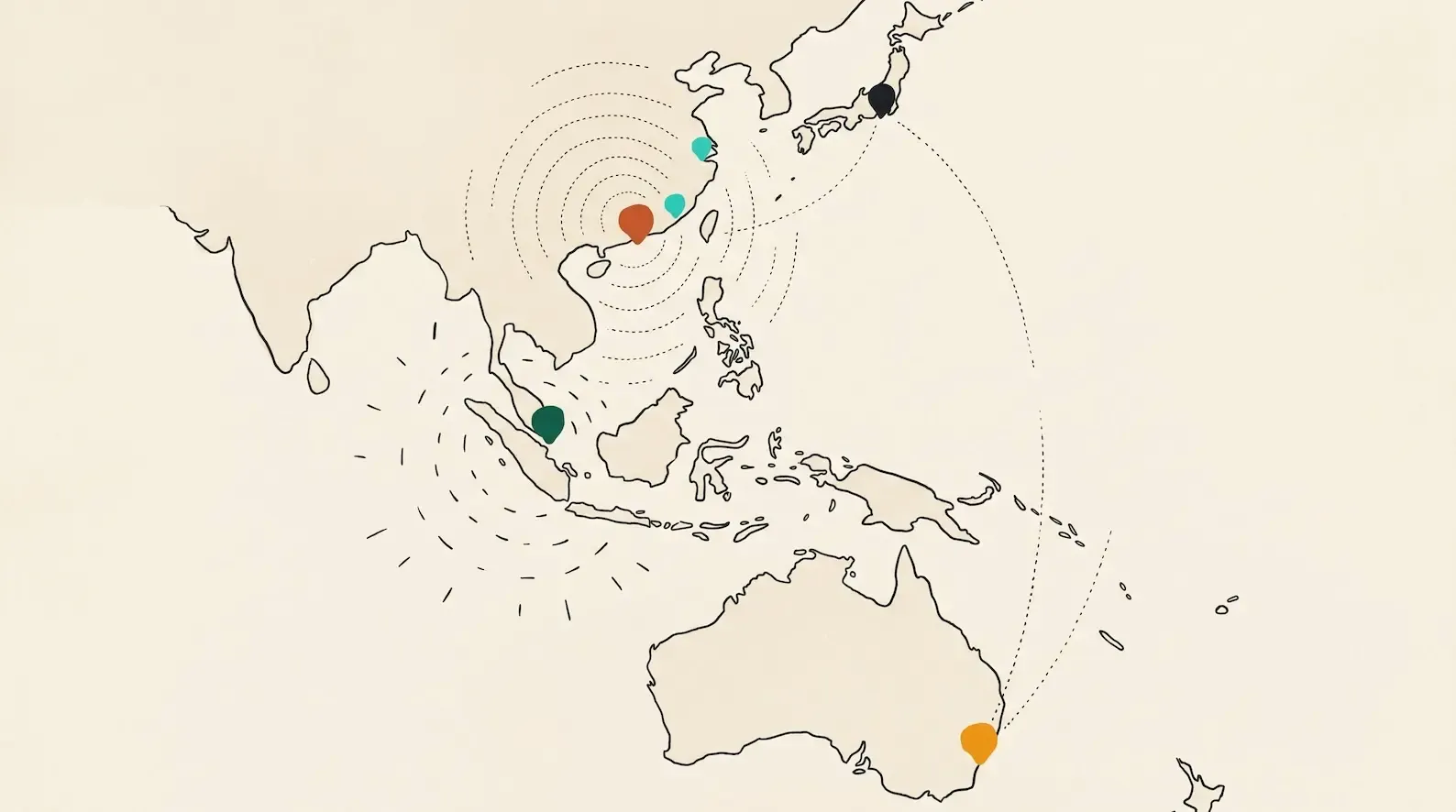
Recruitment in Hong Kong in 2026 looks different from any US/UK guide will describe. The senior partner at a Hong Kong search firm runs three concurrent mandates for tier-one banks, family offices, and a US-headquartered SaaS firm building an APAC HQ in Central. The candidate WhatsApp threads run to forty active conversations. The senior client-side calls happen in the second week of February — the week after bonus. Cross-border mandates into Shenzhen and Guangzhou route through WeChat. This is what recruitment agencies in Hong Kong 2026 actually operate against. This Guide specifies the market: the finance-and-banking sector concentration, the Q1 bonus-cycle rhythm that no US/UK cadence accounts for, the channel mix on a Hong Kong desk, the Greater Bay Area cross-border dynamic, and the tech stack a Hong Kong desk needs to handle all of it.
The Hong Kong recruitment market in 2026 — sectors, sizing, finance-first structure
The Hong Kong recruitment market in 2026 sits on four structural conditions: tight labour supply, sector concentration in financial services, growth-oriented senior demand, and cross-border responsibility into the Greater Bay Area.
The labour supply is tight. Hong Kong’s Census and Statistics Department reported an unemployment rate of 3.0% for March–May 2026, with total employment rising by 7,200 persons in the period Source: HKSAR Census and Statistics Department, June 2026. At sub-3% unemployment, senior hires are contested — the competition is for candidate attention and timing, not for candidate availability.
The sector concentration is where the market shape diverges from Singapore, Sydney, or London. Financial services is the sector the economy is built around, and investment banking, asset management, hedge funds, family offices, and the professional services layer that wraps around them dominate senior mandate flow. A Hong Kong search firm’s calendar looks more like an investment bank’s than like a UK generalist recruitment agency’s — driven by fiscal-year rhythms, bonus cycles, and firm-specific structural moments.
Demand is growth-oriented. Robert Walters’ 2025 Hong Kong Salary Guide reported that 77% of surveyed Hong Kong employers expected to either maintain or increase headcount in 2025, with financial services and professional services among the most optimistic sectors Source: Robert Walters, January 2025. ManpowerGroup’s APAC Employment Outlook for Q2 2025 registered a +30% net hiring intention across the region Source: ManpowerGroup, March 2025.
The regional-hub dimension — Hong Kong’s role as anchor for the Greater Bay Area — is covered later in this Guide. Every senior mandate a Hong Kong desk runs sits within this four-condition frame.
The Q1 bonus-cycle rhythm
The single most Hong Kong-specific feature of the recruitment year is the Q1 bonus cycle. Hong Kong finance hiring does not run on a smooth twelve-month calendar. It runs on bonus season.
The pattern is documented. Selby Jennings’ 2025 Hong Kong Banking Compensation report found that 68% of surveyed front-office bankers received their main annual bonus in Q1 (January to March), and 62% said they would be more likely to consider external offers immediately after bonus payout Source: Selby Jennings, February 2025. LinkedIn’s 2024 Talent Trends for Hong Kong reported that 42% of professionals surveyed said they only actively look for roles in specific windows tied to performance reviews or bonuses, with financial services respondents over-indexing on Q1 transitions Source: LinkedIn Talent Solutions, October 2024.
The operational implication is that a US/UK-style weekly sales cadence misfires in Hong Kong if it ignores this rhythm. Outreach to a senior banker in November is politely deferred — the candidate is not going to jeopardise their bonus payout by initiating conversations that might leak. Outreach in the second week of February, days after bonuses land, is often reciprocated within hours. The window matters.
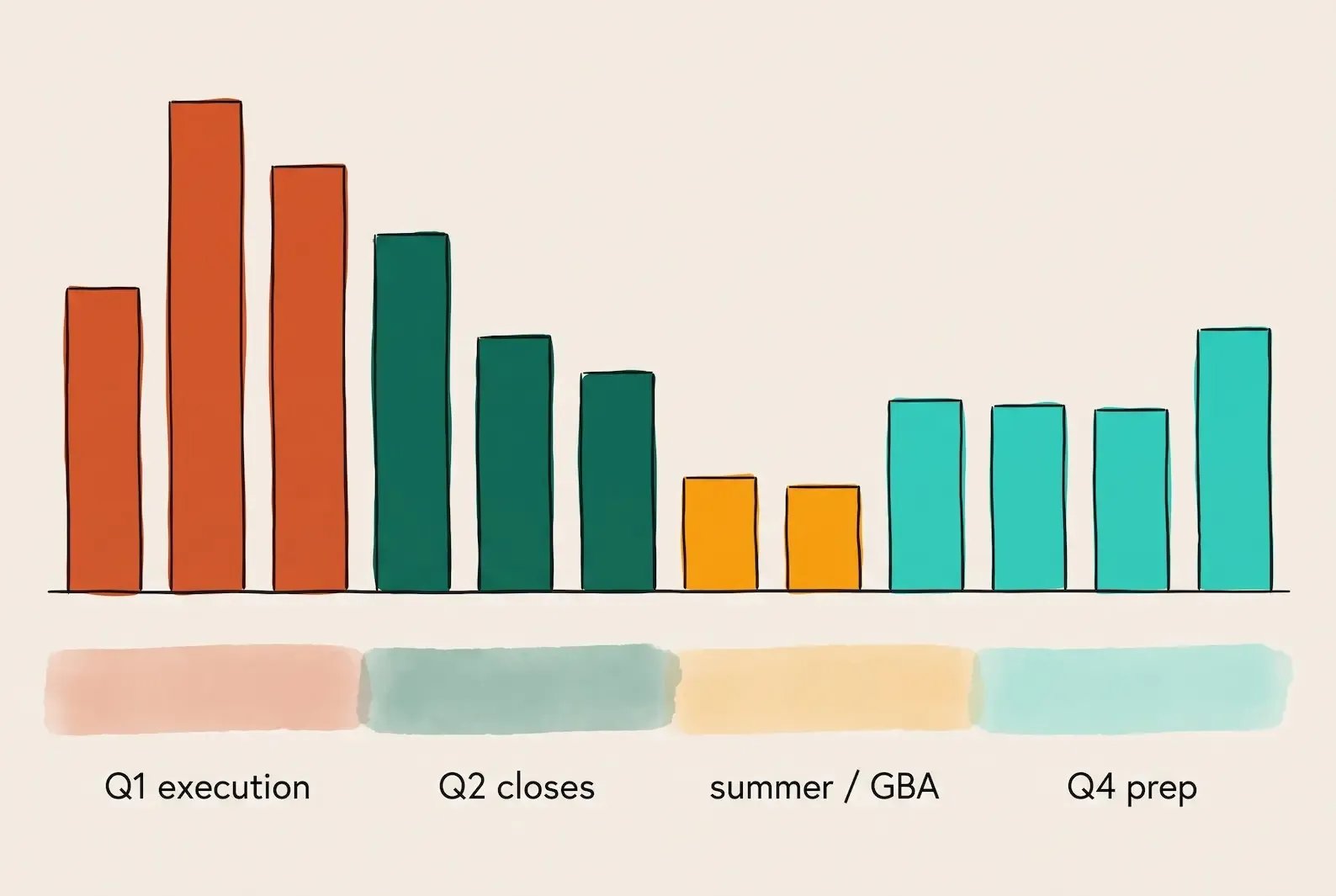
For a Hong Kong desk, this means the BD calendar reverses. Q4 is preparation season — mapping targets, updating relationship histories, scheduling early-Q1 touches. Q1 (specifically weeks 4-10) is execution season — active outreach, meetings, mandate briefings. Q2 is where mandates close and placements land. A partner running this cadence completes disproportionate business in one quarter, then uses the summer for cross-border GBA work and preparation for the next cycle.
The BD Signals layer of an AI-native recruitment CRM should be tuned for this rhythm — surfacing signals in February and March that would be lower-priority in November. The Hiring Intent Signal Map covered this at the level of “Hong Kong reads finance leadership change.” Bonus season is the annual concentration of that signal type.
Channel mix on a Hong Kong desk
The Hong Kong desk runs on four channels, each with a distinct job.
WhatsApp dominates senior candidate communication. Senior bankers, managing directors, family-office principals, and the professional-services partners around them answer WhatsApp before email. The reason is operational — WhatsApp is on the phone, checked constantly, replied to within minutes. Email is checked at desk and often triaged. LinkedIn’s 2024 Hong Kong Talent Trends reported that over 60% of recruiter-initiated outreach in Hong Kong is sent from mobile devices Source: LinkedIn Talent Solutions, October 2024 — reflecting the reality that senior candidates are reached where they read.
LinkedIn carries the international layer. For candidates coming into Hong Kong from London, New York, or Singapore — and for international clients running APAC HQ mandates — LinkedIn is the professional bridge. It’s the channel the international candidate already uses and can be reached on without prior contact.
WeChat is essential for GBA cross-border work. Any mandate touching mainland China — a Shenzhen tech company opening a Hong Kong office, a Hong Kong bank opening a Shenzhen team, a Guangzhou family office recruiting a bilingual COO — routes through WeChat. LinkedIn is restricted on the mainland; WhatsApp is technically available but WeChat is the default professional channel. The consultant working a GBA mandate has WeChat open alongside WhatsApp. The earlier WeChat for recruitment in Hong Kong piece covers this in depth.
Email handles formal continuation. Multi-stakeholder threads, document attachments, board-level correspondence, retainer confirmations — email is where the paper trail lives. Rarely the first-reply channel; often the channel the mandate closes on.
The WhatsApp for Recruiters piece walks the loss patterns when WhatsApp lives outside the CRM. The Hong Kong version of that argument is sharper — because WhatsApp is not one of the primary channels here; it’s the dominant one.
The Greater Bay Area cross-border angle
Hong Kong’s role as anchor for the Greater Bay Area is what makes the market structurally different from a national market like the UK or Australia.
The GBA covers Hong Kong, Macau, and nine mainland cities — Shenzhen, Guangzhou, Foshan, Dongguan, Zhongshan, Zhuhai, Jiangmen, Huizhou, Zhaoqing. Combined economy over US$1.7 trillion. Hong Kong sits at the top of it as the financial and legal gateway. This shapes senior recruitment mandates directly.
A common Hong Kong tech mandate looks like this: a Shenzhen-headquartered fintech opening a Hong Kong office for regulatory and capital-markets reasons, hiring a Hong Kong-based COO who reports to Shenzhen, plus a bilingual General Counsel, plus a Head of Compliance. Three mandates, one client, two jurisdictions, mixed English/Cantonese/Mandarin working environment. The relationship history, the BD signals, the candidate pipeline — all need to be coherent across Hong Kong and mainland China.
The channel implication is that WeChat and WhatsApp both run in parallel on the consultant’s phone, sometimes on the same mandate. The candidate is a Hong Kong national who works in Shenzhen but lives in Kowloon, communicates with mainland colleagues in Mandarin on WeChat and with Hong Kong colleagues in Cantonese on WhatsApp. The senior recruiter needs to reach the same candidate on the channel that fits the context of the conversation.
For Hong Kong desks, this multi-jurisdiction reality is the design requirement — and the differentiator from CRMs that treat each country as a separate workspace.
The tech stack a Hong Kong desk needs
The senior recruiter running a Hong Kong desk in 2026 needs a tech stack designed for finance-first sector concentration, bonus-cycle rhythm, WhatsApp + WeChat dominant channel mix, and cross-border mandates. Three architectural conditions.
Conversation capture at source — especially WhatsApp and WeChat. The dominant channels are messaging apps, not email. If the CRM doesn’t ingest WhatsApp and WeChat automatically, the senior candidate history sits on the consultant’s phone. Manual logging stops happening within two weeks. The Global Recruiter’s 2026 analysis estimated that 15-25% of candidate introductions happen outside the CRM as an industry-wide baseline Source: The Global Recruiter, March 2026. In Hong Kong specifically, where WhatsApp and WeChat dominate senior candidate communication, this gap covers most of the conversation record.
Relationship history that follows the contact across markets. A senior finance candidate in Hong Kong may be reachable across Hong Kong, Shanghai, Singapore, and London over a five-to-ten-year recruiting relationship. Perfect Memory is the architectural layer that holds every conversation across every channel as one record per contact. For a Hong Kong desk running cross-border mandates and multi-jurisdiction career arcs, this is what makes the consultant’s outreach reference the previous conversation — even if the previous conversation was on WeChat, in a different country, three years earlier.
BD signals tuned for the Hong Kong signal mix. Generic BD signal models miss the Hong Kong signal stack. The signals that actually predict mandate opportunity from a Hong Kong desk include executive appointment announcements at tier-one banks, Q1 bonus-cycle-triggered movement patterns, family-office expansion, and cross-border headcount announcements from mainland-headquartered firms opening HK offices. A US/UK-default BD signal model weights LinkedIn job posts and misses the appointment-and-bonus signals that fire first in Hong Kong.
What changes when the CRM is built for Hong Kong reality
The operational difference between a CRM built for Hong Kong reality and a CRM built for US/UK default is not feature-by-feature. It is architectural.
A US/UK default CRM assumes the dominant channels are email and LinkedIn. It assumes a smooth quarterly BD cadence with no bonus-cycle concentration. It assumes mandates are national rather than cross-border. It assumes the BD signal mix runs on LinkedIn job posts and headcount growth without weighting bonus-triggered movement or executive appointment news. None of these assumptions holds on a Hong Kong desk.
A CRM built for Hong Kong reality inverts each assumption. WhatsApp and WeChat are captured at source as first-class channels. The BD signal layer weights executive appointment news at tier-one banks materially higher than a generic job post. The relationship history follows the contact across Hong Kong, Shenzhen, and Shanghai as one record. The bonus-cycle rhythm surfaces as a Q1 concentration in the BD Signals layer — outreach that would be low-priority in November becomes high-priority in February.
For agencies running the Singapore-first stack described in the companion regional piece, the Hong Kong architecture layers additional requirements — WeChat capture, GBA cross-border relationship history, and bonus-cycle-tuned signal weighting. For agencies working only Hong Kong, all three are non-negotiable.
Signals is built for this. Perfect Memory captures WhatsApp, WeChat, LinkedIn, email, voice, and meetings into one record. BD Signals reads the Hong Kong signal mix — appointment news, funding rounds, bonus-cycle triggers — per desk. The Hong Kong recruitment landscape in 2026 — 3% unemployment, finance-heavy sector concentration, +30% regional NEO, Q1 bonus-driven senior movement, cross-border GBA mandates — is the reality the CRM is designed around. Hong Kong desks are built into the architecture, not patched onto it later.
Run a Hong Kong desk on a CRM built for it
See Signals on a recruitment desk like yours.
Common questions
Recruitment in Hong Kong in 2026 operates in a market where the unemployment rate is 3.0%, financial services is the dominant sector, and 77% of employers expected to maintain or increase headcount in 2025. The dominant mandates are senior-leadership in banking, family offices, professional services, and executive search, concentrated by the Q1 bonus cycle. Hong Kong is also the anchor for the Greater Bay Area, meaning many Hong Kong-located mandates extend across into Shenzhen, Guangzhou, and mainland China.
Hong Kong finance hiring concentrates in Q1 because bonuses pay in January to March, and senior bankers move in the weeks immediately after. Selby Jennings' 2025 Hong Kong Banking Compensation report found that 68% of front-office bankers received their main annual bonus in Q1 and 62% said they would be more likely to consider external offers immediately after bonus payout. LinkedIn's 2024 Hong Kong Talent Trends found 42% of professionals only actively look for roles in specific windows tied to reviews or bonuses. Outreach in November is politely deferred; outreach in mid-February is reciprocated within hours. The window matters.
Hong Kong recruiters run on four channels with distinct jobs. WhatsApp dominates senior candidate communication: senior bankers, MDs, family-office principals answer WhatsApp before email. LinkedIn carries the international layer for candidates coming from US/UK/Singapore. WeChat is essential for Greater Bay Area cross-border mandates that touch mainland China (where LinkedIn is restricted). Email handles formal continuation: document threads, board-level correspondence, retainer confirmations. LinkedIn's 2024 Hong Kong data reported that over 60% of recruiter outreach in the market is sent from mobile devices, confirming the mobile-messaging dominance.
The Greater Bay Area covers Hong Kong, Macau, and nine mainland cities including Shenzhen, Guangzhou, and Foshan, a combined economy over US$1.7 trillion with Hong Kong as the financial and legal gateway. A typical Hong Kong tech mandate spans multiple jurisdictions: a Shenzhen fintech opening a Hong Kong office, or a Hong Kong bank building a Shenzhen team, with bilingual English/Cantonese/Mandarin candidate bases. WeChat and WhatsApp run in parallel on the consultant's phone. The relationship history has to follow the contact across the border regardless of which channel the current conversation is on.
A Hong Kong recruitment desk in 2026 needs three architectural capabilities. Conversation capture at source for WhatsApp and WeChat, the two dominant senior-candidate channels, so history isn't fragmented across the consultant's phone. A CRM with relationship history that follows the candidate across markets (Hong Kong, Shenzhen, Shanghai, Singapore, London) anchored in Perfect Memory. BD signals tuned for the Hong Kong signal mix: executive appointment announcements at tier-one banks, Q1 bonus-cycle-triggered movement, family-office expansion, and cross-border headcount signals from mainland-headquartered firms. A US-default BD signal model weights LinkedIn job posts and misses the appointment-and-bonus signals that fire first in Hong Kong.