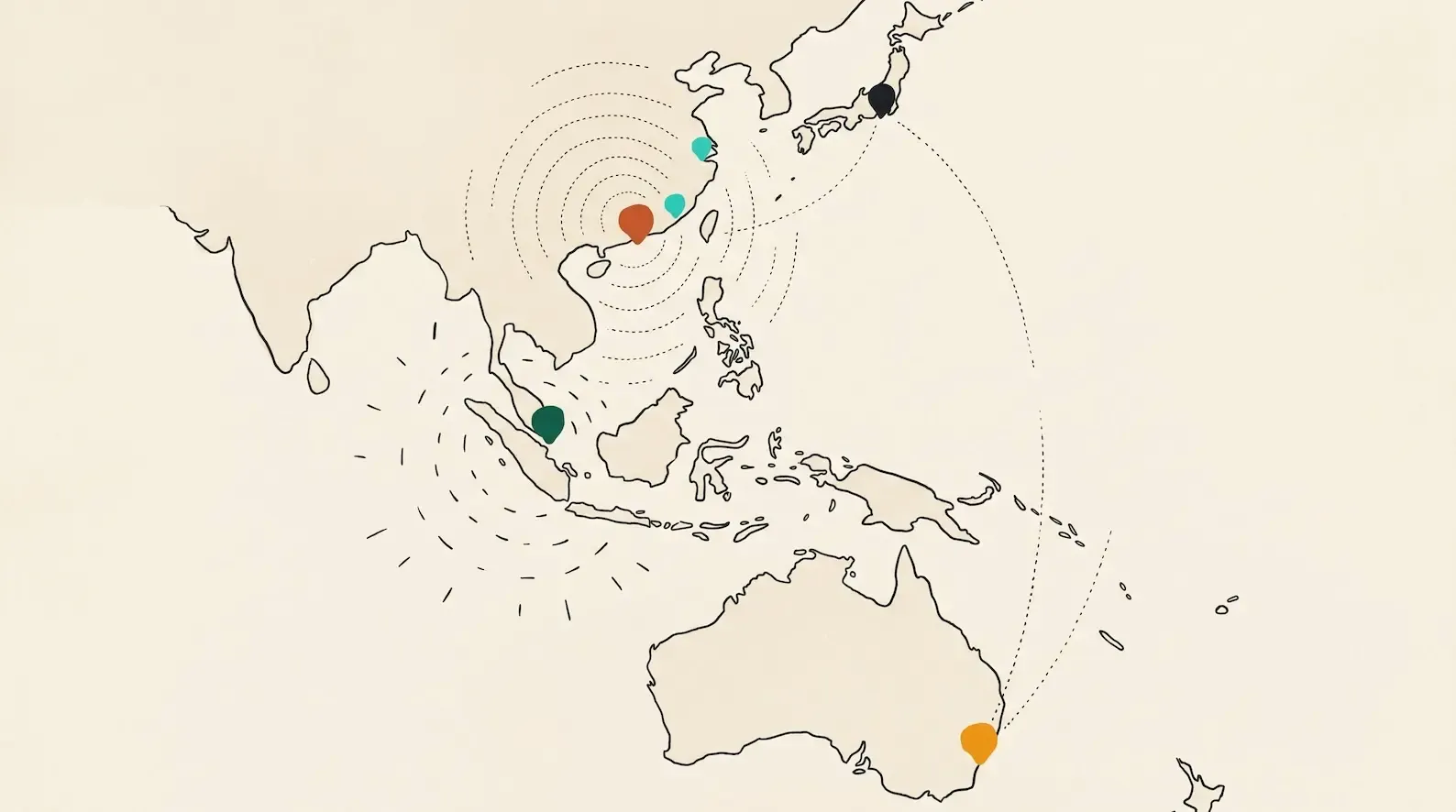
Recruitment in Singapore in 2026 looks different from any US/UK guide will describe. The senior recruiter at a Singapore agency runs three concurrent mandates spanning Indonesia, Vietnam, Thailand, and the Philippines, with candidate conversations on WhatsApp, international touches on LinkedIn, and formal documentation on email. Clients expect shortlists inside ten working days. The unemployment rate is two percent. The talent shortage is sharper than it was three years ago. Speed and channel discipline are not optimisations — they are the operating reality. This Guide specifies what the recruitment landscape in Singapore actually looks like for recruitment agencies in 2026: the market and the sectors, the channel mix on a Singapore desk, the speed expectations clients now bring, the cross-border SEA HQ dynamic, and the tech stack a Singapore desk needs to handle all of it.
The Singapore recruitment market in 2026 — sectors, sizing, regional hub dynamic
The Singapore recruitment market in 2026 sits at the intersection of four structural forces: tight labour supply, growth-oriented demand, sectoral concentration in tech and financial services, and Singapore’s role as a Southeast Asia HQ.
The labour supply is structurally constrained. Singapore’s Ministry of Manpower reported a seasonally adjusted unemployment rate of 2.0% for Q1 2026, remaining near a decade-low Source: MOM Singapore, June 2026. At sub-2% unemployment, every senior hire is contested. Agencies are not competing for candidates; they are competing for candidate attention.
Demand is growth-oriented. ManpowerGroup’s Q3 2025 Singapore Employment Outlook Survey reported a Net Employment Outlook of +24%, with 43% of employers planning to increase staffing — company expansion was cited as the primary driver of hiring Source: ManpowerGroup Singapore, June 2025. That extended into the broader region in Q1 2026: the APME-wide Employment Outlook hit +31%, with Singapore one of the key contributors Source: ManpowerGroup, December 2025. Two consecutive quarters of strong outlook in a tight market is the structural backdrop the senior recruiter is working against.
The sectoral concentration is specific. Singapore recruitment in 2026 is heavily weighted toward technology, financial services, regional headquarter buildouts, and professional services. The dominant mandates are senior-leadership (VP-level and above), region-spanning (Singapore-headquartered with team responsibility across SEA), and time-sensitive (clients moving on Q3 hiring plans by July).
The regional hub dynamic is what most US/UK guides miss. Singapore is not a national recruitment market that happens to sit in Southeast Asia. It is the regional HQ for Southeast Asia, which means a meaningful share of every Singapore-located mandate has hiring responsibility extending into Indonesia, Vietnam, Thailand, and the Philippines. This shapes everything that follows in this Guide.
Channel mix on a Singapore desk — WhatsApp, LinkedIn, email
The Singapore desk runs on three primary channels, and the discipline is knowing which channel does which job.
WhatsApp dominates senior candidate communication. Senior candidates in Singapore — VPs, Heads of, country leaders, regional-roles — answer WhatsApp before they answer email, often before they answer LinkedIn. The reasons are operational: candidates check WhatsApp on their phones during meetings, between meetings, on the MRT, at lunch. Email and LinkedIn are typically checked at desk in the morning and end-of-day. A senior recruiter sending an email at 10am Singapore time waits 24-48 hours for a reply. The same content sent as a WhatsApp message often gets a reply within an hour.
LinkedIn carries the international layer. Where the candidate is international — coming from the US or UK for a Singapore role, or coming from another APAC market — LinkedIn is the bridge. International candidates haven’t built the Singapore WhatsApp habit yet; LinkedIn is the channel they already use professionally and the channel the recruiter can reach them on without prior contact. LinkedIn also carries the client side of regional HQ mandates where the hiring panel is distributed across multiple markets.
Email handles formal continuation. Email is rarely the first-reply channel. It is the channel the conversation moves to when documents need to attach, when multi-stakeholder panels need to be looped in, when the candidate or client needs the paper trail. The senior recruiter doesn’t start a conversation on email and doesn’t get the first reply on email — but every closed mandate ends up with an email thread documenting it.
The discipline is matching the channel to the conversation stage. Cold candidate outreach: LinkedIn for internationals, WhatsApp for locals. Mid-conversation: WhatsApp. Documentation: email. The recruiter who sends a four-paragraph formal email to a Singapore VP for first contact is reaching them on the wrong channel — and getting the reply rates the channel mix is structurally producing.
Speed realities — what Singapore clients now expect
Speed expectations in Singapore have hardened. The combination of tight labour supply, growth-oriented demand, and regional competition means clients have less patience for a 21-day shortlist.
The market evidence is direct. Hays’ 2025 Asia Salary Guide found that 59% of recruiters and hiring managers in Singapore say it has become harder or much harder to find qualified candidates compared to three years ago Source: Hays Asia Salary Guide, February 2025. ManpowerGroup’s 2025 Talent Shortage research reported 63% of businesses in Singapore experiencing talent shortages, with 34% describing the shortage as high or very high Source: ManpowerGroup, March 2025. And Deel’s 2024 APAC Workforce report found 49% of Singapore leaders said hiring delays had caused them to miss growth opportunities or delay projects Source: Deel, February 2024.
The cadence expectations that follow are concrete. For mid-to-senior mandates, clients expect a credible shortlist inside 5-10 working days. For contract or interim roles, faster — sometimes 48-72 hours. The agency that consistently delivers in seven days wins materially more repeat business than the agency delivering in fourteen. The Speed to Shortlist Playbook defines the 7-day operating cadence in detail; the point for this Guide is that the cadence is not optional in Singapore — it is the table-stakes operating rhythm.
The follow-up cadence is similarly tightened. Singapore clients expect responses to candidate updates within hours, not days. WhatsApp makes this possible — and creates the expectation. The senior recruiter who batch-replies on email Friday afternoon is operating on the cadence Singapore clients had three years ago, not the cadence they have now.
In a +24% NEO market where 49% of leaders are reporting hiring delays as a growth blocker, speed is not a service differentiator. It is the minimum service expectation.
The cross-border angle — Singapore as SEA HQ
Singapore is the regional headquarters for Southeast Asia recruitment. This is not a marketing claim — it is the operational reality of most senior mandates a Singapore desk runs.
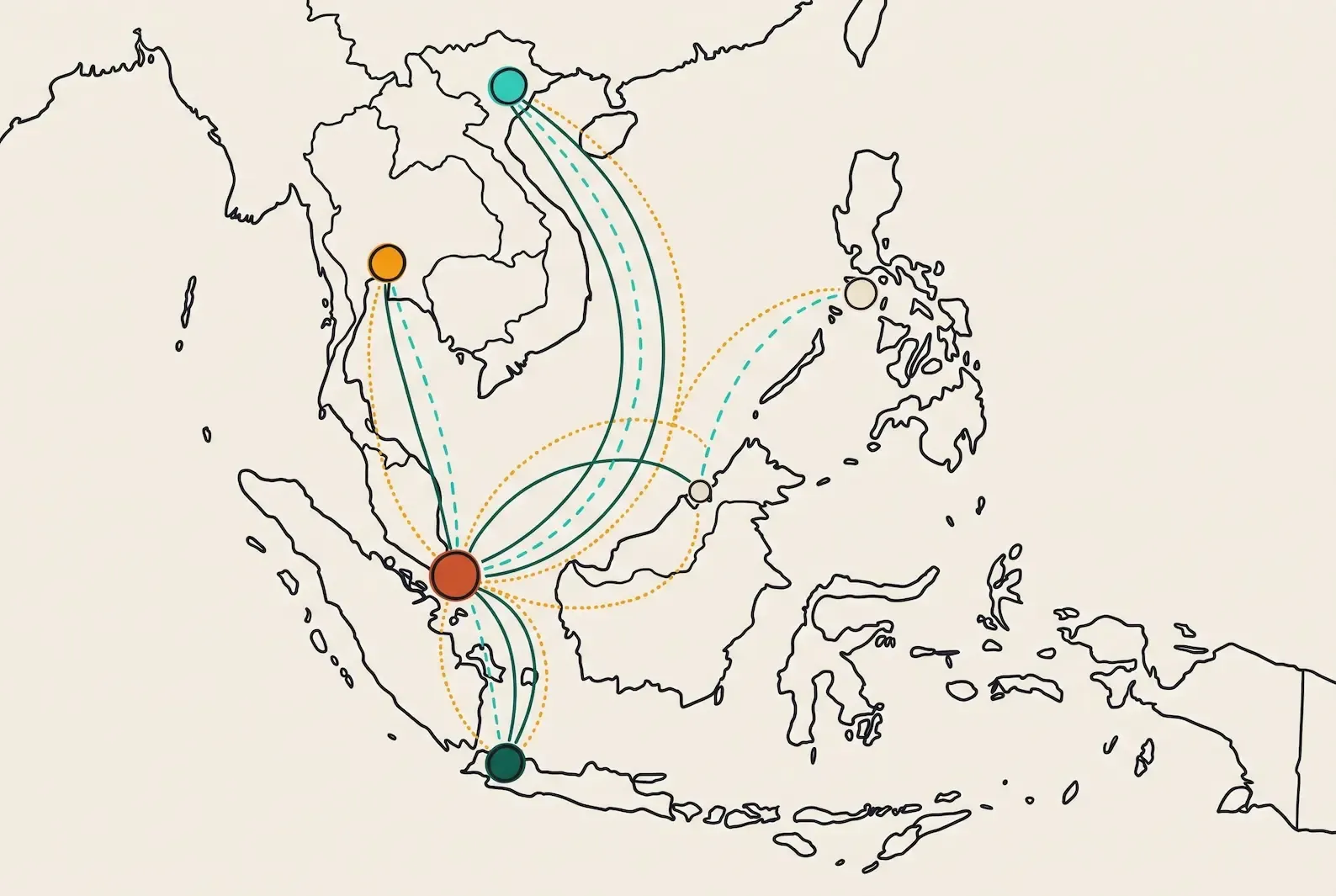
A senior recruiter on a Singapore tech desk will routinely run mandates that look like this: a US-headquartered SaaS company opening their APAC HQ in Singapore, hiring a VP of Engineering and a Head of Sales for the APAC HQ, plus four regional country managers (Indonesia, Vietnam, Thailand, Philippines) reporting into the Singapore-based VP. Six mandates, one client, five countries. The relationship history, the BD signals, the candidate pipeline, the conversation thread — all need to be coherent across the markets.
This is what US/UK guides on recruitment markets miss completely. A US-domestic recruitment guide describes a senior recruiter running domestic mandates. A Singapore-context guide has to describe a senior recruiter running regional mandates with a Singapore anchor. The CRM running those mandates cannot treat Singapore as one country and Indonesia, Vietnam, Thailand, and the Philippines as separate ones — the relationships span the markets.
The Hiring Intent Signal Map defined Singapore as one of five APAC layers with its own dominant signals: tech funding rounds, regional HQ buildouts, MAS announcements, Enterprise Singapore grant rounds. The cross-border angle adds a layer to that — a Singapore desk reading those signals also reads adjacent SEA signals. A Series B announcement at an Indonesian fintech is a hiring signal for the Singapore desk if the company is building a regional team into Singapore. A Vietnamese tech company hiring a Singapore-based regional sales lead is a signal even though the company is Vietnam-headquartered.
For agencies running recruitment CRMs designed for APAC, this multi-market signal flow is the design requirement — and the differentiator from CRMs that treat each country as a separate workspace.
The tech stack a Singapore desk actually needs
The senior recruiter on a Singapore desk in 2026 needs a tech stack designed for the channel mix, the speed expectations, and the cross-border mandates. Three architectural conditions have to be met.
Conversation capture at source — especially WhatsApp. WhatsApp is the dominant senior-candidate channel; if it does not feed the CRM automatically, the candidate history is fragmented across the consultant’s phone. Manual logging stops happening within two weeks. The Conversation Capture Stack is the operational layer that ingests WhatsApp into the candidate record at source, alongside LinkedIn, email, voice, and meetings. For Singapore desks specifically, this is the highest-leverage architectural decision — getting WhatsApp inside the CRM converts most of the senior candidate history from invisible into searchable.
Relationship history that follows the candidate across markets. A senior candidate in Singapore may be reachable across HK, SG, MY, ID for cross-border roles over a five-year recruiting relationship. Perfect Memory is the architectural layer that holds every conversation across every channel as one record per contact. For a Singapore desk running regional mandates, this is what makes the consultant’s reach-out reference the previous conversation — even if the previous conversation was about a different country and a different mandate.
BD signals tuned for the Singapore mix. Generic BD signal models miss the Singapore signal stack. The signals that actually predict mandate opportunity from a Singapore desk include Series B and Series C funding rounds at Southeast Asian SaaS companies (predicting VP Engineering, Head of Sales, APAC GM hires within 2-4 weeks); regional HQ buildout announcements (an entire leadership team’s worth of mandates inside 8 weeks); MAS announcements and Enterprise Singapore grant disbursements; cross-border headcount expansion announcements. A US-default BD signal model overweights LinkedIn job posts and underweights the funding-and-buildout signals that actually fire first in Singapore.
Asia-Pacific talent acquisition software spending is projected to grow from US$3.39 billion in 2026 to US$5.31 billion by 2031 Source: Mordor Intelligence, May 2026. Singapore agencies are increasingly part of that investment — but the right tech stack matters as much as the spend.
What changes when the CRM is built for Singapore reality
The operational difference between a CRM built for Singapore reality and a CRM built for US/UK default is not feature-by-feature. It is architectural.
A US/UK default CRM assumes the dominant channels are email and LinkedIn DMs. It assumes voice calls are scheduled rather than spontaneous. It assumes mandates are domestic rather than cross-border. It assumes the BD signal mix is funding-round-and-headcount-growth without weighting regional HQ buildouts or Enterprise Singapore grant rounds. None of these assumptions holds on a Singapore desk.
A CRM built for Singapore reality — and for the broader APAC channel mix the Hiring Intent Signal Map catalogues — inverts each assumption. WhatsApp is captured at source as a first-class channel, not bolted on as an integration. Voice notes from candidates speaking in their stronger language are transcribed alongside English text. Cross-border mandates carry one relationship history across the five SEA markets a Singapore desk routinely covers. BD signals are weighted per market based on what fires first in that market — funding rounds for Singapore, leadership change for Hong Kong, SEEK clusters for Australia.
What this changes for the senior recruiter on a Singapore desk is that the CRM stops being a system they have to translate from US/UK assumptions into Singapore reality. The system understands the channel mix, surfaces the right signals, holds the right relationship history. The consultant operates as a Singapore-region recruiter, not as a US/UK recruiter using US/UK software to do a Singapore-region job.
Signals is built for this. The Conversation Capture Stack handles WhatsApp, WeChat, LinkedIn, email, voice, and meetings into one record. Perfect Memory holds the cross-border relationship history. BD Signals reads the regional signal mix per desk. The Singapore recruitment landscape in 2026 — tight labour, +24% NEO, 5-10 day shortlist windows, multi-market mandates — is the reality the CRM is designed around. Singapore desks are built into the architecture, not patched onto it later.
Run a Singapore desk on a CRM built for Singapore
See Signals on a recruitment desk like yours.
Common questions
Recruitment in Singapore in 2026 operates in a market where the unemployment rate is 2.0%, the Net Employment Outlook is +24%, and 43% of employers are planning to increase staffing. Demand is concentrated in technology, financial services, regional headquarter buildouts, and professional services. The dominant mandates are senior-leadership (VP-level and above), region-spanning (Singapore-headquartered with hiring responsibility across SEA), and time-sensitive. Singapore functions as the Southeast Asia HQ for many global companies, meaning a Singapore-located mandate routinely extends into Indonesia, Vietnam, Thailand, and the Philippines.
Singapore recruiters run on three primary channels with distinct jobs. WhatsApp dominates senior candidate communication: candidates check it on their phones throughout the day and reply within an hour, versus 24–48 hours on email. LinkedIn carries the international layer, covering candidates relocating from US, UK, or other APAC markets, and client-side panels distributed across multiple markets. Email handles formal continuation: multi-stakeholder threads, document attachments, the paper trail. The discipline is matching the channel to the conversation stage.
Singapore clients in 2026 expect credible shortlists inside 5–10 working days for mid-to-senior mandates, and faster (48–72 hours) for contract positions. They expect responses to candidate updates within hours, not days. The combination of 2.0% unemployment, +24% Net Employment Outlook, 63% of Singapore businesses experiencing talent shortages, and 49% reporting hiring delays as a growth blocker has hardened cadence expectations. The agency that consistently delivers in seven days wins materially more repeat business than the agency delivering in fourteen.
Singapore's role as a Southeast Asia HQ means a meaningful share of every Singapore-located mandate has hiring responsibility extending into Indonesia, Vietnam, Thailand, and the Philippines. A senior tech desk in Singapore routinely runs mandates that look like: US-headquartered SaaS company opens APAC HQ in Singapore, hires VP Engineering plus Head of Sales plus four country managers across the region. Six mandates, one client, five countries. The relationship history, BD signals, and conversation thread all need to be coherent across the markets, which means the CRM has to treat the region as one workspace, not five separate ones.
A Singapore recruitment desk in 2026 needs three architectural capabilities. Conversation capture at source, especially WhatsApp, so the senior candidate history is captured automatically rather than depending on manual logging. A CRM with relationship history that follows the candidate across the SEA markets a Singapore desk covers, anchored in Perfect Memory. BD signals tuned for the Singapore signal mix: Series B and C funding rounds at Southeast Asian SaaS companies, regional HQ buildout announcements, MAS and Enterprise Singapore grant disbursements, cross-border headcount expansion. A US-default BD signal model overweights LinkedIn job posts and underweights the signals that actually fire first in Singapore.