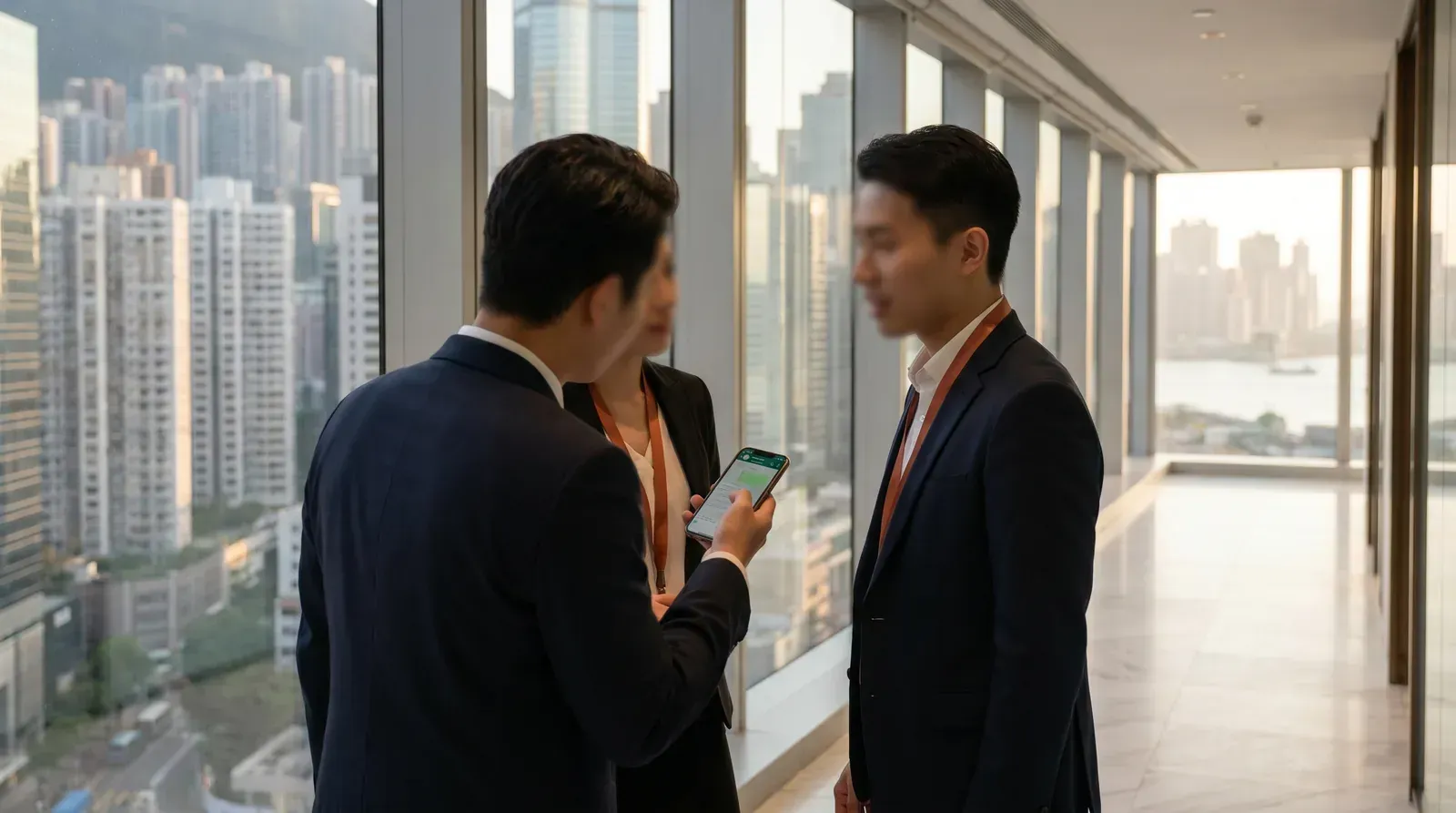
WhatsApp is where most of senior recruitment actually happens in APAC. The candidate messages back in twenty minutes on WhatsApp; they take three days to answer email. The client confirms availability via WhatsApp; the email thread to the same effect would take ten replies. The senior consultant runs three concurrent mandates from a phone that holds the active threads for forty candidates and twelve clients. The CRM, meanwhile, shows none of this. This is the structural problem this article addresses. WhatsApp for recruiters is not the problem — using WhatsApp outside the CRM is. Three loss patterns surface when the thread lives on the consultant’s phone rather than in the candidate record: handover loss, attribution loss, and ghosting attribution. This article walks each pattern and the architectural fix.
Why WhatsApp has become the dominant recruiter-candidate channel
WhatsApp’s scale is structural. For senior recruitment, what matters is not the global install base but the regional one: WhatsApp is the dominant messaging channel in Hong Kong, Singapore, Australia, and most of Southeast Asia, and it is where the working day of a recruiter covering those markets actually happens.
Candidate preference reflects the same shift. The Talent Board’s 2024 Candidate Experience Benchmark Report found that 66% of candidates globally prefer to be contacted by recruiters through messaging apps or text rather than phone calls Source: Talent Board, September 2024. The reason is not generational — it is operational. A WhatsApp message is a low-cost ask: the candidate reads it on their phone, replies in twenty seconds, and moves on. A phone call requires scheduling, attention, and a decision to answer.
On a senior desk in Hong Kong or Singapore, the volume looks like this: forty active candidate WhatsApp threads at any given time, fifteen of which are mid-conversation; twelve client-side WhatsApp threads, six of which involve active mandates; voice notes from candidates who prefer audio to typing in their non-native language; and bilingual exchanges that switch between English and Cantonese or Mandarin mid-thread. The consultant moves through this volume in twenty- to thirty-minute bursts across the day. The messaging app is not a side channel. It is the working channel.
This is why the question “how do recruiters use WhatsApp without losing track of candidates” has become a real one. Volume that high outside the CRM means the candidate history is no longer in the system. The consultant remembers it. The phone holds it. The agency does not have it.
The three loss patterns when WhatsApp lives outside the CRM
The structural problem with running WhatsApp outside the CRM is not one problem. It is three.
| Loss pattern | What it looks like | Compound effect |
|---|---|---|
| Handover loss | A senior consultant leaves the agency, moves desks, or goes on parental leave. Their WhatsApp threads with candidates leave with them — on their personal phone, in their archived chats | The relationship history that took two years to build is gone in one notice period |
| Attribution loss | A placement closes. The partner asks which conversation got it across the line — was it the LinkedIn message in March, the WhatsApp follow-up in April, the call in May? The agency cannot reconstruct the conversation flow | Next quarter’s BD strategy runs on guesswork, not data |
| Ghosting attribution | A candidate stops replying. Did they ghost the agency, or did the consultant’s WhatsApp message land at 11pm on a Friday and get buried? The CRM has no record either way | The agency cannot distinguish bad timing from bad fit — and re-engages the wrong candidates |
OneUp Sales’ 2026 State of Recruitment report found that 30% of agency leaders say losing candidate or client data when a recruiter leaves is one of their top three business risks Source: OneUp Sales, February 2026. That is handover loss showing up in leadership-level risk frameworks. The Atlas 2026 Agency Recruitment Benchmark adds that 43% of agency recruiters say keeping track of conversations across email, LinkedIn, and messaging apps is a top operational challenge Source: Atlas, March 2026. That is the daily texture of the same problem.
The three patterns are not solved by better WhatsApp etiquette. Asking consent before messaging, using WhatsApp Business instead of personal accounts, and tagging threads with labels are process improvements that leave the architecture unchanged. The thread still lives on the consultant’s phone. The agency still loses it when the consultant does. The fix is architectural — the thread has to feed the CRM at source.
What “WhatsApp captured into the CRM” actually means
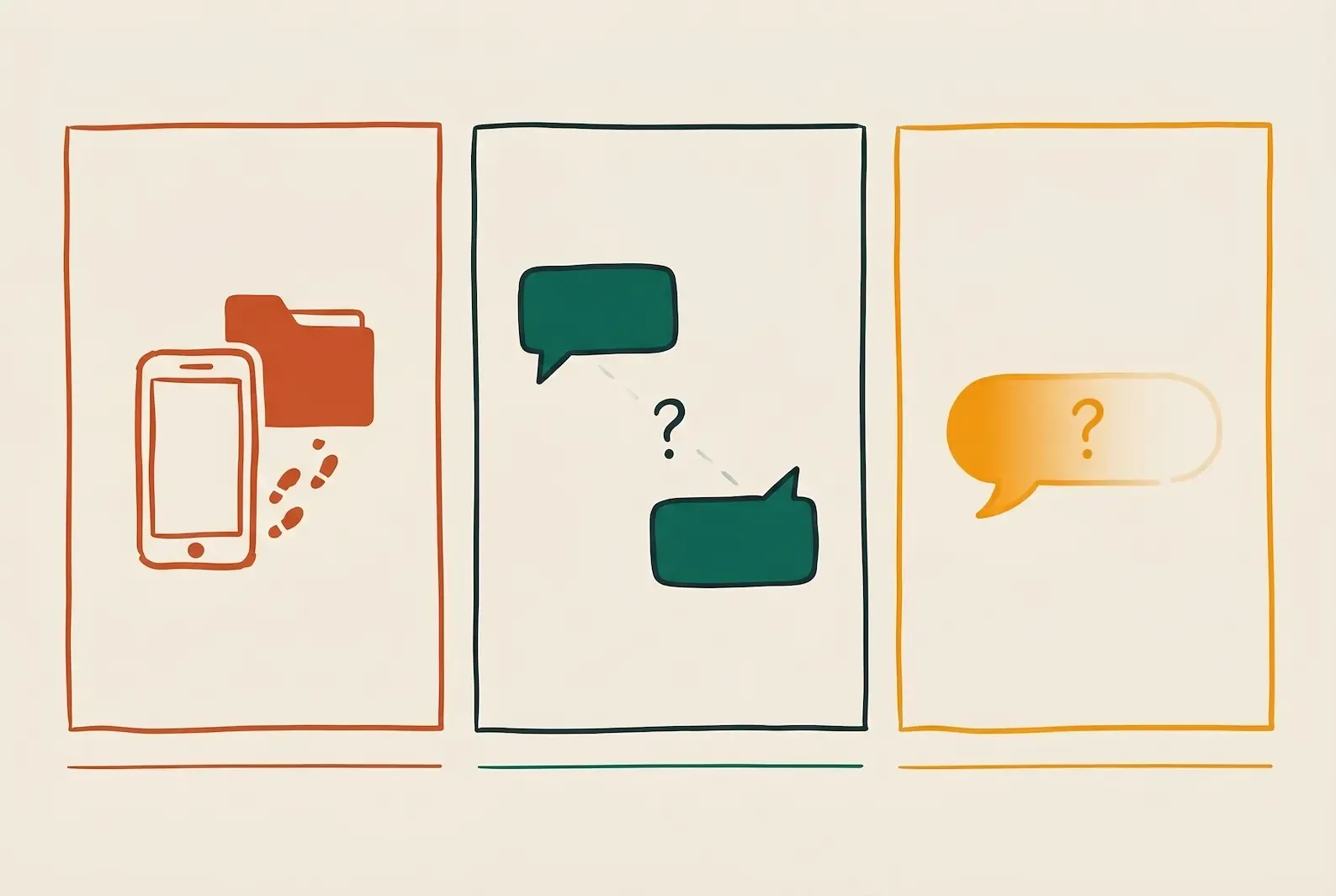
The phrase “WhatsApp captured into the CRM” is used loosely in the market. There are three different things it could mean operationally — and only one of them solves the loss patterns.
Manual screenshot logging. The consultant takes a screenshot of a WhatsApp exchange, opens the CRM, and attaches the screenshot to the candidate record. Some agencies treat this as “capture.” It is not — it is filing. The screenshot is not searchable, not linkable to a candidate identity across mandates, and depends entirely on the consultant remembering to do it. At volume, it stops happening by Week 2.
Manual summary logging. The consultant writes a one-line summary of the WhatsApp conversation into the CRM after each exchange. Better than screenshots but worse than it sounds — the summary captures the consultant’s recollection, not the actual exchange, and the volume problem persists. The Staffing Industry Analysts’ 2024 Small Staffing Firm survey reported that recruiters spend an average of 3 hours per week per recruiter manually updating their ATS or CRM with notes from WhatsApp, SMS, and other off-system conversations Source: SIA, June 2024. Three hours per recruiter per week is what manual logging actually costs.
Automatic ingest at source. The CRM is connected to WhatsApp at the account level, business and personal alike. Every message sent or received on a connected account feeds the candidate record automatically, including text, voice notes, images and document attachments. The consultant types a WhatsApp message; the message lands in the CRM the same moment it lands on the candidate’s phone. No screenshot, no summary, no after-the-fact admin.
Only automatic ingest at source solves the loss patterns. Manual logging is the legacy default that the three loss patterns describe — handover loss, attribution loss, and ghosting attribution are all what happens when capture depends on consultant memory and discipline rather than on system architecture.
The Conversation Capture Stack
The architectural layer that enables automatic ingest at source is what we call the Conversation Capture Stack. Four channel layers feed the candidate record:
- Voice and calls. Inbound and outbound calls with transcription and structured note extraction.
- Email. Inbound and outbound email per candidate, including thread context.
- Messaging apps including WhatsApp and WeChat. Automatic ingest at the API level for WhatsApp Business; equivalent capture for WeChat Work in GBA contexts.
- Meetings. Video calls captured with transcription and structured summaries.
The Conversation Capture Stack is not a separate product. It is the data layer underneath Perfect Memory — every message captured at source becomes part of the single record per candidate, per client, per company. The candidate WhatsApp thread from March, the email from April, the voice note from May, and the meeting from June all sit on the same record. When the consultant opens the candidate next week, the full history is loaded.
What makes this architecturally meaningful for WhatsApp specifically is that the messaging-app layer is where the loss patterns concentrate. Email already feeds most legacy CRMs through standard integrations. Voice calls can be captured by call-recording tools. WhatsApp is the layer where consumer-app reality (personal account, personal phone) and professional-system reality (CRM record, agency asset) collide. Closing the WhatsApp layer is what makes the rest of the stack reliable.
This is also where Agentic CRM becomes possible. An agentic system that surfaces “who to contact next, with what reference” works only when the system has the conversation history to read. With WhatsApp uncaptured, half the relevant signal is missing — and the next action surfaced by the system is a guess rather than a recommendation.
Why this matters more on an APAC desk than US/UK
The WhatsApp loss patterns matter everywhere, but they bite harder on APAC desks for three structural reasons.
Channel-mix asymmetry. US and UK recruitment runs primarily on email and LinkedIn DMs. WhatsApp exists but isn’t the dominant channel for senior-candidate communication. APAC inverts this — WhatsApp dominates Hong Kong, Singapore, Australia, and most of Southeast Asia for senior-candidate work. A Hays Hong Kong piece on the local market notes that candidates routinely receive recruiter contact via WhatsApp, Telegram, WeChat, and LinkedIn Source: Hays Hong Kong, November 2025 — meaning if WhatsApp is uncaptured on a Hong Kong desk, the candidate history is mostly uncaptured.
Bilingual candidate bases. APAC candidate exchanges often switch language mid-thread — English to Cantonese, English to Mandarin, English to Bahasa. Voice notes are common, especially among senior candidates who type faster in English but speak more comfortably in their primary language. Manual logging cannot capture the bilingual texture. Automatic ingest can — and the bilingual exchanges become searchable rather than locked in the consultant’s memory.
Multi-timezone communication. A senior consultant on a Hong Kong desk running a Singapore mandate with a client in Sydney is in three timezones across one Tuesday. WhatsApp accommodates this without requiring synchronous availability. The CRM that captures the WhatsApp threads also captures the timezone context — and the next outreach knows that the candidate is responsive between 7am and 10am Sydney time, not 7pm Hong Kong time.
The earlier piece on WhatsApp for Recruiters in Hong Kong walks the HK-specific channel realities in more depth. The point for this article is that the loss patterns scale with channel dominance — and on APAC desks, the channel dominance is highest.
What changes for Speed to Shortlist when WhatsApp is captured
On the Speed to Shortlist Cadence, Day 4 is the conversation pass — the consultant runs structured conversations with the top 15 candidates from the longlist. The cadence assumes the consultant can enter each conversation with the candidate’s full history loaded.
When WhatsApp is uncaptured, Day 4 conversations start with the half of the history that is in the CRM. The consultant remembers the WhatsApp context for the candidates they personally messaged; for candidates a colleague reached out to last quarter, the WhatsApp context is gone. The conversation either skips the prior reference (and reads cold) or the consultant takes ten minutes before the call to search the colleague’s phone or notes (which doesn’t scale).
When WhatsApp is captured at source, Day 4 conversations start with the full history loaded — regardless of which consultant did the original outreach. The consultant on the call can reference the WhatsApp exchange from March that the team’s researcher had with the candidate, and the call reads as continuous professional intelligence rather than a fresh introduction. The cadence works because the conversation layer beneath it is complete.
This is the operational difference between a 7-day cadence on an AI-native CRM and a 14-21 day cadence on a legacy stack. The 7-day cadence depends on every consultant having access to the full conversation history regardless of who originally captured it. WhatsApp uncaptured breaks that assumption. WhatsApp captured at source restores it.
Signals is built so the Conversation Capture Stack runs WhatsApp ingest as the default — WhatsApp threads feed the candidate record automatically, the senior consultant operates with the full history loaded regardless of which colleague originally messaged the candidate, and the loss patterns that the rest of the industry treats as inevitable become structural exceptions rather than the rule.
Capture WhatsApp at source
See Signals on a recruitment desk like yours.
Common questions
Recruiters use WhatsApp without losing track of candidates by capturing every thread automatically into the candidate record, on business and personal accounts alike, not by taking screenshots or writing summaries after the fact. Manual logging stops happening by Week 2 of a senior consultant's busy desk. Automatic ingest means every WhatsApp message sent or received on a connected account feeds the candidate record the same moment it lands on the candidate's phone. The Conversation Capture Stack is the architectural layer that handles this alongside email, voice, and meetings.
The three loss patterns are handover loss, attribution loss, and ghosting attribution. Handover loss is what happens when a consultant leaves the agency, moves desks, or goes on parental leave: their WhatsApp threads leave with them on their personal phone, and the relationship history that took two years to build is gone in one notice period. Attribution loss is when a placement closes and the partner asks which conversation got it across the line. Without the WhatsApp threads on the candidate record, the agency cannot reconstruct the flow. Ghosting attribution is when a candidate stops replying and the CRM has no way to tell whether the message landed at the wrong time or the candidate genuinely disengaged.
The phrase is used loosely. There are three operational meanings: manual screenshot logging (the consultant attaches screenshots to the CRM record, which is not searchable and depends on consultant discipline), manual summary logging (the consultant writes a one-line summary after each exchange, which is slightly better but the volume problem persists), and automatic ingest at source (the CRM is connected to WhatsApp Business at the API level so every message feeds the candidate record automatically). Only the third solves the three loss patterns. The first two are legacy defaults that fail at senior-desk volume.
Three reasons. Channel-mix asymmetry: US and UK recruitment runs primarily on email and LinkedIn DMs, while APAC inverts this with WhatsApp dominating Hong Kong, Singapore, Australia, and most of Southeast Asia for senior-candidate work. Bilingual candidate bases: APAC exchanges often switch language mid-thread (English to Cantonese, English to Mandarin) and include voice notes, which manual logging cannot capture but automatic ingest can. Multi-timezone communication: a Hong Kong consultant running a Singapore mandate for a Sydney client is in three timezones across one day, and the WhatsApp threads carry the asynchronous context legacy email cannot.
On the Speed to Shortlist 7-Day Cadence, Day 4 is the conversation pass with the top 15 candidates from the longlist. The cadence assumes the consultant enters each call with the candidate's full history loaded. When WhatsApp is uncaptured, Day 4 starts with the half of the history that is in the CRM, because the consultant remembers their own WhatsApp context but not the colleague's exchanges from last quarter. When WhatsApp is captured at source, Day 4 starts with full history regardless of which consultant did the original outreach, and the call reads as continuous professional intelligence rather than a fresh introduction. The 7-day cadence depends on this.