
Most content about the Australian recruitment market for 2026 collapses into a small set of familiar claims — skills shortages, AI adoption is rising, EOFY is the hiring peak, sector X is booming. This article doesn’t. Every claim below is anchored to a primary source — the Australian Bureau of Statistics for vacancy stock and state/sector movement, Jobs and Skills Australia for employer recruitment activity, IBISWorld for market size, SEEK for job-ad seasonality, and RCSA for regulatory context. Where a common industry claim isn’t supported by the data (the EOFY hiring peak is a good example), the piece corrects the record rather than repeating it. The purpose is an Australian recruitment operator’s guide for 2026 that a partner at a Sydney, Melbourne, or Perth agency can use to make specific decisions about desk mix, state prioritisation, sector focus, and the CRM stack that carries the work. Recruitment agencies in Australia in 2026 operate in an A$20.6 billion market with 329,500 job vacancies as of May per ABS — sizeable, softer than 2025, and materially more varied by state and sector than a national narrative captures.
What the 2026 Australian recruitment market actually looks like
Two current authoritative measures anchor the market picture. IBISWorld estimates the Employment Placement & Recruitment Services industry at A$20.6 billion for 2026, revised down from A$21.3 billion in 2025 Source: IBISWorld, November 2025. The ABS Quarterly Job Vacancies Survey reports 329,500 total job vacancies as of May 2026 — 293,800 private-sector and 35,700 public-sector — down 2.1% quarter-on-quarter overall, with private-sector vacancies down 1.4% and public-sector vacancies down 7.9% Source: ABS Job Vacancies Australia May 2026, June 2026.
The buyer-side friction picture comes from Jobs and Skills Australia’s February 2026 Recruitment Insights Report. 51% of Australian employers recruited in February 2026, 43% reported recruitment difficulty, and 42% of recruiting employers could not fill vacancies within one month Source: Jobs and Skills Australia, March 2026. 58% of recruiting employers cited staff turnover as their main reason for recruitment. These are employer-level measures, not agency performance data, but they establish the underlying demand condition: a large market with meaningful hiring friction, where agencies that can shorten time-to-shortlist and improve candidate intelligence have a defensible commercial argument.
Two things this data does not support that are commonly repeated. First, the “Australia is a booming recruitment market” narrative — the 2026 IBISWorld estimate is below the 2025 figure, and quarterly vacancies fell in May. Second, “everything is up” — as the state and sector sections below show, the picture is materially mixed. An Australian desk operating on national-level assumptions will misallocate BD effort.
State-by-state — Australia is national in scale but local in practice
The clearest evidence that Australia can’t be treated as one market is the ABS’s own quarterly state data. In February 2026, job vacancies rose in seven of eight states and territories, with the Northern Territory up 23.0% quarter-on-quarter and Tasmania up 5.9% Source: ABS Job Vacancies February 2026, April 2026. Three months later, in May 2026, vacancies had fallen in seven of eight states and territories — Victoria fell 8.0% quarter-on-quarter, South Australia fell 6.5%, while Tasmania rose 1.4% Source: ABS Job Vacancies May 2026, June 2026.
A cross-state Australian desk that treated “national recruitment market conditions” as uniform in early-to-mid 2026 would have misread every one of its state markets in the same quarter. The signal for the desk is not “the market is up” or “the market is down” — it’s “which of my state markets is moving in which direction, and which of my consultants should adjust their BD focus this month.”
Western Australia specifically has a distinctive resource-and-technical demand profile. SEEK’s January 2025 Employment Report showed WA job ads rising 8.5% month-on-month, with Mining, Resources & Energy up 12.8%, ICT up 18.4%, and Trades & Services up 9.5% Source: SEEK Employment Report January, 2025. A Perth-based desk needs sector workflow and technical-specialism handling that a Sydney-focused CRM configuration won’t necessarily surface.
This is where cross-state visibility from within one CRM matters commercially. When the ABS quarterly data shows Victoria down 8% while Queensland is holding, the Melbourne office’s pipeline should compress and the Brisbane office’s should be prioritised for outbound BD — but only if the CRM shows both simultaneously to the leadership team responsible for capacity allocation.
Sector concentration — 2026’s uneven picture
The sector picture is the sharpest correction to industry narrative. Two data points, from consecutive ABS quarterly releases, show why generic “sector X is hot” claims are unreliable in 2026.
In the three months to February 2026, total vacancies rose in 12 of 18 industries, with construction posting the largest percentage rise at 19.3% and wholesale trade at 14.2% Source: ABS Job Vacancies February 2026, April 2026. In the three months to May 2026, financial and insurance services vacancies fell 21.4% and accommodation and food services vacancies fell 16.1% Source: ABS Job Vacancies May 2026, June 2026.
A desk operating on a “finance is always strong” assumption in Australia would have been wrong in Q2 2026 by 21 percentage points. A desk operating on a “construction has been quiet” assumption would have missed a 19% quarterly rise. The sector-specific signal matters more than the sector-general narrative — and it changes quarter-to-quarter.
The verified hiring cycle — what SEEK’s own data shows
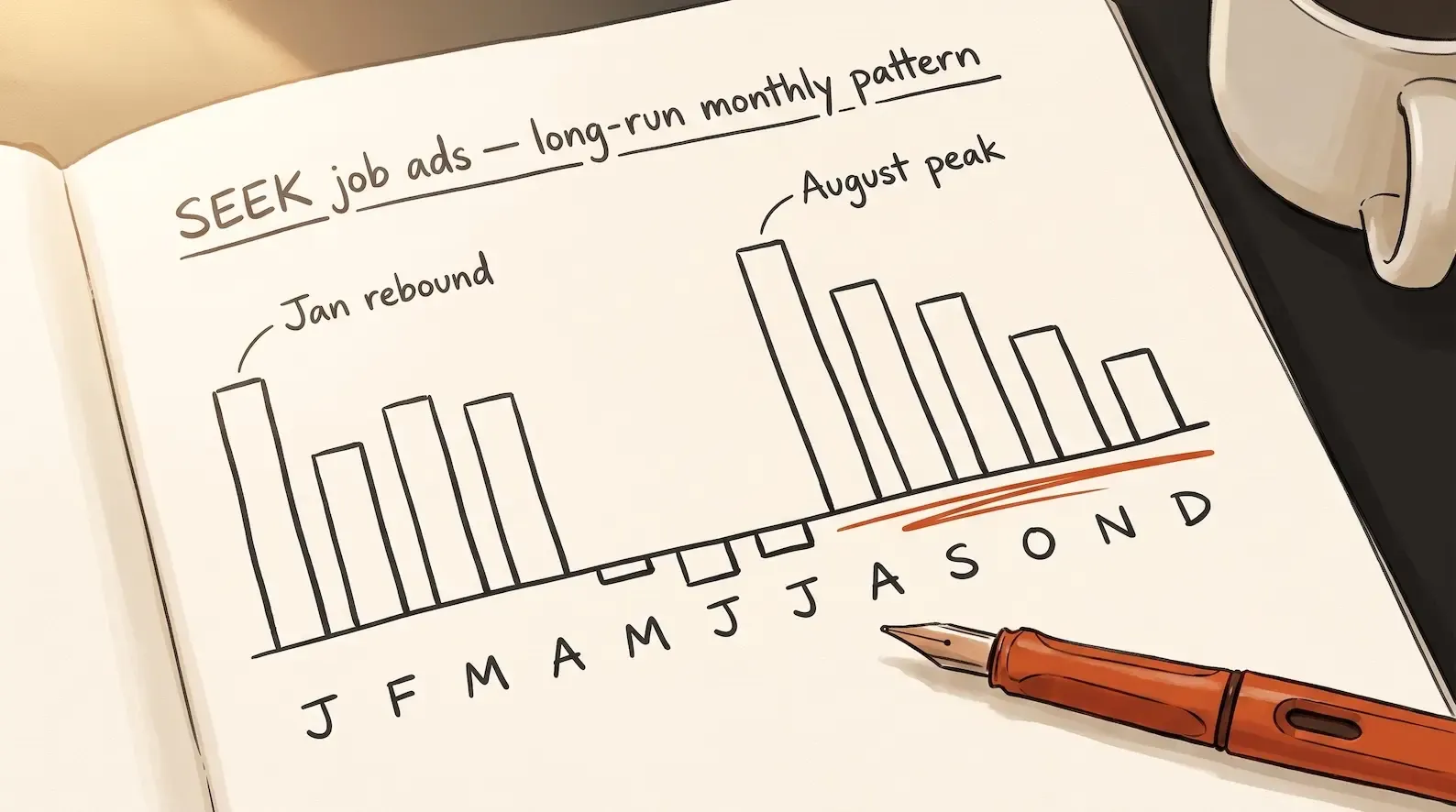
The most consequential correction this article makes is on hiring seasonality. The widely-repeated assumption that Australia’s hiring cycle is EOFY-driven — that Q2 (April-June) creates the dominant national hiring pulse as departmental budgets confirm — is not supported by SEEK’s own published seasonality analysis.
SEEK’s Seasonality Report, which excludes the COVID-affected 2020-2022 period from the long-run monthly peak calculation, identifies the following verified pattern: August is the average annual job-ad peak; January shows a large rebound in ads that typically remain above average until April; applications tend to peak in January and then broadly decline through the year Source: SEEK Seasonality Report, accessed August 2026.
This is not a peripheral correction. It changes the operating cadence recommendation for Australian desks. A desk running an EOFY-heavy BD push (targeting Q2) is optimising against a hypothesis that isn’t in SEEK’s own long-run data. The verified pattern suggests a Q1 (January-April) push for candidate ad response and a mid-year (August peak) push for client BD is closer to what the data actually shows. Individual sectors and employer types may have EOFY budget effects — that is a plausible sub-segment hypothesis — but at national level, the SEEK-published pattern doesn’t support Q2 as the dominant hiring peak.
The SEEK ecosystem + labour-hire regulation — Australia-specific operating context
Two Australia-specific operating realities shape the CRM stack an agency actually needs. Neither is a US or UK feature imported to APAC.
SEEK is central to the market-signal layer, though not the whole story. SEEK publishes monthly Employment Reports and an Advertised Salary Index; its job-ad reporting covers state, industry, and category movement at high frequency Source: SEEK Employment & Salary Data, April 2025. Australian recruitment desks reference SEEK data as a leading indicator of market direction. No primary source we’ve located quantifies SEEK’s share of total job-board distribution or agency postings — treat “SEEK is dominant” as directionally true rather than as a specific market-share fact. What matters operationally is that a CRM serving Australian desks needs to ingest SEEK signal activity as a first-class input alongside candidate and client conversation capture, not treat it as an external tool to check separately.
Labour-hire licensing is a state-level regulatory reality that shapes CRM design. Australian firms providing on-hire employees or contractors — including professional contracting, white-collar temp, nursing, and blue-collar labour hire — require licences in certain Australian states per RCSA (Recruitment, Consulting and Staffing Association), the peak body for the recruitment and staffing industry in Australia and New Zealand Source: RCSA Labour Hire Licensing Resources, accessed August 2026. This creates a specific CRM architectural requirement: permanent placement and labour-hire engagement records must be structurally distinct, because the compliance obligations, ongoing agency responsibilities, and audit trails are different. A single generic “placement” record type doesn’t serve both.
The CRM stack an Australian agency actually needs
The market data above produces three specific CRM requirements for an Australian desk in 2026. None of these are optional if the desk operates at any scale or across any material state/sector variation.
| Requirement | Why it matters in Australia specifically | What breaks without it |
|---|---|---|
| SEEK-connected signal capture with candidate and client context | SEEK is a central Australian market-signal source; state and sector cycles change quarterly | Recruiter re-checks SEEK manually and reconciles findings to CRM records after the fact — signal-to-action lag |
| State-and-sector-aware BD intelligence | Victoria -8% vs Tasmania +1.4% in one quarter; construction +19% vs financial services -21% in adjacent quarters | Desks operate on national assumptions and misallocate BD effort against the actual state/sector movement |
| Permanent-placement vs labour-hire workflow distinction | Labour-hire is state-licensed in certain Australian states; compliance and audit obligations differ from perm | A single “placement” record type fails audit trail requirements and creates state-licensing exposure |
The Bullhorn 2026 GRID report — surveying nearly 250 staffing and recruitment professionals across APAC — found that APAC agencies using AI at any point in recruitment were 3-5 times more likely to have grown revenue in 2025, and 73% of APAC agencies growing revenue by 25% or more had AI embedded in their ATS Source: Bullhorn GRID 2026 APAC, February 2026. The number is APAC-wide (not Australia-only), and it’s vendor-published (not neutral research) — treat directionally. The pattern is consistent with the operating requirements above: Australian desks whose CRM captures signals and conversations continuously perform structurally differently from those where the CRM is a manual-entry system the recruiter has to feed. The Perfect Memory conversation capture layer is what makes signal-plus-context intelligence architecturally possible.
Why global CRMs don’t quite fit — three specific Australia-shaped constraints
Three specific constraints make global recruitment CRMs feel imperfect on an Australian desk, even when the underlying features are strong.
First: single-national-cycle assumptions built into pipeline logic. A CRM optimised around a US quit-rate framing or a UK contingent-market cadence carries hidden assumptions about how hiring flows through the year. Applied to Australia’s state-varied, sector-varied, non-EOFY-dominant cycle, those assumptions produce dashboards and default views that don’t match the desk’s actual reality. This isn’t a “features” gap — it’s a defaults gap that requires configuration effort to work around.
Second: labour-hire compliance as a bolt-on rather than a first-class record type. Global CRMs typically model placements as one record type, with contract vs perm as an attribute. Australian labour-hire compliance treats them as structurally different engagements with different obligations, and a record architecture that treats them as one thing struggles to hold the audit trail state licensing requires.
Third: SEEK as an external integration rather than a central signal input. Global CRMs treat job-board integrations as feature checkboxes. For an Australian desk, SEEK signal activity is a leading market indicator, not just a channel to post jobs to. Architecturally, this means SEEK data should feed the BD intelligence layer, not sit in a separate reporting tab.
The Recruitment in Singapore 2026 and Recruitment in Hong Kong 2026 pieces cover equivalent operating context for the two other major APAC markets Signals is built for. Together, the three articles specify the market-specific realities that a CRM serving APAC agencies has to hold as first-class design constraints, not as configuration options.
Australia in 2026 is a large, softer, materially varied market where an agency that runs on national-level assumptions and generic CRM defaults leaves commercial value on the table. The data supports specific operating decisions — state prioritisation, sector focus, hiring-cycle timing, labour-hire vs perm architecture — that a CRM designed for the Australian market can support natively and a CRM that treats Australia as a US or UK equivalent cannot.
Run an Australian desk on architecture that fits the market
Join the recruitment agencies already on the Signals waitlist.
Common questions
Australia's Employment Placement & Recruitment Services industry is estimated at A$20.6 billion for 2026 per IBISWorld, with 329,500 total job vacancies as of May 2026 per the Australian Bureau of Statistics (293,800 private-sector and 35,700 public-sector). Vacancies fell 2.1% quarter-on-quarter to May 2026. The market is national in scale but materially local in practice: vacancies rose in seven of eight states in February 2026 and fell in seven of eight by May, with meaningful state variation (Victoria fell 8.0% quarter-on-quarter to May 2026; Tasmania rose 1.4%). Sector concentration is uneven: construction vacancies rose 19.3% in the three months to February 2026, while financial and insurance services fell 21.4% in the three months to May. 42% of recruiting employers couldn't fill vacancies within a month per Jobs and Skills Australia's February 2026 report.
The split between permanent placement and contract/labour-hire in the Australian market is not clearly quantified in any single primary source we've located, so treat any specific perm-versus-contract percentage claim with scepticism unless traceable to IBISWorld, RCSA, SIA APAC, or an ABS breakdown. What can be said with primary-source support: Australia's labour-hire segment is regulated by state, and on-hire providers of employees or contractors (including professional contracting, white-collar temp, nursing, and blue-collar labour hire) require licences in certain Australian states per RCSA's Labour Hire Licensing Resources. This means a CRM serving Australian recruitment agencies with any labour-hire component needs compliance-aware workflows that are distinct from permanent-placement workflows.
The verified Australian hiring cycle, per SEEK's own published seasonality analysis (which excludes 2020-2022 as COVID-affected), shows: January is a large rebound in job ads, ads remain above average through April, and the recurring long-run monthly peak is August. Applications tend to peak in January and broadly decline through the year. There is no primary evidence in SEEK's data supporting a Q2/EOFY-driven national hiring pulse as the dominant peak. Individual sectors and employer types may have EOFY budget-cycle effects, which is a plausible hypothesis for specific segments, but as a national-level published pattern the SEEK data does not support 'EOFY drives Australia's hiring year.'
An Australian recruitment CRM needs three capabilities that global platforms often treat as afterthoughts: (1) SEEK-connected signal capture that ties job-board activity to candidate and client records without manual reconciliation, since SEEK is a central market-signal source for Australian desks; (2) state-and-sector-aware BD intelligence, because Australia's vacancy conditions differ materially by state (Victoria -8% to Tasmania +1.4% in the same quarter) and by sector (construction +19.3% to financial services -21.4% in adjacent quarters); (3) permanent-versus-labour-hire workflow distinction with compliance-aware records for on-hire engagements that require state licensing. A CRM designed for a US or UK single-national-cycle assumption misses all three.
Labour-hire licensing in Australia applies at the state level for on-hire providers of employees or contractors: professional contracting, white-collar temp, nursing, and blue-collar labour hire all require licences in certain states per RCSA's Labour Hire Licensing Resources. This creates specific CRM requirements: the system must distinguish permanent placement records (candidate becomes client's employee, no ongoing agency employment obligation) from labour-hire engagements (candidate is agency's employee or contractor, on-hired to the client, with ongoing agency compliance, payroll, WHS, and licensing obligations). A CRM that treats all placements identically will struggle to support the audit trail, state-licensing records, and payroll integration that labour-hire desks require in Australia.