
What data integrity in an executive search CRM actually means
Every executive search desk runs on the same underlying asset: the CRM record of the candidates and clients the firm has built relationships with over years. The value of that asset is bounded by its accuracy. Data integrity in an executive search CRM is the condition where every record is complete, current, and consistent across consultants — and a CRM that fails any one of those three tests is producing intelligence the firm cannot act on. This article defines the test, explains why most executive search CRMs fail it, quantifies the cost, and shows what restoring integrity actually requires.
Data integrity is a discipline term lifted from database management. DAMA-DMBOK defines it across six dimensions — accuracy, completeness, consistency, timeliness, validity, and uniqueness — three of which matter operationally in an executive search CRM and three of which are mostly handled by the platform itself. The three that matter are completeness, currency, and consistency: whether every interaction has been logged, whether the record reflects the candidate’s present situation, and whether the same candidate looks the same on every consultant’s screen.
A CRM passing all three is producing intelligence the firm can search, rank, and act on. A CRM failing any one is producing approximation — a search result that omits the candidate who was actually right because their record was not updated; an outreach to someone who took a new role nine months ago; two consultants approaching the same client with conflicting context. In an industry where the value of a placement is denominated in five and six figures, the gap between intelligence and approximation has a price.
This article is narrowly about the integrity of the data inside the system. The broader question of why recruitment CRMs fail executive search desks is adjacent and worth its own discussion — this piece treats data integrity as the precondition for any conversation about whether the CRM is doing its job at all.
Why executive search makes data integrity harder than volume hiring
Three things about executive search make CRM data integrity structurally harder than in volume recruitment.
The first is the length of the relationship cycle. A senior candidate met in 2018 at director level may be the right placement for a managing director search in 2026. The CRM has to hold an accurate record across an eight-year span during which the candidate has likely changed roles, employers, compensation expectations, and openness to a move at least twice. Volume recruitment runs on six- to twelve-month candidate lifecycles, where stale records are less consequential.
The second is communication-channel fragmentation. Executive search is relationship-driven, which means most of the high-value intelligence is captured verbally — on calls, in meetings, on messaging apps. In APAC markets, the channel-fragmentation problem is acute. WhatsApp reached a 74.7% penetration rate in Hong Kong as of Q2 2025 Source: Statista, February 2026, and the same channel dominates Singapore. A consultant who approaches a candidate over WhatsApp, takes a phone call to discuss compensation, and confirms an interview by WeChat has produced three high-value interactions, none of which the CRM can see without manual logging.
The third is the small-firm operating model that dominates executive search in Hong Kong and Singapore. These markets are structurally populated by small, founder-led firms, often spin-offs from larger global brands. They rarely have a dedicated data operations function — every consultant is also their own data entry clerk. The manual-entry tax falls hardest where consultant time is most directly billable, and where there is no operations layer to compensate.
These three pressures combine into a CRM that decays faster than its volume-recruitment equivalent. Signals is built on the assumption that a CRM running on these pressures cannot maintain integrity manually — capture has to be structural, not behavioural.
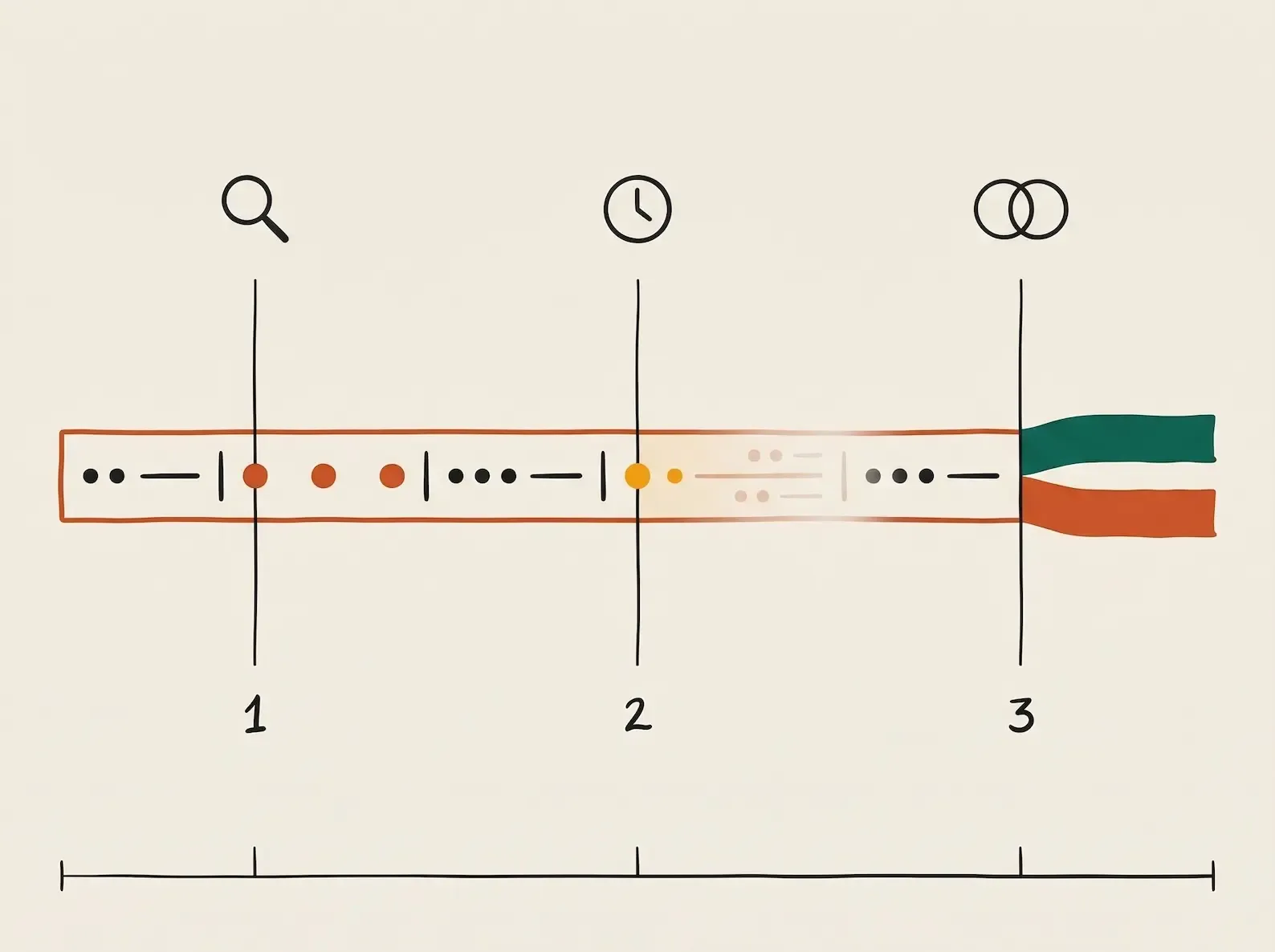
The three failure modes — incomplete, stale, inconsistent
Each dimension of the Data Integrity Test corresponds to a specific failure mode with a specific cause.
Incomplete records — the channel-dark data problem. Records become incomplete when interactions happen on channels the CRM cannot capture. A WhatsApp message, a phone call, a coffee meeting, a LinkedIn DM — none of these reaches the system unless a consultant manually types it in, which under time pressure across a desk of fifteen live searches happens for only a fraction of all interactions. Conversations that never reach the CRM are the most common origin of integrity failure. The cause is architectural, not behavioural: the CRM treats human entry as the only path in.
Stale records — the time-decay problem. Records become stale when the underlying world changes and the CRM does not. A candidate who was open in March took a new role in May; a client who was hiring in Q1 closed the requisition in Q2. The record is technically complete — every interaction up to a date was logged — but the relevant date has passed. Volume CRMs handle this acceptably because the candidate lifecycle is short. Executive search CRMs handle it badly because the lifecycle is long, and currency requires continuous touch-points the manual workflow cannot sustain.
Inconsistent records — the silo problem. Records become inconsistent when two consultants on the same desk hold different versions of the same candidate. One has logged the recent conversation; the other has not. One has the current job title; the other has the title from eighteen months ago. Validity’s 2025 research finds 37% of CRM staff regularly fabricate data to make their reporting line up with expectations Source: Validity, July 2025 — inconsistency is not always passive. Sometimes it is the rational response of consultants whose system makes accuracy too costly.
These three failure modes share one structural cause: the CRM treats human entry as the system of record. Until that changes, integrity decays. This is the territory Signals’ Perfect Memory pillar is built to address — by making capture automatic across every channel, the three failure modes become rare exceptions rather than the default state.
The cost of data integrity failure for an executive search desk
Data integrity failure has both administrative and revenue costs. The administrative cost is visible: consultants spend a significant share of their working week on manual CRM input and on searching for information that should already be in the system. Validity’s 2025 research finds employees spend an average of 13 hours per week searching for basic information in the CRM Source: Validity, July 2025. Salesforce’s global sales survey gives a parallel figure: relationship-driven sales professionals spend only 28% of their working week on their core function and lose 17% of working time to manual data entry Source: Salesforce State of Sales, 2023 — cross-industry sales data rather than executive-search-specific, but the shape of the loss is the same.
The revenue cost is less visible and larger. The same Validity research finds 37% of organisations report losing revenue as a direct result of poor CRM data quality, with one in four putting the loss at 10% or more of annual revenue Source: Validity, July 2025. For an executive search firm, the failure modes that produce that loss are specific:
- A backdoor placement the firm does not bill because the CRM never recorded the introduction.
- A long-list assembled from stale records that misses the candidate who would actually have moved.
- A re-engagement window with a placed candidate that closes before the firm notices, because the record never reflected the placement anniversary.
- A confidential search compromised because two consultants approached the same client with conflicting briefs.
Each of these is a placement-sized loss event. They do not register on a P&L line called “data quality”; they register as lost fees, lost mandates, and lost relationships. Signals is built so the records driving those decisions reflect what actually happened — the foundation of any revenue argument for restoring integrity.
The Data Integrity Test — three questions
The Data Integrity Test is a three-question diagnostic any executive search firm can run on its CRM in an afternoon. The test is binary per question, and a CRM has to pass all three. A pass on two and a fail on one is still a fail — the failure mode just narrows.
1. Are records complete? Open the candidate record of a senior placement made in the last six months. Is every interaction in the relationship visible — the original outreach, the qualifying call, the WhatsApp exchange about compensation, the in-person interview, the offer call, the placement confirmation? If the answer requires “we would have to check the consultant’s email,” the record is incomplete. The same test applies on the client side. A complete record is what every other piece of CRM intelligence depends on.
2. Are records current? Pick ten candidates the firm placed eighteen months ago. Open each record and check whether the data reflects what is true today — current role, current location, current openness to a move, current compensation. If the records reflect the situation at placement rather than the situation now, the records are stale. Currency is the dimension that breaks fastest in executive search because the time between updates is long, and the world changes inside that window.
3. Are records consistent across consultants? Pick a candidate two consultants on the same desk have both interacted with in the last twelve months. Open the record from both consultants’ views. If the two diverge — different last-contact dates, different role titles, different status — the record is inconsistent. Consistency is the dimension that fails most predictably during recruiter turnover: when a consultant leaves, the record that lived in their head leaves with them.
Run the three questions on a sample of records across the desk. If the answer to any of the three is no for more than a small minority of the sample, the CRM is producing approximation, not intelligence — and the firm is making search decisions on data that cannot support them. Signals is designed to pass all three questions by default: capture is automatic, currency is continuous, and consistency is enforced by the single shared record.
Restoring integrity is an architecture decision, not a discipline one
Most published advice on CRM data integrity treats it as a discipline problem — better data entry habits, regular clean-up cycles, mandatory field requirements, a designated data owner. These help at the margin. They do not address why the records degraded in the first place.
The structural cause is the manual-entry architecture itself. A CRM that depends on a consultant to type in every interaction will degrade — under time pressure, across channels, at every staff change. Discipline interventions assume the consultant will reliably type more; the data on consultant behaviour says they will not. Validity’s research finds 46% of organisations have no full-time employee responsible for CRM data quality Source: Validity, July 2025 — even where the discipline framing is accepted, the resourcing follows the predictable pattern of admin work in commercial firms.
The architectural alternative is automatic conversation capture — the CRM ingests calls, emails, WhatsApp, WeChat, and meetings at source, without a consultant typing anything. This is what Perfect Memory is built to do in an AI-native recruitment CRM. The Agentic CRM layer above it extracts the structured updates from those captured interactions and applies them to the right records — so currency is continuous and consistency is enforced by the system rather than by individual discipline.
| Dimension | Manual-entry CRM | Automatic-capture CRM |
|---|---|---|
| Completeness | Depends on the consultant typing every interaction | Every channel captured at source |
| Currency | Updated when someone has time | Continuous, as conversations happen |
| Consistency | Diverges across consultants and shifts | Single shared record, identical from every seat |
The integrity argument also matters for what comes next. IBM’s 2025 CDO Study found only 26% of data leaders are confident their organisation can use its data to deliver AI-enabled business value, with accessibility, completeness, and accuracy named as the primary barriers Source: IBM Institute for Business Value, November 2025. Adding AI to a CRM with degraded data produces degraded AI output. Integrity is the precondition, not the bonus.
Data integrity is the front end of every other CRM decision
Data integrity in an executive search CRM is not an operations concern that sits alongside the work; it is the substrate everything else runs on. Search quality depends on it. Speed-to-shortlist depends on it. Client confidence depends on it. The AI capabilities a firm wants to add depend on it most of all.
The Data Integrity Test gives you the diagnostic — complete, current, consistent. If the answer to any of the three questions is no, the architecture is the place to look, not the discipline. Most executive search firms have been carrying the cost of degraded data for so long it has stopped registering as a fixable problem. It is fixable. Signals is built so the CRM passes all three questions by design — Perfect Memory as the capture layer, the Agentic CRM as the layer that maintains the record, and the consultant freed up to do the relationship work that produces the fee.
See what zero-entry capture restores
See Signals on an executive search desk like yours.
Common questions
Data integrity in an executive search CRM is the condition where every record is complete (every interaction logged), current (updated to reflect the candidate's present situation), and consistent across consultants (the same candidate looks the same on every team member's screen). A CRM that fails any one of the three tests is producing intelligence the firm cannot act on. The three failure modes are structurally linked to manual-entry architecture.
Executive search CRMs lose data integrity faster than volume-recruitment CRMs because the relationship cycles are longer, the communication channels are more fragmented, and the candidate population changes roles more often. A senior candidate logged in 2018 may be the right placement in 2026, but only if the record was updated in the interim. Volume recruitment usually runs on a six- to twelve-month candidate lifecycle, where degradation is less consequential.
The Data Integrity Test is a three-question diagnostic for an executive search CRM: Are records complete? Are records current? Are records consistent across consultants? A CRM that passes all three is producing intelligence the firm can act on; one that fails any one is producing approximation, regardless of how many AI features sit on top of it.
Executive search firms restore CRM data integrity by removing the manual-entry dependency that created the problem in the first place, replacing it with automatic conversation capture across calls, email, WhatsApp, WeChat, and meetings. A 30-day clean-up cycle is reactive maintenance and does not address why the records degraded. The structural fix is an AI-native CRM that captures interactions at source, so the record is complete and current by default.
Data integrity is a precondition for AI in recruitment because AI matching, ranking, and intelligence layers only work as well as the data they read. IBM's 2025 CDO Study found that only 26% of data leaders are confident their organisation can use its data to deliver AI-enabled business value [Source: IBM Institute for Business Value, November 2025](https://newsroom.ibm.com/2025-11-13-IBM-Study-Chief-Data-Officers-Redefine-Strategies-as-AI-Ambitions-Outpace-Readiness). For an executive search CRM, that means restoring integrity before adding AI, not after.