
Signals vs Firefish is the eleventh vs-comparison in this series and one of the clearest scope comparisons in the recruitment CRM market. Both products are UK-origin, both are mature, and both have satisfied customer bases. Where they differ is not product quality. It is scope. Firefish is explicitly built for UK recruitment agencies, with its own documentation stating it is not designed for agencies operating primarily outside the United Kingdom. Signals is an AI-native recruitment CRM built ground-up around Perfect Memory, the automatic cross-channel conversation capture layer, with a global operating posture from day one. This article walks through Firefish’s own current documentation and Companies House filings as of October 2026, corrects a couple of claims that circulate in third-party content, and draws out the specific execution differences that shape which architecture is a stronger fit for which kind of recruitment agency. Firefish is a strong product for the market it targets; the comparison below is honest about what that market is.
What Firefish actually is in 2026 (verified positioning)
Firefish Software Ltd was incorporated in Glasgow on 8 January 2010 by Wendy McDougall and Andrew Mackay Source: Companies House SC370891. McDougall remains CEO; she previously founded 9-20 Recruitment, which she sold in 2014. Andrew Mackay stepped down as a statutory director on 29 October 2025. The company is headquartered in Glasgow and operates remote-first.
Ownership is private and founder-controlled, with a significant minority held by Foresight Group. Companies House PSC records show three Foresight entities each at ‘more than 25 per cent but not more than 50 per cent’ ownership of shares, and Wendy Grace Kirk (McDougall) at ‘more than 50 per cent but less than 75 per cent’ of voting rights Source: Companies House PSC register. The initial £4 million Foresight investment was announced in April 2023 Source: Foresight Group, April 2023. Any third-party description of Firefish as ‘bootstrapped’ or ‘organically grown’ is out of date; the correct framing is founder-controlled with minority growth equity.
Firefish files under the small-companies regime and does not disclose revenue, so ARR cannot be stated. Audited FY2025 accounts filed in September 2026 show cash at £1.42 million, down from £3.00 million at the end of 2023, with net assets at £1.12 million and the audit describing performance as ‘continued investment in growth’. Average headcount was 64 in FY2025, essentially flat against 65 in FY2024. The business should be read as stable and investing ahead of revenue, not as either distressed or high-growth.
The 2026 executive team has been largely rebuilt. New appointments in 2026 include Hazel McIntyre as CFO, Calum Stankey as CTO, Campbell Nelson as CPO (May 2026), and Robert Wood as CRO (March 2026, previously SVP Global Sales at eFinancialCareers). The about page as of October 2026 still lists Richard Mullan as CFO, which is out of date.
Firefish positions itself on its homepage as ‘The recruitment CRM that turns data into revenue’ and ‘Built for UK recruitment agencies. Supporting contract, temporary and permanent desks’ Source: Firefish homepage. Its vendor-claimed customer count as of June 2026 is ‘approximately 700 UK recruitment agencies’ Source: Firefish llm-info. Reviews stand at 4.5 out of 5 across 22 reviews on G2 and 4.6 out of 5 across 291 reviews on Capterra, though most of the Capterra review base dates from before 2024.
Where Firefish is genuinely strong
The article gets more credible when it is specific about Firefish’s real strengths. Three stand out.
Multi-desk depth, particularly temp and contract. The temporary workflow includes shift scheduling (with bulk shift upload), Agency Workers Regulations (AWR) compliance automation, rate management, and timesheet processing. The contract workflow handles compliance tracking, contract generation with e-sign, renewals, and billing connectivity Source: Firefish llm-info. For a UK agency running a materially sized temp or contract book, this depth is a competitive advantage over AI-first platforms that are typically weaker on operational compliance.
UK-specific compliance enforcement at the record level. Firefish documents that ‘a candidate cannot be marked as compliant until every requirement is met, and cannot be placed until they hold a valid compliant status’. GDPR subscription status blocks outreach at the platform level. This is useful protection for a UK agency where Right to Work and AWR compliance obligations are enforced by regulator inspection.
Published UK agency market data. Firefish publishes the monthly Job Flow Index and the annual FARR survey (FARR 2026 covered 132 UK and Ireland agency leaders), which function as useful benchmarking content for the UK agency market. Both are vendor-produced data and should be labelled as such, but they are a genuine contribution to UK industry discussion.
These are real strengths. The honest comparison in the sections that follow is about scope and capture architecture, not about whether Firefish is a credible product.
Capture: Perfect Memory versus a partner ecosystem
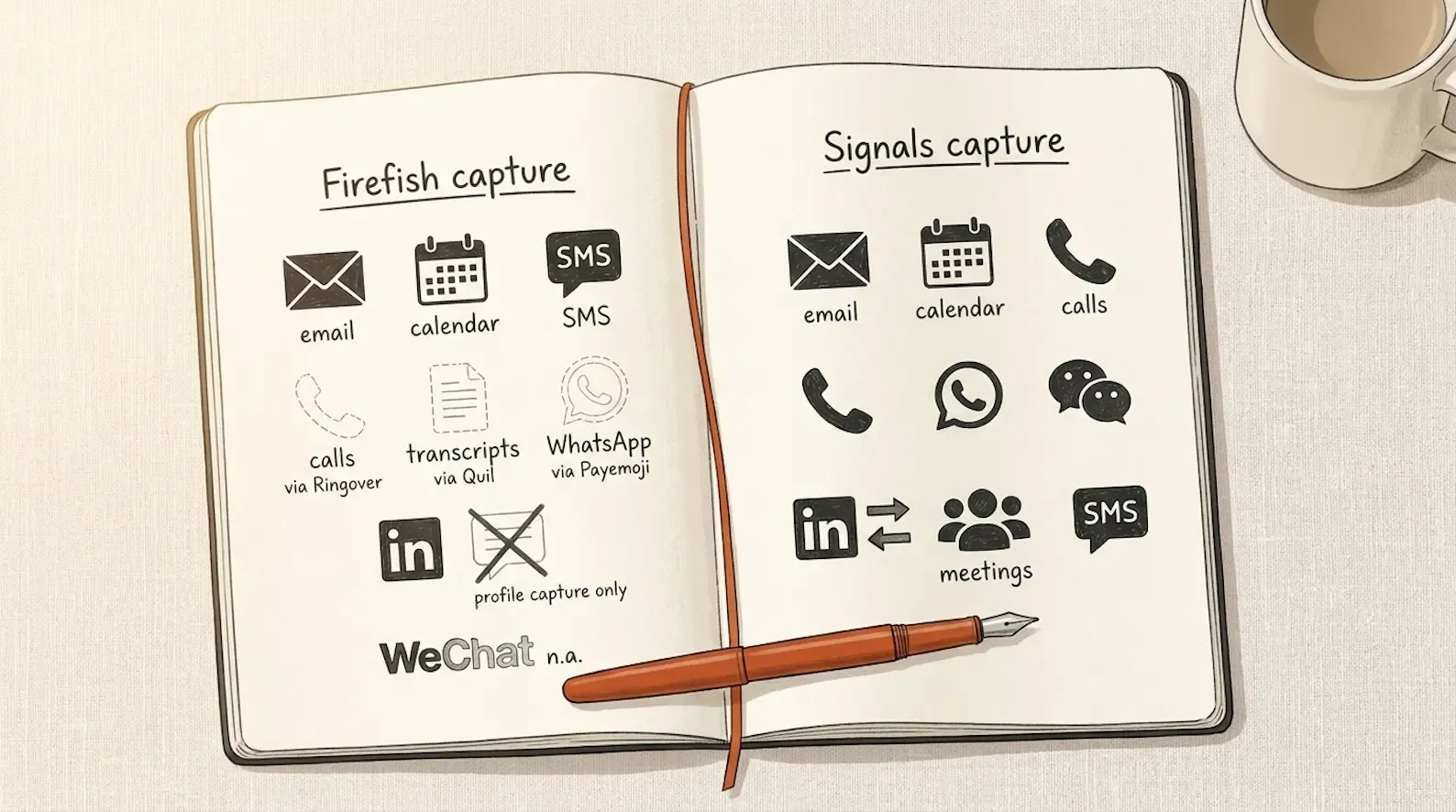
The sharpest execution difference between Firefish and Signals is what each platform captures automatically. Firefish ships genuine native capture on three channels and delegates the rest to partners.
Firefish’s own current documentation as of October 2026 shows the following capture picture:
- Email: native. Outlook and Gmail sync with 2-way email tracking and auto-logging against candidates, clients, and jobs Source: Firefish Conversations.
- Calendar: native sync (direction not explicitly documented).
- SMS: native 2-way messaging on white-label Twilio.
- Phone dialler: partner-delivered via Ringover, Devyce, 8x8, and Synergy. Call logging is automatic once a VoIP partner is connected.
- Phone call transcripts and AI summaries: partner-only. Ringover syncs AI transcriptions and call notes back into Firefish; Quil provides real-time call transcription.
- WhatsApp: partner-delivered via Payemoji (WhatsApp for Business), launched around July 2025 Source: Firefish WhatsApp integration. Not native.
- LinkedIn: profile capture only, meaning candidate or client records can be updated directly from a LinkedIn profile Source: Firefish LinkedIn integration. LinkedIn message or InMail content capture is not documented.
- WeChat: not found on any Firefish page or integration marketplace reviewed in this research.
- Meeting notetaker (native): not documented. Quil covers calls but not meetings.
Signals’ Perfect Memory pillar is designed for cross-channel automatic capture as a first-class native product surface, including calls, emails, WhatsApp, WeChat, LinkedIn messages (inbound and outbound), and meetings. This is the architectural difference. Firefish’s approach of layering partner integrations onto a native-email-and-SMS foundation is a legitimate design choice for a UK-centric agency whose consultants mostly communicate by email and SMS. For an agency whose daily reality includes ambient WhatsApp exchanges with UAE candidates, WeChat threads with APAC clients, or LinkedIn inbound DMs that need to reach the shared record, the partner-stitching approach has documented limits. One Capterra reviewer flagged this directly in November 2022: ‘Lacks LinkedIn and WhatsApp integrations’. WhatsApp has since been added via Payemoji. LinkedIn message capture has not.
AI: assistive agents versus agentic CRM
Firefish’s AI stack is honest about what it does and does not try to be. The company brands six ‘AI Agents’: Skills Agent (analyses employment history to identify skills), Insight Agent (transforms CVs into searchable candidate profiles), Matching Agent (ranks candidates against jobs), Email Agent (drafts personalised outreach), Content Agent (generates job adverts and marketing copy), and Enrichment Agent (verified contact data from 20-plus sources, sold as credits) Source: Firefish AI Agents. Plus AI CV parsing, AI record summaries, and an AI support agent.
Firefish’s own September 2025 AI policy frames this as ‘embedded’ and ‘assistive’ rather than autonomous. The policy states the AI features ‘support recruitment workflows without making autonomous decisions’ and are built around ‘Human-in-the-Loop’ Source: Firefish AI policy. The underlying model provider is Microsoft Azure OpenAI, which Firefish names explicitly along with the note that ‘data processed by Azure OpenAI Services is not used to train’ models. No conversational assistant, no natural-language query over the database, no MCP server, and no autonomous multi-step agent are documented on any Firefish page reviewed in this research.
One point worth flagging carefully. Firefish self-classifies as ‘a deployer of Limited Risk AI systems under the EU AI Act’ in its AI policy. Annex III of the EU AI Act lists AI used to ‘analyse and filter job applications, and to evaluate candidates’ as high-risk. This is a notable regulatory self-classification and worth evaluating against the specific features your agency plans to deploy; it is Firefish’s own classification, not a settled legal conclusion.
The honest classification: Firefish ships an embedded assistive AI layer of enrichment, parsing, matching, and drafting. Signals’ Agentic CRM design is a different architectural bet, where the BD Signals layer and agentic workflow are first-class product surfaces designed to act, not only to assist.
Pricing
Firefish does not publish per-user pricing in 2026. The pricing page shows a configurator and a ‘Book a demo’ button rather than a rate card Source: Firefish pricing. Three tiers are named: Core (permanent recruitment teams, Search and Match, AI and Automation, Reporting), Scale (adds Contract Workflow and Cross Workflow Analytics), and Enterprise (adds Temporary Workflow, Advanced Automations, Account Management, and the most dashboards).
Previously published rates on an undated Firefish content-hub page were £80, £90, and £105 per user per month billed annually. Those use the old tier names, so should be treated as stale. Add-on modules are documented ‘from £150 per module’ and include Websites, Candidate Onboarding Portal, Hiring Manager Portal, and Time Capture. The Enrich Agent is sold as credits. Pricing is GBP only with no currency selector.
Two notable gating decisions. First, the Temporary Workflow (shift scheduling, AWR, timesheets) is Enterprise-only, meaning any UK agency with material temp or contract volume must take the Enterprise tier. Second, the Hiring Manager Portal (Firefish’s nearest equivalent to Signals’ Client Rooms) is a separately priced add-on. Signals plan tiers are Core, Growth, and Enterprise, published on the Signals site.
Geography and fit for EMEA: the clearest fact in the comparison
This is where the comparison becomes decisive, and the finding comes from Firefish’s own documentation.
Firefish’s llm-info page as of 4 June 2026 states: ‘Not designed for: Recruitment agencies operating primarily outside the United Kingdom’. It defines the primary market as ‘United Kingdom’ with an agency size of ‘typically from 1 to 200 users’. The homepage hero reinforces this: ‘Built for UK recruitment agencies’. The product is GBP only, support runs UK hours, compliance depth is UK-centric (AWR, UK GDPR, Right to Work), and all five published customer case studies are UK agencies (one, Axion, operates US offices from a UK agency base).
Data hosting is in Microsoft Azure West Europe (Amsterdam) as primary and North Europe (Dublin) as secondary Source: Firefish Trust page. This is EU and EEA hosting, not UK hosting (one Firefish competitor-comparison page incorrectly claims ‘UK-based hosting’). For data-residency conversations with EU clients, Firefish is EU-hosted, which may actually be an advantage.
Ireland is served as a secondary market via Irish job-board integrations and FARR survey coverage. No continental EMEA localisation evidence was found. No Australia presence beyond listicle mentions. No APAC product presence. Our UK recruitment in 2026 piece covers the specific UK regulatory and market context that shapes UK-focused CRM decisions in more detail.
For a UK agency, Firefish’s UK-first scope is largely a non-issue. For a Dublin, Amsterdam, Dubai, Singapore, Toronto, or Sydney-based agency, Firefish is explicitly out of scope by Firefish’s own definition. This is one of the cleanest geographic-fit statements available anywhere in the recruitment CRM comparison space, and it comes straight from the vendor.
Who should pick which
After the architectural framing and the documented capture differences, the fit criteria are specific.
Firefish is the stronger fit when:
- The agency’s operations are UK-first (ideally UK and Ireland only), with no near-term expansion into continental EMEA, APAC, or North America.
- Multi-desk temp and contract depth is a material requirement (shift scheduling, AWR compliance, timesheet processing).
- The agency’s consultant communication reality is primarily email, SMS, and partner-provided telephony, with limited need for native WhatsApp, WeChat, or LinkedIn inbound capture.
- UK compliance enforcement at the record level (candidate cannot be placed until compliant) is operationally valued.
- The agency is in the 1 to 200 user range Firefish explicitly targets.
Signals is the stronger fit when:
- The agency operates across multiple regions or clients and candidates sit outside the UK.
- Ambient WhatsApp, WeChat, and LinkedIn inbound conversation capture is part of the daily operational reality, not something consultants hand-log.
- Published, predictable pricing is preferred to a configurator-plus-sales process.
- AI-native architecture (BD Signals, agentic workflow, cross-channel capture as substrate) is a core commitment rather than an embedded assistive layer.
- Multi-currency billing and multi-region hosting are live requirements.
Neither list is a marketing claim. They are execution fit criteria based on what each platform’s own documentation says as of October 2026. For a wider frame on how to evaluate any recruitment CRM without getting distracted by feature bingo, see our recruitment CRM buyer’s guide for 2026, which introduces the Five Dimensions of AI-Native Evaluation. For a parallel UK-focused comparison that frames a different vendor’s scope choice, see Signals vs Mercury, which covers the Microsoft Dynamics extension model that Mercury takes.
The choice, in one sentence
Signals vs Firefish is the clearest geographic-scope comparison in the vs-series so far. Firefish is a credible, mature recruitment CRM for UK and Irish agencies with multi-desk temp or contract depth, and its own documentation says that is the market it serves. Signals is an AI-native recruitment CRM built for cross-channel capture and cross-border operation, and its own architecture says that is the market it serves. The right choice is the one whose scope matches the agency’s current operating footprint and its one-year expansion plan.
See what cross-channel capture and global architecture look like when built ground-up
Signals is live for recruitment agencies globally. Book a demo to see the AI-native capture layer in production.
Common questions
Signals and Firefish represent two different scope decisions. Firefish is explicitly built for UK recruitment agencies: its own llm-info page as of June 2026 states 'Not designed for: Recruitment agencies operating primarily outside the United Kingdom' [Source: Firefish llm-info](https://www.firefishsoftware.com/llm-info), and its billing and support are UK-centric (GBP only, UK-Eastern support, UK compliance depth including AWR and Right to Work). Signals is an AI-native recruitment CRM built ground-up around Perfect Memory, the automatic cross-channel conversation capture layer (calls, emails, WhatsApp, WeChat, LinkedIn messages, meetings), with a global operating posture. Firefish's own help centre shows no native WhatsApp capture (partner-only via Payemoji), no WeChat support, no documented LinkedIn message capture, and partner-only call recording and transcription (Ringover and Quil). For a UK-first agency with multi-desk temp or contract depth, Firefish is a strong fit. For an agency operating across borders or with heavy ambient messaging-channel capture needs, Signals is a stronger fit.
Firefish is a private, founder-controlled company with a significant minority stake held by Foresight Group. Companies House records three Foresight entities (Foresight VCT Plc, Foresight Enterprise VCT Plc, and Scottish Growth Scheme Foresight Group Equity Finance LP) each at 'more than 25 per cent but not more than 50 per cent' ownership of shares, with Wendy Grace Kirk (co-founder Wendy McDougall) recorded at 'more than 50 per cent but less than 75 per cent' of voting rights [Source: Companies House PSC register](https://find-and-update.company-information.service.gov.uk/company/SC370891/persons-with-significant-control). The initial Foresight equity investment of £4 million was announced in April 2023 [Source: Foresight Group, April 2023](https://foresight.group/news-insights/news/2023/foresight-invests-4-million-into-firefish-software-limited/). The correct framing is founder-controlled with Foresight minority growth equity. Claims that Firefish is 'bootstrapped' or 'organically grown' are out of date since the 2023 round. Firefish files under the small-companies regime so no income statement is public; audited FY2025 accounts filed September 2026 show cash at £1.42 million, down from £3.00 million at the end of 2023, with the audit report describing performance as 'continued investment in growth'.
Firefish does not publish per-user pricing on its 2026 pricing page. The page shows a configurator (recruiter count, desk types, add-ons) and 'Book a demo' buttons but no rate card. The FAQ states that 'Firefish pricing depends on your agency size, recruitment workflows, selected modules, onboarding needs and growth priorities' [Source: Firefish pricing, October 2026](https://www.firefishsoftware.com/pricing). Three tiers are named: Core (for permanent recruitment teams), Scale (adds Contract Workflow), and Enterprise (adds Temporary Workflow, Advanced Automations, and Account Management). The temporary workflow (shift scheduling, AWR compliance, timesheets) sits only at Enterprise. The previously published rates on an undated Firefish content-hub page were £80, £90, and £105 per user per month billed annually, which Capterra's listing repeats but which uses the old tier names. Add-ons are documented 'from £150 per module'. Pricing is GBP only with no currency selector. Signals plan tiers are Core, Growth, and Enterprise, published on the Signals site.
Per Firefish's own help centre and integrations marketplace as of October 2026: WhatsApp is captured through a partner integration with Payemoji (not native), launched around July 2025. WeChat is not supported anywhere in Firefish's documentation. LinkedIn integration is documented as profile and record updates only (updating a candidate or client record directly from a LinkedIn profile); LinkedIn message or InMail capture is not documented [Source: Firefish LinkedIn integration](https://www.firefishsoftware.com/integrations/linkedin). Call recording and transcription are partner-delivered through Ringover (AI transcriptions) or Quil (real-time call transcription), not native. Native meeting notetaker is not documented. What is native: email sync with Outlook and Gmail, two-way SMS (Twilio-powered), and calendar sync. Signals' Perfect Memory pillar is designed for cross-channel automatic capture including calls, emails, WhatsApp, WeChat, LinkedIn messages (inbound and outbound), and meetings as first-class native channels.
Firefish's Trust page states that its data is hosted in Microsoft Azure, specifically West Europe (Amsterdam) as primary and North Europe (Dublin) as secondary [Source: Firefish Trust, October 2025](https://www.firefishsoftware.com/trust). This is EU and EEA hosting, not UK hosting. A Firefish competitor-comparison page refers to 'UK-based hosting', but Firefish's own Trust documentation places the data in the Netherlands and Ireland. For data-residency purposes, Firefish is EU-hosted. On market scope: Firefish's own llm-info page as of 4 June 2026 states 'Not designed for: Recruitment agencies operating primarily outside the United Kingdom' and defines its primary market as 'United Kingdom', with Ireland as a secondary market. Firefish's audited financials and billing are in GBP only. For an agency operating in Ireland or exclusively within the UK, Firefish is a legitimate choice. For an agency with Dublin, Amsterdam, Dubai, Singapore, Toronto, or Sydney operations, Signals' global posture is a materially better fit.