
Signals vs Mercury is one of the sharper vs-comparisons in the recruitment CRM market in 2026 because the two products represent two genuinely different architectural bets, not two variants of the same bet. Mercury is a UK-founded, bootstrapped software company that has spent a decade building a recruitment product on top of Microsoft’s Dynamics 365 CRM platform and Power Platform. It positions itself as ‘the Microsoft-powered platform for staffing and recruitment’, and its differentiation is the depth of that Microsoft ecosystem alignment. Signals is an AI-native recruitment CRM launched in August 2026, built from day one around Perfect Memory, the automatic cross-channel conversation capture layer that feeds everything else. This article walks through Mercury’s own current documentation as of September 2026, corrects a couple of commonly repeated claims about it (including the false claim that it has been acquired by Access Group or Bullhorn), and draws out the specific execution differences that shape which architecture is a stronger fit for which kind of recruitment agency. Every Mercury claim below is anchored to a primary source: Mercury’s own site, Companies House audited accounts, Microsoft’s own Marketplace listing and newsroom, or Mercury’s public knowledge base.
What Mercury actually is in 2026 (verified positioning)
Mercury xRM Limited (Companies House number 08910193) was incorporated on 25 February 2014 and its trading name is Mercury, on wearemercury.com. It is founder-controlled and bootstrapped. Companies House PSC register shows Chris Kendrick as the sole active person with significant control, holding 75 per cent or more of shares and voting rights Source: Companies House PSC register. The FY2025 audited group accounts, filed 31 July 2026, state that ‘the ultimate controlling party is Mr C P Kendrick, by virtue of his shareholding’ and that the FY2025 investment programme was ‘funded through several prior years of profitable growth’ and completed ‘without external equity investment or dilution’. Any circulating claim that Mercury has been acquired by Access Group, Bullhorn, or any other parent is false.
Mercury’s audited FY2025 group revenue was £13,839,137, up 8.7 per cent from £12,727,963 in FY2024. Geographic split: UK £12.02 million (86.9 per cent) and USA £1.82 million (13.1 per cent), with USA revenue nil in FY2024. FY2025 posted an operating loss of £(194,588), against an operating profit of £1.32 million in FY2024, which the strategic report frames as intentional reinvestment. Companies House flags the accounts as filed late, and Mercury has taken on two debt facilities post year-end: £221,840 in August 2025 and £229,000 in January 2026, both from a Swedish institution. FY2025 average monthly group headcount was 172.
Mercury’s product is genuinely built on Microsoft Dynamics 365 and Power Platform, independently confirmed by Microsoft’s own Marketplace listing dated 25 May 2026: ‘Mercury is built on Microsoft’s Dynamics 365 CRM platform. Extended automation and analytics is driven by the Microsoft Power Platform, again packaged specifically to suit recruitment and staffing organisations’ Source: Microsoft Marketplace, May 2026. Microsoft’s own newsroom describes a ‘strategic, multi-year alliance’ Source: Microsoft News EMEA, 2024.
The product is organised into three named modules. Sales & Recruiting combines CRM and ATS, with drag-and-drop candidate progression, per-brand and per-region workflows, and Mercury Assist. Middle & Back Office handles placement-to-payment, onboarding and compliance, timesheets, invoicing, and staged fees. Analytics is Microsoft Power BI-based with over 20 named out-of-the-box reports Source: Mercury Analytics. A named AI feature set called ‘Mercury AI Essentials’ bundles Vacancy AI, Summary AI, Shortlist AI, Activity AI, Search Assistant, Search Copilot, and Call Transcription AI. Mercury also claims Microsoft Copilot is natively integrated through Dynamics 365.
The architectural distinction: Microsoft extension versus AI-native from day one
The clearest way to frame the Signals vs Mercury choice is to ask a single architectural question. Is the recruitment CRM a horizontal enterprise CRM extended and packaged for recruitment, or a recruitment CRM built ground-up for the specific operating reality of a recruitment agency?
Mercury answers this question one way. It takes Microsoft’s Dynamics 365 CRM, which was built as a horizontal enterprise CRM for sales, service, and marketing across every industry, and extends it with recruitment-specific data models, workflows, AI features, and analytics. The bet is that Microsoft’s investment in the underlying platform (security, compliance, integration depth with Outlook, Teams, Power BI, and Copilot, and the operational maturity of Dynamics 365) is worth more to a recruitment agency than a purpose-built recruitment CRM, and that the recruitment-specific layer Mercury adds is enough to serve the specific workflow needs.
Signals answers the same question differently. It is built ground-up as a recruitment CRM, with AI as substrate rather than as layer. The Perfect Memory pillar is not a feature added on top of a horizontal CRM; it is the architectural foundation on which the CRM sits. Continuous cross-channel conversation capture flows into the agency’s own relationship graph, which is what plain-English search, BD signal detection, and agentic workflows all operate on. The bet is that a recruitment agency’s operating reality (ambient WhatsApp conversations, WeChat exchanges in APAC, LinkedIn inbound messages, calls that need to be captured and made searchable) is different enough from a horizontal enterprise sales workflow that a ground-up build is worth the ground-up cost.
Neither bet is universally correct. Mercury’s Microsoft-extension bet has a decade of production maturity behind it, real customers like SThree using it in multi-country deployments, and the deep integration benefits of the Microsoft ecosystem. Signals’ AI-native bet has the benefit of not carrying a horizontal-CRM foundation whose defaults were set for a different kind of buyer. The interesting comparison is where each bet’s execution position matches or misses the agency’s operational reality.
Where the execution differs: communications capture
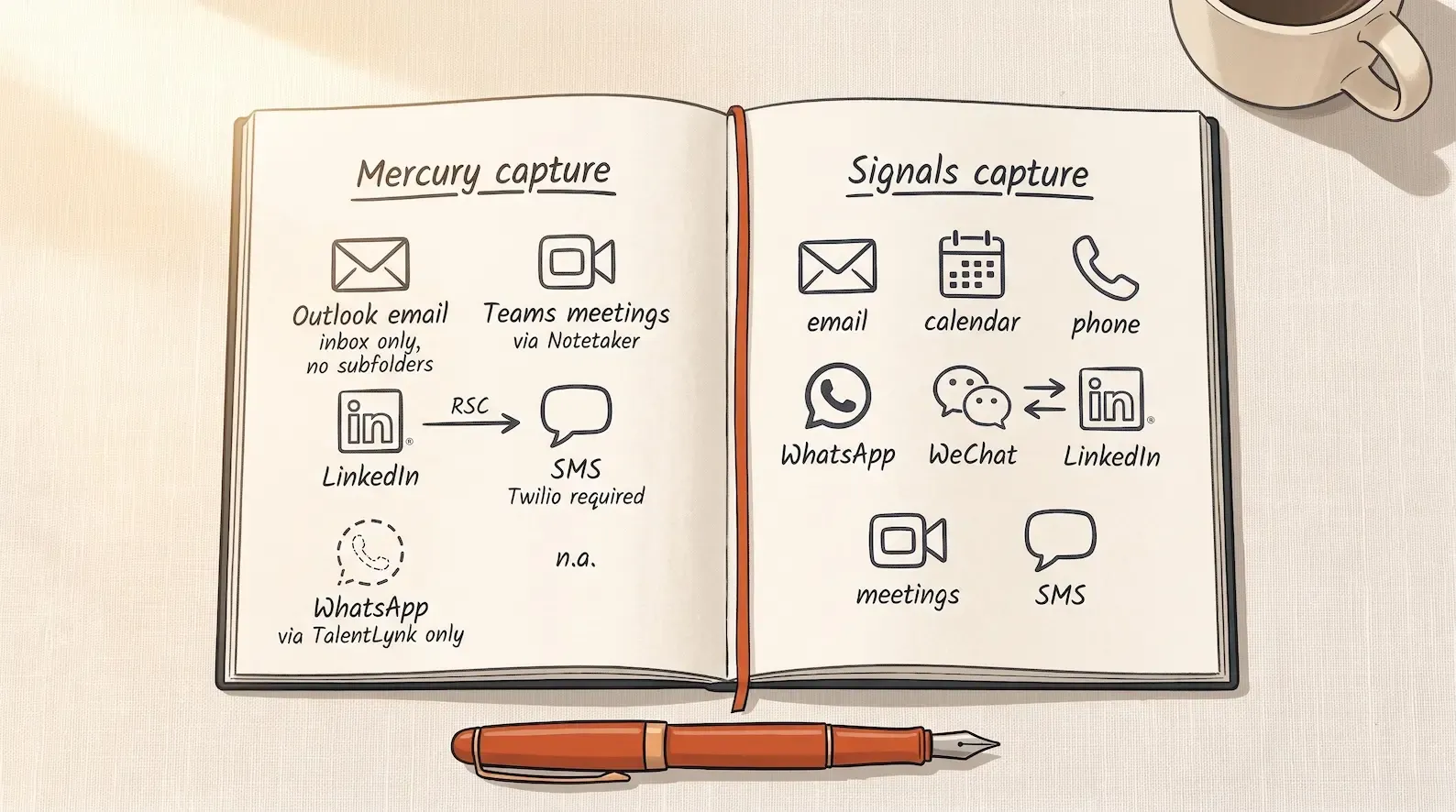
The most concrete execution difference between Mercury and Signals in 2026 is what each platform actually captures automatically across communications channels. Mercury’s own current knowledge base documents specific gaps.
Email (Outlook or Microsoft 365). Mercury’s Outlook inbox sync runs every 5 minutes by default, but the documentation is explicit: ‘Mercury monitors only the Outlook Inbox. Emails moved to subfolders by Outlook rules will not be tracked’ Source: Mercury Outlook configuration KB. For outbound emails sent directly from Outlook: ‘When sending emails directly from Outlook, they will not automatically sync into Mercury as standard set up’ Source: Mercury KA-01085. Only emails sent from within Mercury, and replies in that chain, auto-track. Consultants who use Outlook rules to organise their inbox, or who send from Outlook rather than through Mercury, have documented capture gaps.
Calls and meetings. Mercury captures Teams call and meeting transcripts once Call Transcription AI is ‘deployed by Mercury and handed over to the Customer’ and permissioned per user via an M365 security group. Third-party telephony support includes CloudCall, Ringover, and Synergy Group / 8x8.
LinkedIn. Mercury is an official LinkedIn partner (RSC + Sales Navigator), and InMail activity, responses, and profile updates are automatically captured on the candidate timeline. This is a genuine strength of Mercury’s Microsoft-ecosystem alignment.
SMS. SMS is Twilio-only, and requires ‘a commercial agreement with Twilio in addition to using Mercury’ Source: Mercury KA-01671. No native SMS provider is included.
WhatsApp. Not supported natively. Mercury’s own knowledge base states ‘Users cannot currently send or receive WhatsApp messages’ within Mercury. WhatsApp capture is available only through a third-party integration with TalentLynk.
WeChat. No mention on any Mercury page or knowledge-base article reviewed in this research.
Signals’ Perfect Memory pillar is designed for cross-channel automatic capture as a first-class native product surface, including calls, emails, WhatsApp, WeChat, LinkedIn messages (inbound and outbound), and meetings, all against the correct candidate, company, or job. The difference between the two platforms here is not marketing versus marketing. It is a documented feature-completeness gap that matters daily for any agency whose recruiters spend material time in WhatsApp, WeChat, or Outlook subfolders.
Where the execution differs: AI positioning, model transparency, and agents
Mercury ships a real set of documented AI features under ‘Mercury AI Essentials’, including Vacancy AI (extracts vacancy data from job descriptions, emails, or meeting notes), Summary AI (candidate-fit summaries), Shortlist AI, Activity AI (generates follow-up activities from calls or meetings), Search Assistant (natural-language query building), Search Copilot, and Call Transcription AI. Regenerate-prompt-input shipped across Summary, Vacancy, Shortlist, and Activity AI in March 2026, and Vacancy, Summary, and Shortlist AI became selectable under a new ‘Mercury Action’ button in June 2026. Mercury also claims Microsoft Copilot is natively integrated through Dynamics 365 and the Power Platform.
Three specific points are worth calling out on Mercury’s AI positioning.
First, the underlying AI model or provider powering Mercury’s named AI features is not disclosed anywhere primary. Mercury’s own knowledge base names the features but does not state that Copilot or Azure OpenAI specifically powers them. Exactly one documented feature is explicitly Copilot-branded (Search Copilot). Both the common claim that ‘Mercury’s AI is just Copilot’ and the opposite claim that ‘Mercury has built proprietary foundation-model AI’ oversimplify what Mercury actually documents. The article treats this as an open question rather than resolving it.
Second, Mercury does not currently document a shipped autonomous AI agent product. Its blog discusses agentic technology conceptually and forward-looking, but no named, shipped agent workflow exists on the product pages reviewed. This is a different execution position from platforms whose agentic layer is a first-class product surface.
Third, Mercury’s implicit critique of AI-native competitors, in its own blog language, is that governance and Microsoft-ecosystem integration matter more than proprietary AI capability. This is a legitimate position, and it is the position Mercury explicitly advances in its ‘Your AI Strategy Shouldn’t Depend on Your Vendor’s Roadmap’ blog dated 7 September 2026 Source: Mercury blog, September 2026. Signals’ architecture takes the opposite position: AI-native design from day one is the differentiator, and it is what allows the CRM to hold the full relationship graph as the substrate for search and agent workflows.
Pricing, geography, and the EMEA question
Two further execution differences matter commercially, especially for agencies operating outside the UK and US.
Pricing. Mercury has no public pricing page. There is no /pricing URL on wearemercury.com as of September 2026. Capterra records ‘Starting Price: Not provided by vendor’. Microsoft’s Marketplace ‘Plans + Pricing’ tab shows no plan pricing. Named plan tiers: none documented publicly. The only publicly priced add-on is the Mercury Storage Solution at ‘from £5 per user per month’ with three years of data retention. Whether Microsoft Dynamics 365 licences are bundled into Mercury’s fee or billed separately is not stated explicitly either way in any primary source, though circumstantial evidence points to Microsoft licences being billed separately. Signals plan tiers are Core, Growth, and Enterprise, published on the Signals site.
Geography and EMEA presence. This is the most consequential finding for any recruitment agency operating outside the UK and US. Mercury’s own audited FY2025 revenue was 86.9 per cent UK and 13.1 per cent USA. Mercury has offices in Coleshill (registered head office), London (70 Gracechurch Street), Boston, Sydney, and Tokyo. There is no Mercury office in Ireland, Cyprus, or continental Europe. There is no localised German, French, Dutch, or other continental-EU site or language locale. EMEA outside the UK is served only by an email alias and a UK phone number. The verified 2026 geographic expansion is Tokyo, not Europe Source: Mercury blog, May 2026.
For a recruitment agency operating in the UK or US, Mercury’s geographic footprint aligns well. For a recruitment agency operating in continental Europe, Cyprus, Ireland, or across the Middle East, Mercury’s EMEA-beyond-UK presence is materially thin. Our recruitment in the UK 2026 piece covers the specific regulatory and market context that shapes UK-focused CRM decisions in more detail.
What each is best for
After the architectural framing and the execution differences, the fit criteria are specific.
Mercury is the stronger fit when:
- The agency is deeply standardised on Microsoft (Outlook, Teams, Power BI, Office 365, Copilot licences) and wants the CRM to sit inside that ecosystem natively.
- The agency’s operating base is UK or US, and multi-brand or multi-entity enterprise complexity is a live requirement.
- The agency has, or can build, comfort with quote-only pricing and Microsoft licence-cost complexity.
- Legacy multi-tool consolidation onto one Microsoft-native platform is the primary architectural pain.
- The agency’s conversation reality happens mostly in email, calendar, Teams calls, and LinkedIn InMail, with limited need for native WhatsApp or WeChat capture.
Signals is the stronger fit when:
- Ambient WhatsApp, WeChat, and LinkedIn inbound conversation capture is part of the daily operational reality of the agency’s recruiters, not something they can hand-log after the fact.
- Plain-English search across the whole captured graph (candidates, clients, jobs, conversations) matters more than filter-based query construction.
- The agency operates in APAC, EMEA-beyond-UK, or globally, and wants a CRM whose vendor has a genuine presence in those geographies rather than an email alias.
- Published, predictable pricing structure is preferred to quote-only enterprise procurement.
- AI-native architecture as a core commitment, rather than AI features layered onto a horizontal CRM foundation, matches the agency’s technology strategy.
Neither list is a marketing pitch. They are execution fit criteria based on what each platform’s own documentation says as of September 2026. For a wider frame on how to evaluate any recruitment CRM without getting distracted by feature bingo, our recruitment CRM buyer’s guide for 2026 walks through the Five Dimensions of AI-Native Evaluation.
The choice, in one sentence
The Signals vs Mercury choice reduces to one architectural question that is different from the Signals vs Loxo choice and different from the Signals vs Recruiterflow choice. It is whether the recruitment CRM should be a horizontal Microsoft-CRM extended and packaged for recruitment, or a recruitment CRM built ground-up for the specific operating reality of a recruitment agency, with AI as substrate rather than layer. Mercury’s answer is the first. Signals’ answer is the second. Both are legitimate architectural bets. Both can serve real agencies well. The right choice is the one whose architectural bet matches where the agency wants to invest its own operating leverage: in Microsoft-ecosystem depth, or in AI-native capture and search architecture built for how a recruitment agency actually works day to day.
See what capture breadth and AI-native architecture look like when built from day one
Signals is live for recruitment agencies globally. Book a demo to see cross-channel Perfect Memory and plain-English search.
Common questions
Signals and Mercury represent two genuinely different architectural bets. Mercury is built on Microsoft Dynamics 365 CRM and the Power Platform, independently confirmed by Microsoft's own Marketplace listing dated 25 May 2026 [Source: Microsoft Marketplace, May 2026](https://marketplace.microsoft.com/en-us/product/dynamics-365/mercuryxrmltd1695373135811.mercury_standard). Its differentiation is depth of Microsoft ecosystem alignment (Outlook, Teams, Power BI, Office 365, Copilot integrated). Signals is an AI-native recruitment CRM built ground-up around Perfect Memory, the automatic cross-channel conversation capture layer (calls, emails, WhatsApp, WeChat, LinkedIn messages, meetings), designed so plain-English search, agentic workflows, and BD signal detection all run against the agency's own captured relationship graph. Mercury does not natively capture WhatsApp or WeChat, and its Outlook email capture has documented gaps. The choice comes down to whether the agency is standardising on Microsoft or standardising on AI-native architecture from day one.
No. This is a folklore claim that primary evidence contradicts directly. Companies House PSC (Persons of Significant Control) register shows Mercury xRM Limited (company number 08910193) has one active person with significant control: Chris Kendrick, notified 1 June 2016, holding 75 per cent or more of shares and voting rights [Source: Companies House PSC register](https://find-and-update.company-information.service.gov.uk/company/08910193/persons-with-significant-control). Mercury's FY2025 audited group accounts, filed 31 July 2026, state explicitly that 'the ultimate controlling party is Mr C P Kendrick, by virtue of his shareholding' [Source: Mercury xRM Limited FY2025 accounts](https://find-and-update.company-information.service.gov.uk/company/08910193/filing-history/). Mercury is a founder-controlled, bootstrapped UK software company. Its FY2025 strategic report states the investment programme was 'funded through several prior years of profitable growth' and completed 'without external equity investment or dilution'.
Mercury does not publish per-user or per-tier pricing. There is no `/pricing` page on wearemercury.com as of September 2026 [Source: Mercury sitemap](https://www.wearemercury.com/sitemap.xml). Capterra records 'Starting Price: Not provided by vendor' [Source: Capterra UK](https://www.capterra.co.uk/software/134452/mercury-xrm), and Microsoft's Marketplace 'Plans + Pricing' tab shows no plan pricing either. Pricing is quote-only through Mercury's demo process. The only publicly priced add-on documented is the Mercury Storage Solution at 'from £5 per user per month' with three years of data retention [Source: Mercury blog, March 2026](https://wearemercury.com/blog/how-mercury-helps-you-reduce-microsoft-dataverse-storage-costs). Whether Microsoft Dynamics 365 licences are included in Mercury's fee or billed separately is not stated explicitly in any primary source. Signals plan tiers are Core, Growth, and Enterprise, published on the Signals site.
Per Mercury's own current knowledge-base documentation as of September 2026: WhatsApp is not supported natively. Users cannot currently send or receive WhatsApp messages within Mercury; WhatsApp capture is only available through a third-party partner called TalentLynk [Source: Mercury KB KA-01671](https://portal.wearemercury.com/knowledgebase/article/KA-01671/en-us). WeChat is not mentioned anywhere on Mercury's site or knowledge base reviewed in this research. LinkedIn is captured via Mercury's official RSC and Sales Navigator partnership: InMail activity, responses, and profile updates are automatically captured on the candidate timeline. Outlook email inbox sync runs every 5 minutes by default, but Mercury monitors only the Outlook Inbox: emails moved to subfolders by Outlook rules are not tracked. Outbound emails sent directly from Outlook are not automatically synced into Mercury as standard set up; only emails sent from within Mercury, and replies in that chain, auto-track. Signals' Perfect Memory pillar is designed for cross-channel capture including calls, emails, WhatsApp, WeChat, LinkedIn messages (inbound and outbound), and meetings as first-class native channels.
This depends on the definition. Mercury ships a documented set of named AI features under the label 'Mercury AI Essentials', including Vacancy AI (extracts vacancy data from job descriptions, emails, or meeting notes), Summary AI (candidate-fit summaries), Shortlist AI, Activity AI (generates follow-up activities from calls or meetings), Search Assistant (natural-language query building), Search Copilot, and Call Transcription AI [Source: Mercury Knowledge Base](https://portal.wearemercury.com/knowledgebase/). Mercury also claims Microsoft Copilot is 'natively integrated into Mercury through Dynamics 365 and the Power Platform'. However, Mercury's underlying architecture is Microsoft Dynamics 365 CRM extended for recruitment, not a recruitment CRM built ground-up around AI. Mercury does not currently document a shipped autonomous AI agent product; agentic language on its blog is conceptual and forward-looking. The underlying AI model or provider powering Mercury's named AI features is not disclosed anywhere primary. Both the claim that 'Mercury's AI is just Copilot' and the claim that 'Mercury has built proprietary foundation-model AI' oversimplify what Mercury actually documents.