
Executive search firms do not buy a recruitment CRM for the same reasons agency staffing firms do, and the technology landscape has not always reflected that. This buyer’s guide covers what has changed in 2026, what AESC Professional Practice Standards actually require from the systems a search firm operates on, what the verified vendor landscape looks like today, the seven criteria that should govern the buying decision, and a demo scorecard partners and principals can run against any vendor. It is a landmark evergreen piece, not a vs-comparison and not part of the Signal Detection mini-series. Every claim about market size, vendor capability, or regulatory obligation carries a primary source. AESC member partnerships and vendor-published statistics are explicitly labelled as such. Where review-platform data exists at meaningful sample size, it is used; where samples are too thin to carry weight, that is said plainly.
Why executive search needs a different recruitment CRM
The clearest statement of what exec search is, and why that matters for the technology, comes from AESC itself. The AESC Professional Practice Standards define member firms as operating ‘on a retained and exclusive basis’ and ‘providing expert advice from the beginning to the conclusion of each assignment’ Source: AESC Professional Practice Standards. Engagement terms ‘should be in writing’ and cover ‘fees and payment schedule, deliverables’, plus ‘guarantees, off-limits, conflicts, data management’. The AESC Client Bill of Rights adds that conflicts ‘must be disclosed and resolved, including client waiver where appropriate’ Source: AESC Client Bill of Rights.
Four of the terms in that AESC-defined engagement structure are contractual objects that have to live inside the CRM as data, not as recruiter notes: off-limits agreements, conflicts, retainer fee schedules, and data-management commitments. A recruitment CRM designed for high-volume agency staffing typically does not treat any of them as first-class record fields. That is the architectural gap.
The market in 2025 grew. Hunt Scanlon reports that the Top 50 US and Americas search firms earned $6.69 billion in fees in 2025, up 11 per cent year on year, with 75 per cent of firms growing and 24 posting double-digit growth Source: Hunt Scanlon, March 2026. The Big 5 global firms earned $7.43 billion. Korn Ferry Executive Search reported FY26 fee revenue of $924.1 million (up 9.2 per cent), with regional growth of 10.8 per cent EMEA, 11.7 per cent APAC, and 8.9 per cent North America Source: Korn Ferry FY26 results, June 2026. Korn Ferry’s 350 Marquee and Diamond accounts represent about 40 per cent of consolidated fee revenue, which is a useful proxy for how much relationship depth drives economics at the top of the market.
The macro backdrop supports continued search demand into 2026. Spencer Stuart counted 168 new S&P 1500 CEOs in 2025, the most since 2010, with 40 per cent external appointments Source: Spencer Stuart, February 2026. Russell Reynolds counted 234 CEO exits across 13 global indices in 2025 with 86 per cent of appointees first-time CEOs. Hunt Scanlon’s Scott Scanlon describes the 2025 to 2026 shift as a move ‘away from transactional models toward talent intelligence, AI integration, and earlier influence in leadership decisions’.
The seven functional jobs an exec-search CRM has to do
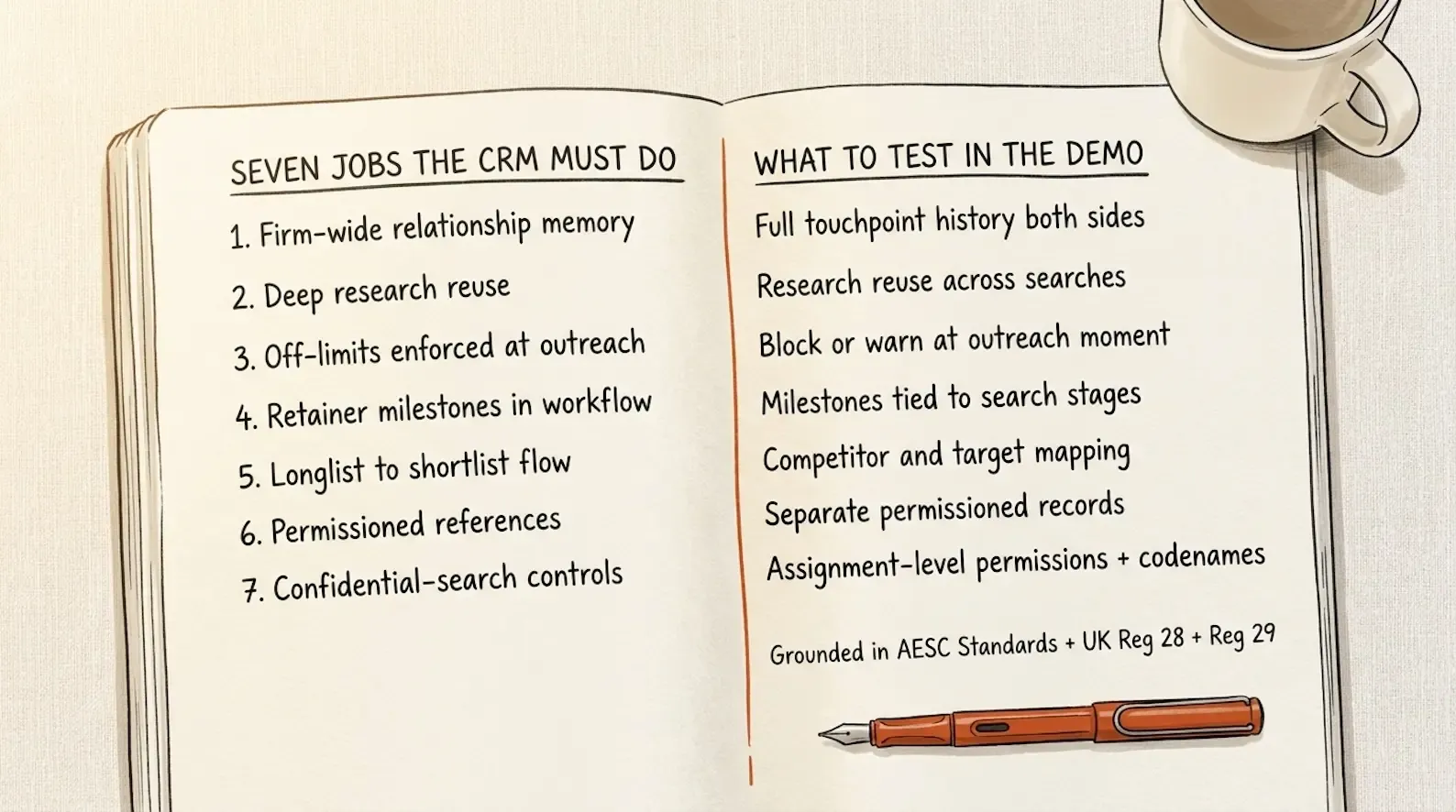
The seven functional needs below are each grounded in either AESC Professional Practice Standards, UK regulation, documented operational reality, or published vendor framing. Each row names what the system must do and what the buyer should test in a demo.
| Functional job | Grounding | What to test in the demo |
|---|---|---|
| Long-term relationship tracking across firm | Korn Ferry 350-account programme drives about 40 per cent of fees. Clockwork states ‘Your candidate relationships are your IP’ | Full firm-wide view of every touchpoint on both the candidate and client side, across years |
| Deep research (education, boards, publications, network mapping) | Cluen states Encore ‘maps board seats, referrals, and investments to reveal introductions’; BoardEx tracks 1.7 million-plus leaders | Structured fields for board seats and education; third-party data imports; research reuse across searches |
| Off-limits enforcement | AESC lists off-limits as an engagement term | Does the system block or warn at the moment of outreach, or is off-limits only a tag? |
| Retainer fee milestones and staged invoicing | AESC requires written ‘fees and payment schedule’ | Milestone schedule per assignment; invoice triggers tied to search stages; fee splits across consultants |
| Longlist and shortlist workflows | Invenias documents building longlists by competitor targeting | Competitor and target-company mapping; longlist-to-shortlist stage reporting; progress visibility |
| Referencing with lawful-basis documentation | ICO: confidential references are exempt from the right of access; general references are not | Separate permissioned reference records; documented lawful basis note; back-channel reference workflow |
| Confidential-search controls | UK Conduct Regs Reg 28(2): no disclosure to any current employer without consent; AESC: safeguard confidential information | Assignment-level access control; codenames; client portal that shows only what is permitted |
The one point worth emphasising: off-limits is the single capability most commonly oversold in vendor demos and most commonly missing in product. Several vendors (Crelate, Bullhorn Invenias) describe off-limits as a tag or flag at the record layer. No vendor documentation in this research shows AI that automatically blocks a candidate-outreach draft because the candidate’s current employer is a retained client at the firm. If off-limits enforcement at the moment of outreach matters to your firm (and under AESC Standards it should), test it specifically in the demo.
The 2026 executive search CRM vendor landscape
The vendor profiles below are neutral one-paragraph summaries of each product’s own current positioning. All capability and scale claims are vendor-reported unless noted. AESC and SIA partnerships are commercial relationships and are labelled as such. No pay-to-play awards appear in this landscape as independent benchmarks.
Invenias by Bullhorn is described by Bullhorn as ‘a leading boutique executive search platform’ with ‘700+ global customers with 10,000 users’ and 18 years in market Source: Bullhorn Invenias. It documents longlist construction by competitor mapping, bulk GDPR notifications, and consent-request handling. Bullhorn for Executive Search positions ‘5 of the top 10 largest search firms on Bullhorn’ and offers an Amplify Agent for Executive Search described as ‘AI agents designed for confidential, high-value searches’. Bullhorn is an AESC partner (start date not disclosed on the fetched pages).
Thrive TRM states ‘30,000+ executives are hired using Thrive every year’ and describes itself as powering ‘more searches in more spaces than any other executive search software’ Source: Thrive TRM. Its ‘Start a search from 60%’ positioning emphasises research reuse across assignments.
Clockwork Recruiting positions as ‘Software for Retained Executive Search, done right’. Its AI capability is grounded in a published framework called ‘The Eight Stages of Successful Retained Search’ Source: Clockwork AI. Its Client Portal supports search-strategy, longlist, and scorecard sharing.
Crelate describes its executive-search module as ‘purpose-built for retained, confidential, relationship-driven search’. Its documentation describes flagging off-limits candidates and active clients, and showing ‘who is already engaged on another search’. Retainer milestones are tracked with the search Source: Crelate executive search. Crelate became an AESC Americas Partner from 1 October 2025 Source: AESC partnership page, with a 20 per cent member migration discount.
Loxo markets itself as ‘The Leading Executive Search & CRM Platform’, citing ‘Personal contact info for over 800 million professionals’. Our Signals vs Loxo piece covers Loxo’s talent-graph architecture in more detail.
Cluen Encore has been in the executive-search software market for over 30 years. In May 2026 it announced an MCP integration enabling connection to Claude, ChatGPT, and Copilot, plus a Maxwell AI Agent and AI Sandbox, with ‘GDPR and EU AI Act data governance’ positioning Source: Business Wire, May 2026. Cluen self-describes as ‘the AESC’s longest sponsor’.
Ezekia positions as ‘The AI-powered all-in-one BD, CRM & ATS platform’ with vendor-reported ‘750+ executive search firms worldwide’ and monthly contracts without lock-ins. Ezekia announced a year-long AESC sponsorship of the AESC Proactive Selling programme on 6 April 2026. Our Ezekia vs Thrive TRM vs Signals piece covers the Ezekia-Thrive comparison in more detail.
Dillistone FileFinder and Talentis (both Ikiru People brands) target executive search with FileFinder’s 80-plus standard reports and Talentis’s built-in search across ‘250+ million public profiles’ per vendor documentation.
Firefish sells primarily as a UK agency recruitment CRM with an executive-search module that handles retainer agreements and milestone payments. See our Signals vs Firefish piece for the UK-first scope context.
Recruit CRM became an AESC Global Partner on 16 June 2026. Its positioning is ‘AI-First ATS + CRM’ across both agency and executive-search workflows.
Signals is an AI-native recruitment CRM built around Perfect Memory (automatic cross-channel capture of calls, emails, WhatsApp, WeChat, LinkedIn messages, and meetings) plus an agentic layer and Client Rooms for shared workspaces per search. It is included here as an AI-native option alongside incumbents; this is a buyer’s guide, so Signals is framed and not evaluated against itself.
The verified AESC partnership dates in this landscape are Crelate (1 October 2025), Ezekia (6 April 2026 sponsorship), and Recruit CRM (16 June 2026). Bullhorn and Cluen name themselves as AESC partners with dates not disclosed on the fetched pages. All AESC partnerships are commercial relationships, not independent benchmarks or evaluations. SIA partnerships: none of the vendors in this landscape shows an SIA partnership on the pages reviewed.
AI in executive search: assist, do not replace
AESC’s own position on AI is unambiguous. The Professional Practice Standards state: ‘Artificial intelligence may support the work we do, but it should never take the place of professional judgment’. This is the professional standard a search firm’s AI tooling has to be compatible with, not an optional opinion.
What the vendor set actually ships in 2026 includes: Bullhorn’s Amplify agents for sourcing, outreach, screening, and submissions; Cluen’s Maxwell AI Agent, AI Sandbox, and MCP connector; Ezekia’s ‘AI Connections’ linking Claude, ChatGPT, and Copilot directly to live search data; Clockwork’s AI-generated research criteria and longlist rating; and Loxo’s instant AI sourcing, ranking, and matching. All vendor-reported. All assistive. None documents AI that executes autonomous decisions on retained search workflows.
Four specific exec-search AI capabilities are worth testing in demo rather than taking on vendor positioning:
- Research summaries with cited sources. Does the AI output specify which source produced which fact? Is a human review step required before the summary becomes a record?
- Off-limits enforcement at the moment of outreach. As noted above, no vendor documentation shows this. If a vendor claims it, ask to see it.
- Discreet outreach drafting. Is the AI aware of search confidentiality and does it generate drafts that respect it?
- Relationship-graph queries. ‘Who in our firm knows the CFO of X?’ The best exec-search CRMs can answer this in seconds. Many cannot.
The regulatory edge is the EU AI Act. Annex III lists AI used to analyse and filter job applications and evaluate candidates as high-risk. A number of vendors self-classify at a lower risk tier; verify the specific features your firm plans to deploy against the Act’s language directly, and factor that compliance posture into procurement.
Aptitude Research’s September 2026 recruiter-experience research found that 74 per cent of recruiters are very or extremely confident their candidate data is accurate, while 61 per cent believe at least a quarter of their ATS records are out of date Source: Aptitude Research reports. The sample is corporate talent acquisition rather than exec search, but the finding translates: AI that runs on stale data produces stale outputs. For a search firm whose IP is the quality of its relationship memory, AI quality is capture quality.
The UK regulation an executive search CRM has to handle
UK executive search firms are explicitly in scope of the Conduct of Employment Agencies and Employment Businesses Regulations 2003 per GOV.UK guidance updated 22 June 2026 Source: GOV.UK Conduct Regulations guidance, June 2026. Enforcement moved to the Fair Work Agency from 7 April 2026. Three regulatory layers matter directly for CRM design.
Regulation 28(2): Confidentiality. ‘An agency shall not disclose information relating to a work-seeker to any current employer of that work-seeker without that work-seeker’s prior consent’ Source: Reg 28. In exec search this translates directly into assignment-level permissions, codenames, and portal scoping. A CRM that shows every active search to every logged-in user is not Reg 28-compliant.
Regulation 29(2): Record retention. Records must be kept ‘for at least one year from the date of their creation’ and for applicant particulars ‘at least one year after the date on which the agency last provides services’ Source: Reg 29. This is a minimum, not a maximum.
UK GDPR storage limitation and legitimate interests. The ICO explicitly states ‘The UK GDPR does not set specific time limits’ and that data must be kept ‘no longer than is necessary’. For long-term candidate relationships that may span decades, this requires a documented legitimate interests assessment. The ICO updated its legitimate interests guidance on 23 March 2026 to reflect the Data (Use and Access) Act. The tension at the heart of exec search is that relationships last decades, but the law requires purpose-bound retention. A CRM that cannot support configurable retention per record class, with lawful-basis documentation and consent workflows, will struggle to pass ICO review.
For the broader UK context around recruitment agency compliance, our Recruitment in the UK in 2026 piece covers the regulatory landscape in more depth.
What reviews can and cannot tell you
Review-platform data for exec-search CRMs is unusually thin, and buyers should calibrate accordingly. Invenias has 6 G2 reviews and 15 Capterra reviews. Thrive TRM has 0 Capterra reviews. Clockwork has 6 G2 reviews and 51 Capterra reviews. Ezekia’s four Capterra reviews are all from August 2020. Cluen Encore’s five Capterra reviews span 2012 to 2022. Only Loxo (182 G2 reviews) and Crelate (443 Capterra reviews) have review bases substantial enough to analyse thematically.
The documented complaints across the review set are about usability, bulk-upload friction, reporting depth, and manual data entry. Notably, no review in this research mentions off-limits enforcement or confidentiality failures (positively or negatively). The absence is not evidence of absence; it is evidence that off-limits and confidentiality do not get surfaced through review platforms. These capabilities have to be tested in a demo and in reference calls with firms of the same model.
For a wider frame on how to evaluate any recruitment CRM without being distracted by feature bingo, our recruitment CRM buyer’s guide for 2026 walks through the Five Dimensions of AI-Native Evaluation.
The seven-criterion buyer’s scorecard
Each criterion is grounded. Each has a test. Use it as a scorecard against any vendor demo.
- Off-limits and conflicts as enforced data, not tags. Grounding: AESC Client Bill of Rights lists off-limits and conflicts as engagement terms. Test: does the system block or warn at the moment of outreach? Add a candidate from an off-limits client in the demo and see what happens.
- Confidential-search controls. Grounding: UK Conduct Regs Reg 28(2) and AESC ‘safeguard confidential information’. Test: assignment-level permissions, codenames, portal scoping, and audit trail of who saw what and when.
- Relationship memory that compounds. Grounding: Korn Ferry’s 350-account programme produces about 40 per cent of fees; Thrive’s ‘Start a search from 60%’ framing. Test: can the system reuse research across assignments, surface mutual connections, and show the full touchpoint history on both candidate and client side?
- Retainer economics in the workflow. Grounding: AESC requires a written ‘fees and payment schedule’. Test: milestone schedule per assignment, invoice triggers tied to search stages, fee splits across consultants and research staff.
- Defensible retention and lawful basis. Grounding: Reg 29 (one-year minimum), ICO storage limitation, ICO legitimate interests update (23 March 2026). Test: configurable retention rules per record class, a stored legitimate interests assessment, consent tooling, and a documented deletion or suppression workflow.
- AI that assists judgment and shows its sources. Grounding: AESC Standards on AI and judgment; Aptitude Research 2026 data-decay finding; EU AI Act Annex III high-risk status. Test: cited research summaries, human approval before outreach, model-provider disclosure, and data-governance posture.
- Evidence of fit beyond reviews. Grounding: thin review bases, paid AESC partnerships. Test: reference calls with firms of the same size and model, live demo on your own data, contract flexibility (monthly terms where offered), and migration support quality.
The one-sentence close
Executive search firms do not buy a CRM for feature counts. They buy for the four things that cannot be bolted on later: off-limits enforced at outreach, confidential searches that stay confidential, retainer economics in the workflow, and relationship memory that compounds across decades. The seven criteria above translate those four needs into testable demo requirements. Run them against every vendor the firm shortlists.
See what a CRM built around relationship memory looks like for exec search
Signals is live for recruitment agencies globally, including exec search firms. Book a demo to see Perfect Memory and the agentic layer in production.
Common questions
Executive search operates on a retained and exclusive basis per AESC Professional Practice Standards, with written engagement terms that cover fees and payment schedule, deliverables, guarantees, off-limits, conflicts, and data management [Source: AESC Professional Practice Standards](https://www.aesc.org/wp-content/uploads/2025/10/AESC_Professional_Practice_Standards.pdf). This translates into specific CRM requirements that general staffing platforms rarely treat as first-class: off-limits agreements must be enforced at the record level (not just tagged), confidential searches require assignment-level permissions and portal scoping, retainer fee milestones must be tracked against the search workflow, references and back-channel notes need separate permissioned records with documented lawful basis, and multi-year relationship data must survive storage-limitation review under GDPR. The operational tempo also differs: low volume, long cycles, outbound-heavy, research-intensive, and revenue recognised in stages rather than at placement.
The 2026 vendor landscape includes several platforms with executive-search positioning: Invenias by Bullhorn (described by Bullhorn as a leading boutique executive search platform with 700-plus customers and 10,000 users [vendor-reported]) [Source: Bullhorn Invenias](https://www.bullhorn.com/products/invenias-executive-search/); Thrive TRM (claims 30,000-plus executives hired annually via Thrive, vendor-reported); Clockwork (grounded in its Eight Stages of Successful Retained Search framework); Crelate (AESC Americas Partner since 1 October 2025, 25,000-plus pros and 1,500-plus teams per vendor-reported figures); Loxo (markets itself as leading executive search and CRM platform); Cluen Encore (self-described AESC longest sponsor, with MCP integration for Claude, ChatGPT, and Copilot announced May 2026); Ezekia (750-plus exec search firms per vendor-reported figures, AESC partnership announced April 2026); Dillistone FileFinder and Talentis via Ikiru People; and newer entrants including Recruit CRM (AESC Global Partner from June 2026) and Signals (AI-native, cross-channel capture). AESC partnerships are commercial relationships, not independent benchmarks.
The seven criteria that should govern the executive search CRM buying decision in 2026 are: (1) off-limits and conflicts as enforced record-level data, not tags; (2) confidential-search controls (assignment-level permissions, codenames, portal scoping); (3) relationship memory that compounds across years and searches; (4) retainer economics in the workflow (milestones, invoices, fee splits tied to search stages); (5) defensible retention and lawful basis documentation (Conduct Regulations 2003 Reg 29 one-year minimum, UK GDPR storage limitation, ICO legitimate interests assessment); (6) AI that assists judgment and cites its sources (AESC's own position: AI should support but not replace professional judgment); and (7) evidence of fit beyond review-platform averages (reference calls with same-model firms, live demo on your own data, contract flexibility). Each criterion is grounded in either AESC Professional Practice Standards, UK regulation, documented operational reality, or published analyst framing.
The UK Conduct of Employment Agencies and Employment Businesses Regulations 2003 explicitly apply to executive search consultants per GOV.UK guidance updated June 2026 [Source: GOV.UK Conduct Regulations guidance, June 2026](https://www.gov.uk/government/publications/conduct-regulations-2003-guidance-for-employment-agencies-and-employment-businesses/overview-of-the-conduct-regulations-2003). Enforcement moved to the Fair Work Agency from 7 April 2026. Regulation 28(2) prohibits an agency from disclosing a work-seeker's information to any current employer without the work-seeker's prior consent [Source: Reg 28](https://www.legislation.gov.uk/uksi/2003/3319/regulation/28). Regulation 29(2) requires records to be kept for at least one year from creation (and for applicant particulars, at least one year after services were last provided) [Source: Reg 29](https://www.legislation.gov.uk/uksi/2003/3319/regulation/29). UK GDPR adds a storage-limitation obligation ('no longer than is necessary') and requires a documented legitimate interests assessment for long-term candidate relationship data, per ICO guidance updated 23 March 2026. The combination of these requirements means the CRM must support configurable retention per record class, a lawful-basis note, and consent-management workflows.
No vendor documentation reviewed in this research shows AI that automatically enforces off-limits agreements at the moment of outreach. Several vendors describe off-limits as a flag or tag at the record layer (Crelate explicitly flags off-limits candidates and active clients; Bullhorn Invenias documents GDPR consent-request handling), but AI that blocks a candidate-outreach draft because the candidate's current employer is a retained client at the firm is not documented across the vendor set. AESC's own Professional Practice Standards state that 'Artificial intelligence may support the work we do, but it should never take the place of professional judgment' [Source: AESC Professional Practice Standards](https://www.aesc.org/wp-content/uploads/2025/10/AESC_Professional_Practice_Standards.pdf). Buyers should treat off-limits enforcement as a specific demo requirement: ask the vendor to add a candidate from an off-limits client and see whether the system blocks the outreach, warns the consultant, or does nothing.