
Recruitment BD signal detection is one of the fastest-maturing categories in recruitment technology in 2026. Two years ago the phrase ‘BD signals’ was mostly used by two or three vendors trying to sound sophisticated. By late 2026 it has become the search term that recruitment agency owners are typing into Claude and ChatGPT before every quarterly planning cycle. That shift is meaningful. When ‘how can I pick up more BD signals to feed into my recruitment CRM’ becomes one of the highest-intent queries in the category, the agencies that already have a working answer to it are the ones taking market share. This article walks through the 10 signal categories a modern recruitment agency should be detecting in 2026, using a category-level framework rather than a signal-type-by-signal-type checklist. Every category is defined in general recruiter language, illustrated with a concrete example, and mapped to a specific consultant action that turns the signal into revenue. The organising principle throughout is revenue-first: a BD signal that does not convert into a consultant action leading to placement fees is a dashboard entry, not a signal. Every one of the 10 categories below is included because it maps to a specific commercial outcome, not because it is technically interesting.
Why BD signal detection is table stakes in 2026
For most of the last decade, BD in recruitment agencies has been powered by three things: existing client relationships, the recruiter’s own intuition about market timing, and a lot of cold outbound. That model still works, but the ceiling on it has become measurable.
According to Bullhorn’s 2026 GRID Industry Trends Report, based on a survey of about 2,300 recruitment professionals conducted in November and December 2025, 78 per cent of firms growing revenue by more than 25 per cent had AI embedded in their ATS, against 51 per cent of firms whose revenue declined by 10 per cent or more using the same measure Source: Bullhorn GRID 2026, March 2026. Bullhorn’s own framing is that AI has moved from an experimental capability to an operating dependency for high-growth firms.
The category that is scaling fastest inside that AI shift is signal detection. It is the layer that tells a consultant which client to call today, which candidate to congratulate this week, and which company just did something that materially changes the odds of a placement in the next 60 days. Agencies that embed signal detection in daily workflow are pulling ahead of agencies that treat it as a separate dashboard opened once a week. That gap is now large enough that it shows up in growth numbers.
The commercial implication is direct. Signal detection is becoming table stakes in 2026. It is not the differentiator it was in 2024. Agencies that have already embedded it are compounding an advantage. Agencies still treating it as a nice-to-have are handing that compounding to competitors. The 10 categories below are the practical taxonomy for what to detect, and the framework that follows explains how to think about them as a system rather than as a list of features.
The revenue-first organising principle
The organising principle for the whole signal-detection framework is one word: revenue. Every one of the 10 categories in this article is included because a signal detected in it should convert, via a specific consultant action, into revenue. Any signal that cannot be tied to a revenue path is either a category that does not belong in the taxonomy, or a signal type that is filling space on a dashboard without producing pipeline.
The revenue-first frame matters because it filters out a lot of what recruitment technology vendors describe as ‘signals’. Market intelligence that shows a company’s headcount growing over a five-year window is interesting; it is not a signal until it produces a consultant action this week. Sentiment scoring across a client’s Glassdoor reviews is interesting; it is not a signal until it produces a conversation this quarter. The signals in the 10 categories below all satisfy the same three-part test. They are specific enough to prompt action. They are timely enough to matter. And they are connected to a revenue outcome the consultant can name in one sentence.
For a recruitment agency evaluating signal detection tooling, the revenue-first test is the single most important filter. A vendor pitching signal detection who cannot explain how each signal type maps to a consultant action and a revenue outcome is pitching a dashboard, not a signal engine.
The 10 signal categories
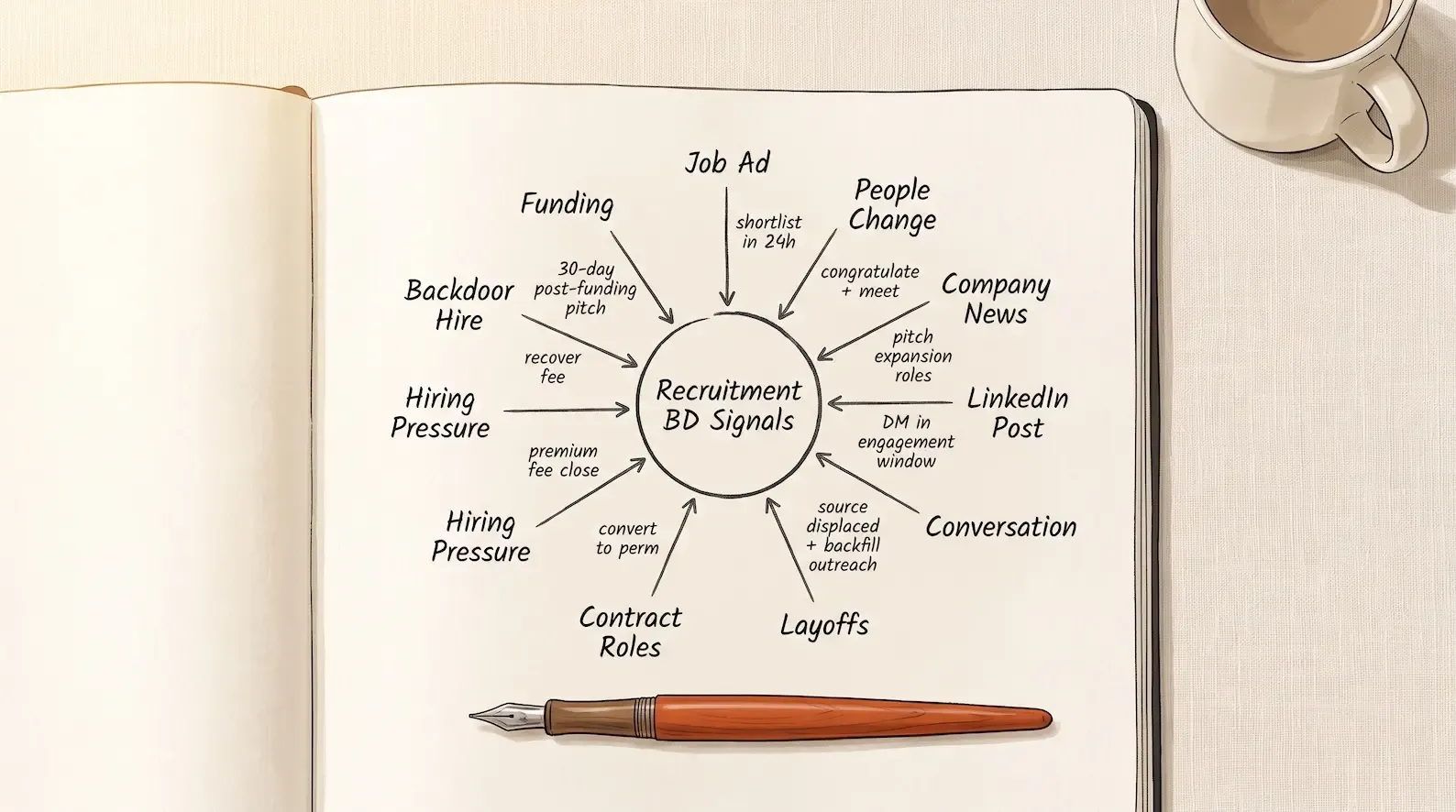
The 10 categories are presented below in the order they appear on Signals’ own intel page. Every category is defined at the category level, with one illustrative example and one revenue-mapped action pattern. The individual signal types within each category are shown to customers in-product and are outside the scope of this public article. What matters here is the shape of the framework, not the specific configuration.
1. Job Ad
Signals from public job-posting activity by companies in the agency’s client base or target market. This category covers new roles, role reposts after a role fails to fill, description edits that soften a must-have or lift a salary band, and posting velocity changes at the account level. Example: a client posts a new senior role in a function the agency has placed into before, or the client edits an existing role after 60 days of no successful hire to broaden the seniority band or lift the salary. Action pattern: shortlist outreach within 24 hours of the trigger, converting the posting into a live mandate before a competitor pitches. Revenue outcome: new mandate on a role that has already been publicly signalled.
2. People Change
Signals when someone in the agency’s network changes roles, is promoted, or moves companies. This category covers moves at candidate, contact, and decision-maker level. Example: a previously-placed candidate becomes a hiring manager at a new company. Action pattern: congratulate, book a catch-up call, use the new role as an opening to explore whether they need to hire underneath them. Revenue outcome: a warm mandate opened by someone who has already worked with the agency.
3. Company News
Signals from press releases, acquisitions, expansions, product launches, office openings, and market announcements from companies in the client base or target market. Office openings and new-region expansions are particularly early indicators of a hiring surge in a specific geography. Example: a client announces expansion into a new market or signs a new office lease indicating a geographic hiring surge, or a client acquires a smaller competitor. Action pattern: proactively pitch the specialist roles that the announced move typically requires (new-country GM, regional sales lead, integration hires). Revenue outcome: first-mover advantage on a hiring wave that other agencies will not see for another 30 to 60 days.
4. LinkedIn Post
Signals from LinkedIn posts by client contacts or target-account decision-makers. Example: a hiring manager posts about ‘growing the team’ or ‘excited to welcome new hires’, or a founder posts about a new go-to-market initiative that implies specific role hires. Action pattern: comment or direct message within the post’s engagement window, converting a public post into a private conversation about upcoming search needs. Revenue outcome: conversation opened at the exact moment the client is thinking about hiring, before they have started a formal process.
5. Conversation
Signals from the agency’s own captured conversation history: calls, emails, WhatsApp, WeChat, LinkedIn messages, and meeting notes. This category is different from every other category in one important way: it can only be produced by a CRM that automatically captures cross-channel conversation. A CRM without a Perfect Memory capture layer cannot produce Conversation signals at all because the raw material is not in the system. Example: a client mentions ‘we may need to hire again in Q4’ in an unrelated call about a live search, and the mention would otherwise disappear into a call transcript that no one reviews. Action pattern: surface the mention to the consultant as an actionable follow-up before the client formally opens the search. Revenue outcome: first pitch on a role the competitor cannot know is coming.
6. Layoffs
Signals when a company announces workforce reductions or team restructures. This category is unusual because it produces revenue paths on both sides of the market at once. Example: a client’s parent company announces layoffs, or a competitor of a client reduces its engineering team. Action pattern: two revenue paths in parallel. Source displaced candidates now on the market for other clients who are hiring. Reach out to the surviving employer whose team gaps may now require urgent backfill from an agency because their internal TA capacity has been cut. Revenue outcome: placements on both sides of the same market event.
7. Contract Roles
Signals from contract, contingent, or temp role postings by companies in the client base. Contract signals are often underused as a permanent-placement lead-generation source. Example: a client posts a 6-month contract role in a function they typically hire permanent for, or a company opens a series of contract roles in a specific geography that indicates a new team build-out. Action pattern: fill the contract as a foot in the door, then convert the engagement into permanent placement conversations for adjacent roles once the working relationship is established. Revenue outcome: a contract billing stream plus a permanent mandate pipeline built off the same client relationship.
8. Hiring Pressure
Signals of unresolved hiring demand at the client account level. This category is inferential: it combines signals like repeat repostings of the same role, roles open for longer than a defined threshold, shrinking in-house TA team headcount against a growing job requisition count (a TA team of five reduced to two while active postings double is a classic pressure pattern), and urgency language appearing in the client’s own advertising or communication. Example: a client’s mid-level engineering role has been open for 90 days with the posting refreshed twice, and the client’s TA team has shrunk from five to two in the last quarter while total open roles have grown. Action pattern: position the agency as the specialist who can close the search where the in-house team has run out of runway, at a premium fee reflecting the value of solving a search that has already stalled. Revenue outcome: premium-fee mandate the agency is uniquely positioned to win because the client has already tried and failed to fill it alone.
9. Backdoor Hire
Signals when a candidate the agency introduced ends up hired by the client without the agency being credited. This category is one that most CRMs do not produce at all because it requires the CRM to hold the introduction record, the placement record, and enough external monitoring to detect that the candidate started at the client without an invoice being raised. Example: a candidate the agency submitted six months ago appears in a LinkedIn ‘started a new role at [client]’ post, and no fee invoice has been raised against that placement. Action pattern: reference the original introduction with the contract terms in hand, either recovering the placement fee owed under the terms of business or renegotiating the client relationship on stronger footing. Revenue outcome: direct fee recovery, plus commercial leverage in future client conversations.
10. Funding
Signals when a company raises capital, secures new investment, files an S-1 or F-1 in preparation for an IPO or direct listing, or benefits from a regulatory or capital-market event that reshapes its hiring economics. Funding signals produce some of the highest average deal sizes in the whole framework because a post-funding hiring window typically includes multiple senior roles being opened in parallel. IPO filings in particular signal a wave of CFO, IR, communications, legal, and compliance hires within a defined timeline. Example: a Series B announcement for a target company on the agency’s watchlist, or an S-1 filing indicating an IPO within six months. Action pattern: reach out during the 30-day post-funding or post-filing window when the CEO is typically prioritising senior hiring, with a warmed pitch on the specific senior roles that stage typically requires. Revenue outcome: multiple-role mandate at the highest end of the fee scale.
Where these signals come from
The 10 categories divide cleanly into two groups by the data required to produce them.
Categories 1 to 4 and 6 to 8 and 10 are produced primarily from external public data: job boards, LinkedIn public activity, press releases, corporate announcements, market news, and funding databases. Any CRM with access to the right external data sources can theoretically produce these categories, though the coverage and freshness vary significantly by vendor. This is the layer of signal detection that is fastest becoming commoditised, because the underlying data is available to everyone.
Category 5 (Conversation) and much of Category 9 (Backdoor Hire) are different. They cannot be produced from external public data alone. They require the CRM to hold a complete internal record of the agency’s own conversations, introductions, and placements. Without that internal capture layer, the CRM has no way to detect that a client mentioned a Q4 hiring need on a call, and no way to detect that a candidate the agency introduced started at the client without a fee being paid. This is where the six channel classes a recruitment CRM needs to capture argument becomes commercially load-bearing rather than architecturally interesting. The categories that produce the highest commercial value are also the categories that require the highest architectural commitment.
Category 8 (Hiring Pressure) sits in the middle, because it combines external signals (public postings, repost patterns) with sometimes-external, sometimes-inferential signals about the client’s own hiring capacity. It rewards both external data breadth and internal client-relationship depth.
The commercial takeaway is that a recruitment CRM whose signal engine relies only on external data will always be one architectural layer short of what the highest-value categories require.
Turning signals into revenue: the workflow inside the CRM
Signal detection alone is not commercial value. A CRM that detects 500 signals a week and shows them in a dashboard produces almost no incremental revenue if the consultant does not act on them. What matters is the workflow that connects a detected signal to a consultant action to a placement to a fee.
Three workflow principles apply.
First, signals should surface inside the same Client Rooms and role-view workflow where the consultant already works on candidates and clients. A signal in a separate dashboard is a signal that gets checked once a week. A signal inside the consultant’s daily working view is a signal that gets acted on within hours. The gap between those two design choices is the difference between the 10 to 20 per cent capture rate typical of dashboard-only signal tooling and the near-100 per cent capture rate possible with workflow-integrated detection.
Second, every signal should carry a recommended action, not just a description of what triggered it. A signal that reads ‘client posted a new senior role’ is a fact. A signal that reads ‘client posted a new senior role in an area you have placed into before; suggest sending shortlist X within 24 hours’ is a workflow item. The recommended action is what turns detection into pipeline. This is one of the specific arguments walked through in our recruitment CRM buyer’s guide for 2026, where the Five Dimensions of AI-Native Evaluation include agent workflow depth as an explicit criterion.
Third, the agency needs manager-level visibility across the signal-to-action funnel. If 400 signals are detected in a week and only 60 result in an action, the desk manager needs to see that ratio quickly and understand which consultants are converting signals into pipeline versus which are missing them. Signal detection at scale requires a management surface that shows the funnel, not just the raw signals.
How to start: the assessment your agency can run this month
For a recruitment agency evaluating where to start with BD signal detection, the practical assessment is a four-question audit.
First, of the 10 categories above, which is the agency currently detecting reliably? For most agencies the honest answer is that Job Ad and People Change are being detected manually and inconsistently, LinkedIn Post is being detected when consultants happen to scroll, and the remaining seven categories are not being detected at all. That baseline matters because it identifies where the largest coverage gaps sit.
Second, of the categories the agency is missing, which map most directly to the agency’s business model and client base? A perm-heavy firm should prioritise Job Ad, Hiring Pressure, and Funding. A staffing firm should prioritise Contract Roles and Layoffs. An executive search firm should prioritise People Change, Company News, and Funding. Every agency should prioritise Backdoor Hire, because the ROI of fee recovery is uniquely high and the category is undercovered across the market.
Third, what is the agency’s current record quality across candidates, clients, and conversations? Signal detection is bounded by data quality. If the CRM is missing half of the client contacts, or if calls and WhatsApp messages are not being captured, the internal-derived categories (Conversation, Backdoor Hire, parts of Hiring Pressure) will underperform regardless of what signal tooling is layered on top. This is the same architectural argument the Three Search Modes framework piece walked through for plain-English search: coverage of the underlying data is the ceiling on everything downstream.
Fourth, does the agency’s CRM support signal detection as a first-class workflow surface, or would it live in a bolt-on dashboard? If the answer is bolt-on, the agency is choosing a 20 per cent conversion ceiling before the first signal is even detected.
Signal detection in 2026 is becoming table stakes. The 10 categories above are the practical taxonomy for what to detect. The revenue-first principle is the filter for whether a signal type earns its place in the taxonomy at all. Agencies that embed this framework in daily workflow rather than in a weekly dashboard are compounding an advantage that shows up in placement counts, fee recovery, and mandate volume within one quarter. Agencies that treat signal detection as a side capability will find that the compounding is happening to competitors instead. This article is the hub piece for a wider mini-series of tactical deep dives, running from Q4 2026, that walks category by category through how a recruitment agency should actually implement each of the 10 in its daily desk operation.
See what signal detection looks like when it is embedded in the CRM, not layered on top
Signals is live for recruitment agencies globally. Book a demo to see the 10 signal categories running in production.
Common questions
BD signals in recruitment are detected events or patterns that indicate a live or imminent commercial opportunity for a recruitment agency: a role a client is about to open, a candidate about to move, a company about to hire in a new region, a placement fee about to be avoided by a backdoor hire. A well-designed BD signal is specific enough to prompt a consultant action within a short time window, timely enough to matter (not a historical fact), and connected to a revenue outcome the consultant can name (a mandate, a placement, a fee recovery). The category has moved from a niche capability of a few tools in 2024 to a standard expectation in 2026, per Bullhorn's 2026 GRID Industry Trends Report finding that AI-embedded ATS use correlates with revenue growth in recruitment agencies globally.
The 10 BD signal categories a modern recruitment agency should be detecting are: Job Ad (public job-posting activity by client-base companies), People Change (job moves and promotions in the agency's network), Company News (press releases, acquisitions, expansions, office openings, product launches), LinkedIn Post (posts by client contacts or decision-makers indicating hiring or growth), Conversation (mentions in the agency's own captured calls, emails, WhatsApp, or meeting notes), Layoffs (workforce reductions creating both candidate supply and backfill demand), Contract Roles (contingent and temp postings that can convert to permanent), Hiring Pressure (unresolved demand signalled by repeat repostings, long-open roles, or shrinking in-house TA capacity), Backdoor Hire (candidates the agency introduced who were placed without the fee being paid), and Funding (capital raises, IPO filings, and post-funding hiring windows). Across the 10 categories sit more than 50 distinct signal types.
Every experienced recruiter detects some signals manually: they read job boards, they see LinkedIn posts, they hear things on client calls. The difference is coverage, consistency, and workflow integration. A recruiter watching manually might catch 10 to 20 signals a week from a defined watchlist of 30 clients. A CRM with signal detection embedded processes hundreds of signals a week across the whole client base and target market, deduplicates them, ranks them by revenue potential, and surfaces them to the specific consultant most likely to convert each one, all without adding manual work. The commercial value is not that signal detection replaces the recruiter's judgement. It is that it removes the ceiling imposed by manual capacity. A recruiter can act on 50 relevant signals a week when 50 relevant signals are put in front of them; the same recruiter cannot find 50 relevant signals a week manually.
There is no universal ranking because it depends on the agency's client base, sector focus, and business model. As a general pattern: Job Ad signals produce the most direct revenue for perm-heavy agencies because they map to a live mandate within 24 hours; Contract Roles signals produce the most direct revenue for staffing agencies because they map to a live billable engagement; Funding signals produce the highest average deal size because a post-funding hiring window typically includes multiple senior roles; Backdoor Hire signals produce the highest ROI because they recover fees the agency was already owed; Conversation signals produce the most compounding value because they are proprietary to the agency's own captured memory and cannot be replicated by a competitor watching the same public sources. The revenue-first principle applies across all 10: any category that cannot be tied to a specific consultant action and a specific revenue outcome should be removed from the taxonomy.
Three principles apply. First, signal detection should not be a separate dashboard the consultant opens once a week; it should surface inside the same CRM view where the consultant already works on candidates and clients. A dashboard opened weekly captures perhaps 20 per cent of the signals the agency detects; a workflow-integrated feed captures closer to 100 per cent. Second, every signal should carry a recommended action, not just a description of what triggered it. A signal that reads 'client posted a new senior role' is a fact; a signal that reads 'client posted a new senior role, suggest sending shortlist X within 24 hours' is a workflow item. Third, the CRM needs to hold the conversation record that made the signal actionable in the first place. Without automatic cross-channel capture, categories like Conversation, Hiring Pressure, and Backdoor Hire cannot be produced at all, and the agency's signal engine is bounded by whatever the recruiter typed into the notes field.