
The most consequential shift in recruitment CRM design in 2026 is not another AI feature announcement. It is the arrival of plain-English search as a genuine third search mode alongside Boolean strings and structured filters. For twenty years the working recruiter has had two ways to interrogate a CRM: write a Boolean string that assumes the exact words in the record, or set structured filters that only work where the record was tagged. A third mode is now shipping in production recruitment CRMs. It lets a recruiter ask a question in natural language and get an answer grounded in the agency’s own captured memory. This article introduces the Signals-coined Three Search Modes framework, walks through which platforms have actually shipped this capability in 2026 (using each vendor’s own documentation), and argues that the constraining variable in recruitment CRM search is not the search UI. It is what the CRM has captured, and therefore what the AI can find.
What plain-English search actually means
Plain-English search is a compound capability. It typically combines two underlying technologies. Semantic retrieval uses vector embeddings to match on meaning rather than exact keywords. LLM-based query interpretation reads the natural-language question, decomposes multi-part requests, and can hold multi-turn clarifications.
Manatal defines semantic search in its own product documentation as contextual matching based on meaning rather than exact words, and gives the example of searching for UX designer and retrieving product designer or interaction designer Source: Manatal AI Advanced Search, 2026. Recruiterflow describes its AIRA Search as reasoning over resumes, files, emails, notes, external data, and professional-network information from a natural-language query Source: Recruiterflow AIRA Search, 2026. SeekOut describes its MCP workflow as letting a recruiter describe a need in plain language, then having the assistant search, analyse results, and help take action Source: SeekOut MCP, 2026.
Under the hood, three engineering primitives are shared across most of these implementations. First, records are chunked and embedded into a vector index at ingestion. Second, the query is embedded and used for nearest-neighbour retrieval. Third, an LLM reads the retrieved context and either ranks, explains, or drafts follow-up actions. What differentiates one product from another is not usually the semantic model, which is commercially available. It is what the model is retrieving from.
The Three Search Modes framework
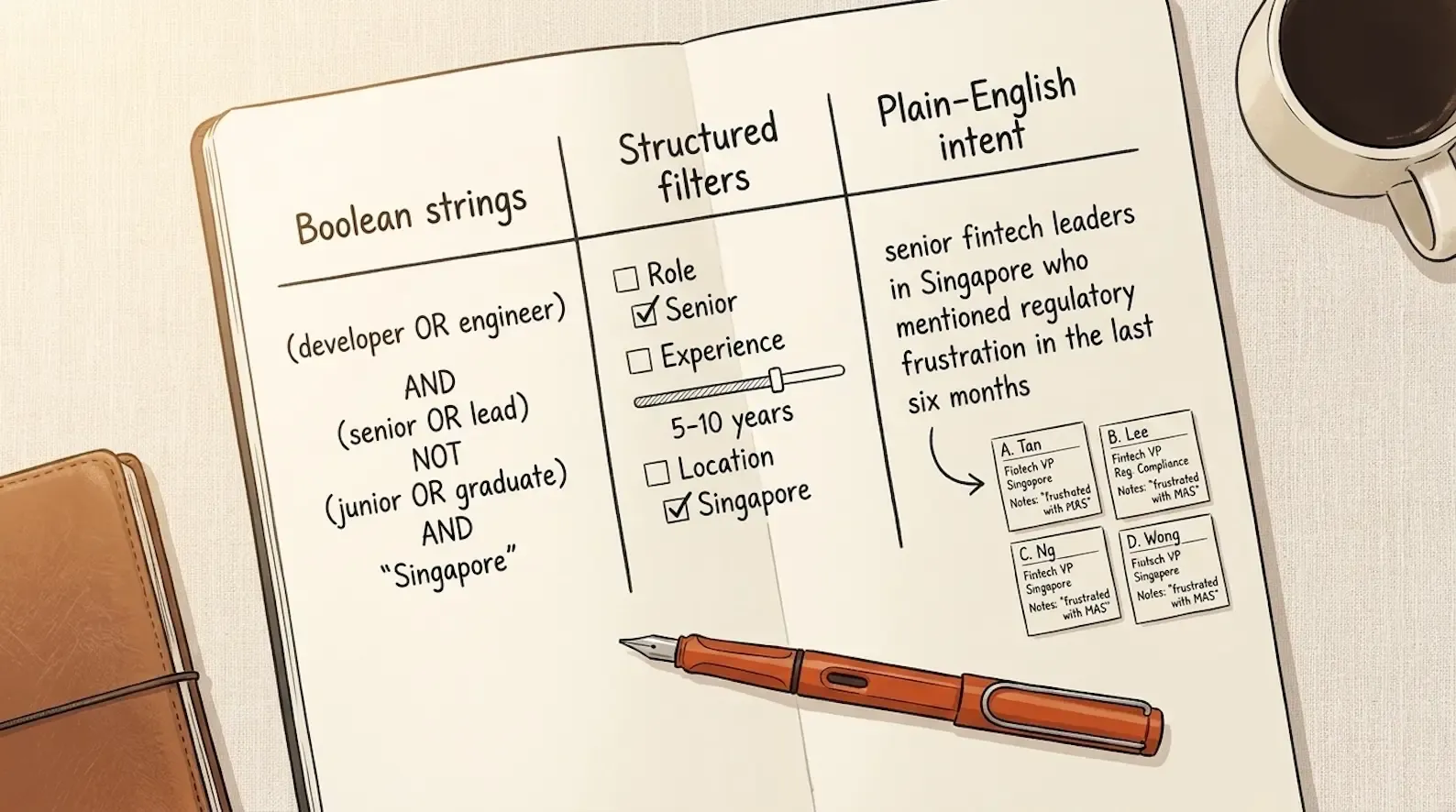
The clearest way to sort the current debate is to name the three modes explicitly. Each has a distinct strength and a distinct failure mode. Treating them as sequential (Boolean is old, semantic is new, LLM is next) is the wrong mental model. They are complementary, and a well-designed recruitment CRM makes all three available to the recruiter on the same data.
| Mode | What it does | Strongest when | Failure mode |
|---|---|---|---|
| Boolean strings | Exact operator logic, AND, OR, NOT, parentheses, proximity | Strict inclusion or exclusion where the recruiter knows the exact words in the record | Fails when the record uses different vocabulary or when the recruiter’s syntax is imperfect |
| Structured filters | Controlled fields and facets, location radius, seniority, availability, compensation, work authorisation | Auditable hard constraints, compliance-visible criteria, reporting consistency | Fails when the constraint was never tagged, or when the constraint sits inside a free-text note the filter cannot see |
| Plain-English intent | Semantic retrieval plus LLM query understanding across notes, conversations, resumes, and structured records | Exploratory or multi-constraint queries where context, history, adjacent experience, or implied criteria matter | Fails when the underlying record is thin, missing, or fragmented; can over-expand relevance without explicit constraints |
The framework’s practical implication is that the recruiter’s job is not to pick one search mode and stick with it. The job is to reach for the right mode for the specific question. A search for Australian citizen, cleared to work in defence, currently in Canberra, availability inside sixty days is a filter question. A search for senior fintech leaders in Singapore who mentioned regulatory frustration in the last six months is a plain-English intent question. A search for Python AND Django AND (senior OR lead) is a Boolean question that fits when the record’s vocabulary is known.
What actually ships in 2026
The market conversation about AI search often runs ahead of what platforms have publicly documented. The list below is conservative: each entry is verifiable against the vendor’s own currently accessible product documentation, and every claim carries an inline source. Where a platform is not listed, it is either not verified from public documentation at the time of this research, or the AI features shipped are of a different type (drafting, summarisation, or agentic workflow) rather than plain-English database search.
Verified natural-language or semantic recruitment CRM search as of August 2026:
- Recruit CRM has AI Sourcing, which accepts keyword or natural-language queries such as
senior React developer in Berlin, and AI Copilot, which accepts natural-language commands to create tasks, generate reports, and analyse CRM data Source: Recruit CRM AI automation, 2026. AI Sourcing uses X-ray search against external platforms including LinkedIn Source: Recruit CRM AI features, 2026. - Manatal has AI Advanced Search, which combines conventional filters with semantic criteria and returns relevance scores, and an AI Copilot that accepts plain-English questions about candidates, jobs, matches, and organisations Source: Manatal AI Advanced Search, 2026; Source: Manatal AI Copilot, 2026. Manatal also announced a public-beta MCP server in January 2026 that lets ChatGPT, Claude, and other LLMs query candidates, jobs, notes, and organisations Source: Manatal MCP announcement, 2026.
- Recruiterflow has AIRA Search, which accepts natural-language queries across the agency database and reasons over resumes, files, emails, notes, external data, and professional-network information Source: Recruiterflow AIRA Search, 2026. Ask AIRA reads profiles in a job pipeline and returns a ranked shortlist with reasoning from a plain-English question Source: Recruiterflow Ask AIRA, 2026.
- SeekOut has SeekOut Assist, which supports conversational search, and a SeekOut MCP that allows plain-English recruiting queries inside ChatGPT, Claude, Gemini, and Copilot Source: SeekOut Search Help Center, 2026; Source: SeekOut MCP, 2026. SeekOut’s search runs over public profiles, GitHub, academic, healthcare, and ATS sources.
Not verified from public documentation in this research pass:
- Bullhorn Copilot has publicly documented generative workflow tasks (pre-screening questions, rejection messages, candidate pitches, resume updates, profile summaries), but a released, general plain-English CRM search interface is not verified in the reviewed launch material Source: Bullhorn Copilot launch, 2024.
- JobAdder, Vincere, hireEZ, Sense, and Loxo each market AI capabilities in their broader product positioning, but their currently accessible public product pages do not verify a general plain-English CRM database-search workflow in this research pass. This does not mean those capabilities do not exist. It means they are not documented on the pages reviewed, and any agency evaluating those platforms should verify current capability from the vendor directly.
Reading an inventory like this one is an evaluation exercise, and search architecture is only one axis of it. Our recruitment CRM buyer’s guide for 2026 sets out the Five Dimensions of AI-Native Evaluation, of which search architecture is one.
Why Boolean is not going away
The strongest current critique of plain-English recruiting search comes from inside the vendor community, not from outside it. Manatal’s own product documentation explicitly recommends combining semantic search with structured filters for accuracy, on the grounds that semantic retrieval can over-expand relevance and needs to be bounded by explicit criteria Source: Manatal AI Advanced Search, 2026. That is the honest answer.
There are three specific situations where Boolean or filters remain the correct tool even in an AI-native workflow. Compliance-visible constraints, where an auditor may need to trace how a search was scoped: filters produce a reproducible, machine-readable log; a plain-English query produces natural language that has to be reverse-engineered. Exact-vocabulary constraints, where the recruiter knows the specific term appears in the record: AWS Certified Solutions Architect Professional is a Boolean question, not an intent question. Strict exclusions, where the search must not return anyone who has been placed at a client in the last twelve months or anyone who is currently under active contract with a competitor. Semantic search on exclusion tends to be probabilistic; Boolean and filters make exclusion deterministic.
The framing that plain-English search replaces Boolean is a marketing frame, not a technical frame. What actually happens in a mature workflow is that all three modes coexist, and the recruiter picks the mode that matches the question.
The prerequisite: what the CRM has actually captured
There is a widely repeated claim in recruitment technology marketing that AI search transforms a recruiter’s productivity. The claim omits its own precondition. AI search can only surface what the CRM already holds. If the conversation was on WhatsApp and never reached the CRM, plain-English search cannot find it. If the call was on a mobile and never transcribed, the search cannot cite it. If the WeChat exchange was in Chinese and never captured, the search does not know it happened.
The data-quality picture from adjacent CRM contexts is stark. Validity’s 2025 CRM Impact Report surveyed 602 CRM users and stakeholders in the US, UK, and Australia and found that 76 per cent of respondents say less than half of their CRM data is accurate and complete, 45 per cent say their CRM data is not ready for AI, and 37 per cent say poor data quality has caused revenue loss Source: Validity CRM Impact Report 2025. The survey covers general CRM users rather than recruitment agencies specifically, but the underlying dynamic transfers directly. This is the same recruitment CRM data decay problem covered in our earlier piece, which distinguishes decay-by-neglect (a preventable capture failure) from decay-by-world-change (an unavoidable staleness of external facts).
The practical consequence is that plain-English search delivered on top of a fragmented capture layer produces confident-sounding answers over incomplete data. The recruiter feels productive, but the shortlist is missing the candidates and clients whose relevant activity never made it into the record. This is why the six channel classes a recruitment CRM needs to capture matter as an architectural argument. The capture layer is the constraint.
How Signals implements plain-English search
Signals is an AI-native recruitment CRM built for recruitment agencies across Asia Pacific, Europe and the Americas. Its architecture solves the capture problem first, and the search problem second, in that order. The Perfect Memory pillar captures every call, email, WhatsApp, WeChat, LinkedIn message, and meeting automatically against the right candidate, company, or job. That capture is not a nice-to-have. It is the architectural condition on which plain-English search depends. Without it, the search layer would produce the same confident-but-partial answers that other platforms produce over fragmented data.
On top of that capture layer, Signals runs plain-English search across the agency’s full relationship graph. A recruiter can ask Signals questions like who did I speak to about a CFO role in Sydney last quarter and what did they say about compensation or which of my active clients mentioned hiring intentions for engineering leadership in the past twelve months. The answers come from the agency’s own captured conversation history and structured records, not from an external database of profiles that a hundred other agencies also query. The same architecture also powers BD Signals, which reads hiring-intent cues out of the same captured stream before the client posts a job.
The distinction from platforms whose search is primarily an external-database interface is that Signals’ plain-English search is designed to compound in value the longer the agency uses the system, because the underlying graph grows denser over time. That compounding is the AI-native argument: build the memory layer natively, then build the search layer on top of it, rather than the other way around. Recruit CRM is the clearest live contrast, because its AI Sourcing runs X-ray search against external platforms rather than against the agency’s own record; our piece on Signals vs Recruit CRM draws that distinction out at length as workflow-record AI against relationship-graph AI.
What matters in 2026
The 2026 recruitment CRM search decision is not Boolean versus AI. It is a decision about what the AI can retrieve. A plain-English query is only as good as the record it queries. A recruitment CRM that has automated the capture of every channel across every conversation makes plain-English search materially more useful than a CRM that has not. The Three Search Modes framework helps the recruiter reach for the right tool for a specific question, and the honest hybrid recommendation from vendors like Manatal reflects the operational reality inside real agencies.
See what plain-English search looks like on your agency's own memory
Signals is live for recruitment agencies globally. Book a demo to see plain-English search on Perfect Memory.
Common questions
Recruitment CRM search in plain English is the ability to query the agency's memory using natural language rather than Boolean operators or filter dropdowns. Instead of writing a string like `(python OR django) AND (senior OR lead) AND (Sydney OR Melbourne)`, a recruiter types or speaks something like `senior Python developers I have spoken to in the last six months in Sydney or Melbourne who mentioned they were open to a move`. The system interprets the intent, retrieves matching records from the CRM, and returns candidates with an explanation of why each match was made. Plain-English search typically combines semantic retrieval, which uses vector embeddings to match on meaning rather than exact keywords, with LLM-based query interpretation that decomposes complex requests and can hold a multi-turn clarification.
Verified as of August 2026, using each vendor's own product documentation: Recruit CRM has AI Sourcing and AI Copilot with natural-language and voice queries [Source: Recruit CRM AI automation, 2026](https://recruitcrm.io/ai-automation-by-recruit-crm/). Manatal has AI Advanced Search with semantic matching and an AI Copilot that accepts plain-English questions about candidates, jobs, and notes [Source: Manatal AI Advanced Search, 2026](https://support.manatal.com/docs/advanced-search). Recruiterflow has AIRA Search, which searches an internal Talent Graph using natural-language queries [Source: Recruiterflow AIRA Search, 2026](https://recruiterflow.com/blog/what-true-natural-language-search-looks-like/). SeekOut has SeekOut Assist and a SeekOut MCP that allows plain-English recruiting queries inside ChatGPT, Claude, and Gemini [Source: SeekOut MCP, 2026](https://www.seekout.com/solutions/mcp/). Several other platforms including Bullhorn Copilot, JobAdder, Vincere, hireEZ, Sense, and Loxo market AI capabilities more broadly, but their currently accessible public documentation does not verify a general plain-English CRM search interface at the time of this research.
Neither is universally better. They are different search modes with different strengths. Boolean strings and structured filters are strongest for auditable hard constraints, such as mandatory certification, work authorisation, specific location radius, salary bands, or a named tech stack version. Plain-English intent is strongest for exploratory or multi-constraint queries where the request contains context, adjacent experience, implied criteria, or history the recruiter cannot easily encode in a filter. Manatal's own product documentation recommends combining semantic criteria with filters for accuracy, which is the practical answer for most agencies [Source: Manatal AI Advanced Search, 2026](https://support.manatal.com/docs/advanced-search). The Three Search Modes framework, coined by Signals, treats Boolean strings, structured filters, and plain-English intent as complementary rather than a progression.
No. The quality of any AI search is bounded by the quality of the underlying agency record. Validity's 2025 CRM Impact Report found that 76 per cent of surveyed CRM users say less than half of their CRM data is accurate and complete, 45 per cent say their CRM data is not ready for AI, and 37 per cent say poor data quality has caused revenue loss [Source: Validity CRM Impact Report 2025](https://www.validity.com/resource-center/the-state-of-crm-data-management-in-2025/). The survey covered 602 CRM users in the US, UK, and Australia. It is general CRM data, not recruitment-specific, but the underlying pattern applies: if calls, WhatsApp threads, WeChat messages, LinkedIn conversations, or meeting notes never reach the CRM, plain-English search cannot retrieve them. Data capture is the architectural prerequisite. This is why an AI-native recruitment CRM has to solve automatic cross-channel capture before it can meaningfully solve plain-English search.
Signals is designed so that plain-English search runs on the relationship graph the agency itself owns, kept current by the Perfect Memory pillar. Perfect Memory captures every call, email, WhatsApp, WeChat, LinkedIn message, and meeting automatically against the right candidate, company, or job. That capture layer is the architectural condition on which plain-English search depends. A recruiter can ask, in natural language, questions like `who did I speak to about a CFO role in Sydney last quarter and what did they say about compensation` or `which of my active clients have hired for engineering leadership in the past twelve months`. The answers come from the agency's own captured conversation history, not from an external database. This is a different architectural bet from platforms whose search runs primarily on an external talent graph, and it is the reason plain-English search on Signals is only as strong as the completeness of the agency's own record.