
Buyers who search “Signals vs Recruit CRM” are usually recruitment agency owners in the middle of a real evaluation — often already running Recruit CRM, often having demoed it alongside a Signals introduction, often confused about how two products that both call themselves AI-first can actually differ. The honest answer is that the difference isn’t whether either has AI. Both do. Recruit CRM markets itself as “AI-first recruitment software,” has named AI agents, and operates a Model Context Protocol server that lets Claude, ChatGPT, and other AI applications connect to live CRM data. That is a real architectural investment. The sharper comparison — the one that actually determines which system fits which agency — is what the AI operates on. This piece walks that comparison specifically, using only Recruit CRM’s own primary documentation for Recruit CRM facts, and closes with how to think about the choice without either overclaiming Signals’ distinctiveness or dismissing Recruit CRM’s investment.
What buyers actually mean when they compare Signals vs Recruit CRM
Buyers rarely compare recruitment CRMs in the abstract. They’re standing at a specific decision point — usually one of three: evaluating a switch off Recruit CRM because the AI capabilities feel narrowly scoped to document work, evaluating Signals alongside Recruit CRM for a first serious CRM as a scaling agency, or evaluating both because “AI-first” and “AI-native” sound similar and the buyer wants to understand what actually differs at the architecture level.
If the buyer’s decision is “we want a mature, feature-rich ATS+CRM with genuine AI agents for parsing, formatting, and submission work, plus a way to query our CRM through external AI models,” Recruit CRM is a legitimate choice. Self-reported customer scale is 2,500+ agencies Source: Recruit CRM, accessed August 2026, G2 rates it 4.8/5 across 115 reviews Source: G2, accessed August 2026, and Capterra rates it 4.9/5 across 474 reviews Source: Capterra, accessed July 2026. The AI investment is real.
If the buyer’s decision is “we want a system where the AI reasons over the full history of every relationship across every channel, and where the CRM’s core actions run without being asked,” the comparison lands differently. That buyer isn’t comparing two things at the same abstraction level — they’re comparing a workflow platform with agents (Recruit CRM) with an AI-native architecture where the data model itself was designed for continuous relationship capture (Signals). Both are legitimate purchases. They answer different questions.
Recruit CRM — what’s verifiably true
Recruit CRM markets itself as “AI-first recruitment software” and describes itself as “trusted by 2,500+ agencies” — a self-reported customer count Source: Recruit CRM, accessed August 2026. The product is positioned as an integrated ATS+CRM covering candidate management, client and contact records, jobs, submissions, placements, sourcing, email, automation, and reporting within one platform Source: Recruit CRM Features, accessed August 2026.
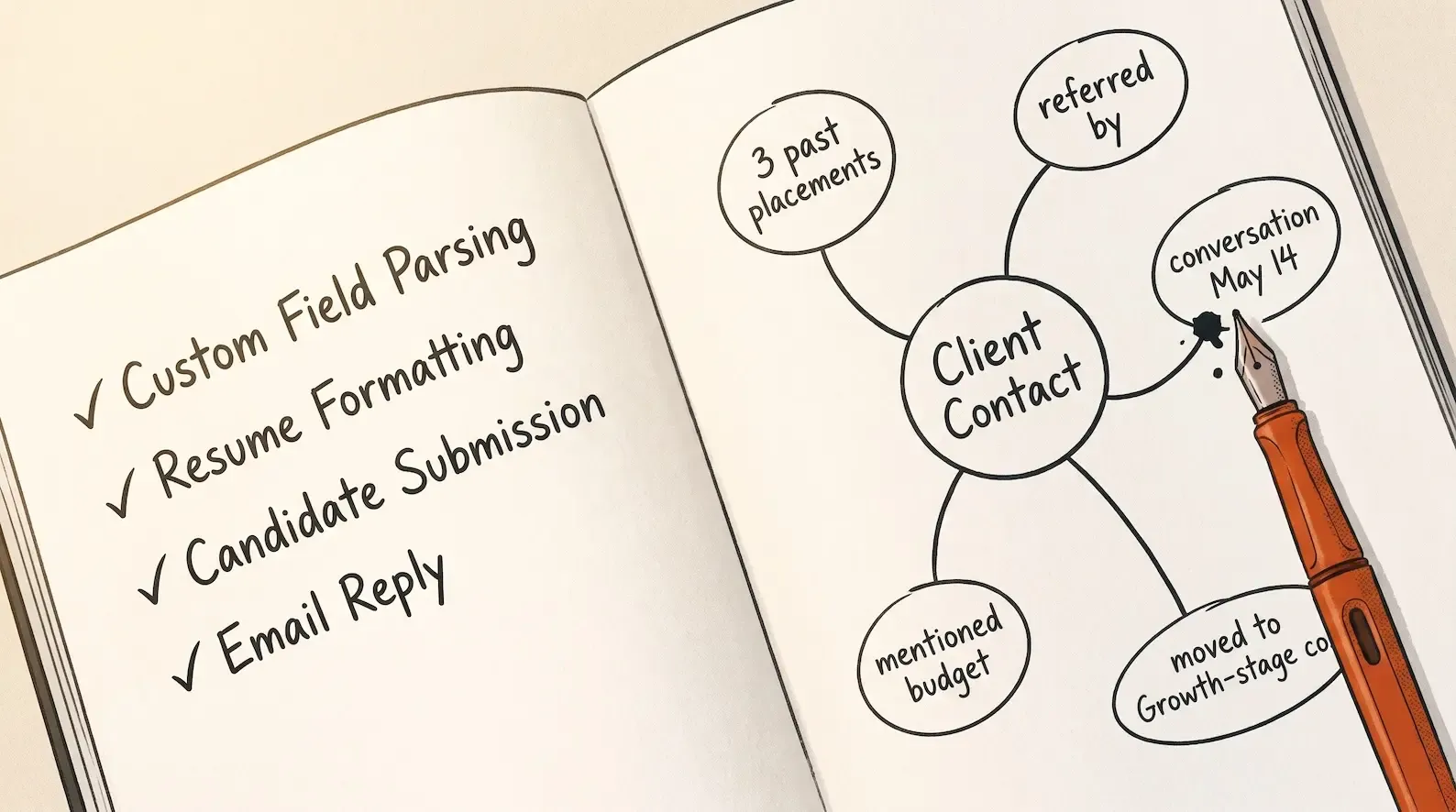
The AI investment is documented and material. Recruit CRM’s public AI-agent pages name the Custom Field Parsing Agent (which fills selected custom fields from resumes), the Candidate Submission Agent (which formats selected candidates into branded submissions and adds key insights), the Resume/CV Formatting Agent, and an Email Reply Agent Source: Recruit CRM AI Agents, accessed August 2026. These are genuine workflow agents — document, parsing, and submission work automated at the CRM record level. Alongside the agents, Recruit CRM offers GPT integration and plan-limited candidate matching: Free plan up to two candidate matches; Business and Enterprise up to 50 Source: Recruit CRM GPT Integration, January 2025.
The most architecturally interesting Recruit CRM investment is the Model Context Protocol (MCP) server at agent.recruitcrm.io/mcp. This lets external AI applications — Claude, ChatGPT, and other MCP-compatible clients — connect to live Recruit CRM data and query, retrieve, and update records through natural language. Users authenticate the connector, then their AI application can access pipeline, candidate, and task data Source: Recruit CRM MCP, accessed August 2026. This is a legitimate architectural investment and worth acknowledging directly: it opens Recruit CRM’s data to external AI reasoning without a custom integration project.
The interface is available in seven languages: English, French, Dutch, Spanish, German, Japanese, and Portuguese Source: Recruit CRM Help Center, September 2024. Public pricing starts at $100/user/month (Pro), $150/user/month (Business), and $165/user/month (Enterprise) as hosted on Capterra’s Recruit CRM listing Source: Capterra, accessed August 2026.
Signals — what’s architecturally true
Signals is an AI-native recruitment CRM built for agencies operating primarily on relationship management, BD intelligence, and cross-channel conversation capture. Where Recruit CRM’s AI investment is agents and integrations layered onto an ATS+CRM data model, Signals was designed from inception with AI as a core component of the architecture — data model, decision surfaces, and user experience.
The five pillar categories: Perfect Memory — conversation capture across six channel classes (WhatsApp, WeChat, email, phone, voice notes, LinkedIn signals) continuously attached to the person record without manual logging; Agentic CRM — the system runs the Three Autonomous Actions without being asked: ranked BD prompts, contact-context surfacing, signal-fire routing; BD Signals — hiring intent capture from external signals routed to the desk with highest historical conversion; Speed to Shortlist — ranking architecture built for contract and retained cadences; Client Rooms — mandate-scoped workspaces with four collaboration surfaces.
IBM’s authoritative definition of AI-native is a system where AI is “a core component, not bolted on later as a feature” — one that “shapes architecture, decision-making, UX, and the entire system lifecycle from the outset” Source: IBM, February 2026. By that definition, Signals qualifies architecturally. Recruit CRM’s AI investment is real, but its architecture is different: agents that act on a workflow record model, and an MCP server that lets external AI query that record model. Both are legitimate. They are not the same architecture.
Where the two architectures actually diverge
The Removal Test — Taskade’s diagnostic that asks what remains when AI features are stripped from a product Source: Taskade, March 2026 — still applies here, but the reading is different from the Bullhorn or JobAdder comparisons.
Apply the test to Recruit CRM. Remove the AI agents (Custom Field Parsing, Candidate Submission, Resume/CV Formatting, Email Reply). Disable the MCP server. Remove the GPT integration and candidate matching. What remains is a functional integrated ATS+CRM that manages candidates, clients, jobs, submissions, placements, sourcing, email, automation, and reporting. That’s not a criticism — it’s a legitimate mature platform that operated before its AI layer, and it will operate without it. The AI investment is meaningful, and it sits above a well-formed workflow architecture.
Apply the test to Signals. Remove Perfect Memory’s conversation capture, Agentic CRM’s autonomous actions, BD Signals’ signal ranking, Speed to Shortlist’s ranking layer, Client Rooms’ collaboration surfaces. What remains is not a functional recruitment CRM. It is a contact database that couldn’t do the work an agency uses Signals for. That’s what “AI-native” architecturally means — the AI isn’t a set of agents; it’s the operating substrate.
The functional distinction that matters day-to-day: Recruit CRM’s AI acts on records that already exist in the platform (a candidate record, a submission, a job posting, an email in the system). Signals’ AI acts on continuously captured conversation events — every WhatsApp thread, every phone transcript, every LinkedIn signal — that flow into the person record as they happen. Recruit CRM’s Custom Field Parsing Agent reads a resume that was uploaded. Signals’ Perfect Memory captures a WhatsApp voice note that never touched an upload flow. Different capture surfaces, different downstream AI capabilities.
The Recruitment CRM Buyer’s Guide 2026 frames the general architectural evaluation across five dimensions (data model, decision surfaces, conversation capture, autonomous actions, future-proofing). Applied to Recruit CRM specifically, dimensions 1-4 (data model, decision surfaces, conversation capture, autonomous actions) all resolve to “workflow-record architecture with AI agents on top.” Applied to Signals, they resolve to “AI-native architecture with continuous multi-channel capture at source.”
The MCP question — what external AI access changes and what it doesn’t
The Model Context Protocol integration deserves specific attention because it is Recruit CRM’s most architecturally interesting investment and because it will be the feature buyers ask about most. What MCP does: it opens Recruit CRM’s data to external AI applications through a standardised protocol, so a recruiter can ask Claude or ChatGPT questions about their pipeline, candidates, or tasks and get answers grounded in live CRM data Source: Recruit CRM MCP, accessed August 2026. This is a real advance over export-based or manual-copy workflows.
What MCP doesn’t change: the underlying record model the external AI queries. If the CRM contains records the recruiter or an agent has entered, the external AI can query rich data. If most of the actual relationship — the WhatsApp threads with the candidate over eighteen months, the voice notes with the client during the mandate, the LinkedIn message where the CFO mentioned they’d consider moving — never reached the CRM in the first place, MCP-mediated queries return answers grounded in the same partial record the CRM already held. The Data Decay in a Recruitment CRM analysis is relevant here — MCP is a powerful retrieval layer, but retrieval quality depends on capture completeness.
The Signals architecture makes a different bet: instead of exposing an existing record model to external AI more efficiently, capture the full relationship at source into the record model, then reason over it natively. Both bets are legitimate. They serve different operating models — Recruit CRM’s is the mature ATS+CRM buyer who wants their existing workflows to gain external AI reasoning; Signals’ is the relationship-driven agency where the point of the CRM is that it captures conversations no manual-entry system would have caught.
What each is built for — who Recruit CRM fits, who Signals fits
Recruit CRM is optimised for recruitment agencies wanting a mature, feature-rich integrated ATS+CRM with named AI agents for parsing, formatting, and submission work — and increasingly, external AI access to their pipeline through MCP. The 2,500+ self-reported agency count and G2/Capterra ratings (4.8 and 4.9) reflect genuine platform satisfaction. The value proposition is workflow maturity plus modern AI investment plus a demonstrated commitment to opening the platform to broader AI reasoning through MCP. The prior decision — whether the ATS and the CRM should be one system at all — is worked through in ATS and CRM in One; Recruit CRM answers it the same way Signals does, and diverges only on what the unified record is built to hold.
Signals is optimised for recruitment agencies where BD intelligence, conversation capture across channels, and autonomous CRM actions are the primary work — not the ATS workflow. The buyer is an agency owner or partner whose day runs on conversations (WhatsApp threads with senior candidates, phone calls with hiring managers, WeChat for China-facing work, LinkedIn signals, voice notes for quick updates) rather than on an ATS pipeline. Signals is APAC-founded and launches globally in August 2026 across APAC, North America, and EMEA — with WhatsApp-first workflows as a first-class citizen for markets where messaging dominates senior candidate communication.
Neither product is “better.” They are built for different operating models. A firm running a high-volume workflow with a mature middle-office and a need for external AI querying of pipeline data may find Recruit CRM’s platform breadth, published pricing, and MCP capabilities the right fit. An agency running executive search, retained search, or a relationship-driven BD desk where cross-channel intelligence and autonomous CRM actions drive placement outcomes needs the architecture of a system where those capabilities are the substrate, not agents layered on top. The same architectural question at enterprise scale, where the platform is the category standard rather than a challenger, is Signals vs Bullhorn.
The comparison, condensed — and how to choose
| Dimension | Recruit CRM | Signals |
|---|---|---|
| Positioning | ”AI-first recruitment software” | AI-native from the data model up |
| Architecture | Integrated ATS+CRM with named AI agents on top | AI-native — AI and data model are one system |
| Scale | Self-reported 2,500+ agencies | Pre-launch |
| AI agents | Custom Field Parsing, Candidate Submission, Resume/CV Formatting, Email Reply | Perfect Memory · Agentic CRM · BD Signals · Speed to Shortlist · Client Rooms — as pillars, not agents |
| Where AI operates | On workflow records (candidates, submissions, jobs, emails) | On continuously captured relationship graph across six channel classes |
| External AI access | MCP server (agent.recruitcrm.io/mcp) — Claude, ChatGPT, other MCP-compatible clients | Not a current focus |
| Removal Test | Passes as functional ATS+CRM without AI agents or MCP | No functional product without AI |
| Interface languages | 7 (EN, FR, NL, ES, DE, JA, PT) | English at launch |
| G2 / Capterra | G2 4.8 (n=115) / Capterra 4.9 (n=474) | Pre-launch |
| Pricing model | Published: Pro $100, Business $150, Enterprise $165 per user/month | Waitlist (launching August 2026) |
How to choose. The question isn’t which platform has more AI features. Both have real AI. The question is what the AI operates on — workflow records (Recruit CRM) or continuous relationship-context capture (Signals). Buyers who ask “can our existing CRM data be queried by external AI more powerfully?” usually end up on the Recruit CRM side. Buyers who ask “can the AI reason over the full history of every relationship across every channel, whether or not anyone typed it into the CRM?” end up on the Signals side. Both are legitimate answers to different operating questions.
See what continuously-captured relationship context actually delivers
Join the recruitment agencies already on the Signals waitlist.
Common questions
The difference between Signals and Recruit CRM is architectural, not featural. Both are integrated ATS+CRM platforms with genuine AI investment. Recruit CRM positions as 'AI-first recruitment software' and has named AI agents (Custom Field Parsing Agent, Candidate Submission Agent, Resume/CV Formatting Agent, Email Reply Agent) plus a Model Context Protocol server that lets external AI applications like Claude and ChatGPT connect to live Recruit CRM data. Signals is AI-native, built from inception so AI and the data model are one system, with five pillar categories (Perfect Memory, Agentic CRM, BD Signals, Speed to Shortlist, Client Rooms) as the underlying architecture rather than agent capabilities layered on top. The Removal Test makes the distinction concrete: remove AI from Recruit CRM and you have a functional ATS+CRM with agents disabled and MCP off; remove AI from Signals and there is no product.
Recruit CRM markets itself as 'AI-first recruitment software' and has invested genuinely in AI capabilities: named workflow agents, GPT integration, and a Model Context Protocol (MCP) server that opens live CRM data to external AI models. Whether it meets a strict architectural definition of 'AI-native' depends on the definition used. IBM defines AI-native as software where AI is 'a core component, not bolted on later as a feature.' Recruit CRM's AI capabilities operate as agents and integrations acting on the platform's existing candidate, client, submission, and pipeline records. Signals' architecture is different: AI is not a set of agents on top of the data model; the data model itself was designed for continuous multi-channel capture and the AI operates on the relationship graph that produces. Both are legitimate architectural choices, and the distinction matters for what the AI can and cannot do in daily work.
Recruit CRM is built for recruitment agencies wanting an integrated ATS+CRM with strong workflow automation and named AI agents for parsing, formatting, and submission work. Self-reported customer scale is 2,500+ agencies. G2 rating is 4.8/5 across 115 reviews and Capterra is 4.9/5 across 474 reviews. The platform is available in seven interface languages (English, French, Dutch, Spanish, German, Japanese, Portuguese) and has published pricing starting at $100/user/month (Pro), $150/user/month (Business), $165/user/month (Enterprise). The value proposition is mature workflow automation with genuine AI investment layered on top.
Signals is built for recruitment agencies where BD intelligence, cross-channel conversation capture, and autonomous CRM actions are the primary work. The buyer is an agency owner or partner whose day runs on conversations (WhatsApp, phone, email, LinkedIn, WeChat) and relationship management rather than on an ATS pipeline. Signals is AI-native, designed so the system of record and the system of engagement are the same architecture. Regional focus at launch spans APAC (Hong Kong, Singapore, Australia), North America (US, Canada), and EMEA (UK, Europe), with WhatsApp-first workflows as a first-class citizen for markets where messaging dominates senior candidate communication.
Recruit CRM operates a Model Context Protocol (MCP) server at agent.recruitcrm.io/mcp that lets external AI applications like Claude and ChatGPT connect to live Recruit CRM data. This is a genuine architectural investment, because it opens the CRM to external AI reasoning without a custom integration project. It changes the comparison by ruling out any framing that suggests Recruit CRM lacks AI ambition; it does not resolve the deeper architectural question, which is whether the underlying record model was designed for continuous multi-channel conversation capture (Signals) or whether AI is querying and acting on records built in the ATS+CRM paradigm the platform was originally designed for (Recruit CRM). Both approaches are legitimate. The choice depends on which architecture matches the agency's operating cadence.