
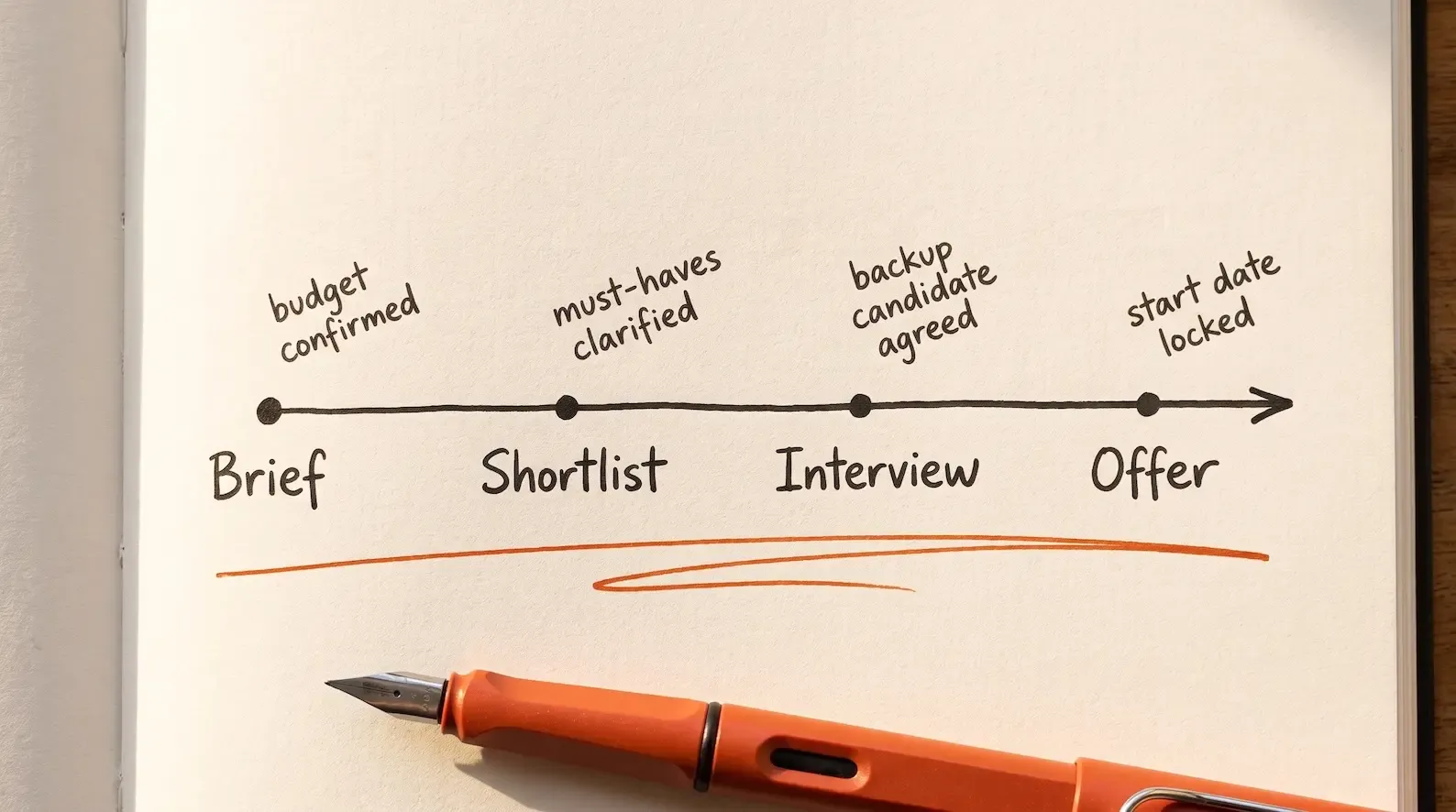
An accepted offer is not a completed placement. Every perm-desk recruiter knows this operationally — the counter-offer window sits between “yes” and “resigned,” and the guarantee period sits between “started” and fee-earned-finally-and-fully. Standard recruitment CRMs don’t. They model a perm placement as a pipeline with sequential stages — “offer sent” then “offer accepted” then “started” — and treat each transition as forward progress. The reality is that each transition opens a new risk window with different owners, different information requirements, and different failure modes. This piece introduces the perm desk recruitment CRM framework Signals uses internally: The Four Structural Moments of a Perm Desk — brief lock, offer negotiation, counter-offer window, guarantee period. Each moment specifies what the CRM must hold, who must act, and what failure the moment prevents. The framework is Signals-coined; no equivalent industry framework was found in the SERP research pass. The market data (CIPD, Robert Half, KPMG/REC, ZipRecruiter) explains why the counter-offer window and guarantee period need first-class operating states rather than being collapsed into pipeline labels.
Why perm-desk architecture is not contract or retained architecture
Recruitment cadence isn’t uniform. Different desk models run on structurally different operating architectures. Contract desks run on the 72-hour speed-to-shortlist cadence covered in the Speed to Shortlist for Contract Recruitment piece — Day 0 brief intake, Day 1 morning ranked longlist, Day 1 afternoon conversation pass, Day 2 morning delivery. Retained executive search runs on the 7-day cadence covered in the Speed to Shortlist Playbook — Day 1 brief lock, Days 2-3 longlist, Day 4 conversation pass, Day 5 triangulation, Day 6 shortlist construction, Day 7 client delivery.
Perm-desk cadence is different from both. The delivery cycle is longer than contract but shorter than retained. The commercial model is contingent (typically success-fee) but with lower fee percentage than retained. The risk profile spans further: it doesn’t end at shortlist delivery or even at offer acceptance. It extends through resignation, start, and guarantee expiry. What the perm desk needs from the CRM isn’t a faster or slower version of the contract or retained cadence — it’s a different operating architecture that recognises the moments a perm placement actually passes through.
KPMG and REC’s monthly UK Report on Jobs found that UK permanent placements had fallen for 39 consecutive months by December 2025, with the Permanent Placements Index at 44.3 (50 indicates no month-on-month change) Source: KPMG/REC/S&P Global, January 2026. In July 2025, UK permanent placements declined at the fastest pace in 22 months Source: KPMG/REC, July 2025. In a constrained perm market, losing a late-stage placement to counter-offer acceptance or guarantee-period failure carries greater desk-level significance than in a high-volume year. Perm-desk architecture that surfaces those risks early is not a nice-to-have.
The Four Structural Moments of a Perm Desk — at a glance
The Four Structural Moments are the operating states a permanent placement passes through, each requiring different CRM behaviour. Each moment has a defined trigger, a defined risk it manages, and a defined transition to the next moment.
| Moment | Trigger | Primary risk | Transition to next |
|---|---|---|---|
| 1. Brief lock | Signed client mandate | Missing compensation range, non-negotiables, or guarantee terms in the record | Ranked candidates enter the process |
| 2. Offer negotiation | Client agrees a shortlist candidate is the hire | Offer terms not versioned; stakeholder approvals ambiguous; candidate motivators un-tracked | Candidate says yes |
| 3. Counter-offer window | Candidate accepts the offer verbally or in writing | Counter-offer from current employer reverses the decision before physical resignation | Candidate has physically resigned |
| 4. Guarantee period | Candidate starts | Placement fails in the guarantee period, triggering replacement or refund | Guarantee expires; fee fully earned |
The moments share the same operating logic but different time boxes and different stakeholders. What’s the same: each moment must be captured in the CRM as a first-class state, not a pipeline label. What’s different: each moment’s information requirements are distinct, so treating them as one stage collapses the operational visibility the recruiter needs.
Moments 1 and 2 — Brief lock and Offer negotiation
Moment 1: Brief lock. The brief lock is not a note in a job record. It’s a structured capture of the mandate that the entire downstream process depends on. What the CRM must hold: compensation range (target and ceiling), non-negotiables (must-haves, deal-breakers), hiring-manager priorities (what the client will actually optimise for versus what the JD says), candidate ownership rules (off-limits accounts, PSL exclusivity terms), process timeline, fee terms, and guarantee terms. If any of these are missing at brief lock, the failure surfaces at offer negotiation or worse.
The ranked shortlist that follows brief lock is only as accurate as the mandate the ranking runs against. A brief-lock record that captures “senior finance role in Singapore” produces a different shortlist than one that captures “senior finance role in Singapore, must be Chinese-speaking, S$300-350k base, no candidates from three named competitors, hiring manager priorities candidate quality of thought over years of experience.” The CRM must hold the second, not the first.
Moment 2: Offer negotiation. Offer negotiation is where the recruiter earns the placement fee that Moment 1 made possible. What the CRM must hold: versioned offer terms (v1 with base X, bonus Y, signing bonus Z; v2 with adjusted base; v3 with additional relocation package), stakeholder approvals (which hiring-manager, HR, and executive-committee sign-offs are needed at each version), candidate motivators (what the candidate said mattered most in the qualification calls), competing processes (which other offers the candidate is considering, at what stage), and agreed next actions with dated commitments.
Versioning matters. A perm placement that goes through three offer iterations before acceptance is a normal placement, not a difficult one. But if the CRM only holds “offer sent — offer accepted” as pipeline states, the negotiation history is lost, the terms that were rejected are lost, and the recruiter’s ability to defend the fee to the client if the candidate later negotiates upward post-start is lost. The negotiation history is the audit trail of the placement’s actual value.
Moment 3 — Counter-offer window
Moment 3 is where the market data most sharply supports the framework’s core claim: an accepted offer is provisional until the candidate has physically resigned.
CIPD’s 2023 UK Labour Market Outlook found that 40% of UK employers had made a counter-offer in the preceding 12 months, with prevalence highest in London at 58% Source: CIPD, August 2023. Among employers that made counter-offers, 51% said they had increased their use over the prior year. Robert Half’s UK survey — conducted by Opinium Research with n=2,000 UK employees — found that 31% of surveyed jobseekers said they would consider a counter-offer, 53% of people who had received one accepted it, and 34% of those who accepted the counter-offer had moved on within six months anyway Source: Robert Half / Opinium Research, November 2023. The Robert Half data is from a December 2021 field, so treat the exact percentages as directional rather than current, but the pattern is consistent with more recent US data: ZipRecruiter Economic Research found that 26% of new hires in Q1 2025 received a counter-offer from their former employer Source: ZipRecruiter Economic Research, 2025.
Across three independent sources and two continents, counter-offers are a material post-offer risk, and the counter-offer window between acceptance and resignation is the specific operational window where the risk is live. What the CRM must hold during this window: the accepted-offer terms as a snapshot; the resignation plan (date candidate intends to resign, notice period, manager they’re resigning to); the counter-offer response protocol (agency scripts, hiring manager talking points, executive escalation triggers); a structured check-in cadence (daily or every-other-day touch during the resignation week); and any signals of retention-attempt activity (candidate goes quiet, hiring manager suddenly proposes an urgent conversation, candidate mentions a “conversation with current boss”).
Standard recruitment CRMs move the pipeline stage to “offer accepted” at Moment 3 entry and then reduce attention on the record. The CRM’s information architecture treats acceptance as forward progress. The reality is that Moment 3 requires more intensive record-keeping than any other moment — the risk is actively open, the outcome is not yet determined, and the recruiter’s ability to intervene depends on structured visibility into what’s happening candidate-side. The Client Rooms mandate-scoped workspace is where the client-agency side of this coordination happens; the candidate side needs equivalent structure.
Moment 4 — Guarantee period
The guarantee period is the second delivery commitment. Most agency contracts include a replacement guarantee — Recruit CRM’s published example staffing-agency agreement uses a 90-day replacement guarantee, in which a candidate who resigns or is terminated within 90 days triggers one replacement search at no extra charge Source: Recruit CRM, April 2026. Actual guarantee terms vary meaningfully by agency, region, and mandate type — treat 90 days as an illustrative common term rather than a universal norm.
What the CRM must hold from candidate start through guarantee expiry: start date and guarantee-expiry date visible on the placement record; structured client and candidate health-check touchpoints scheduled through the period (typically week 2, week 4, week 8, week 12 for a 90-day guarantee); early-warning signal capture — any indication of candidate dissatisfaction, client dissatisfaction, or role mismatch surfaced through the CRM’s conversation capture layer; explicit replacement or remedy commitment tracked as a contract term visible on the record, not buried in a filed PDF; and placement release at guarantee expiry, at which point the fee is fully earned and the delivery obligation closes.
The failure mode this moment prevents: a placement fails silently in week 6 because no one from the agency spoke to either candidate or client between week 4 and the “we’re letting him go” call in week 10. In a legacy CRM where the record went dormant at “started” status, the recruiter finds out too late to intervene, to coach the candidate, or to prepare the client for a graceful transition. The guarantee-period claim triggers, the replacement search runs at no fee, and the agency’s per-mandate profitability collapses. This is not an edge case in perm agencies with any volume — it’s a structural risk the CRM either helps manage or leaves to the recruiter’s memory.
Bullhorn defines job fill rate as the proportion of job orders placed within 90 days of being opened Source: Bullhorn Hiring Outlook, August 2026. Job fill rate is a useful cadence metric, but it measures the front end of the perm process — placement made. It does not measure whether the placement held through the guarantee period. A perm desk optimising for job fill rate without measuring guarantee-period claim rate is optimising for the wrong end of the cycle.
What each moment requires from the CRM architecturally
The Four Structural Moments framework produces specific architectural requirements for the CRM. Each moment’s failure mode maps to a specific CRM capability the system must have — not as a feature, but as a first-class operating state.
| Moment | CRM must hold | Failure if the CRM doesn’t |
|---|---|---|
| 1. Brief lock | Mandate terms, compensation range, non-negotiables, priorities, ownership rules, guarantee terms | Wrong candidates ranked; failure surfaces at offer stage |
| 2. Offer negotiation | Versioned offer terms; stakeholder approvals; candidate motivators; competing processes | Negotiation history lost; fee defensibility weakened; upward re-negotiation post-start uncountered |
| 3. Counter-offer window | Resignation plan; counter-offer response protocol; structured check-in cadence; retention-attempt signal capture | Recruiter loses intervention window; placement reversed before resignation |
| 4. Guarantee period | Start date; guarantee-expiry date; scheduled health checks; early-warning signal capture; replacement commitment tracking | Placement fails silently; guarantee claim triggers; per-mandate profitability collapses |
The Perfect Memory conversation capture layer is what makes Moments 3 and 4 architecturally feasible. Counter-offer signals typically arrive through WhatsApp voice notes (“just had a difficult conversation with my boss”), tone shifts in phone calls with the recruiter, or LinkedIn activity patterns (candidate suddenly re-appearing on LinkedIn after a period of quiet). Guarantee-period early-warning signals arrive the same way — a candidate WhatsApp mentioning “the role is different from what I expected” three weeks in, a client email complaining about ramp speed, a Slack DM between hiring manager and recruiter. If those channels are captured continuously at source, the CRM has the signal-fire routing to act. If they’re not, the CRM finds out at post-mortem.
Why a perm-desk-fit stack matters more in a constrained market
In a market where UK permanent placements have contracted for 39 consecutive months (per KPMG/REC through December 2025), every late-stage placement carries greater weight. Losing a placement to counter-offer acceptance in Moment 3 or to guarantee-period failure in Moment 4 doesn’t just cost that specific fee — it costs the mandate that the agency won on the strength of prior placements to the same client. A CRM architecture that treats “offer accepted” as forward progress and “started” as delivery complete underweights the risk profile of the two moments that most directly determine agency reputation with the client.
The Four Structural Moments of a Perm Desk is not a new capability to add to a legacy CRM. It’s an architectural frame that specifies what the CRM must hold at each moment and what it must surface without being asked. A CRM built with continuous conversation capture at source, mandate-scoped workspaces for the offer-negotiation stage, and autonomous signal routing for counter-offer and guarantee-period risk is a CRM that treats a perm placement as an operating state that runs from brief lock to guarantee expiry — not as a pipeline stage that ends when the candidate says yes.
An accepted offer is not a completed placement. Three more structural moments follow. A perm-desk CRM either recognises that architecturally, or it doesn’t. There isn’t a middle position.
Run perm-desk cadence as the default
Join the recruitment agencies already on the Signals waitlist.
Common questions
A permanent placement recruitment agency should handle offer, counter-offer, and guarantee periods through four structurally distinct moments: brief lock, offer negotiation, counter-offer window, and guarantee period. Each moment has different information requirements, different stakeholders, and different failure modes. Standard recruitment CRMs collapse them into pipeline stages ('offer sent' → 'accepted' → 'started') that don't capture the transitions between them. The CRM must hold the mandate at brief lock, preserve versioned offer terms and stakeholder approvals during negotiation, treat acceptance as provisional through the counter-offer window until the candidate has physically resigned, and maintain a post-start delivery record with client and candidate health checks through the guarantee period.
The Four Structural Moments of a Perm Desk are the operating states a permanent placement passes through, each requiring different CRM behaviour. Moment 1, brief lock: the mandate, compensation range, non-negotiables, hiring-manager priorities, and guarantee terms are captured. Moment 2, offer negotiation: versioned offer terms, stakeholder approvals, candidate motivators, and competing processes are tracked. Moment 3, counter-offer window: acceptance is treated as provisional until resignation, counter-offer response is captured explicitly, and pre-start risk is monitored actively. Moment 4, guarantee period: a post-start delivery record with early-warning signals, health checks, and replacement/remedy obligations runs through guarantee expiry.
A counter-offer window is a distinct moment because 'offer accepted' is not the end of placement risk. It's the start of a new risk window with different owners and different information requirements. CIPD's 2023 UK Labour Market Outlook found that 40% of UK employers had made a counter-offer in the previous 12 months, rising to 58% in London. Robert Half's UK survey found that 53% of respondents who received a counter-offer accepted it. Treating acceptance as a pipeline stage ('offer accepted') moves the CRM's attention forward when it should intensify on the actively-open risk of the candidate reversing the decision. The counter-offer window ends when the candidate has physically resigned, not when they've said yes to the offer.
During the guarantee period, the CRM needs to maintain a post-start delivery record that runs from start date through guarantee expiry. This includes: (1) start date and guarantee-expiry date visible on the placement record; (2) structured client and candidate health-check touchpoints scheduled through the period; (3) early-warning signal capture, meaning any indication of candidate dissatisfaction, client dissatisfaction, or role mismatch surfaced through the CRM's conversation capture layer; (4) explicit replacement or remedy commitment tracked as a contract term, not a footnote; (5) placement release at guarantee expiry, at which point the fee is fully earned and the delivery obligation closes. Standard recruitment CRMs mark placements as 'started' and the record effectively goes dormant, so the guarantee period runs on the recruiter's memory, not the system's.
Perm-desk cadence and contract-desk cadence are structurally different operating models. Contract desks run on speed to shortlist: 48-72 hour windows from brief to first candidates in front of the client, high volume, short cycles. Perm desks run on structural moments (brief lock, offer negotiation, counter-offer window, guarantee period) spread across weeks or months per placement, with the risk profile changing at each transition. The Speed to Shortlist Playbook covers the 7-day retained cadence and the 72-hour contract cadence; the Perm Desk Playbook covers the moments that follow a locked brief through to guarantee expiry. They aren't the same cadence at different speeds. They're different operating architectures that a single generic pipeline can't serve well.