
Multi-office is where recruitment CRM design gets serious. A single-office agency can run on almost any CRM, or on almost none at all, because the operating context is entirely inside the room. The moment an agency operates across two offices, three offices, or an M&A-produced set of brands and legal entities, the CRM stops being a productivity tool and starts being the operating substrate. Every design decision in the multi-office CRM propagates: how a candidate is deduplicated across offices, how a client with multiple sites is represented, how a consultant in London sees (or does not see) an active brief in Sydney, how a merged group produces one weekly forecast rather than five, how a cross-office referral becomes a placement rather than an email that sits in someone’s inbox. This article introduces the Signals-coined framework, the Four Consolidation Failures, walks through how the current recruitment CRM market actually handles multi-office setups (using each vendor’s own documentation), covers the cross-border privacy layer that quietly shapes the decision, and closes with the structural requirements a real multi-office recruitment CRM has to hold in 2026.
The state of multi-office recruitment in 2026
There is a genuine primary-source gap on multi-office recruitment prevalence. No industry body publishes a share-of-agencies figure for multi-office operation. Bullhorn’s GRID 2026 Industry Trends Report, based on a survey of about 2,300 recruitment professionals conducted in November and December 2025, does not report office or branch counts Source: Bullhorn GRID 2026, March 2026. The REC UK Recruitment Industry Status Report 2024 to 2025, published in December 2025, states no office data. Neither ACSESS Canada nor ASA US publish multi-office statistics. SIA’s M&A research is paywalled and could not be verified in this pass.
The best-available primary anchor is derived, not headline-reported. Computed from the ONS ‘UK business: activity, size and location 2025’ workbook, published September 2025 using the March 2025 IDBR snapshot Source: ONS UK business, September 2025, recruitment-sector enterprises (SIC 78) operate an average of 1.23 physical sites per enterprise, rising to 1.56 for temporary and contract staffing (SIC 7820) specifically. Across the whole UK VAT and PAYE business population, 58,175 of 2,734,615 businesses operated from more than one site as of March 2025. This ratio is a calculation from official tables rather than a pre-published ONS headline figure, but it is the strongest sourced anchor available for ‘multi-office is a normal, sizeable pattern’ in this research pass.
Company-disclosed footprints fill in the shape at the top of the market. Hays reports 207 offices in 31 countries. Robert Walters reports 29 countries with about 2,900 employees, consolidated under a single brand in 2024. Staffmark Group reports 400 locations across 38 US states after its April 2025 brand-unification announcement.
The current M&A picture is active. Q1 2026 recorded 35 announced staffing and workforce transactions, the strongest opening quarter since Q4 2022, with IT staffing and executive search each contributing 8 deals [Source: StaffingHub Q1 2026 M&A roundup, April 2026]. Q2 2026 recorded 26 North American transactions [Source: Momentum Advisory Partners, July 2026]. Notably, large groups moved in both directions on footprint in 2025 to 2026: ManpowerGroup divested Jefferson Wells, Adecco divested Entegee, Hays exited six European countries, and Robert Walters closed its Brazil office, while Atlantic International and Circle8 Group merged to form a $1.2 billion revenue platform. The dominant pattern among larger, listed, and PE-backed groups is not organic office proliferation. It is footprint rationalisation, brand consolidation, and integration of acquired entities onto a single system.
The Four Consolidation Failures framework
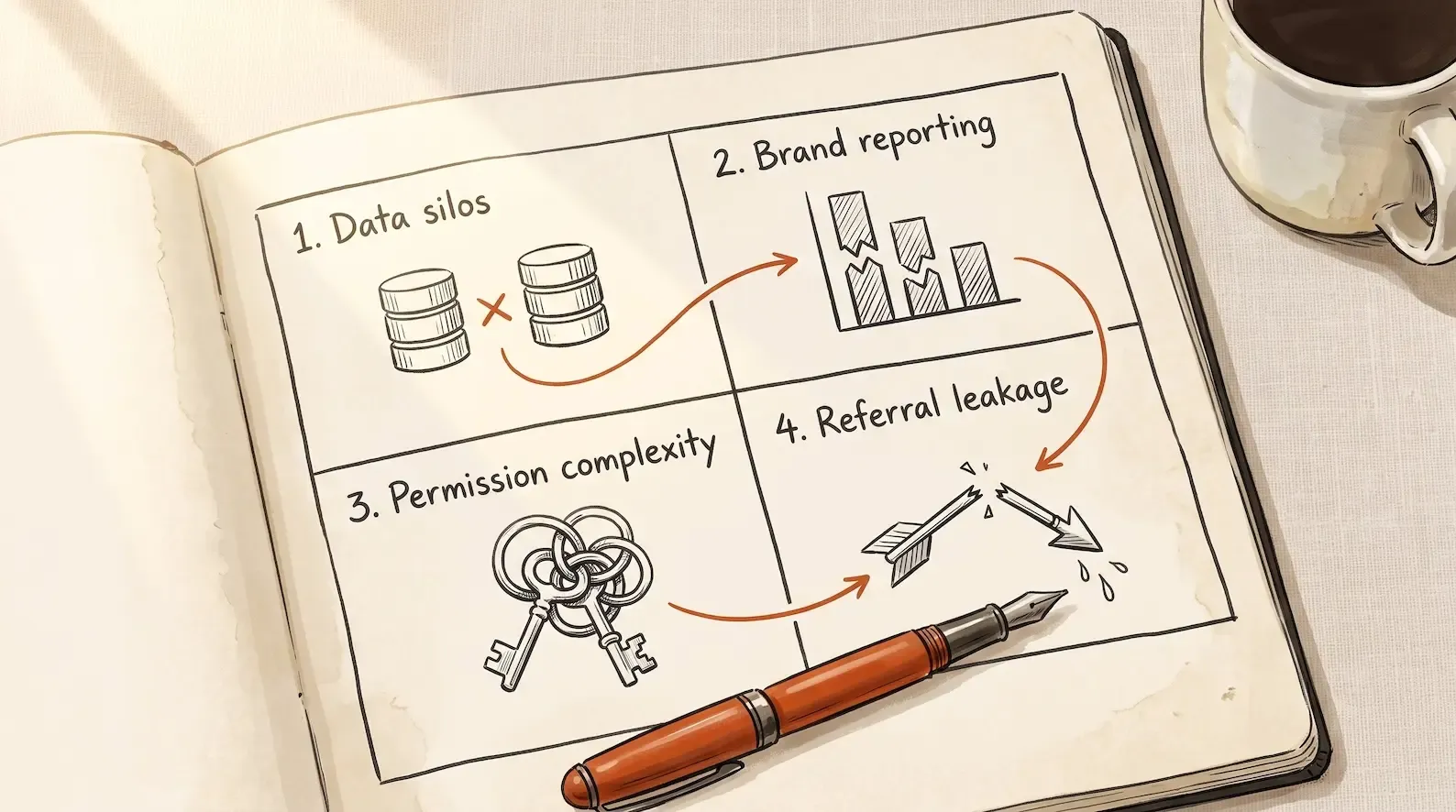
Multi-office recruitment CRM implementations tend to fail along four repeating axes. Signals calls these the Four Consolidation Failures. No industry body publishes a prevalence figure for any of them, which is worth stating plainly: this framework is built on vendor documentation, implementation-partner analysis, and named user complaints, not on a controlled survey. Each failure is real, well-documented mechanistically, and unquantified in aggregate.
1. Data silos between offices. The same candidate is recorded differently across offices. Pipeline stages mean different things to different teams. Location-specific workarounds calcify into local practices. Bullhorn’s own writing on large-firm CRM consolidation names the pattern plainly: ‘records accumulated across dozens of offices over decades’, ‘multiple legacy systems that don’t talk to each other’, ‘inconsistent data entry standards that vary by region and by team’, requiring ‘a program that takes many months of planning’ to fix Source: Bullhorn blog, August 2026. This is the underlying architecture failure. Everything downstream (search quality, matching, BD signal detection, reporting) inherits its ceiling from it. Our recruitment CRM data decay piece covers the mechanics of decay-by-neglect in detail.
2. Brand-level reporting failure. Multi-branch reporting is not usually a data-availability problem. It is a configuration problem. Each office produces its own numbers, headquarters becomes the manual integration layer, field definitions diverge across locations, and the same metric no longer means the same thing in two different branches. Bullhorn’s own documentation corroborates the mechanism: per-brand (‘private label’) reports must be configured separately per brand, and standard reporting depends on every user’s ‘Reports To’ field and primary department matching their manager’s, which is fragile when consultants move between offices.
3. Permission complexity. The permission model has to serve two opposing requirements at once. Some cross-office visibility is essential (a Sydney consultant needs to see that a London consultant is already working with a candidate before duplicating outreach). Some cross-office invisibility is essential (Ontario privacy law, or a client’s confidentiality clause, may prevent an office from viewing another office’s records). The failure mode is not that permissions do not exist. It is that vendors ship complex permission trees that require support tickets, professional-services engagements, or top-tier plans to configure, and the resulting configurations then break as the org chart changes.
4. Cross-office referral leakage. A candidate known to one office is invisible to another. A client relationship in one office does not surface as a warm introduction in another. A specialist in Melbourne cannot easily be surfaced for a mandate in Perth. No published data quantifies the commercial cost of this pattern; it is the weakest-evidenced of the four failure modes and should be understood as a logical argument rather than a measured statistic. The mechanism is nonetheless real, and consolidated brand groups explicitly cite ‘faster access to specialised talent’ and ‘broader collaboration across practice areas’ as consolidation rationale [Source: Odyssey Investment Partners, April 2025].
The four failures compound. A CRM that silos data (failure 1) produces reports that cannot roll up (failure 2), which drive permission workarounds (failure 3), which produce the exact invisibility that causes referral leakage (failure 4). Solving one without solving the others addresses a symptom, not the architecture.
How the current CRM market actually handles multi-office
Seven recruitment CRMs were reviewed for their own documented multi-office and multi-brand handling as of September 2026. Where a vendor treats multi-office as a paid add-on, top-tier plan, or professional-services engagement, that is stated explicitly.
| Vendor | Multi-office support (per own docs) | How it is gated |
|---|---|---|
| Bullhorn | Yes, extensively documented via Corporations (fully isolated), Private Labels (branding only, no data restriction), and Departments (the real office visibility mechanism) | Private-label data splitting requires Corporate edition and above. Only Bullhorn Support can create a Private Label. All department changes are made by Bullhorn Support Source: Bullhorn KB, Corporations & Private Labels; [Source: Bullhorn KB, Departments] |
| Vincere | Yes, via a four-level Brands, Branches, Divisions, Teams hierarchy with per-brand templated documents | Not gated on public pricing page (from £69 per user per month plus AI Smart Packs), but a Capterra UK reviewer reports being quoted extra for a second brand’s job board or offered a split tenancy instead Source: Vincere pricing |
| JobAdder | Yes, via sub-records per office or brand and User Groups | No pricing published; multi-office not named as gated [Source: JobAdder pricing, March 2026] |
| Recruit CRM | No dedicated agency-side multi-office model; only custom roles and teams | Custom roles and teams gated to Business and Enterprise plans only Source: Recruit CRM pricing |
| Loxo | No documented multi-office feature; achieved via professional-services customisation | Enterprise-tier engagement with ‘forward-deployed engineers and business transformation consulting’ Source: Loxo pricing |
| Recruiterflow | No agency-side multi-brand feature in own help centre; single global office list | No multi-brand or multi-office wording on the pricing page Source: Recruiterflow pricing |
| Manatal | Yes, via Organizations and User Groups explicitly for offices | Hardest documented gate: User Groups are ‘only available in the Enterprise Plus plan’ at roughly 3.7 times the Professional per-seat price Source: Manatal pricing |
The pattern worth naming is that only Manatal states an explicit, priced gate for multi-office functionality. The other six vendors leave pricing either entirely unpublished (JobAdder, Vincere, Bullhorn’s higher tiers), or behind a support ticket (Bullhorn Departments and Private Labels), a professional-services engagement (Loxo), or a functionally gated top plan (Recruit CRM’s Business and Enterprise tiers for the roles and teams needed to run multiple offices safely).
Two named user complaints deserve calling out. First, on Bullhorn: ‘managing employee access is a cumbersome process, often necessitating ticket creation to enable permissions that should be manageable directly from the Admin interface’ (r/RecruitmentAgencies, September 2024) and ‘some of the options and customizations can only be accessed, managed or implemented at the enterprise level’ (Brian G., Capterra, August 2017). Second, on Vincere: ‘When I first looked into Vincere I had 2 requirements: 1. Managing 2 brands in one tenancy. They offered to provide the solution for an extra cost or split the tenancy’ (Capterra UK, 2024). Neither is a one-off. Both point to the same underlying pattern: multi-office capability that looks straightforward in the marketing but arrives with an unpriced services engagement, a top-tier plan gate, or a support-ticket workflow to change basic settings. The Signals vs Bullhorn piece walks through the specific implications of the Bullhorn three-tier model for a multi-office agency in more detail.
The cross-border privacy layer nobody talks about
Multi-office recruitment CRM design has a privacy dimension that is often absent from vendor demos. It becomes binding as soon as offices sit in different privacy regimes. Five relevant jurisdictions behave as follows.
United Kingdom (UK GDPR). A restricted transfer arises when the UK GDPR applies, the transfer goes outside the UK, and the recipient is a separate legal entity. It applies to small and infrequent transfers, and to merely making data accessible, not only to sending it Source: ICO A brief guide to international transfers, January 2026.
Canada (PIPEDA). Cross-border transfer to another jurisdiction for processing is a use, not a new disclosure, and is not prohibited. It requires contractual or other means to provide a comparable level of protection Source: OPC Guidelines for processing personal data across borders.
Singapore (PDPA). The Transfer Limitation Obligation applies under Personal Data Protection Regulations 2021, Part 3. PDPC provides a method-selection flowchart, ASEAN Model Contractual Clauses, and sample clauses for APEC CBPR/PRP-certified recipients Source: PDPC Guide to Cross-Border Data Transfers, April 2026.
Hong Kong (PDPO). Section 33 prohibits transfer outside Hong Kong unless one of five conditions is met, including gazetted equivalent-law jurisdictions and ‘all reasonable precautions and due diligence’ Source: PCPD Section 33 fact sheet.
Australia (Privacy Act). APP 8.1 requires ‘reasonable steps’ and s 16C makes the disclosing entity accountable for the overseas recipient’s acts. Critically, an overseas office of the same legal entity is out of scope, but a related body corporate located overseas is in scope Source: OAIC APP Guidelines Chapter 8.
The commercially useful pattern in this comparison is that the trigger is legal-entity structure, not office location. A multi-country agency group that grew by acquisition (separate entities in each country) faces harder data-sharing compliance questions than an agency that opened organic branch offices under one entity, because in the acquired-group case every cross-country record view is arguably a cross-border transfer. Any claim that a jurisdiction ‘legally requires’ in-country hosting of recruitment records could not be verified from any regulator source checked in this research pass; each regime regulates transfer and disclosure, not hosting location. This distinction is often the first thing that surprises agencies whose CRM was chosen when they were single-country and now spans two or three.
What post-M&A CRM consolidation actually requires
There is no published benchmark for how long post-M&A recruitment CRM consolidation typically takes in any Bullhorn, SIA, or ACSESS source openly accessible in this research pass. Do not cite a specific duration figure as fact.
The anchors that do exist are specific rather than aggregate. Robert Walters’ group CRM ‘Zenith’ completed global rollout in 2025 with disclosed capex of £8.0 million in 2024 and £4.5 million in 2025, but no stated start date or duration [Source: Robert Walters FY2025 results, March 2026]. Trade-press sequencing guidance recommends planning consolidation before deal close, running a structured data audit in the first 30 days, migrating active job orders first, and layering AI or automation only after core ATS consolidation stabilises [Source: Staffing Brokerage, July 2026].
The failure modes are consistent across vendor and trade-press writing. Two parallel ATS platforms produce ‘two candidate pools, two sets of job order records, two reporting structures, and two versions of the truth’. Dirty inherited data (duplicates, stale records, formatting inconsistencies) means consolidation only improves fill rates and speed if data is clean, deduplicated, and accessible to the full recruiting team. Consent and cross-border transfer compliance gaps at migration are frequently the last thing addressed and the most expensive to fix. And at scale, Bullhorn’s own writing describes the pattern as records spread across dozens of offices over decades, on legacy systems that don’t talk to each other, with no single owner positioned to decide quickly [Source: Bullhorn blog, August 2026].
The commercial implication is that the CRM choice for an agency planning growth by acquisition, or an agency being built to be acquired, is different from the CRM choice for a stable single-brand operation. Both cases benefit from a CRM whose data model already anticipates consolidation, rather than one whose multi-office capability has to be added later as a services engagement.
AI on siloed versus consolidated data
The most consequential 2026 argument for solving the Four Consolidation Failures is that AI performance is bounded by data completeness. This is a logical link, not a controlled study. No controlled comparison of AI recruiting-search performance on siloed per-office data versus consolidated agency-wide data was located in this research pass. Nor did Aptitude Research or SIA publish a multi-office-specific AI framing.
Bullhorn’s own GRID 2026 report, based on about 2,300 respondents, states that 78 per cent of firms growing revenue by more than 25 per cent have AI embedded in their ATS, and full-lifecycle AI adopters have more than double the chances of fill rates above 75 per cent [Source: Bullhorn GRID 2026, March 2026]. GRID also states plainly that ‘data quality and security are challenges many firms have not quite been able to overcome’. Bullhorn’s separate August 2026 writing on large-firm CRM consolidation is more direct: ‘a candidate matching tool that works from incomplete records will surface incomplete results. If candidate records are incomplete, AI can’t surface the right people’.
The logical chain is straightforward. Data silos across offices produce incomplete records at the agency level. Incomplete records produce incomplete AI output. Incomplete AI output produces slower time to shortlist, missed candidates, and duplicated outreach. This is why the six channel classes a recruitment CRM needs to capture argument matters as much for multi-office consolidation as it does for single-office capture: it is the same architectural constraint applied across a wider organisational surface. And it is why manager-level visibility across offices is not a reporting nicety in 2026. It is the operational surface on which multi-office AI actually works.
What the multi-office recruitment CRM stack has to hold
Pulling the framework, the vendor picture, the privacy layer, and the AI argument together produces a specific set of multi-office recruitment CRM requirements for 2026.
- One consolidated agency-wide relationship record per candidate and per client, with office-level and brand-level context as attributes rather than as separate tenants. The Perfect Memory pillar is designed exactly for this: capture flows into one graph the agency owns, not into per-office silos that then require a services engagement to reconcile.
- Office-level, brand-level, and consultant-level visibility rules configurable without a support ticket. This is where most current vendors underperform their own marketing. Multi-office should be a configuration decision, not a professional-services engagement.
- Brand-level reporting that rolls up cleanly to agency-wide reporting, without HQ becoming a manual integration layer.
- Cross-office referral surfacing as an active BD signal. If a candidate known to Melbourne is being pitched a role in Perth, the CRM should surface that overlap as a hiring-intent signal, not leave it to informal messaging.
- Cross-border data-transfer awareness built into the record structure. When an office in Singapore views a record originating in Australia, the CRM should know which legal-entity boundary is being crossed and treat that view as an audit-visible action.
For a wider frame on how to evaluate any recruitment CRM against multi-office requirements without getting distracted by feature bingo, our recruitment CRM buyer’s guide for 2026 walks through the Five Dimensions of AI-Native Evaluation.
Multi-office is where the CRM choice stops being about which tool a consultant likes and starts being about which architecture the whole business runs on. The framework, the vendor gaps, and the cross-border dimension all point in the same direction. Multi-office recruitment CRM is not a scale problem to solve later. It is a data architecture problem that decides whether every office’s memory adds to, or subtracts from, the agency’s collective intelligence.
Run one CRM across every office without a services engagement
Signals is live for recruitment agencies globally. Book a demo to see the multi-office data model.
Common questions
A multi-office recruitment CRM is a CRM that operates across two or more offices, cities, brands, or legal entities as one consolidated system, while preserving office-level, brand-level, and permission boundaries where regulation or commercial structure requires them. In practice this means one consolidated agency record per candidate and per client with office and brand context as attributes rather than as separate tenants, office-level and consultant-level visibility rules that can be configured without a support ticket, brand-level reporting that rolls up cleanly to agency-wide reporting, cross-office referral surfacing as an active BD signal, and cross-border data-transfer awareness built into the record structure. Any recruitment CRM that treats multi-office as a paid add-on, an enterprise-tier gate, or a professional-services engagement is architecturally single-office with multi-office bolted on.
The Four Consolidation Failures is a framework coined by Signals to describe the four repeating patterns in which multi-office recruitment CRM implementations break: (1) data silos between offices, where the same candidate is recorded differently, pipeline stages mean different things to different teams, and location-specific workarounds calcify; (2) brand-level reporting failure, where each office produces its own numbers, HQ becomes a manual integration layer, and the same metric no longer means the same thing in two different branches; (3) permission complexity, where the permission model has to serve opposing requirements (cross-office visibility to prevent duplication, cross-office invisibility for privacy or client confidentiality) and vendors ship trees that require support tickets to configure; (4) cross-office referral leakage, where a candidate or client relationship known in one office is invisible to another. No industry body publishes prevalence figures for any of the four failure modes as of 2026. The framework is built on vendor documentation, implementation-partner analysis, and named user complaints, not on a controlled survey.
Per each vendor's own documentation as of September 2026: Bullhorn documents Corporations (fully isolated data), Private Labels (branding only, no data restriction), and Departments (the real office visibility mechanism), with all department changes and Private Label creation gated to Bullhorn Support tickets [Source: Bullhorn KB, Corporations & Private Labels](https://www.bullhorn.com/). Vincere ships a four-level Brands, Branches, Divisions, Teams hierarchy [Source: Vincere Help Centre](https://www.vincere.io/), though a Capterra UK reviewer reports being quoted extra for a second brand's job board. JobAdder documents sub-records per office or brand and User Groups. Recruit CRM has no dedicated multi-office model; only custom roles and teams, gated to Business and Enterprise plans. Loxo has no documented multi-office feature and achieves it via professional-services customisation. Recruiterflow has no agency-side multi-brand feature in its help centre. Manatal ships Organizations and User Groups explicitly for offices, gated to the Enterprise Plus plan at roughly 3.7 times the Professional per-seat price. Only Manatal states an explicit, priced gate for multi-office functionality.
The privacy trigger is legal-entity structure, not office location. Australia's Privacy Act (APP 8.1) is the clearest example: an overseas office of the same legal entity is out of scope of cross-border disclosure rules, but a related body corporate located overseas is in scope [Source: OAIC APP Guidelines Chapter 8](https://www.oaic.gov.au/). The UK's ICO defines a restricted transfer as occurring when UK GDPR applies, the transfer goes outside the UK, and the recipient is a separate legal entity [Source: ICO A brief guide to international transfers, January 2026](https://ico.org.uk/). Canada's PIPEDA treats cross-border transfer to another jurisdiction for processing as a use, not a new disclosure, and requires contractual or other means to provide a comparable level of protection. Singapore's PDPA imposes a Transfer Limitation Obligation. Hong Kong's PDPO Section 33 prohibits transfer outside Hong Kong unless one of five conditions is met. No jurisdiction among these five was found to legally require in-country hosting of recruitment records; each regulates transfer and disclosure, not physical hosting location.
There is no published benchmark for post-M&A recruitment CRM consolidation duration in any Bullhorn, SIA, or ACSESS source openly accessible as of September 2026. Do not cite a specific duration figure (for example 9 to 18 months) as fact; none exists. Available anchors are specific rather than aggregate. Robert Walters' group CRM 'Zenith' completed global rollout in 2025 with disclosed capex of £8.0 million in 2024 and £4.5 million in 2025, but no stated start date or duration [Source: Robert Walters FY2025 results, March 2026]. Bullhorn's own writing describes large multi-office CRM consolidation as records spread across dozens of offices over decades, on legacy systems that don't talk to each other, requiring 'a program that takes many months of planning' [Source: Bullhorn blog, August 2026](https://www.bullhorn.com/blog/). Trade-press sequencing guidance recommends planning consolidation before deal close, running a structured data audit in the first 30 days, migrating active job orders first, and layering AI or automation only after core ATS consolidation stabilises.