
A senior partner opens the CRM on Monday morning and looks at last week’s activity dashboard. It shows seven logged calls, four emails, two meetings. The partner knows the team made forty calls, sent two hundred emails, ran nine WhatsApp threads, and held two in-person dinners. The dashboard is wrong. The question that follows is the one this article answers: why doesn’t my recruiting CRM show results in executive search? The first instinct is to blame the tool. The second is to blame the team for not logging. Neither is quite right. The visibility gap sits upstream of both — in the conversation capture layer that legacy CRMs were never built to see.
What recruiters mean when they say “the CRM isn’t showing results”
The complaint sounds like one complaint. It is actually three.
The first is blind activity. The dashboard shows minimal activity — a handful of calls, a few emails, a sparse meeting log — while the team has been demonstrably busy. The senior consultants know what they did last week. They saw the WhatsApp threads, took the calls, ran the partner reviews. The CRM saw none of it.
The second is blind attribution. A retained mandate closed. The partner wants to know which sequence of conversations got it across the line — which BD touch surfaced the opportunity, which consultant ran the candidate pass, which client-side conversation locked the offer. The CRM cannot answer with confidence because the conversation trail is split across email, WhatsApp, and the consultant’s voice memos.
The third is blind pipeline. The forecast for the next quarter rests on the partner’s manual read of the open mandates — not on what the CRM says — because what the CRM says is fields that were last updated three weeks ago and don’t reflect Friday’s client meeting or yesterday’s WeChat exchange.
Each symptom looks like a different complaint about the tool. All three trace to the same upstream cause. Until that cause is fixed, switching CRMs simply moves the visibility gap to a new dashboard.
Blind activity — dashboards say “no calls” while the team lives on WhatsApp
Blind activity is the most visible of the three symptoms. The partner walks into the Monday meeting, asks for the team’s activity, and the dashboard says fewer calls happened last week than the partner knows for a fact happened. The partner’s first thought is that the team isn’t logging. The team’s response is that they were busy doing the work — and they were.
The structural cause is simple. In an executive search desk in Hong Kong, Singapore, or anywhere else with an APAC client base, most consultant-to-candidate and consultant-to-client communication happens on WhatsApp, WeChat, voice notes, email, and increasingly Zoom. The CRM is logged into when the consultant remembers to update a status field. The communication itself sits on the consultant’s phone, in their email client, in their voice note app — channels the CRM has no automatic visibility into.
This is what Pivotal Leap’s 2025 integration guide captures bluntly: when ATS and CRM run separately, “recruiters have one half of a conversation and sales teams another” Source: Pivotal Leap, August 2025. In executive search the situation is sharper still — the consultant has the conversation, the CRM has nothing, and the dashboard reflects the latter. A Hays Hong Kong piece on the local market notes that candidates routinely receive recruiter contact via WhatsApp, Telegram, WeChat, and LinkedIn Source: Hays Hong Kong, November 2025 — meaning in Hong Kong specifically, blind activity is the default unless the CRM is built to ingest those channels.
The fix is not to enforce manual logging. Manual logging has been the proposed fix for fifteen years and it has never worked at scale. The fix is to capture conversation at source, automatically, into a single record per contact.
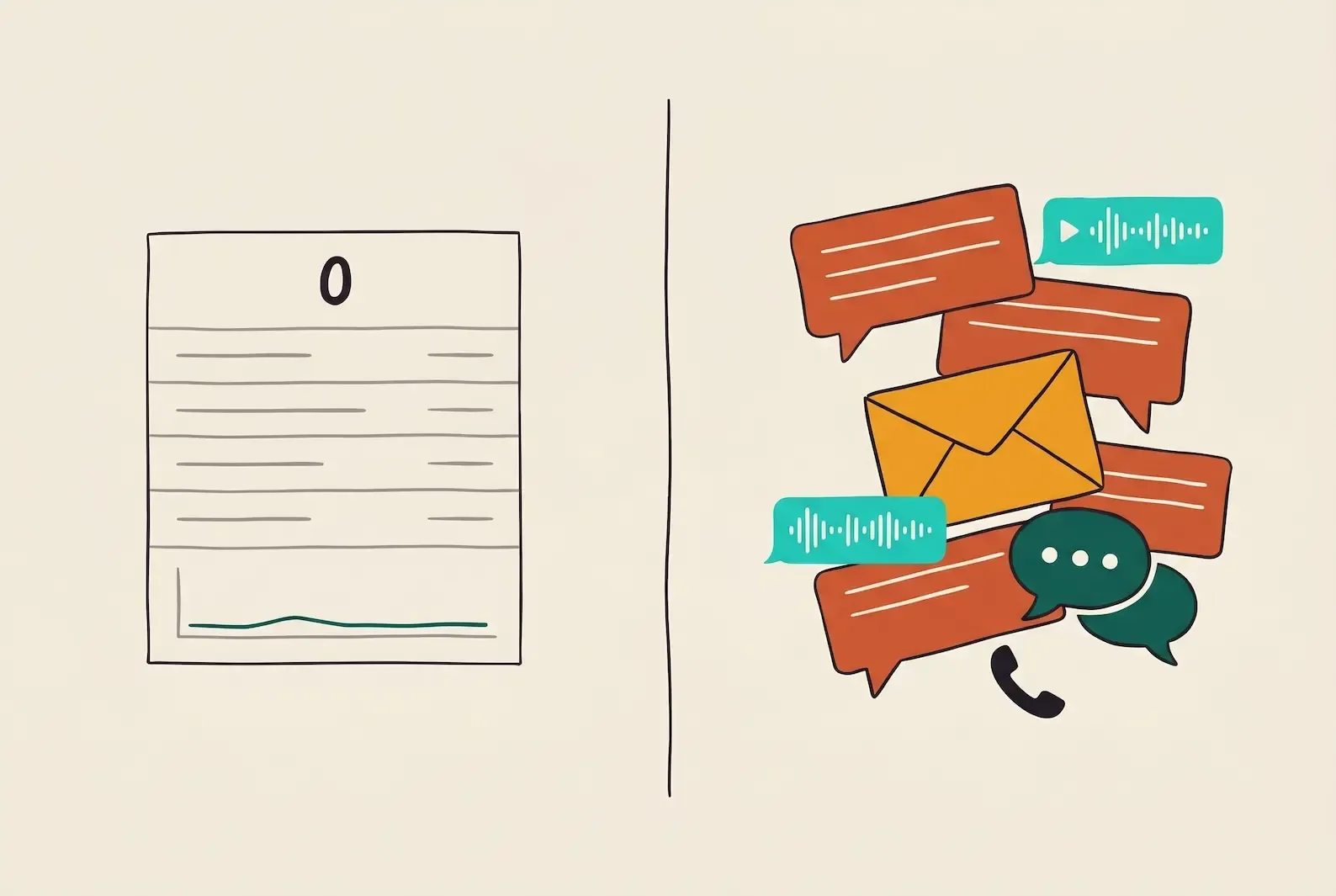
Blind attribution — which conversation closed the search?
Blind attribution is the more dangerous symptom because it is less visible. The activity dashboard might eventually be fixed by better capture. Attribution requires the conversation history to be linked.
A retained executive search mandate that closes after a six-month cycle traces back through dozens of conversations across three or four channels. The original BD touch may have been a LinkedIn message. The mandate brief came in over a Zoom call. The longlist conversations ran on WhatsApp. The candidate triangulation involved a researcher’s voice notes and a partner’s email thread. The client-side offer conversation happened in person over coffee at a Singapore hotel lobby.
When the placement closes and the partner asks “which conversation drove this?” the legacy CRM offers a status-field summary. It cannot show the conversation flow that actually got the search across the line. Which means it cannot tell the partner which consultant’s BD reach-out worked, which channel converted, which client conversation produced the offer ceiling. The agency runs the next quarter’s BD strategy on intuition rather than data — not because the data doesn’t exist, but because the visibility layer never captured it.
This is the second-order cost of the ATS+CRM integration failures that compound at the architecture level. Even when the integration moves structured fields cleanly between systems, the unstructured conversation history remains uncaptured. Attribution requires the conversation, not the field. Without the conversation, the dashboard runs on opinion.
Blind pipeline — forecasts on stale fields
Blind pipeline is the third symptom and the one partner groups feel monthly when the forecast doesn’t match reality.
The pipeline view in a legacy CRM is built from the structured fields consultants update — open mandates, stage, probability, estimated close. Those fields get updated when the consultant remembers to update them, usually before a Monday partner review and not often otherwise. Between updates, the pipeline view is stale by definition. Friday’s client meeting that changed the offer ceiling? Not in the pipeline. Tuesday’s WhatsApp from the candidate withdrawing? Not in the pipeline. Yesterday’s WeChat exchange with the GBA client confirming a second mandate? Not in the pipeline.
The forecast that comes out of this view is wrong in both directions. It overstates probability on mandates that have actually stalled because the stall happened in a conversation the CRM never saw. It understates probability on mandates that have actually progressed because the progression also lived in conversations the CRM didn’t capture. The partner’s instinct that the forecast is wrong is correct — the dashboard runs three to five days behind reality, sometimes more.
The data integrity problem that surfaces in pipeline reports is the same problem that surfaces in attribution reports and activity reports. All three are symptoms of the same upstream gap — conversation captured nowhere centrally.
Why the visibility gap is upstream of the dashboard
All three symptoms point to the same architectural fact. Legacy recruiting CRMs were designed around the assumption that activity, attribution, and pipeline data would be entered by consultants as structured updates. The CRM’s job was to store, organise, and report on what humans typed in.
That assumption has held for low-touch sales motions. It does not hold for executive search. Retained search runs on multi-channel, multi-stakeholder, unstructured conversations that occur faster than any consultant can manually log. A senior partner running three concurrent mandates across Hong Kong, Singapore, and Sydney is in five active WhatsApp threads, twelve email chains, six voice-note exchanges, and three Zoom calls on a normal Thursday. Asking the partner to manually log all of that into the CRM is not a process gap to be filled with training — it is an architectural mismatch between what the CRM is built to ingest and what the work actually produces.
A LinkedIn analysis of executive search technology captures the same conclusion from the practitioner side: firms handle sensitive data — compensation packages, assessments, board feedback — and email-based, spreadsheet-heavy workflows produce fragmented, hard-to-visualise data trails Source: M. Khare, LinkedIn, November 2025.
A vendor analysis of AI recruiting deployments reports that 41% fail at the integration layer Source: HeyMilo, June 2026 — a self-reported figure with vendor bias, but consistent with the structural problem. Adding an AI layer on top of a CRM that doesn’t see most of the activity produces confident-looking dashboards on data that was never complete. The visibility gap is upstream of both the CRM and the AI on top of it. It is in the conversation layer.
How conversation capture at source fixes the visibility layer
The fix is structural, not behavioural. The CRM has to capture conversation at source — automatically, across every channel — so the record per contact reflects what actually happened rather than what the consultant remembered to log.
Perfect Memory is the architecture for this. Every WhatsApp message, every WeChat thread, every email, every voice note, every Zoom call feeds the single record per candidate, per client, per company. The dashboard that sits on top of that record is no longer reporting on what was typed in. It is reporting on the actual conversation history.
What this changes for the three symptoms is direct. Blind activity disappears because the activity is captured automatically — the dashboard shows the seven calls plus the twelve WhatsApp threads plus the four voice notes, not just the seven calls. Blind attribution disappears because the conversation flow from BD touch to offer close is one threaded history that can be traced end-to-end. Blind pipeline disappears because the forecast is built on conversations that happened this morning, not on fields that were updated three weeks ago.
The Conversation Capture Stack is the operational layer that makes this work across the channel mix executive search actually uses — WhatsApp, WeChat, voice, email, video — rather than the channel mix US/UK CRMs were originally designed for.
The downstream layer above conversation capture is what makes the system intelligent. Agentic CRM reads the captured conversation history and surfaces the right actions per consultant: who to contact, when, on which mandate, with which reference. The dashboard becomes a decision-making layer rather than a reporting layer. None of that works if the conversation layer beneath it isn’t captured at source.
Three questions partners can ask before assuming the CRM is broken
Before assuming the CRM itself needs to change, three diagnostic questions surface whether the visibility gap is structural or process-level.
Question 1 — Channels. Which channels did the team’s actual work happen on last week? List them honestly: email, WhatsApp, WeChat, voice notes, Zoom, in-person meetings. Now check which of those channels the CRM automatically captured. If the answer is fewer than half, the CRM is structurally blind. The dashboard is not showing results because the data was never there.
Question 2 — Who-saw-what. For one specific closed mandate in the last quarter, can the CRM show the full conversation history from BD touch to offer close, in one threaded view, across every channel? If yes, the visibility layer is working. If the answer is “we have some emails and some status updates,” the system is producing attribution that cannot be trusted to drive next-quarter strategy.
Question 3 — Source-of-truth. When two reports run against the same data, do they return the same answer? If the partner pulls activity for last month from the dashboard and a consultant pulls the same activity for the same month a day later, the numbers should match. If they don’t, the system is arbitrating ambiguity — meaning the visibility layer has a structural integrity problem, not a configuration problem.
A “yes” to all three means the CRM is doing its job and the issue is process. A “no” to any one means the dashboard is reporting on incomplete data — and switching to a different CRM with the same conversation-blind architecture will produce the same incomplete dashboards. The visibility layer has to be fixed at source, in the CRM that captures conversation across every channel into one record. That is the architectural choice that determines whether next quarter’s dashboard is opinion or intelligence.
See the visibility layer working at source
See Signals on a recruitment desk like yours.
Common questions
Recruiting CRMs don't show results in executive search when the conversation capture layer is missing upstream. The complaint usually presents as three distinct symptoms: blind activity (the dashboard reports far fewer interactions than the team actually had), blind attribution (no clear conversation trail showing which touches closed the mandate), and blind pipeline (forecasts running on stale fields rather than live conversation data). All three trace to the same architectural fact: legacy CRMs only see structured updates entered into them, missing the WhatsApp, WeChat, voice, and email exchanges where most retained search work actually happens. The fix is conversation capture at source, not switching to a different dashboard.
Blind activity is the symptom where the CRM activity dashboard shows minimal activity (a handful of calls, a few emails, a sparse meeting log) while the team has demonstrably been busy on WhatsApp, WeChat, voice notes, and Zoom. The dashboard is not wrong because the team isn't logging. The dashboard is wrong because the CRM is structurally blind to the channels where the work actually happens. Enforcing manual logging has been the proposed fix for fifteen years and has never worked at scale; the architectural fix is automatic conversation capture across every channel into one record per contact.
Conversation capture at source feeds every channel (WhatsApp, WeChat, voice, email, video, in-person meeting notes) into the single record per candidate, client, and company. The dashboard that sits on top of that record is no longer reporting on what was typed in. It is reporting on the actual conversation history. Blind activity disappears because the activity is captured automatically. Blind attribution disappears because the conversation flow from BD touch to offer close is one threaded history. Blind pipeline disappears because the forecast is built on conversations that happened this morning, not on fields updated three weeks ago.
It is a problem any CRM has when its architecture assumes that activity, attribution, and pipeline data will be entered by consultants as structured updates. That assumption was reasonable for low-touch sales motions; it does not hold for executive search, where retained search runs on multi-channel, multi-stakeholder, unstructured conversations that occur faster than any consultant can manually log. The category of CRM that solves this is AI-native, designed from the data layer up to ingest the conversation rather than to require humans to summarise it into fields.
Before assuming the CRM itself needs to change, three diagnostic questions surface whether the visibility gap is structural or process-level. Question 1, channels: which channels did the team's actual work happen on last week, and which did the CRM capture automatically? Question 2, who-saw-what: for one specific closed mandate, can the CRM show the full conversation history from BD touch to offer close, threaded across every channel? Question 3, source-of-truth: when two reports run against the same data, do they return the same answer? A 'no' to any one of the three means the CRM has a structural visibility-layer problem, and switching to a different CRM with the same conversation-blind architecture produces the same incomplete dashboards.