
People change signals are the second category in the Signals-coined framework introduced in the 10 BD signal categories recruitment agencies should be detecting in 2026 hub piece, and the second spoke of the Signal Detection mini-series that followed with Job Ad Signals last week. This article walks through what the research actually supports when a recruiter reads a leadership move, a promotion, or a quiet LinkedIn update as a BD signal, where the fastest and most verifiable signals come from (hint: not LinkedIn), the timing ladder from four business days to two years, and the failure modes that lose money. The organising principle throughout is honest labelling. Where the evidence is strong (new leadership hire cascades, vacancy chains), it is cited. Where the evidence is thin (LinkedIn post velocity, the famous ‘respond in five minutes’ claim), that is stated too. Category-level tactical playbook, applicable to any recruitment agency, not a specific vendor’s product spec.
Why people change predicts hiring (the cascade is real)
The strongest research-backed argument for watching people-change signals is that leadership moves cascade through the organisation they land in, and that the effect is measurable within a 12-month window.
The outsider-CEO effect. When an insider replaces the CEO, the probability a top manager leaves within the next year is nearly 15 per cent. When an outsider replaces the CEO, that probability doubles to 30 per cent, with turnover ‘mainly attributed to interpersonal relationships’ rather than strategy, per Hayes, Oyer and Schaefer summarised by Stanford Graduate School of Business Source: Stanford GSB, 2004. The study is foundational but the direction holds in more recent work.
The CEO-to-CFO cascade. A 2025 study of US listed firms covering 5,457 CFO turnovers and 4,393 CEO turnovers from 2005 to 2019 finds that ‘CEO turnover significantly increases the likelihood of CFO turnover’ within one year, for both forced and voluntary CEO exits Source: European Journal of Finance, published November 2025. The CFO slot is one of the most agency-relevant exec-search mandates. The study is specific, large-sample, and recent.
The vacancy chain. When someone moves, their old role opens, which is filled by someone whose move opens another role, and so on. Harrison White introduced the concept in Chains of Opportunity (1970, foundational), and the Philadelphia Fed’s 2022 working paper formalises replacement hiring on US establishment data covering around 77 million workers Source: Philadelphia Fed WP 22-23, August 2022. The practical implication is that the leader who left is often the higher-value signal, not the leader who arrived.
People bring their people. 35.1 per cent of new firms with five or more employees hire at least one coworker from a founder’s last employer in the first year, and 9.2 per cent of first-year hires are such coworkers, per NBER working paper w33230 (Brazilian data, firms founded 2002 to 2014) Source: NBER w33230, December 2024. The research is on founders rather than general team leads, but the direction of effect (new leaders recruit people they already know) is well established.
The macro backdrop in 2026 raises signal-to-noise. The US quits rate was 1.9 per cent in August 2026, essentially unchanged month on month Source: BLS JOLTS, 29 September 2026. Australian job mobility was 7.2 per cent in the year to February 2026, down from 7.7 per cent and continuing a long-term decline from 17.4 per cent in 1972 Source: ABS Job Mobility, July 2026. Canada’s monthly job-changing rate was 0.4 per cent in January 2025 against a pre-pandemic January average of 0.7 per cent Source: StatCan, 7 February 2025. Low churn is often read as a traffic drought for recruitment BD. The more useful read is the inverse: each individual senior move counts for more than it did two years ago, because there are fewer of them competing for the recruiter’s attention.
The seven patterns, evidenced versus craft
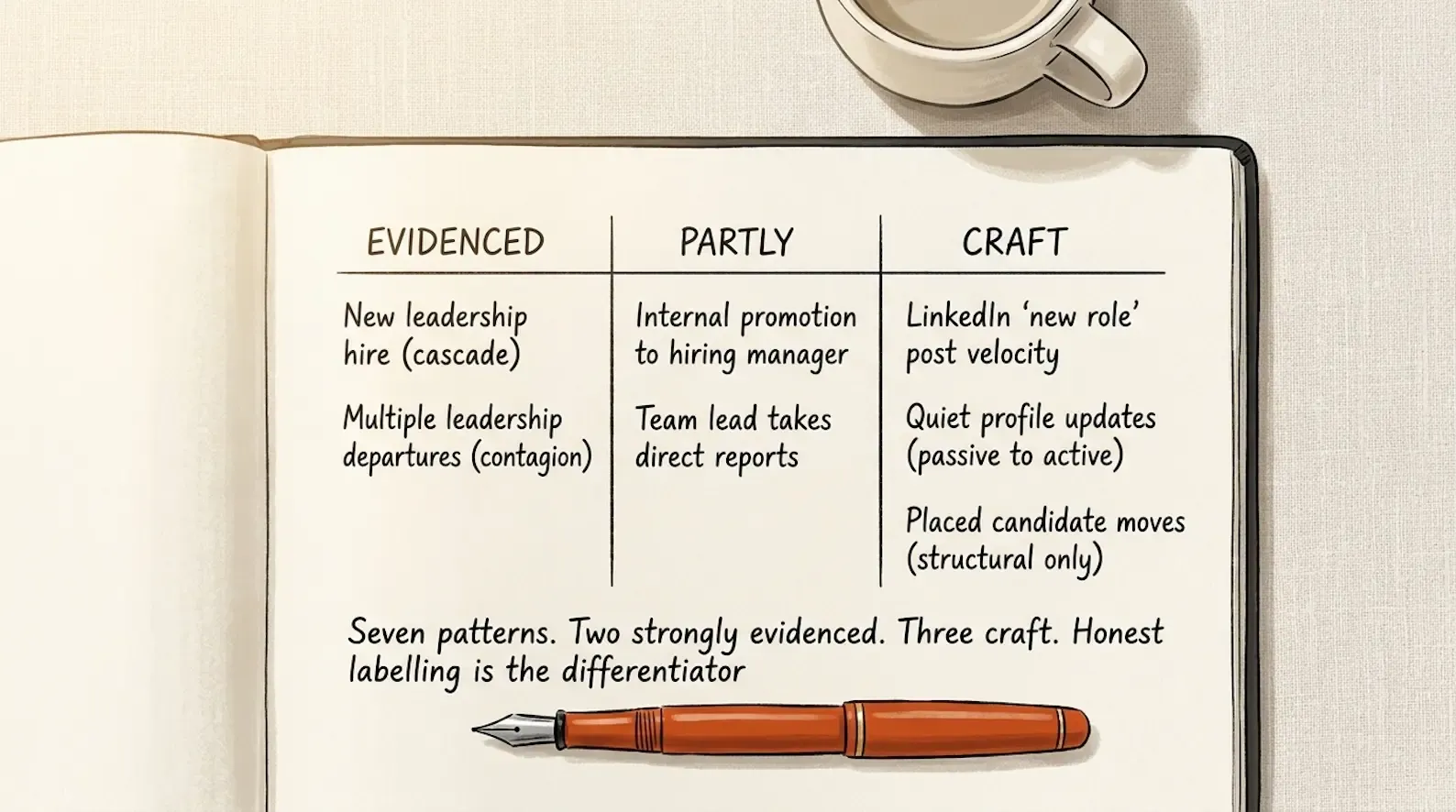
Seven people-change patterns are commonly cited as BD signals. Honest labelling gives them very different weights.
| Pattern | Research-backed? | What the evidence actually shows |
|---|---|---|
| New leadership hire at a target account | Strong | Outsider CEOs raise top-manager exits 15 → 30 per cent (Stanford); CEO turnover raises CFO turnover within 12 months (European Journal of Finance 2025) |
| Multiple leadership departures in short window | Strong (direction) | Turnover contagion established in the AMJ literature; interim CEO successions raise executive turnover per Corporate Governance 2025 |
| Internal promotion to hiring-manager role | Moderate | Manager mobility raises subordinates’ promotion prospects per Organization Science. No agency-specific conversion rate exists |
| Previously placed candidate moves to new company | Structural | 20.6 per cent of US workers have 1 year or less tenure (BLS Sept 2026). Candidates moving is structural certainty, not a measured BD rate |
| Team lead moves and takes direct reports | Moderate | NBER w33230 covers founders specifically; the lift-out literature (law, banking, consulting, software) is foundational but older |
| LinkedIn ‘starting a new role’ post velocity | Platform-reported | LinkedIn states 93 people add a new role every minute. No study links post velocity to BD conversion |
| Quiet LinkedIn updates (passive-to-active) | Mechanism only | Profile edits are visible as soon as saved; Open to Work can be shown privately to Recruiter users. No study on conversion |
The pattern that most reliably converts is also the best-evidenced one. A new leadership hire at a target account where the agency has placed into the function before is a genuine BD trigger. The 12-month CFO-after-CEO cascade is published and large-sample.
The three patterns commonly asserted as facts but not supported by published research are worth naming plainly. On LinkedIn post velocity: 93 new-role posts per minute globally means a lot of noise, and LinkedIn maps free-text titles to standardised titles using machine learning, so seniority inference is probabilistic rather than exact. On quiet profile updates: the mechanism is verified (LinkedIn makes edits visible as saved, with Open to Work optionally private to Recruiter), but no published study links passive-to-active behavioural inference to BD conversion. On team lead rebuilds: the foundational research is on founders and lift-outs in specific sectors; generalising to ‘any team lead will take their reports’ overstates the evidence.
Boomerang context (worth including, modest claim). 3.4 per cent of US new hires in late 2025 were returning employees, up from 3.1 per cent two years earlier, per Revelio Labs analysis cited by LinkedIn News Source: LinkedIn News, 8 September 2026. Placed candidates become future hiring managers who, if the agency relationship was handled well at placement, return to the placing agency. No published rate exists for this specific loop. Treat it as a long-cycle BD argument.
Where to see moves first: the data hierarchy
The surprise finding for most recruitment agencies is that regulators are faster than LinkedIn.
Regulators (fastest, most verifiable). US SEC 8-K Item 5.02 must be filed within four business days of a listed company’s leadership change and is searchable via EDGAR Full Text Search Source: SEC Form 8-K; Source: SEC EDGAR. A 2021 academic study of 18,693 single-item 5.02 filings found that 24.6 per cent were filed on day zero and 23.4 per cent on day four. UK Companies House AP01 (director appointment) and TM01 (termination) filings have a 14-day statutory deadline Source: GOV.UK. Both are free and reliable. For UK private-company director changes specifically, Companies House is often faster than LinkedIn.
Press wires. PR Newswire and Business Wire both run dedicated personnel-announcement feeds. Volume is high and the signal is already structured. Spencer Stuart’s own research counted 168 new S&P 1500 CEOs in 2025, the most since 2010, with 40 per cent external appointments Source: Spencer Stuart, February 2026. Russell Reynolds counted 234 CEO exits across 13 global indices in 2025, with 86 per cent of appointees being first-time CEOs Source: Russell Reynolds CEO Turnover Index. These are published aggregates, not just announcement feeds; they confirm that the executive-change category is genuinely active.
LinkedIn Sales Navigator alerts. The named alerts include ‘Lead changed jobs’ (saved lead moves to a new company), ‘Lead changed roles’ (saved lead moves within the company), ‘Senior hires at account’ (director level or above), and ‘Accounts preparing to grow’ (more jobs posted in the past 90 days). The ‘Changed jobs (in the last 90 days)’ filter is one of the most useful BD-prospecting filters that recruitment agencies underuse. Some alerts require Sales Navigator Advanced. LinkedIn’s User Agreement effective 3 November 2025 prohibits automated scraping; the hiQ v LinkedIn consent judgment of December 2022 settled the limits of what third parties can do.
Third-party data vendors. Cognism, ZoomInfo, Apollo, Lusha, UserGems, and BoardEx layer alerts on top of LinkedIn and other public sources. All are vendor-reported. Apollo’s own documentation openly notes that profile edits trigger ‘job change’ flags even when nobody has moved companies Source: Apollo Knowledge Base, which is the root of false positives in the entire vendor layer. BoardEx specifically covers 1.7 million board, executive, and senior leadership members across 2.2 million organisations with 27,000 changes recorded weekly; the vetting is described as human-researcher assisted.
The data hierarchy, ranked. Regulators first for US and UK listed and private companies, then press wires, then LinkedIn alerts for broader coverage, then vendor feeds for aggregation and historical context. An agency relying only on LinkedIn is relying on the slowest and noisiest layer in the stack.
The timing ladder: from four days to two years
| Window | Evidence |
|---|---|
| 0 to 4 business days | SEC 8-K Item 5.02 filed. Earliest verifiable public record for US listed companies |
| 0 to 14 days | UK Companies House director change filed |
| Up to 2 hours and then 90 days | LinkedIn auto-posts appear within two hours; deleted after 90 days |
| Around 3 months | Executives are commonly under pressure to deliver quick wins in the first quarter |
| Within 12 months | CEO change raises CFO turnover (European Journal of Finance 2025); new leaders hire former coworkers in year one (NBER w33230) |
| Around 14 months | Average time stakeholders give a CEO to build the team (McKinsey 2017, foundational) |
| Up to 2 years | 69 per cent of new CEOs reshuffle management teams (McKinsey 2018, foundational) |
The defensible framing a BD lead should carry into every account conversation: inside the first fortnight to make yourself known, inside the first quarter to win the first brief, across the first year to own the rebuild. The common ‘respond within 5 minutes’ claim traces to a 2007 MIT and InsideSales study of inbound web leads and is not transferable to leadership outreach. Bullhorn GRID 2026 contains no data on BD conversion by signal freshness. Treat timing as a reasoned window, not a benchmark.
Failure modes that lose money
Three failure modes recur across the research and the recruiter workflow literature.
Generic congratulations within the first 48 hours. LinkedIn auto-generates ‘new position’ posts, which means dozens of people react to the same trigger at the same time. Standing out requires a specific, researched note referencing the leader’s prior work, the specific challenge they are inheriting, or a mutual connection, not ‘congrats on the new role!’
Chasing only the leader who arrived, not the one who left. The vacancy-chain research (White 1970, Philly Fed 2022) establishes that every leadership move opens a downstream role. The leader who left often becomes the higher-value signal, because they are either immediately in-market for their next role (candidate side) or carries a network of former colleagues the agency can engage (BD side). Tracking only the hire misses half the economic value of the signal.
Misreading a lateral move or a demotion as a promotion. LinkedIn’s title standardisation is probabilistic. Apollo flags profile edits as ‘job change’ events even when no company change occurred. The published Wharton research notes that effects differ substantively across promotion, lateral move, exit, and firing. A BD outreach built on a false ‘promotion’ read lands poorly.
Treating the new leader as a buyer on day one. 92 per cent of external hires and 72 per cent of internal hires take ‘far more than 90 days’ to get up to speed per McKinsey’s 2017 research. Gartner research suggests 39 per cent of new executives underperform in their new role. The practical implication is that first-mandate opportunities with a new leader typically land in month three to month six, not week one. BD timing calibrated to the leader’s own readiness will convert better than BD timing calibrated to signal freshness alone.
The post-placement loop
The quietest BD signal in the whole category is the one that compounds over years rather than weeks. 20.6 per cent of US workers had one year or less of tenure in January 2026, and median tenure was 4.1 years Source: BLS Employee Tenure, 24 September 2026. Placed candidates do not stay still. Those who move on are candidates again, and if the placing agency maintained a genuine post-placement relationship, they come back as hiring managers at the new employer. There is no published rate for this specific loop; it is a long-cycle argument based on tenure maths and the boomerang-hire pattern (3.4 per cent of US new hires in late 2025 were returning employees). The post-placement loop is why an agency’s own captured relationship history is the most defensible category of all; external data vendors cannot replicate it.
Where Signals sits in this category
For an agency evaluating how to detect, prioritise, and act on people-change signals as a system rather than as a scattered set of LinkedIn alerts, the architectural question is where the signals land. A dashboard opened once a week captures perhaps 20 per cent of the signals the agency detects. A workflow where BD signals surface inside the same CRM view where the consultant already works on candidates and clients captures closer to 100 per cent. Signals is designed around this difference: regulators, press wires, LinkedIn alerts, and vendor feeds consolidated as signal types in the BD Signals product surface, with each surfaced signal carrying a recommended consultant action and the correct timing window attached. The next spoke in the mini-series covers Company News signals, the third BD signal category.
See what people-change signal detection looks like inside the CRM
Signals is live for recruitment agencies globally. Book a demo to see the BD Signals layer in production.
Common questions
People change signals in recruitment BD are detected events when leaders, hiring managers, or network contacts move roles, change companies, get promoted, or leave. They matter commercially because each move creates a cascade: a leadership hire raises the probability of further senior exits (outsider CEOs raise top-manager exit probability from nearly 15 per cent to 30 per cent per Stanford GSB research) [Source: Stanford GSB, 2004](https://www.gsb.stanford.edu/insights/paul-oyer-new-ceos-dont-always-mean-executive-turnover); CEO turnover raises CFO turnover within 12 months per a 2025 European Journal of Finance study of 5,457 CFO and 4,393 CEO turnovers [Source: European Journal of Finance, November 2025](https://www.tandfonline.com/doi/full/10.1080/1351847X.2025.2585966); and new leaders bring former colleagues (35.1 per cent of new firms with five or more employees hire a founder's former coworker in year one per NBER w33230) [Source: NBER working paper, December 2024](https://www.nber.org/papers/w33230). People change is the second of the ten BD signal categories introduced in the hub piece on recruitment BD signals.
There is no independently sourced rule. The '5-minute lead response' claim circulating in BD content traces to a 2007 MIT and InsideSales study of inbound web leads, which is not transferable to leadership outreach. ZoomInfo's 'act within two days' is vendor positioning without method. What the published research does support is a timing ladder. The earliest verifiable public record is the SEC 8-K Item 5.02 filing (within four business days of a US public-company leadership change) and the UK Companies House AP01/TM01 director filing (within 14 days) [Source: SEC Form 8-K](https://www.sec.gov/files/form8-k.pdf); [Source: GOV.UK Running a limited company](https://www.gov.uk/running-a-limited-company/company-changes-you-must-report). LinkedIn auto-generated 'new role' posts appear within up to two hours and disappear from the feed after 90 days. New-CEO team rebuilds unfold over 3 to 24 months per the research. A defensible framing: inside the first fortnight to make yourself known, inside the first quarter to win the first brief, across the first year to own the rebuild.
Regulators are faster than LinkedIn, which surprises most recruiters. US SEC 8-K Item 5.02 must be filed within four business days of a listed company's leadership change and is searchable via EDGAR Full Text Search [Source: SEC EDGAR Full Text Search](https://www.sec.gov/edgar/search/). UK Companies House AP01 (director appointment) and TM01 (director termination) filings have a 14-day deadline, and the data is free. PR Newswire and Business Wire run dedicated personnel-announcement feeds. LinkedIn comes next: Sales Navigator alerts include 'Lead changed jobs', 'Lead changed roles', 'Senior hires at account' (director level or above), and 'Accounts preparing to grow'. Third-party data vendors (Cognism, ZoomInfo, Apollo, Lusha, UserGems, BoardEx) layer alerts on top of LinkedIn and other public sources but inherit LinkedIn's rate of false positives (profile edits trigger 'job change' flags even when nobody has moved, per Apollo's own documentation).
No, and this is one of the most consequential corrections for recruitment BD. McKinsey's widely-cited '69 per cent of new CEOs reshuffle their management teams within the first two years' figure is from 2018 and should be treated as directional. Separate research shows that turnover after a manager leaves is 'not consistent, immediate, or predictable' (University of Nebraska study of 239 general-manager departures 2012 to 2014). McKinsey also notes that 92 per cent of external hires take 'far more than 90 days' to get up to full speed, and stakeholders give CEOs an average of 14 months to build the right team. The practical implication for an agency is that a leadership hire is not a 'buy today' signal. It is the start of a 3 to 24 month BD window, with the first touch inside two weeks and the first mandate opportunity typically in the first quarter.
It is a signal, but a noisy one. LinkedIn states that 93 people add a new role to their profile every minute [Source: LinkedIn pressroom](https://news.linkedin.com/about-us). Posts are auto-generated within up to two hours of a profile update and are deleted from the feed after 90 days per LinkedIn Help. Three mechanical limitations make LinkedIn-only detection weaker than it looks. First, LinkedIn maps free-text job titles to standardised titles using machine learning, so seniority inference is probabilistic rather than exact. Second, data vendors that rely on LinkedIn (Apollo documents this openly) trigger 'job change' flags on any profile edit, which produces false positives when a user corrects a typo. Third, LinkedIn's User Agreement effective 3 November 2025 prohibits automated scraping, and the hiQ v LinkedIn arc ended in a December 2022 consent judgment with a $500,000 settlement. Treat LinkedIn as one data layer among regulator filings, press wires, and verified vendor feeds, not as the primary layer.