
Job ad monitoring is one of the most commonly promised and least honestly evidenced categories in recruitment BD content. Every vendor sells it. Almost no vendor cites a peer-reviewed study when they do. This article walks through what the research actually supports, what is craft rather than evidence, what the 2026 Ontario regulation changed for the first time, and where the folklore in this category can be traced to its origins. It is spoke 1 of the Signal Detection mini-series that follows the hub piece introducing the 10 BD signal categories recruitment agencies should be detecting in 2026. The framing throughout is category-level tactical playbook, applicable to any recruitment agency, not a specific vendor’s product spec. The organising principle is honest labelling: patterns that are evidenced are labelled as such, patterns that are craft are labelled as craft, and folklore is traced to where it came from. That candour is the actual differentiator, because every competing piece in the category asserts the craft patterns as facts.
Why job-ad activity is a leading BD indicator (the premise, evidenced)
The premise is genuinely validated by peer-reviewed research. A study on Danish linked employer-employee register data found that posting a vacancy is associated with a 4.5 percentage-point rise in a firm’s hiring rate, with two-thirds of the additional hiring occurring within two months Source: IZA DP 14436. Hiring from employment is twice as responsive as hiring from non-employment, which means replacement chains and vacancy sequences are a material part of the effect. Separations at a firm also predict subsequent posting, so a new advert at an existing client often signals further movement inside that account, not just the single role on the face of the advert.
Two structural points are worth naming for a recruitment agency reading this evidence commercially. First, a live advert is by construction a faster signal than any official labour-market statistic. UK vacancy statistics are published six to seven weeks after a single-day reference date Source: ONS Vacancy Survey QMI. The agency watching adverts is operating weeks ahead of the published labour-market picture.
Second, the SME caveat matters commercially. NBER working paper 35697 finds that postings data are strongest for large employers and weakest for SMEs; smaller employers post fewer roles online than the size of their hiring warrants Source: NBER WP 35697. Silence at a small client is therefore weak evidence of no hiring. Job-ad monitoring is a strong instrument for mid-market and enterprise accounts and a weaker one for small employers. Any agency BD framework that treats posting silence as authoritative signal at a 40-person client is misusing the data.
The resolution problem: up to 80 per cent of what you see is duplicates
The single most useful statistic in this category is not about hiring; it is about noise. Lightcast, one of the major providers of job posting data, publishes its methodology openly. Its two-step deduplication removes up to 80 per cent of the jobs collected Source: Lightcast duplicate handling. The deduplication window is 60 days on matched title, company, and location. Lightcast’s own worked example: a company posting the same advert every day for a year is counted six times.
Textkernel, a separate provider, estimates duplicates at 50 to 80 per cent of collected ads across eight countries Source: Textkernel, November 2023. Indeed’s own data FAQ is explicit that its counts are monthly and quarterly averages of daily figures, and that the deduplication process is focused on the jobseeker experience rather than on accurately counting the number of available jobs Source: Indeed Data FAQ, September 2025. Lightcast’s plainest statement summarises the position: ‘Job postings are not necessarily the same as job vacancies. Job postings are a measure of recruitment marketing by employers purportedly looking to fill job vacancies’ Source: Lightcast JPA methodology.
The practical consequence for a recruitment agency BD desk is a reframing of the whole problem. The constraint is not access to job postings. It is resolution. Any raw job-board feed a recruiter monitors manually is, to a first approximation, mostly the same jobs repeatedly. Any account-level ‘they posted N roles this quarter’ claim inherits a 60-day duplicate window at minimum. The commercial job of a BD signal system is not to find more postings; it is to strip duplicates, dedupe reposts, cluster related openings, and surface the residue as an actionable event stream.
The six patterns, evidenced versus craft
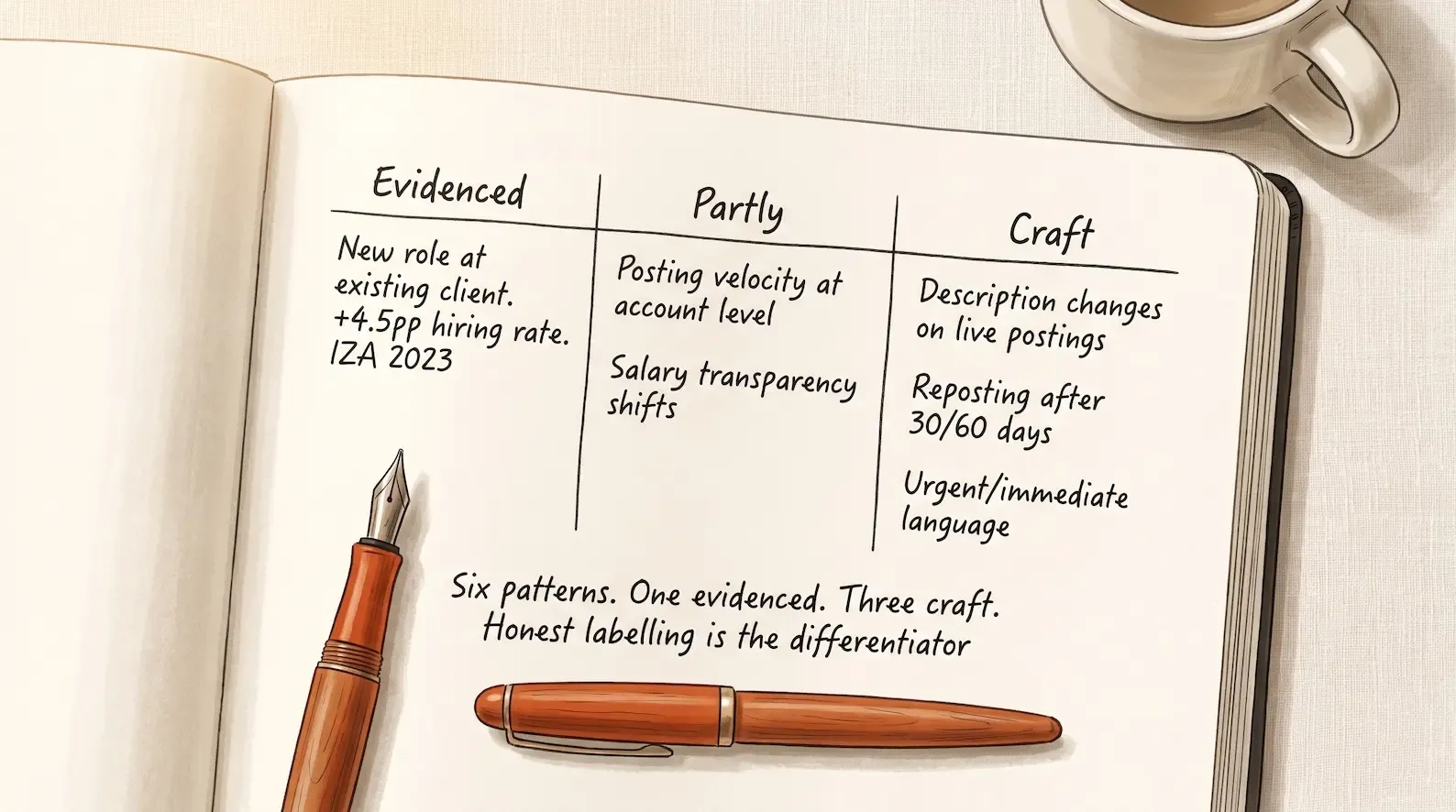
Six patterns are commonly cited by BD content in this category. Honest labelling gives them very different weights.
| Pattern | Research-backed? | What the evidence actually shows |
|---|---|---|
| New role posted by an existing client | Yes | Danish register data: +4.5pp firm hiring rate; two-thirds of extra hiring within two months |
| Description changes on a live posting (title, seniority, must-haves, salary) | No | No published research tracks edits to live job postings. Treat as craft |
| Reposting after 30 or 60 days | No | No published repost-rate statistic. Major data providers actively suppress reposts in deduplication |
| Posting-velocity change at account level | Partly | Firm-level posting predicts firm-level hiring; no validated threshold rule exists |
| Advertised-salary or pay-transparency shifts | Partly | NBER WP 34480 establishes market-level effects. Nothing on a single employer lifting a band mid-search |
| Urgent or immediate-start language | Weak | Only 2021 Indeed data exists. No 2024 to 2026 update; nothing links urgency to fill speed or agency win rate |
The pattern that most reliably converts is also the least contested. A new role at an existing client, particularly one where the agency has placed into the same function before, is a well-evidenced trigger. Two-thirds of the additional hiring inside two months means the commercial window is days to weeks, not months.
The three patterns commonly asserted as facts but not supported by published research are worth naming plainly. On description changes: no study, index, or vendor dataset tracks edits to live postings for title shifts, seniority-band widening, removal of must-haves, or salary uplifts applied to an already-live advert. What does exist is market-level requirement drift, such as Indeed Hiring Lab’s finding that US senior-level postings were up 14.7 per cent year-on-year as of May 2026 Source: Indeed Hiring Lab, July 2026. That is market movement, not a within-posting edit signal for a specific account.
On reposts: no primary source publishes a job-ad repost rate. The Textkernel figure sometimes cited (an average job ad is reposted 2 to 5 times depending on country) has no sample size, observation period, or definition of ‘reposted’ attached to it. Worse, the major aggregated datasets are engineered to suppress reposts. Lightcast’s 60-day duplicate window explicitly collapses reposts into a single record. Indeed’s daily-average method suppresses within-period relistings. Any ‘30 days without fill equals failed search’ rule is craft assertion, not measured probability.
On urgency language: the only primary research is a 2021 Indeed Hiring Lab study that found urgent-hiring share of US postings at 2.3 per cent in May 2021, up from 1.6 per cent that January, with sector extremes ranging from 8.8 per cent (personal care and home health) down to under 2 per cent (food prep and hospitality) Source: Indeed Hiring Lab, June 2021. No 2024 to 2026 update exists. No research links urgency language to fill speed, hire probability, or agency win rate. Treat urgency phrasing as directional context, not a scored signal.
The 2026 regulatory shift Ontario and Colorado created
The most concrete change in the category in 2026 is regulatory. Ontario is the only jurisdiction identified in this research where job-posting rules require the employer to state, on the face of the advert, whether the vacancy is real. Section 8.5(1)(a) of the ESA requires ‘a statement disclosing whether the posting is for an existing vacancy or not’ Source: Ontario ESA Part III.1. Section 8.2(1) requires expected compensation or a compensation range. Section 8.4(1) requires disclosure of whether AI screens, assesses, or selects applicants. Section 8.3(1) bans Canadian-experience requirements. O. Reg. 476/24 caps salary ranges at $50,000 spread, exempts pay disclosure above $200,000, and applies only to employers with 25 or more employees Source: O. Reg. 476/24. The rules apply to postings posted on or after 1 January 2026 Source: Ontario ESA guidance, February 2026.
The measured effect on posting readability is large. Explicit pay information in Ontario postings rose from 49 per cent just before the law to 71 per cent by June 2026 Source: Indeed Hiring Lab, July 2026. For a Canadian recruitment agency watching Ontario postings in 2026, the vacancy-reality question is now answered on the advert by law. Everywhere else, the recruiter is inferring it. Our Recruitment in Canada 2026 piece covers the wider Ontario regulatory picture (licensing, retention, penalties) in more detail.
Colorado’s regime under 7 CCR 1103-18 is the widest-scope posting-level disclosure in the US. INFO #9A requires every posting to include the compensation to be offered, the benefits to be offered, and ‘how and when to apply’, explicitly bans ‘open until filled’ language, and requires that genuinely evergreen roles disclose ‘that it accepts ongoing applications’ Source: CDLE INFO #9A. The ‘open until filled’ ban is another regulatory attempt to make posting freshness legible.
Two research findings frame what these laws do and do not change. Peer-reviewed causal evidence from NBER WP 34480 (November 2025) using difference-in-differences on state pay-transparency mandates found that the laws raised postings containing salary information by 30 percentage points and wages by 1.3 to 3.6 per cent, with no impact on posting volumes, pay dispersion, employment, or skill requirements Source: NBER WP 34480. The commercial takeaway: transparency laws add a machine-readable field without distorting posting counts. Volume-based signals remain comparable across the legal change; salary-based signals become newly available for the first time.
Where to actually look for job-ad signals
The public data-source layer has three material shifts to know about in 2026.
Openly accessible sources with BD-usable endpoints. Adzuna publishes a public REST API with a free app_id and app_key. Its endpoints include a ‘current number of vacancies by region or company’ function, which is the most directly BD-relevant free public endpoint in the category Source: Adzuna API Overview. Reed’s Jobseeker API in the UK exposes two parameters (postedByRecruitmentAgency and postedByDirectEmployer) that flag whether a specific posting is agency-posted or direct-employer-posted Source: Reed for Developers, which directly answers one of the most expensive BD failure modes below. Job Bank Canada publishes monthly open-data CSVs under Open Government Licence, with a ‘number of vacancies’ field per posting that most job boards do not surface Source: Open Government Portal Canada.
Compelled-advert layers, underused. US employers filing PERM labour certifications must run a wage-floored, employer-named public advert plus a 30-day state job order Source: 20 CFR 656.17. Quarterly OFLC disclosure files publish the case-level records. Canadian LMIA high-wage-stream applications require at least three recruitment activities including a Job Bank posting for four consecutive weeks within the three months before submission Source: ESDC, September 2026. Stacked on the Ontario existing-vacancy rule, an Ontario LMIA advert now carries a mandatory wage, a mandatory four-week run, a real-vacancy statement, and a compliance reason the employer cannot pull it early. That combination is the cleanest publicly observable hiring signal identified in this research.
The two large platforms are effectively closed. Indeed’s Terms of Service (last updated July 2026) prohibit automated access including ‘AI or Agentic AI’ without written permission Source: Indeed ToS. LinkedIn’s User Agreement (effective November 2025) forbids scraping the service; LinkedIn Talent Insights states no API and no posting-activity metric Source: LinkedIn User Agreement. Any BD-signal system that promises comprehensive coverage of Indeed and LinkedIn job posting activity is either using approved partnerships or making claims its terms do not support.
Failure modes that lose money
Three failure modes matter commercially, and each corresponds to a specific base-rate finding.
The in-house assumption. The most expensive error in this category is reading a live advert as evidence that the client has engaged an agency. 78 per cent of surveyed companies now operate primarily through direct hiring models, only 22 per cent used agencies, 42 per cent had reduced agency usage over two years, and 29 per cent operate niche preferred-supplier lists Source: Personnel Today reporting The Talent Labs 2026, August 2026. On this base rate, a live advert is more likely to sit inside an in-house process than an agency mandate. The commercial trigger for agency engagement is not that a role has been posted; it is that a role has been posted and the internal team has not been able to fill it within a specific window. Reed’s postedByRecruitmentAgency flag is the closest observable proxy where the flag is available.
The duplicate assumption. Every ‘volume is up at this account’ read inherits the 60-day duplicate window described above. A raw job-board feed watched manually by a recruiter is mostly the same jobs repeatedly. This is the failure mode whose mechanics are best documented in the category, per Lightcast’s and Indeed’s own methodology disclosures.
The ghost-posting assumption in either direction. The Congressional Research Service is explicit: ‘There are no official statistics on the magnitude of ghost jobs’ Source: CRS IF12977, April 2025. CRS also notes that ‘the firms behind these studies market hiring-related services, including job posting verification tools … making it difficult to assess the quality of ghost job prevalence estimates based on these data’. Do not cite a specific ghost-job percentage as fact. Do treat ‘open until filled’ language and postings older than a market’s typical fill duration as candidates for closer investigation, not as reliable ghost-posting indicators.
Retiring the folklore
Three claims commonly repeated in this category deserve to be retired.
‘80 per cent of jobs are never advertised.’ Traced to origin: a 1966 pilot funded by the Ford Foundation, run by the National Industrial Conference Board, surveying 27 companies in Rochester, New York. The 80 per cent was an artefact of a local employers’ agreement not to advertise in the Rochester newspapers; the original report explicitly warned Rochester was unrepresentative, and on comparable categories the share that ‘could be advertised’ was 46.4 per cent. The study’s own conclusion was that postings are a poor labour-market metric. Every 70, 80, or 85 per cent variant in circulation traces to this single unrepresentative 27-company pilot.
‘The first agency to call wins X per cent of the time.’ No primary source exists. The most fully specified version of the claim in circulation is a vendor blog table with no source, no sample, no methodology, and no fieldwork dates. The category error worth naming: the underlying figures the table cites are about candidate response speed, not client win rate.
‘A job reposted after N days indicates a failed search at X per cent probability.’ No published probability exists. The only quantified reposting figures anywhere (Textkernel’s 2 to 5 times per ad) have no sample, period, or definition of ‘reposted’ attached, and neither is a failed-search probability.
The pattern across all three is the same. The category has been dominated by unsourced round numbers for so long that honest labelling is a differentiator. For a wider frame on how to evaluate any AI-native recruitment CRM that offers signal detection, see our recruitment CRM buyer’s guide for 2026.
The real category-level argument is simple. Job ad monitoring works because posting a vacancy is associated with near-term hiring, but the recruiter’s operating constraint is resolution rather than access, and the honest patterns to watch are narrower and more specific than the industry commonly claims. Signals is designed around this argument: BD signal detection as a first-class product surface where the hiring-intent signal layer processes external job-ad activity against the agency’s own client base and target market, deduplicates, and surfaces the residue as workflow items with a specific consultant action attached. Category matters more than raw volume. Actionability matters more than notification. The next spoke in the mini-series covers People Change signals, the second BD signal category.
See what BD signal detection looks like as a first-class product surface
Signals is live for recruitment agencies globally. Book a demo to see the BD Signals layer running in production.
Common questions
Peer-reviewed research on Danish linked employer-employee register data found that posting a vacancy is associated with a 4.5 percentage-point rise in a firm's hiring rate, with two-thirds of the additional hiring occurring within two months [Source: IZA DP 14436](https://www.iza.org/publications/dp/14436/vacancies-employment-outcomes-and-firm-growth-evidence-from-denmark). Separations also predict subsequent posting, so a new posting at an existing client often signals further movement in that account, not just the one role. The lead time is days-to-weeks, not months, which sizes the commercial window for agency BD response. The effect is stronger at smaller and fast-growing firms but materialises faster at larger ones. Note the SME caveat: silence at a small client is weak evidence of no hiring because smaller employers post fewer roles online than the size of their hiring warrants.
Six patterns are commonly cited as BD signals. Only the first is properly evidenced. (1) New role postings by an existing client: strongly evidenced by the Danish register study. (2) Description changes on live postings (title, seniority, salary edits): no published research tracks edits to live postings; treat as craft. (3) Reposting after 30 or 60 days: no published repost-rate statistic; major data providers actively suppress reposts in deduplication (Lightcast uses a 60-day window). (4) Posting-velocity changes at account level: partly evidenced (firm-level posting predicts firm-level hiring), but no validated threshold rule exists. (5) Advertised-salary and pay-transparency shifts: evidenced at market level per NBER WP 34480 [Source: NBER, November 2025](https://www.nber.org/papers/w34480); nothing published on a single employer lifting a band mid-search. (6) Urgent or immediate-start language: 2021 data only; no 2024 to 2026 update and nothing linking urgency language to fill speed or agency win rate. Honest labelling is the differentiator.
Ontario's Working for Workers Act, effective 1 January 2026 for employers with 25 or more employees, is the only jurisdiction identified where posting-level rules require disclosure of whether the vacancy is real. Section 8.5(1)(a) of the ESA requires 'a statement disclosing whether the posting is for an existing vacancy or not' [Source: Ontario ESA Part III.1](https://www.ontario.ca/laws/statute/00e41). O. Reg. 476/24 caps salary ranges at $50,000 spread, requires AI-screening disclosure, and permits omission of pay above $200,000 [Source: O. Reg. 476/24](https://www.ontario.ca/laws/regulation/240476). Explicit pay information in Ontario postings rose from 49 per cent just before the law to 71 per cent by June 2026 [Source: Indeed Hiring Lab, July 2026](https://hiringlab.indeed.com/en-ca/2026/07/23/growth-in-canadian-salary-transparency-driven-by-two-provinces/). For a Canadian recruitment agency watching Ontario postings, the vacancy-reality question is now answered on the face of the advert by law, everywhere else it is inferred.
No primary source quantifies this. What primary sources do show is that most companies do not use agencies to source most hires in 2026. 78 per cent of companies surveyed in a 2026 in-house talent professional benchmark said they operate primarily through direct hiring models, only 22 per cent used agencies, 42 per cent had reduced agency usage over two years, and 29 per cent operate niche preferred-supplier lists [Source: Personnel Today reporting The Talent Labs 2026, August 2026](https://www.personneltoday.com/hr/in-house-recruiters-favour-direct-hiring-over-agencies/). On this base rate, a live advert is more likely to sit inside an in-house process than an agency mandate, and where agencies are used it is increasingly via structured PSLs. Reed's `postedByRecruitmentAgency` and `postedByDirectEmployer` API parameters are the cleanest observable proxy for the agency-versus-direct distinction where the flag is available.
A ghost job is a public job posting for a position that does not exist or that the employer is not planning to fill immediately, per the Congressional Research Service. There are no official statistics on the magnitude of ghost jobs [Source: CRS IF12977, April 2025](https://www.congress.gov/crs-product/IF12977). Vendor estimates in circulation range from 18 per cent (Greenhouse, an ATS vendor, on its own platform data) to 22 per cent (same source), to 21 per cent (Ng arXiv paper on Glassdoor interview reviews, where a keyword-based classifier on the same data returned 1.3 to 1.6 per cent), to 34.4 per cent (a UK CV-writing company that used 'posted 30+ days ago' on Indeed as the ghost-job proxy, on 2023 base data). The CRS is explicit: 'The firms behind these studies market hiring-related services, including job posting verification tools ... making it difficult to assess the quality of ghost job prevalence estimates based on these data.' Do not cite a specific ghost-job percentage as fact.