
Most recruitment agencies have an inbound marketing programme. The agency runs a blog. The marketing manager posts to LinkedIn three times a week. The website has a contact form. Two whitepapers sit behind a form fill. The dashboard shows views, downloads, social engagement. The senior partner asks where the pipeline is. The marketing manager points at the dashboard. The senior partner doesn’t see the pipeline because the dashboard is not measuring pipeline — it is measuring content. This is what most inbound marketing for recruitment agencies actually looks like, and it is why most programmes underdeliver. The fix is not more content. The fix is a different architecture — the Inbound-to-Relationship Loop — that turns every inbound touch into a tracked relationship rather than a content metric.
Why most agency inbound programmes underdeliver — the content treadmill trap
The structural problem with most agency inbound programmes is that they are optimised for the wrong measurement. The content treadmill — publish, post, repeat — runs on its own logic. Each blog post produces views; each social post produces impressions; each whitepaper produces downloads. The marketing function reports on the content metrics because the content metrics are what the content function can directly influence. The pipeline metrics, meanwhile, sit somewhere else — usually in the BD partner’s head — and the two never connect.
This is not because content doesn’t work. Edelman and LinkedIn’s 2024 B2B Thought Leadership Impact Report found that 71% of B2B decision makers consume three or more pieces of content before engaging with a sales representative Source: Edelman & LinkedIn, January 2024. Content creates buying intent. The structural problem is what happens to that intent — most of it never becomes a tracked relationship.
Bullhorn’s GRID 2026 Recruitment Industry Trends Report found that 61% of staffing and recruitment firms increased marketing activities in the past 12 months, but only 36% believe their marketing generates high-quality leads for the business Source: Bullhorn GRID, March 2026. That gap — between marketing volume and perceived lead quality — is the content treadmill in a single statistic. The activity went up; the converted pipeline did not.
Gartner’s 2024 marketing measurement research is sharper still. 76% of marketing leaders say their organisation measures campaign performance primarily in vanity metrics — views, clicks, downloads — rather than pipeline or revenue contribution Source: Gartner, April 2024.
The reason this matters for recruitment agencies specifically is that the partner is the BD function. The partner is also the closest thing the agency has to a sales team. So when the marketing programme produces leads the partner does not act on, the failure mode is not marketing-vs-sales misalignment — it is marketing-without-a-system. Without a CRM that captures every inbound touch into the relationship record, the partner has no way to act on the lead even if they wanted to.
The Inbound-to-Relationship Loop — three inputs that fix the content treadmill
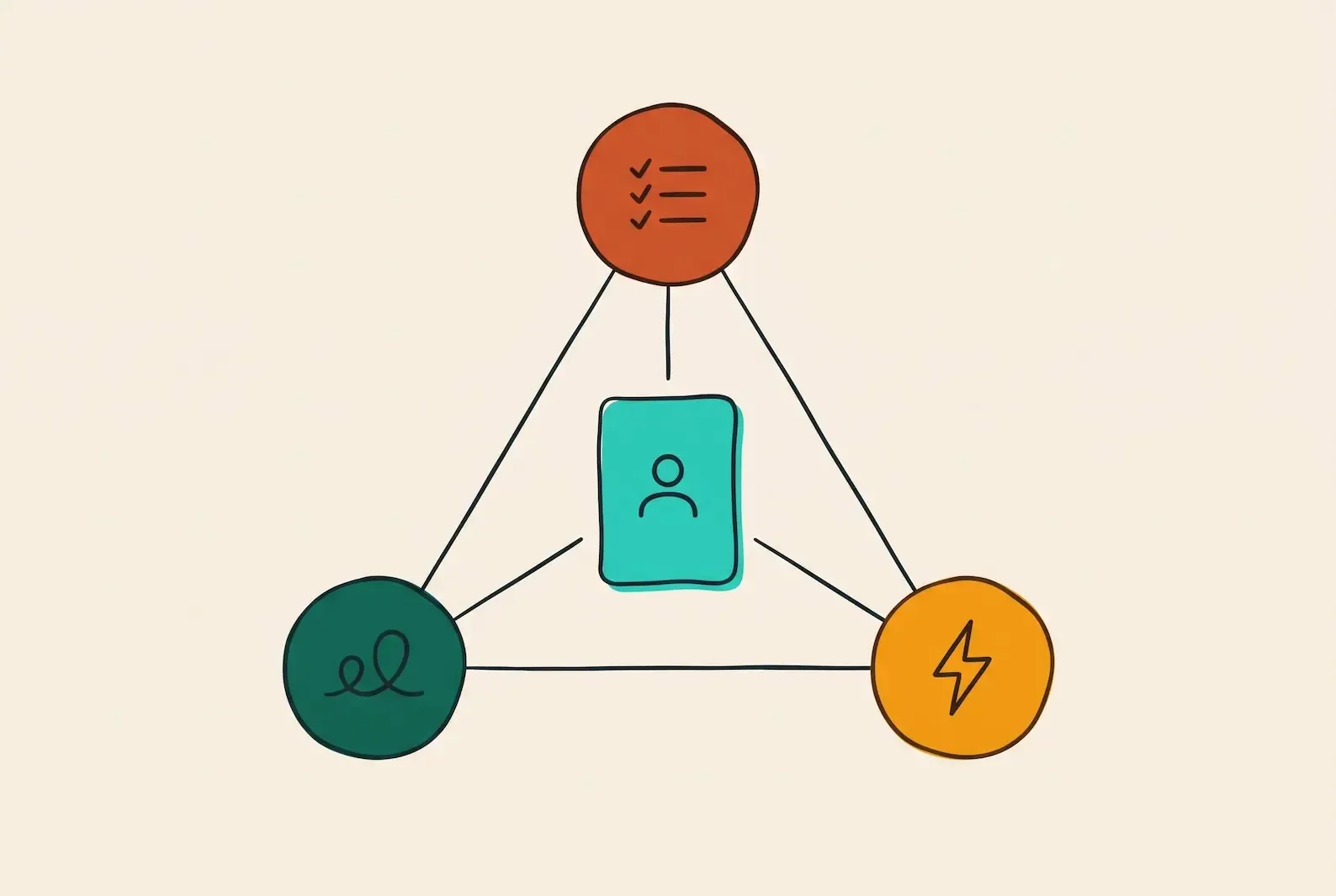
The Inbound-to-Relationship Loop is a three-input model that converts inbound engagement into qualified BD opportunity. The model is deliberately simple because the operational difficulty is not in naming the inputs — it is in making the CRM architecture support them.
The three inputs:
1. Engagement signal capture. Every inbound touch is captured at source into the candidate or contact record — not into a separate marketing automation tool. A form fill, a webinar attendance, a guide download, a repeat visit to the pricing page — all of it lands on the contact’s record in the CRM.
2. Perfect Memory thread continuation. Once the contact exists in the CRM, every subsequent interaction continues the thread. The next email, the next call, the next WhatsApp exchange feeds the same record. The relationship doesn’t restart when the contact moves from “marketing lead” to “BD prospect” — there is no such handover because there is only one record.
3. BD Signals signal-timed follow-up. When the contact’s behaviour indicates buying intent — repeat visits to the pricing page, multiple guide downloads in a week, attendance at a senior-search webinar — the BD Signals layer surfaces the signal and the partner gets prompted to reach out at the right moment.
The model is the antidote to the content treadmill because it changes what the marketing programme is optimising for. Content volume becomes a means to an end — more tracked relationships, more BD signals firing — rather than the end itself.
The next three sections walk each input in practical terms.
Input 1 — Engagement signal capture (the first-touch architecture)
Engagement signal capture is the first input because everything that follows depends on it. If the first inbound touch isn’t captured into the candidate or contact record, there is no relationship to track.
Most agency inbound programmes fail this input at the architecture level. The marketing function uses a separate tool — a marketing automation platform — to capture form fills, webinar registrations, and content downloads. The CRM, where BD lives, doesn’t see any of it. The leads exist in the marketing tool, with marketing metadata (UTM source, campaign attribution, lead score). When marketing “passes the lead to sales,” the lead arrives in the CRM as a name and an email address. The behavioural context — what content they engaged with, how often they came back, which page they visited last — stays in the marketing tool.
A marketing tool and a CRM holding two halves of the same contact is what agencies mean when they say attribution is difficult. The siloing isn’t accidental — it’s the result of two tools that weren’t designed to share a contact record.
The fix at the architecture level is to capture engagement signals directly into the candidate or contact record in the CRM. A form fill creates a new record or matches an existing one. A webinar attendance adds an interaction. A repeat visit to the pricing page adds a behavioural data point. There is no marketing system feeding a sales system — there is one system of record that captures everything.
This is the structural meaning of “the CRM is the marketing engine” — and the structural reason most inbound programmes underdeliver. The CRM was never the marketing engine. The marketing tool was, and the CRM was the place leads were imported into too late.
Input 2 — Perfect Memory thread continuation
Perfect Memory thread continuation is the second input. Once a contact exists in the CRM, every subsequent interaction across every channel continues the same thread — not a fresh record.
The default failure mode here is the new-lead-fresh-record pattern. A contact downloads a whitepaper in March. The CRM logs them as a lead. In May, the same contact attends a webinar. The webinar registration creates a second lead record with a slightly different email format. In June, the contact replies to a partner’s LinkedIn message. The partner adds them as a new contact. The agency now has three records for the same person, none of which know about the others, and the relationship history is split across three places.
Perfect Memory is the architecture that prevents this. Every interaction across every channel — email, WhatsApp, WeChat, calls, meetings, and the inbound signals captured in Input 1 — feeds the single record per contact. When the partner opens the contact in June, they see the March whitepaper download, the May webinar attendance, and the LinkedIn reply in one history. The next outbound touch references the full history rather than starting from “thanks for downloading our whitepaper.”
The economic case is that relationship-anchored outreach converts at multiples of cold outreach — every senior partner knows this. The architectural case is that without thread continuation, the partner cannot reference the inbound history at all because the inbound history sits in a different system. The partner’s experience is that the lead arrived “from marketing” — and they treat it accordingly, which is to say they barely treat it. With thread continuation, the inbound history is the partner’s starting context, and the outbound becomes a continuation of a conversation that already exists.
Input 3 — BD Signals signal-timed follow-up
BD Signals signal-timed follow-up is the third input — and the one that distinguishes inbound-to-relationship from inbound-to-nurture-sequence.
The standard inbound playbook handles a new lead by enrolling them in a nurture sequence: a four-email drip campaign that sends weekly, with calls-to-action that escalate over time. Some leads engage; most don’t. The marketing function reports on sequence performance (open rate, click rate, unsubscribe rate). The partner doesn’t see anything until the lead’s behaviour crosses a hard threshold (lead score 75+), at which point the lead is “passed to sales.”
The Inbound-to-Relationship Loop replaces this with a BD Signals layer. The outbound half of that layer — which signals fire in which market, and how they are weighted — is set out in the Hiring Intent Signal Map; the Loop is the same machinery pointed at contacts who arrived on their own. The CRM reads behavioural signals on the contact’s record — repeat visits to the pricing page, multiple guide downloads, attendance at a webinar specifically about retained search, a LinkedIn role change that suggests they’re now in a buying position. A hiring manager downloading a senior-search guide is a signal in its own right. When a signal fires, the partner is prompted to reach out with the relationship history already loaded. The contact doesn’t need to score 75 to qualify; the signal itself is the qualification.
This matters operationally because in retained executive search, buying intent rarely arrives through a single form fill. It arrives through a sequence of behaviours that the contact themselves might not consciously connect — a pricing page visit on Tuesday, a guide download on Thursday, a webinar registration the following Monday. The Inbound-to-Relationship Loop reads that sequence as one signal. The lead-scoring model treats them as three discrete events.
The Staffing Industry Analysts’ 2025 Lead Management Benchmark reported that 70% of recruitment and staffing firms follow up on fewer than half of inbound leads within 24 hours Source: SIA, June 2025. The follow-up gap is not a discipline problem. It is a routing problem. The partner doesn’t know which leads to act on because the system doesn’t surface the signals.
How an AI-native CRM treats every inbound contact as a tracked relationship
What makes the Inbound-to-Relationship Loop operationally credible is the underlying CRM architecture. Legacy CRMs were not built to ingest behavioural signals — they were built to record what humans typed in. Marketing automation tools weren’t built to feed a CRM at the relationship level — they were built to score leads and trigger sequences.
An AI-native recruitment CRM treats every inbound touch as a relationship event by default. A form fill creates or updates a contact record. A webinar attendance attaches as an interaction. A guide download records as a behavioural signal. A repeat visit to a high-intent page (pricing, comparison, methodology) fires a BD Signal. The contact’s record builds itself as the marketing programme runs — without the marketing function passing leads to a separate sales function.
This is the architectural meaning of Signal-Timed Outbound — the W6 framework that defined outbound as the discipline of timing touches against captured relationship history and live BD signals. Inbound is not a separate motion. Inbound is where the relationship history starts. The first downloaded whitepaper is the same kind of input to the BD signal layer as a leadership change announcement on LinkedIn — both are signals, both indicate something has shifted for that contact, both are surfaced to the partner with the relationship context already loaded.
McKinsey’s 2023 research on marketing-sales alignment found that organisations with tightly aligned marketing and sales — shared KPIs, integrated systems — are 67% more likely to report above-median revenue growth Source: McKinsey, March 2023. The recruitment-agency reading of this is that the marketing-and-BD divide most agencies run is the structural cost — and the AI-native CRM that makes them one motion is the architectural fix.
The compound effect — one marketing programme rather than two siloed ones
The compound effect of running inbound through the Inbound-to-Relationship Loop is that the agency stops running two marketing programmes and starts running one.
Today, most agencies run a content programme (the marketing function — blog, social, whitepapers, webinars) and a BD programme (the partners — outbound calls, LinkedIn outreach, relationship maintenance). The two programmes report to different people, measure different things, and rarely connect. Sometimes they actively conflict: the marketing function sends a nurture email to a contact the BD partner is already in active conversation with, and the conversation gets diluted.
When the inbound and outbound motions run from the same CRM, the conflict disappears. The contact has one record. Every interaction — inbound or outbound, marketing-led or BD-led — feeds the same history. The signal layer reads both. The partner sees one view of the relationship and acts accordingly.
ManpowerGroup’s Q1 2026 APME Employment Outlook Survey reported a +31% net hiring intention across the region Source: ManpowerGroup, December 2025. In a strengthening market, the agency that runs inbound and outbound as one marketing motion converts a higher proportion of its marketing investment into placed mandates than the agency that runs two siloed programmes.
The Inbound-to-Relationship Loop is the inbound-side equivalent of the outbound signal specification. Both layers feed the same record, both surface to the same partner, both run from the same CRM. Signals is built so the inbound funnel is the front end of Signal-Timed Outbound by default — not a separate marketing motion that the BD function has to integrate later.
See inbound and outbound run from one CRM
See Signals on a recruitment desk like yours.
Common questions
Recruitment agencies make inbound marketing deliver qualified leads by treating every inbound touch as the start of a tracked relationship in the CRM, rather than as a marketing-tool lead that gets passed to BD later. The Inbound-to-Relationship Loop is the architectural framework: engagement signal capture (every inbound touch into the candidate or contact record at source), Perfect Memory thread continuation (every subsequent interaction feeds the same record across every channel), and BD Signals signal-timed follow-up (the system surfaces buying intent the moment behavioural signals fire). The fix is not more content. It is a different CRM architecture beneath the content.
The Inbound-to-Relationship Loop is a three-input model for converting inbound engagement into qualified BD opportunity. Input one is engagement signal capture: every form fill, webinar attendance, guide download, and high-intent page visit is captured into the contact record in the CRM, not into a separate marketing automation tool. Input two is Perfect Memory thread continuation: every subsequent interaction across every channel feeds the same record, so the relationship history is unbroken. Input three is BD Signals signal-timed follow-up: when behavioural signals indicate buying intent, the partner is prompted to reach out with the relationship history already loaded.
Most agency inbound marketing programmes underdeliver because they optimise for content volume rather than tracked relationships. Bullhorn's GRID 2026 found that 61% of staffing and recruitment firms increased marketing activities last year, but only 36% believe their marketing generates high-quality leads. Gartner's 2024 marketing measurement research found 76% of marketing leaders measure performance primarily in vanity metrics rather than pipeline. The structural cause is that marketing tools and CRMs were never designed to share a contact record, so the inbound engagement history sits in one system while the BD partner works in another, and the relationship never becomes whole.
An AI-native CRM changes inbound marketing by treating every inbound touch as a relationship event by default rather than as a marketing-tool lead. A form fill creates or updates a contact record in the CRM directly. A webinar attendance attaches as an interaction. A guide download records as a behavioural signal. A repeat visit to a high-intent page fires a BD Signal. The contact's record builds itself as the marketing programme runs, without a marketing-to-sales handover step. Inbound becomes the front end of Signal-Timed Outbound rather than a separate motion.
Inbound marketing connects to Signal-Timed Outbound at the data layer. The W6 Recruitment Marketing piece defined Signal-Timed Outbound as the discipline of timing outbound touches against captured relationship history and live BD signals. Inbound is where the relationship history starts. The first guide downloaded by a hiring manager is the same kind of input to the BD signal layer as a leadership change announcement on LinkedIn: both are signals, both indicate something has shifted for that contact, and both are surfaced to the partner with the relationship context already loaded. The same CRM runs both.