
Client Rooms is one of Signals’ five pillar categories, referenced across published articles as the reason shortlist collaboration doesn’t have to live in an email thread. This piece answers the definitional question directly: what a Client Room actually is, why “room” is the architecturally correct word for it (rather than “portal”), and what four specific collaboration surfaces it provides that an email thread — or a login portal — cannot. Every competitor in this space sells a portal: a place clients log in to view candidates. A Client Room is a different concept — the mandate itself turned into a shared workspace. This piece specifies the four surfaces, applies the framework across Signals’ three launch regions, and closes with the commercial pain the shortlist thread creates when it breaks.
What Client Rooms are — and why “room” not “portal”
The dominant category vocabulary is “client portal.” Vincere’s portal is billed as a login where clients “review and rate candidates, arrange interviews, share documents and contracts” Source: Vincere Recruitment Client Portal, October 2025. Candidately’s portal promises “submissions that don’t get ghosted” by replacing PDF attachments with branded, trackable shortlist views Source: Candidately Client Portal. Crelate’s portal is framed as keeping “consultants and hiring managers in sync” Source: Crelate Client Portal. The consensus category message is: replace status emails with a place clients can log in to.
That is a real improvement over reply-all. It is not the architectural shift a Client Room makes.
A portal is a place a client logs in to view the agency’s data. A Client Room is the mandate itself, turned into a shared workspace. The distinction is between access and architecture. A portal scales by adding features (more views, more filters, more roles). A Client Room scales by adding mandates — each mandate is a room, each room is scoped to the mandate, and everything about the mandate (shortlist, feedback, conversation, permissions) lives inside the room. When the mandate closes, the room archives. When a new mandate opens, a new room opens. The workspace is the mandate. That is the Portal-to-Room Shift.
This matters because a portal treats collaboration as an access problem: give the client credentials to see the agency’s records. A Client Room treats collaboration as an architectural problem: build the mandate as a first-class object that both sides work inside. Every candidate revision, every client comment, every follow-up conversation lives against the mandate — not in the client’s inbox, not in a WhatsApp thread on the recruiter’s personal phone, not in an Excel tracker the agency reconciles manually on Friday.
The W4 definitional Client Rooms piece introduced the concept. The W7 email shortlist thread piece walked the four structural costs of the incumbent workflow. This piece defines the architecture — the Four Collaboration Surfaces.
The Four Collaboration Surfaces at a glance
A Client Room provides four specific collaboration surfaces that no email thread and no client portal (in the incumbent sense) can match. Each surface is defined by what it captures, what it produces, and what it eliminates.
| # | Surface | What it does | What it eliminates |
|---|---|---|---|
| 1 | Single-source shortlist versioning | One canonical shortlist that updates in place; every revision replaces the prior state; version history preserved | Chains of PDF attachments; “here’s the updated version” emails; five slightly different shortlists in five inboxes |
| 2 | Structured client feedback capture | Client rates, approves, rejects, comments inline per candidate; feedback attaches to the candidate record | Reply-all threads; feedback lost in Slack DMs; consultant reconciling three feedback streams manually |
| 3 | In-context conversation continuation | Mandate discussion across every channel (WhatsApp, phone, email, in-app) lands inside the room | Client sign-off happening in a WhatsApp voice note on the recruiter’s personal phone |
| 4 | Mandate-scoped access control | Permissions set at the mandate level — who sees what is defined by the mandate itself | Access via inbox forwarding luck; over-broad CRM permissions; PII exposed to team members not on the mandate |
The four surfaces are architectural, not configurable. A CRM without a mandate-first data model cannot produce them by adding features. The Perfect Memory data layer captures the conversations that flow into surface 3; the mandate-object architecture is what makes surfaces 1, 2, and 4 possible as native behaviour rather than as workarounds. Client Rooms sit on top of that architecture — they are the operational output of it.
Surfaces 1 and 2 — Single-source shortlist versioning + Structured feedback capture
Surface 1: Single-source shortlist versioning. A shortlist is not a document; it’s a state. The recruiter presents five candidates. The client rejects two. The recruiter adds three more. The client wants to see revised positioning notes on the strongest. Now the client is asking specific questions about candidate three. In an email thread, each of those state changes is a new attachment — a new PDF, a new spreadsheet, a new “revised shortlist v3 final FINAL.” No one is looking at the same document. Version drift is inevitable.
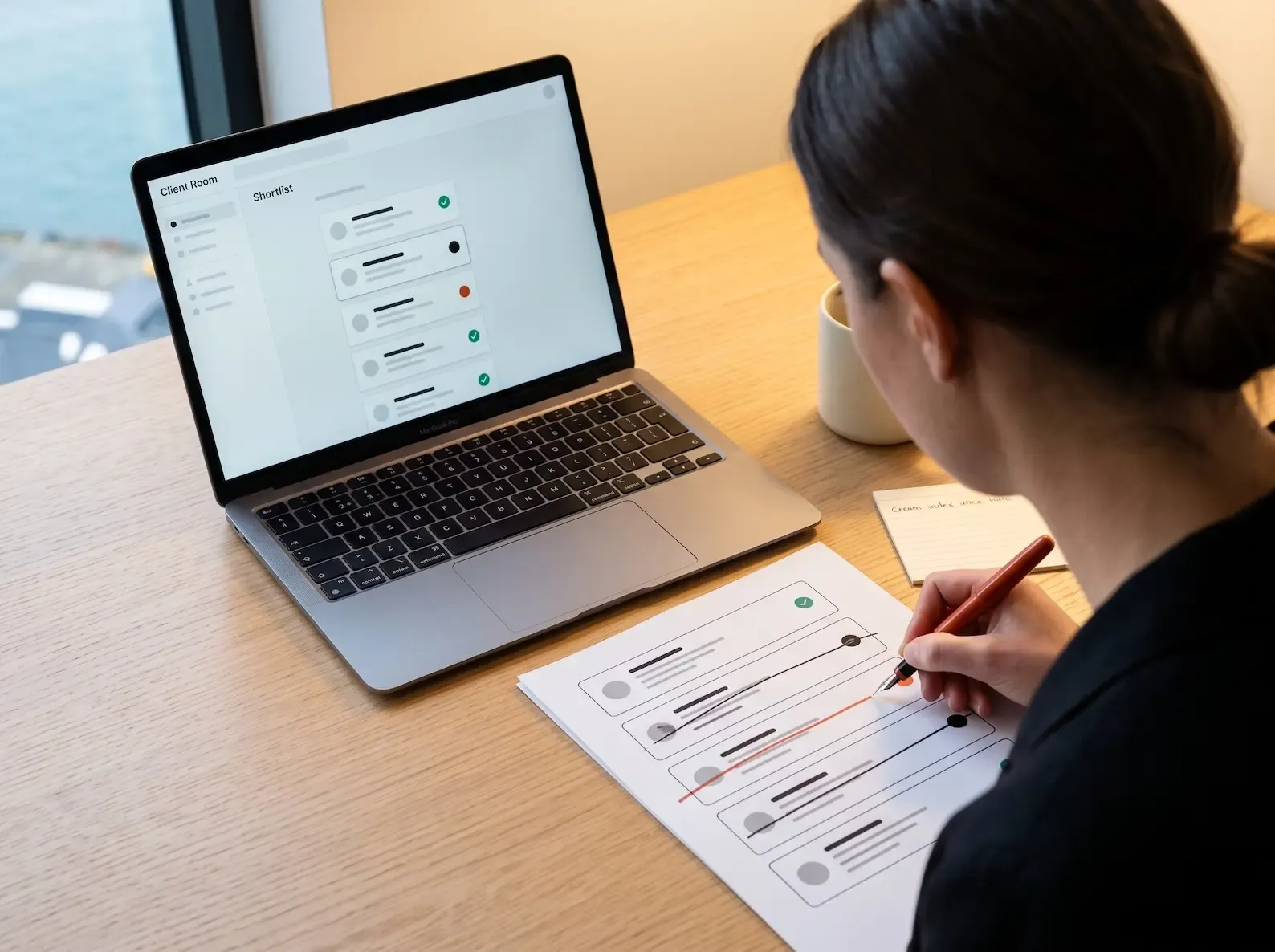
In a Client Room, the shortlist is a single object that updates in place. When the recruiter adds a candidate, the shortlist updates for everyone. When the client rejects two, the shortlist reflects rejection status without a new email. Version history is preserved, but the current version is unambiguous. There is exactly one shortlist, and it is the one everyone is looking at.
Surface 2: Structured client feedback capture. In the email workflow, feedback arrives as reply-all commentary — “candidate 2 looks good but concerned about experience level, can we see two more like candidate 4, and what’s the story on candidate 5’s gap year?” The recruiter parses that into three action items across three candidates, then loses track of which client comment corresponds to which candidate two weeks later.
In a Client Room, feedback attaches to the candidate record directly. The client rates candidate 2, approves candidate 4, rejects candidate 5, comments inline against each. The feedback is structured (yes/no/hold) and qualitative (comment thread per candidate) and attached (each comment lives on the candidate record, not in a reply-all string). Robert Half’s June 2025 US survey of ~2,200 hiring managers found that 51% cited evaluating candidates as the part of the hiring process that has grown longest — ahead of references (47%) and interview scheduling (43%) Source: Robert Half, June 2025. Structured feedback capture directly addresses the biggest reported slowdown.
Surfaces 3 and 4 — In-context conversation continuation + Mandate-scoped access control
Surface 3: In-context conversation continuation. This is the surface that most distinguishes Client Rooms from every “portal” in the market. A portal is a place a client visits to review candidates. But the actual conversation about the mandate is happening across five channels — the client’s follow-up email, the recruiter’s WhatsApp check-in, the phone call with the hiring manager, the LinkedIn message from the internal referrer, the Slack DM between the recruitment partners. In a portal architecture, none of that lives with the mandate. In a Client Room architecture, all of it does.
The Perfect Memory data layer captures the six channel classes at source. The Client Room is where the mandate-scoped subset of that capture lives — the WhatsApp thread with this client about this mandate, the phone-call transcript with the hiring manager about this shortlist, the email chain with this candidate about this interview. When a consultant opens the room, the full mandate conversation is there. When the mandate closes, the conversation is preserved as part of the record — not scattered across five apps.
Surface 4: Mandate-scoped access control. Access to the mandate isn’t inherited from CRM role permissions or granted by the accident of who was CC’d on the last email. It’s set at the mandate level. The client’s HR lead has access to the mandate; the client’s finance lead doesn’t (they’ll only see it when the placement fee is being processed). The consultant leading the mandate has access; the consultant covering the same client’s other mandate doesn’t. The candidate’s data is exposed only to those the mandate scope requires.
This matters because candidate data is personal data. In EMEA, GDPR breaches of core data-subject rights sit in the upper tier — up to €20 million or 4% of total worldwide annual turnover, whichever is higher (Article 83(5)) Source: GDPRhub, Article 83 GDPR verbatim; the UK ICO applies £17.5 million or 4% at the higher tier Source: ICO Data Protection Fining Guidance, September 2025. Mandate-scoped access control is architecture, not a permission checkbox — it’s what makes right-to-access, right-to-erasure, and consent scoping cleanly satisfiable.
One architecture, three regional proofs
The Four Collaboration Surfaces apply universally. The commercial pain they solve shows up differently in each of Signals’ three launch regions — which is why the same architecture is the answer across markets, but the evidence that lands hardest varies.
North America — speed and version control. Robert Half’s June 2025 survey found 93% of US hiring managers say the hiring process takes longer than two years ago, with candidate evaluation as the top slowdown (51%). In the incumbent US workflow (email + Excel + ATS + reply-all feedback), each version of the shortlist creates a new reconciliation cycle. Single-source shortlist versioning collapses that overhead — one shortlist, one state, one place feedback attaches. Bullhorn’s 2025 GRID Talent Trends Report found 54% of candidates who stopped working with a recruiter cited processes being too slow or communication breaking down; satisfaction with speed and responsiveness fell 20% year-on-year Source: Bullhorn GRID Talent Trends, February 2026. Slow shortlist cycles are where the relationship dies.
EMEA — compliance-grade access control. GDPR turns the shortlist thread from an operational nuisance into a regulatory exposure. Candidate data forwarded across three inboxes, held on personal devices, and retained past the mandate close is a data-protection breach waiting to happen — and the upper-tier fine is 4% of worldwide turnover. In the UK, £17.5M is the ceiling at the higher tier. Mandate-scoped access control isn’t a feature; it’s the architecture that makes a compliant workflow possible without asking recruiters to remember what to delete manually. The Recruitment CRM Buyer’s Guide 2026 frames GDPR as an architecture argument, not a compliance checklist — Client Rooms are one of the specific surfaces that architecture produces.
APAC — multi-channel capture. WhatsApp penetration reaches approximately 90% in both Hong Kong and Singapore Source: Infobip, April 2026. 71% of Hong Kong consumers message businesses on WhatsApp at least weekly; approximately 50% prefer WhatsApp for business contact versus email (29%) and phone (28%) Source: The Standard reporting Meta/Kantar survey, October 2024. The client’s shortlist feedback in HK arrives as a WhatsApp voice note; the confirmation of interview times arrives as three messages in a group chat; the sign-off on the final candidate arrives as a thumbs-up emoji. In-context conversation continuation is what pulls this into the agency’s system of record rather than leaving it on the individual recruiter’s personal phone. Without it, when the recruiter leaves, the mandate’s decision history leaves too.
Robert Half’s September 2024 Australian survey of 1,000 office workers found 57% lose interest in a role within 10 business days — 13% inside 5 business days, 44% between 5 and 10 Source: Robert Half Australia, September 2024. The candidate window in APAC is measured in business days, not weeks. Every day the shortlist thread spends fragmenting across channels is a day borrowed against the placement.
One architecture, three regional proofs. North America wants speed and version control. EMEA wants compliance-grade access. APAC wants multi-channel capture. All three are outputs of the same underlying architecture: the mandate is the workspace, and every collaboration surface is scoped to it.
Why the email shortlist thread breaks — and what it costs
The email shortlist thread doesn’t break because of recruiter error; it breaks because it isn’t structurally capable of holding what it’s being asked to hold. A live, multi-party, multi-version collaboration on a single object — with feedback attached, conversation threaded, revisions tracked, access controlled — is not a job an inbox is designed to do. The inbox holds messages. It doesn’t hold state. So every state change becomes another message, and every participant ends up with a slightly different view of what the current state actually is.
That’s the operational problem. The commercial problem is what the delay costs. Bullhorn’s 2025 GRID Talent Trends Report found 54% of candidates who ended a recruiter relationship cited slow processes or broken communication as the reason Source: Bullhorn GRID Talent Trends, February 2026. Robert Half’s US 2025 survey put 51% of US hiring managers naming candidate evaluation as the biggest slowdown Source: Robert Half, June 2025. Robert Half’s Australian 2024 survey put 57% of workers losing interest within 10 business days Source: Robert Half Australia, September 2024. Three independent primary surveys, three continents, one converging picture: the collaboration cycle is where mandates die.
Client Rooms are the architectural response. Not a portal, not a shared folder, not a set of features layered onto an ATS — a mandate-scoped workspace with four specific collaboration surfaces. The email thread doesn’t need optimisation. It needs replacing with the right primitive. The mandate is the room.
See what a Client Room actually looks like in practice
See Signals on a recruitment desk like yours.
Common questions
Client Rooms in a recruitment CRM are the shortlist collaboration layer: a dedicated, persistent workspace shared between the agency and the client for a single mandate. Each Client Room holds the shortlist, candidate profiles, positioning notes, client feedback, and full conversation history in one view. Client Rooms replace the pattern of sending shortlists by email, chasing feedback on WhatsApp, and reconciling revisions across three channels, by making the mandate itself the workspace rather than a series of scattered messages across different tools and inboxes.
A client portal is a place a client logs in to view candidates and documents; a Client Room is the mandate itself turned into a shared workspace. The difference is access versus architecture. A portal treats the client as an authenticated viewer of the agency's data. A Client Room treats the mandate as the primary object, so every version, comment, feedback item, and decision lives inside the room with the mandate. Portals scale by adding features (more views, more filters). Rooms scale by adding mandates. That distinction changes what the collaboration layer is architecturally, not just what the UI looks like.
The email shortlist thread breaks because it is structurally incapable of holding a live, multi-party, multi-version collaboration on a single object. Every candidate revision creates a new attachment. Every client comment creates a new reply-all. Every WhatsApp voice note from the client with additional feedback lives outside the thread entirely. When the same conversation happens across email, WhatsApp, and phone across five people over three weeks, no participant has the same view of the current state. Bullhorn's 2025 GRID Talent Trends Report found that 54% of candidates who ended a recruiter relationship cited slow processes or broken communication as the reason, and the fragmented thread is a leading cause of that breakage.
The Four Collaboration Surfaces are the specific capabilities a Client Room provides that a portal or an email thread cannot. (1) Single-source shortlist versioning: one canonical shortlist that updates in place, not a chain of PDF attachments. (2) Structured client feedback capture: the client rates, approves, rejects, and comments inline against each candidate, not in a reply-all. (3) In-context conversation continuation: the mandate discussion (WhatsApp, phone, email, in-app) all lands inside the room and stays attached to the mandate object. (4) Mandate-scoped access control: permissions are set at the mandate level, so who sees what is defined by the mandate itself, not by inbox forwarding luck.
In APAC markets, particularly Hong Kong and Singapore, where WhatsApp penetration is around 90% (Infobip 2026) and 71% of Hong Kong consumers message businesses on WhatsApp weekly (Meta/Kantar via The Standard, October 2024), client shortlist feedback typically arrives as WhatsApp voice notes and short replies on a recruiter's personal phone. A Client Room's in-context conversation continuation surface captures these into the mandate itself, so sign-off, revisions, and decisions live inside the agency's system of record rather than on an individual's device. The Client Room becomes the destination the WhatsApp thread feeds into, not a competing channel the client has to switch to.