
Why most recruitment tools are built for delivery, not BD
Business development is how recruitment agencies grow. Delivery is how they fulfil what BD wins. Most recruitment ATS platforms are built almost entirely for delivery — candidate sourcing, pipeline management, CV parsing, job posting — with BD added as a secondary CRM module that tracks activity after the fact rather than driving revenue proactively.
The best BD features for recruitment agencies are not the ones that log what happened. They are the ones that surface what should happen next — which client is about to hire, which relationship needs attention, which mandate is yours to win if you call today. This article defines the five BD features that actually move revenue, evaluates how the major platforms deliver them, and explains what a genuinely revenue-first approach to BD tooling looks like in 2026.
Why BD features matter more than ever for recruitment agencies
Recruitment BD exists in a compressed window. The agencies that win mandates are those that call before the brief is written — when the client is thinking about hiring but has not yet engaged anyone. By the time a role appears on LinkedIn or SEEK, the client has already committed, and the BD conversation has become a vendor pitch competing against three other agencies who saw the same post.
This dynamic makes BD tooling a compounding advantage. Recruiters already spend 70–80% of their working day on admin rather than BD or delivery — a time burden that leaves limited capacity for proactive client development unless the system does the signal work automatically. [Source: HootRecruit, Aug 2025] When a recruiter does have BD time, it should be spent on the highest-priority call — the client showing the clearest intent signal, not the next name on a rotating spreadsheet.
Most recruitment CRMs do not provide this. A 2026 recruitment CRM buyer’s guide notes that the majority of ATS platforms lead with delivery features such as job posting distribution, candidate sourcing, and pipeline automation, with BD appearing as generic CRM modules rather than dedicated revenue-intelligence layers. [Source: Pin, Feb 2026] The BD modules that do exist typically track what consultants have already done — calls logged, emails sent, meetings booked — rather than telling them what to do next.
“Most recruitment CRMs tell you what happened yesterday. The best BD tool tells you who to call this morning — and why.”
APAC is where this gap is sharpest. Recruitment BD in Hong Kong, Singapore, and across Southeast Asia runs through WhatsApp — where 70%+ of Hong Kong consumers contact businesses weekly and where the most valuable client signals arrive informally, in real time, through channels that most ATS platforms cannot see. [Source: Meta/Kantar via The Standard, Oct 2024] A BD feature set that cannot capture WhatsApp conversations is structurally incomplete for any agency operating in this market.
The five BD features that actually drive revenue
BD feature: a capability within a recruitment CRM or ATS that directly improves the agency’s ability to identify, win, and retain client mandates — as distinct from delivery features that fulfil mandates once won.
The following five features represent the BD capabilities with the clearest revenue impact. Not all CRMs offer all five. The gap between those that do and those that do not determines whether BD is systematic or accidental.
Feature 1 — Hiring signal detection
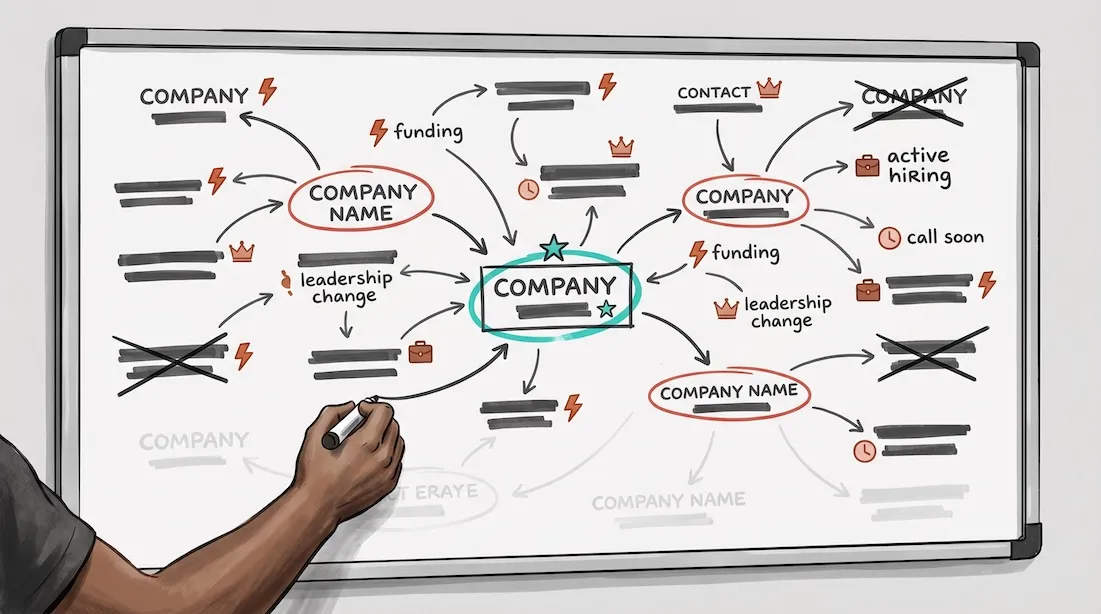
Hiring signal detection surfaces early indicators that a client company is about to hire — before any role is publicly advertised. Funding announcements, leadership changes, job ad clusters, department headcount growth, and informal signals from client conversations are all detectable weeks before a brief arrives.
Manatal’s BD guide defines hiring signals as events indicating future hiring needs — new role creation, leadership appointments, funding rounds, and office expansions — and notes that awareness of these signals can position an agency as the first call a client makes. [Source: Manatal, Sep 2024] The challenge is execution: most agencies monitor these signals manually through Google Alerts, LinkedIn job notifications, and news monitoring — a process that does not scale and misses the conversational signals that arrive over WhatsApp.
An effective hiring signal detection feature does this automatically and continuously — monitoring the existing client base for observable signals and surfacing them as prioritised BD prompts without requiring a consultant to check multiple sources every morning.
Feature 2 — Automatic client intel capture
Client intel capture refers to the automatic logging of every recruiter-client interaction — calls, emails, WhatsApp messages, meetings — against the right client record, without manual input. It is the foundation of everything else in the BD feature set: without complete, current client intel, signal detection produces false positives, PSL management is based on stale terms, and BD prompts fire at the wrong moment.
Bullhorn Pulse, the most developed automatic capture tool among the major platforms, captures phone and email activity automatically and highlights relationships that need attention based on engagement patterns — explicitly designed to “eliminate the need to manually add conversations into the system.” [Source: Bullhorn Pulse] For APAC agencies, the gap is WhatsApp and WeChat: Pulse does not capture these channels, which means the client intel it surfaces reflects a fraction of the actual relationship history in markets where messaging apps carry the majority of communication.
Feature 3 — PSL management
PSL management tracks a client’s Preferred Supplier List status — whether the agency is on panel, under what commercial terms, what performance obligations apply, and how panel position compares to competing agencies. Being on a PSL provides exclusive access to roles that are never advertised to non-panel agencies, making PSL status one of the highest-value BD assets a recruitment agency can hold.
Most recruitment CRMs do not offer PSL management as a named feature. Agencies typically model PSL status using custom fields — which means tracking is inconsistent across consultants and commercial terms live in spreadsheets rather than alongside the client record. When a consultant leaves, the PSL context leaves with them.
Effective PSL management in a recruitment CRM ties PSL status directly to the client record, tracks renewal dates and performance obligations, and flags when panel status is at risk based on engagement patterns — so BD effort is concentrated on protecting and expanding existing panel relationships rather than winning them back after they lapse.
Feature 4 — Market mapping
Market mapping builds structured intelligence about a target sector or account — the organizational chart, key decision-makers by function and seniority, talent pool depth, competitor placements, and hiring patterns over time. In executive search it is foundational; in mid-market and specialist recruitment it is a competitive differentiator.
Most agencies build market maps manually — LinkedIn browsing, note-taking, spreadsheet maintenance — using tools like LinkedIn Sales Navigator, Apollo, or ZoomInfo that were built for generic B2B sales rather than recruitment-specific workflows. [Source: Manatal, Sep 2024] The result is market intelligence that lives in personal notebooks and spreadsheets rather than in the CRM, and that decays immediately when the consultant who built it moves on.
A recruitment CRM with effective market mapping capability structures this intelligence as a persistent asset — linked to company records, updated as new interactions are captured, and searchable by the whole team rather than owned by one person.
Feature 5 — Proactive BD prompts and next-action intelligence
BD prompts surface the right next action for the right client at the right moment — not based on a scheduled activity reminder, but based on actual signal data from the client relationship. “Morgan Stanley’s new CFO started three weeks ago — call your contact” is a BD prompt driven by intelligence. “Your scheduled quarterly check-in is overdue” is a calendar reminder. They are not the same thing.
Modern B2B revenue intelligence tools like Gong and Clari have moved from activity tracking to outcome-driven next-action surfacing — shifting measurement from calls made to pipeline health and mandate likelihood. Bullhorn’s 2025 product roadmap is moving in the same direction with its AI assistant and automation capabilities. [Source: Bullhorn, Dec 2024] The question for recruitment agencies is whether their BD system surfaces the right prompt before the window closes, or after.
How the major platforms compare across the five BD features
| BD Feature | Bullhorn | Vincere | Manatal | Signals |
|---|---|---|---|---|
| Hiring signal detection | Not a dedicated feature | Not a dedicated feature | Not a dedicated feature | Yes — BD Signals, automatic and continuous |
| Automatic client intel capture | Yes — Pulse (email/phone only) | Partial — Comms Hub (email/calendar) | Partial — email/SMS integration | Yes — Perfect Memory (WhatsApp, WeChat, calls, email, LinkedIn) |
| WhatsApp / WeChat capture | No | No | No | Yes — Perfect Memory |
| PSL management | Via custom fields | Via custom fields | Via custom fields | Native PSL tracking |
| Market mapping | Via standard CRM records | Via standard CRM records | Via standard CRM records | Structured market intelligence layer |
| Proactive BD prompts | Yes — Pulse relationship alerts | Not confirmed | Not confirmed | Yes — Agentic CRM, signal-driven prompts |
| AI-driven BD features | AI automation step (2025) | AI analytics (Vincere Intelligence) | AI matching / candidate focus | AI-native architecture — BD is the foundation |
| APAC messaging fit | Poor — WhatsApp/WeChat absent | Poor — messaging apps not captured | Poor — messaging apps not captured | Strong — built for APAC messaging channels |
[Sources: Bullhorn product documentation and Desking review, Dec 2025; Vincere product pages and HRStacks review, Nov 2025; Manatal Forbes Advisor review, Mar 2024; Signals product, 2026]
Bullhorn — strongest legacy BD layer, with a meaningful APAC gap
Bullhorn has the most mature BD infrastructure of the major platforms. Pulse automatically captures email and phone activity, maintains relationship history across consultant changes, and surfaces accounts that need attention based on engagement patterns — all of which are genuinely useful BD capabilities that most competitors have not matched. [Source: Bullhorn Pulse]
The 2025 product roadmap extends this with AI automation steps that allow agencies to build intelligent BD sequences and personalize outreach at scale. [Source: Bullhorn, Dec 2024] For agencies operating primarily in email-and-phone markets, Bullhorn’s BD layer is competitive.
The gap is APAC. Pulse captures email and phone. It does not capture WhatsApp or WeChat — which means for agencies in Hong Kong, Singapore, and across Southeast Asia, the client intel that Pulse surfaces reflects a fraction of the actual relationship activity. A system built on partial data produces partial intelligence, regardless of how sophisticated the analysis layer is.
Vincere — good delivery platform, BD intelligence thin
Vincere’s Comms Hub centralises emails, calls, and messages, and its Vincere Intelligence module provides analytics and forecasting. [Source: HRStacks, Nov 2025] For delivery tracking and reporting, Vincere is well-regarded — it earns consistently high usability scores on independent review platforms.
For BD specifically, Vincere’s capabilities are thinner. There is no dedicated hiring signal detection feature in public materials. The Comms Hub captures email and calendar, but WhatsApp and WeChat are not captured natively. BD intelligence relies on analytics dashboards rather than proactive prompts. For agencies whose BD model depends on calling before the brief is written — especially in APAC — Vincere’s BD layer requires significant manual supplementation with external tools.
Manatal — delivery and ATS focus, BD a secondary capability
Manatal is positioned primarily for volume ATS and candidate management, with a CRM layer that tracks accounts, revenue, and interactions via email and SMS integration. [Source: Forbes Advisor, Mar 2024] Its AI capabilities are focused on candidate matching rather than client BD intelligence.
For BD, Manatal provides the basics — client tracking, revenue reporting, interaction logging — but lacks dedicated signal detection, market mapping, or proactive BD prompts. WhatsApp and WeChat capture are absent. For agencies whose BD depends on knowing which client is about to hire and being first to call, Manatal’s BD feature set does not close that gap.
Signals — BD as the core architecture, not the module
Signals is built from the ground up as a BD-first, AI-native recruitment CRM. The distinction from the other platforms is not that Signals has more BD features — it is that BD intelligence is the architectural foundation rather than a module added to a delivery system.
BD Signals monitors the existing client base continuously for hiring intent — combining external signals (funding rounds, leadership changes, job ad activity) with conversational signals captured automatically from client WhatsApp, email, calls, and LinkedIn through Perfect Memory. The output is not a dashboard requiring a consultant to check — it is a prioritised BD prompt surfaced through the Agentic CRM layer, telling the right consultant which client to call this morning and what intelligence to open with.
For APAC agencies where 70%+ of client relationship activity happens over WhatsApp, this architecture changes the quality of BD intelligence at the foundation. A client mentioning headcount pressure in a WhatsApp message at 9pm becomes a BD prompt in the system by the next morning — not a piece of context that disappeared when the consultant closed their phone. BCG’s 2025 survey found that 78% of APAC professionals use AI tools at least weekly, reflecting the appetite for exactly this kind of intelligence infrastructure. [Source: BCG, Oct 2025]
What a revenue-first approach to BD tooling actually looks like
The difference between a delivery-first CRM with a BD module and a revenue-first BD system is not a feature checklist. It is a design question: does the system start from “what happened” or “what should happen next”?
A delivery-first system records activity and presents it as data. A revenue-first system interprets that activity — combined with external signals and relationship patterns — and surfaces specific, actionable intelligence. Only 2% of companies report using all the functionality in their CRM. [Source: EverReady.ai, Dec 2025] The BD features that actually drive revenue are not the ones hidden in configuration menus — they are the ones that surface the right information at the right moment without requiring a consultant to go looking for it.
For recruitment agencies in APAC — growing at 8–13% CAGR in a market where the fastest-moving agencies win the mandates — this distinction is the margin between a BD pipeline that compounds and one that stagnates. The agency whose system tells them about a Series B funding round at a target client on Monday morning is not working harder than the agency that found out on Wednesday when the job was posted. They are working with better information at the right moment.
See BD Signals in action
See Signals on a desk like yours.
Common questions
The five BD features that most directly drive revenue for recruitment agencies are: hiring signal detection (identifying clients about to hire before roles go live), automatic client intel capture across WhatsApp, email, and calls, PSL management that tracks panel status and commercial terms, market mapping tools that build target account intelligence, and proactive BD prompts that surface the right next action without requiring a consultant to manually check their pipeline. Most ATS tools provide some version of a BD module but treat these capabilities as add-ons to a delivery-first system, which means the BD features that matter are either absent, require manual maintenance, or produce incomplete intelligence because off-platform conversations are never captured.
Most recruitment ATS tools get BD wrong because they were designed for delivery, covering candidate sourcing, ATS pipeline, job posting, and placement tracking, and added BD as a secondary module afterward. A 2026 recruitment CRM buyer's guide notes that most platforms lead with delivery features such as job posting distribution, candidate sourcing, and pipeline automation, with BD appearing as generic CRM modules rather than dedicated revenue-intelligence layers. [Source: Pin, Feb 2026] The result is a system that tracks BD activity after the fact but cannot surface BD opportunities proactively, cannot capture the WhatsApp and WeChat conversations where most client relationships actually happen, and cannot tell a consultant who their highest-priority call is this morning.
Bullhorn has the most developed BD layer of the major recruitment ATS platforms. Its Pulse product automatically captures phone and email activity to maintain relationship history and highlights accounts that need attention based on engagement patterns. [Source: Bullhorn Pulse, 2021] Bullhorn is also introducing AI assistant capabilities within automation flows, which can support BD sequences and personalized outreach. [Source: Bullhorn, Dec 2024] Where Bullhorn falls short for APAC agencies is in off-platform capture: WhatsApp and WeChat conversations that represent the majority of recruiter-client communication in Hong Kong and Singapore are not captured automatically, which means the client intel that Pulse surfaces is incomplete by definition.
PSL management in a recruitment CRM refers to tracking a client's Preferred Supplier List status: whether your agency is on panel, under what commercial terms, what performance obligations apply, and how your position compares to competitor agencies on the same panel. Being on a PSL provides access to roles that are never advertised to non-panel agencies, making PSL status one of the highest-value BD assets an agency can hold. Most recruitment CRMs do not offer dedicated PSL management as a named feature, so agencies typically model PSL status using custom fields, which means tracking is inconsistent and commercial terms are often maintained in separate spreadsheets rather than alongside the client relationship record.
Signals handles BD for APAC recruitment agencies through BD Signals, a core product pillar that monitors the existing client base continuously for early hiring intent signals including funding rounds, leadership changes, job ad clusters, and conversational signals captured automatically from client WhatsApp and email exchanges. Perfect Memory captures every client interaction automatically across WhatsApp, WeChat, email, calls, and LinkedIn, building a complete and current picture of every client relationship without manual logging. The Agentic CRM layer combines this intelligence into a prioritised BD prompt telling the consultant which client to call today, which signal fired, and what context to open with, so BD activity is driven by intelligence rather than a rotating call list.